
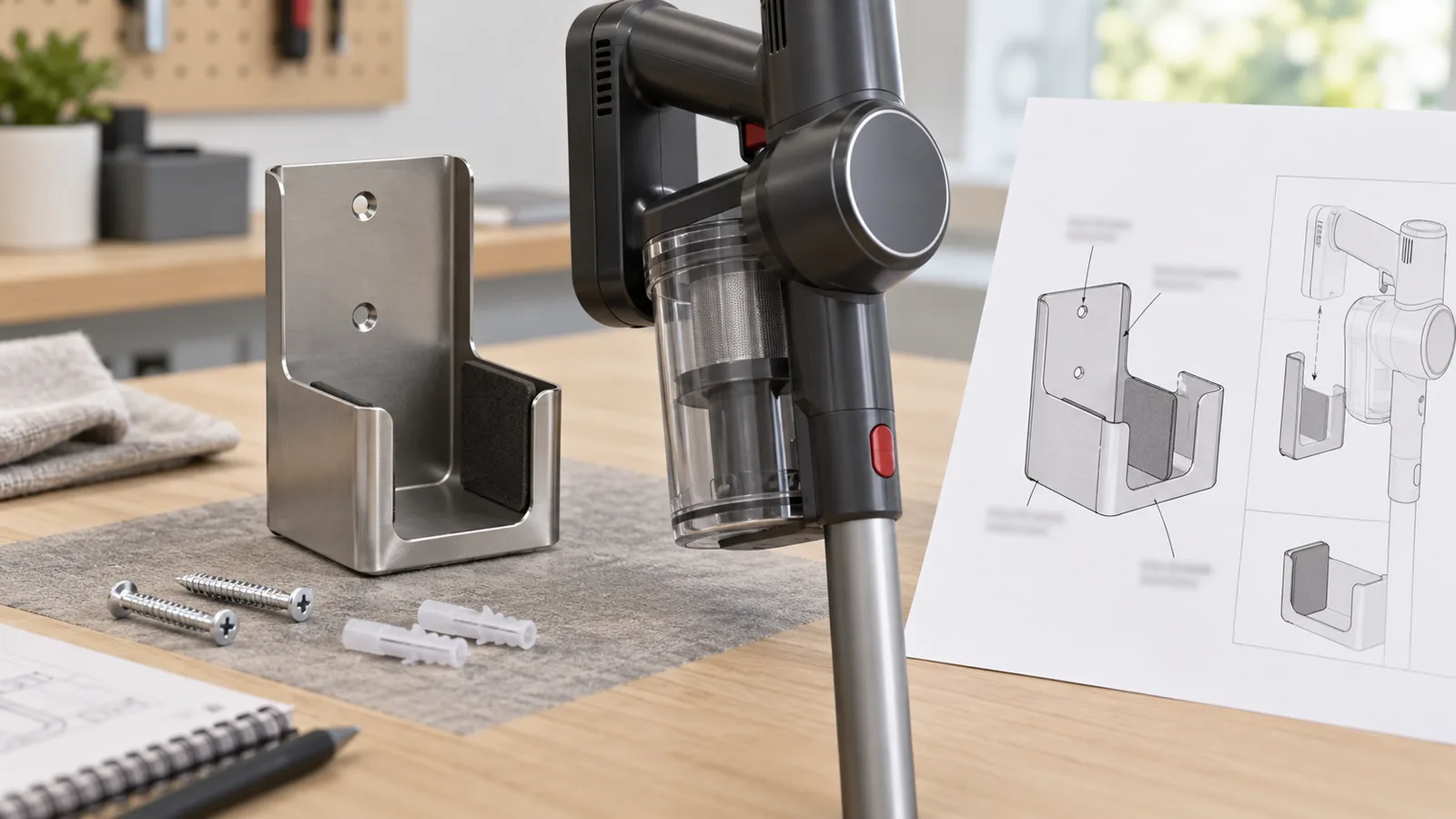
Cordless vacuum wall mount compatibility is a model-by-model product decision, not a safe assumption based on one holder opening or a supplier’s “universal” label. An importer should identify the appliance models and revisions, define where the metal holder contacts or supports each one, and approve a sample against the intended insertion and removal path. Official accessory listings illustrate why model scope matters: one bracket may name a product family, while another is sold for selected models. This guide covers passive storage brackets; it does not assess charging docks, electrical functions, or installation safety.
What does model-fit compatibility include?
A usable fit means the named appliance can be placed into the holder, rests on the intended support points, stays clear of controls and removable parts, and can be taken out along the expected path. A list of model names alone does not define those conditions. Two vacuum cleaners can share a brand or product family while differing in body width, handle shape, bin position, accessories, or wall-side geometry.
Treat compatibility as a relationship among a particular holder drawing, the appliance’s model and revision, and the buyer’s intended use. The same holder can fit one configuration and fail another because a handle loop, motor housing, dust bin, wand release, floor head, or accessory changes the contact envelope. A holder intended to store the main unit may not also support a detachable wand or tools. List those functions separately.
Manufacturer accessory pages provide useful examples of scoped claims. Makita identifies its 458571-5 wall bracket for 18V LXT hand vacuums; that statement applies to the named accessory and product family, not to an unrelated third-party holder. A Gtech Pro 2 wall-mount listing likewise identifies a particular product family. These are examples of how a buyer can look for a defined compatibility statement, not evidence that any generic metal bracket fits those appliances.
For an importer, the central distinction is claim scope versus verified fit. A supplier may quote a list of models from a marketplace description. The buyer still needs to establish whether each listed model was checked on the actual sample, whether the check covered the same revision, and whether the bracket supports the appliance in the intended orientation. Do not convert an unverified seller list into a private-label packaging claim.
How should buyers document cordless vacuum wall mount compatibility?
Build a model-fit matrix before requesting a final sample. “Fits cordless vacuums” is not an approval criterion. The matrix should state which appliance configurations are included, how each one will be checked, and what result will appear in the product listing, instruction sheet, carton, or private-label materials.
| Matrix field | What the buyer should record | Pourquoi est-ce important ? |
|---|---|---|
| Appliance identity | Brand, commercial model name, model code, revision or generation, and relevant configuration | Names can persist across revisions or differ by market |
| Reference sample | Serial or sample identity where available, body/wand/accessory combination, and source | Reviewers need to know which physical configuration was tested |
| Holder identity | Drawing number and revision, material/finish, and sample status | A fit result belongs to a specific holder configuration |
| Contact geometry | Which surfaces, hook, cradle, stop, or support points carry or locate the appliance | An opening measurement alone may miss the actual interface |
| Motion | Direction and clearance required to insert, seat, release, and remove the appliance | A holder can accept a unit but block normal removal |
| Included scope | Main body only, wand, floor head, charger, tools, or cable storage | Every added component may affect space and interference |
| Claim and packaging | Approved model names, exclusions, label and instruction revision | The buyer’s public compatibility claim must match the evidence |
Keep an explicit status for each row: verified on the sample, not tested, does not fit, or requires further review. If the buyer has only a drawing, mark the fit as provisional. If an older appliance was tested but a revised model has a different handle or body, do not silently carry approval forward. Ask the brand owner or authorized product source whether the physical configuration is unchanged, then decide if a new sample check is needed.
This simple control is more useful than a long model list with no version history. It also makes later changes visible. If the vacuum model changes, the holder geometry changes, or a contact pad/finish is added, compare the revision and decide which matrix rows need to be repeated.
Which contact points and movements should the sample check?
Start with the appliance’s actual support or attachment feature, not the general outline of its body. A passive metal holder might use a hook, formed cradle, plate, clip-like contact, or another geometry. The correct design depends on the target appliance and the holder concept; the buyer should not assume that the holder can safely carry the vacuum by any convenient surface.
Inspect the following areas against the drawing and approved function:
- Support interface: Identify the surface that carries or locates the unit. Check whether the support contacts a structural area intended for storage, rather than a removable cover, thin trim, release lever, or other sensitive part.
- Clearance envelope: Compare the holder with the largest body, widest handle, protrusions, buttons, bin, wand connection, and any accessories included in the declared scope. Record where clearance is required; do not replace a physical fit check with a nominal width alone.
- Insertion path: Move the sample through the expected entry path. Note whether the user needs to tilt, rotate, lift, press, or operate a release. A configuration that fits only through an awkward motion may not meet the intended user experience.
- Removal path: Confirm that the vacuum can be taken out without catching a control, cable, wand, or neighboring attachment. If one-handed removal is a buyer requirement, state it and review it on the representative appliance.
- Surface contact: Check for unintended rubbing at the finish-sensitive areas. A contact pad or coating may reduce direct metal contact in some designs, but its presence does not prove scratch resistance or long-term performance; the buyer must define the material and acceptance method.
- Orientation and access: Confirm that stored orientation leaves the intended controls and removable components accessible. If the holder blocks a bin release or filter service, that may be a fit failure even when the main body is supported.
The sample exercise is not a structural rating. A hand-held demonstration cannot establish load capacity, long-term durability, wall-anchor performance, or safe installation in every wall type. Set any load or installation test conditions with the responsible product and installation specialists, and record the intended wall construction and fastener scope separately from appliance fit.
How should an importer approve a representative sample?
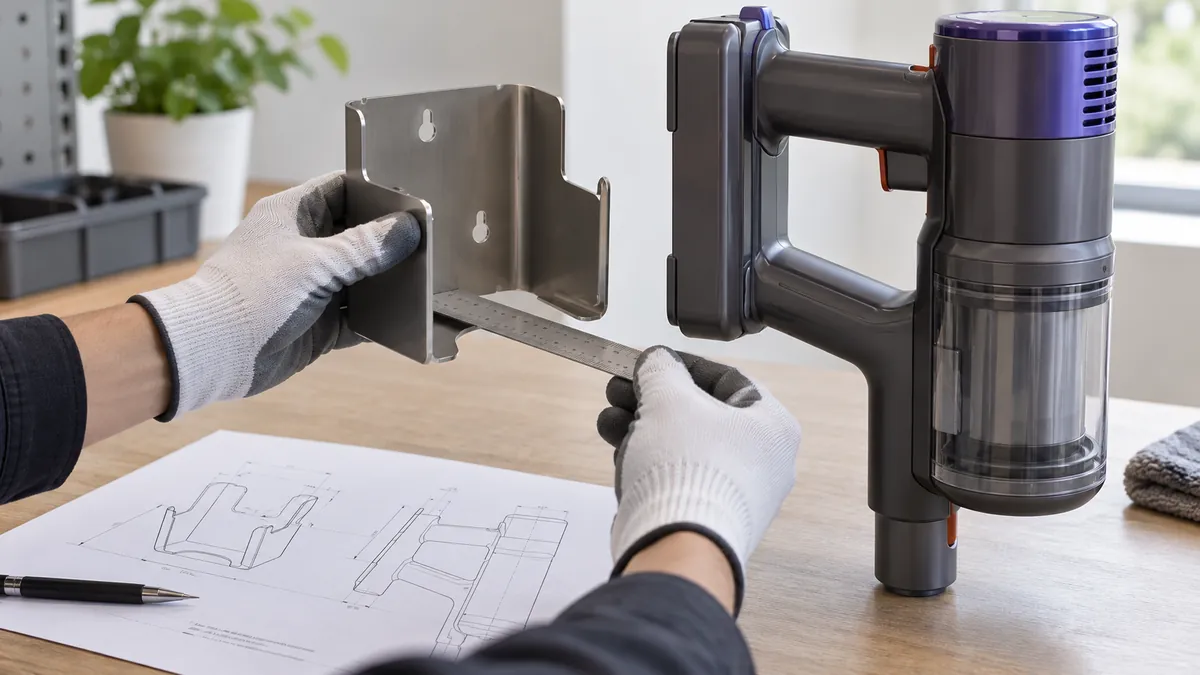
Agree on the test setup before the sample arrives. Name the appliance sample, holder drawing revision, included accessories, test surface, and acceptable motion. Then have the buyer or an authorized reviewer check each matrix row and record what was observed. If the physical appliance is not available, the fit remains unverified unless the buyer has an approved, dimensionally complete reference and has agreed how to use it.
A practical approval sequence is:
- Confirm identity. Photograph or record the appliance model, revision, and included configuration. Identify the holder drawing and finish on the sample record.
- Confirm assembly. Build the holder as intended, including any buyer-specified pads, spacers, hooks, or accessory retainers. Do not add a temporary component that will not exist in production.
- Check contact and clearance. Seat each named appliance. Review the defined support points, interference zones, and any finish-sensitive contact area.
- Check normal movement. Insert and remove the unit using the expected user motion. If a release, tilt, or rotation is required, record it and compare it with the buyer’s intended use.
- Check declared accessories. Add only the wand, floor head, charger, tool, or cable storage that the product is meant to support. Mark excluded accessories clearly.
- Record exceptions. Capture the result, photographs if permitted, reviewer, date, sample identity, and any open questions. Update the model list only after the buyer resolves the exception.
- Freeze the approved version. Link the approval to the holder drawing, physical sample, packaging claim, and supplier change-control request.
One successful sample is evidence about that sample configuration under the conditions checked. It does not prove that every production piece is dimensionally identical, that a new vacuum generation will fit, or that the holder works with an untested accessory set. The buyer may therefore define separate controls for a production run, including applicable dimensional inspection or batch checks, without presenting the sample approval as a substitute for them.
Keep approval language bounded. “Sample checked with model X, revision Y, main body only” is more informative than “universal.” If the sample fails one matrix row, decide whether the holder should be revised, the model excluded, or the product claim narrowed. Do not solve a failure by deleting a model from internal records while leaving it on the carton or listing.
What should an RFQ specify beyond the holder shape?
A useful RFQ includes enough information for a supplier to quote and review a defined metal part rather than guessing from a product photo. Send a drawing or physical reference when possible, then identify the requirements that affect forming, attachment, finish, assembly, and packing. If dimensions are not final, label the drawing as preliminary and identify what the first sample must confirm.
Specify at least:
- named appliance models and revisions to be supported, along with any explicit exclusions;
- where and how the holder contacts or supports the appliance;
- the expected insertion/removal path, orientation, and access to buttons or removable parts;
- whether the scope includes a wand, floor head, tools, charger, cable, or only the main body;
- holder material, thickness or wire/tube dimensions where defined, bend or joint locations, exposed edges, and cosmetic surfaces;
- finish, color, contact pad or protective component, and the relevant appearance or fit acceptance criteria;
- wall-side mounting geometry, fasteners included or excluded, installation responsibility, and package/instruction scope;
- sample quantity, which appliance models are available for checking, and the approval record required before production;
- product label, carton identification, private-label artwork, and exactly which model claims are authorized.
Wall-side installation and appliance-side fit are separate questions. A particular Midea user manual instructs owners to choose supplied fixings appropriate to the wall type; that model-specific instruction is a reminder to define wall and fastener responsibilities, not a universal installation specification. Do not use an appliance-fit sample to imply that one anchor suits every substrate. If the product includes a charger or wiring, it has moved beyond this article’s passive-holder scope and requires separate electrical and product-safety expertise.
Packaging should preserve the approved contact geometry and finish. Ask how the holder is separated from other metal parts, how protrusions are protected, and how the SKU and model scope appear on the carton. A package that lists unapproved models can create a buyer problem even when the metal sample itself fits correctly.
Where can an OEM discussion support this product decision?
A buyer evaluating an adjacent category can use a supplier conversation to clarify manufacturability: which drawing dimensions affect bends or joints, what finish and contact protection are specified, whether a sample can be built to the approved geometry, and how packaging or product changes will be recorded. Those are development questions, not proof of appliance compatibility. The buyer must supply or approve the model references and decide what constitutes a pass.
Koitor Hardware is a family-owned custom metal hardware factory focused on bathroom and home-storage hardware. Its confirmed capabilities include drawing- or sample-based development, metal forming and joining, finishing, assembly, and packaging preparation. Koitor’s current vacuum-holder SKU and compatibility with any vacuum model are not confirmed. If a buyer wants to explore an adjacent home-storage item, they can review the OEM home-storage hardware manufacturer page and the home-storage sourcing cluster guide for broader assortment context; neither page promises this product.
For small-batch OEM work, the most useful first exchange is the product drawing or physical sample, named appliance list, finish, target market, packaging requirements, and the buyer’s intended fit matrix. A manufacturer can review the metal part and sample plan against those inputs. It should not claim a model fit or test result before the relevant appliance and holder configuration are checked.
Buyer checklist before sample approval
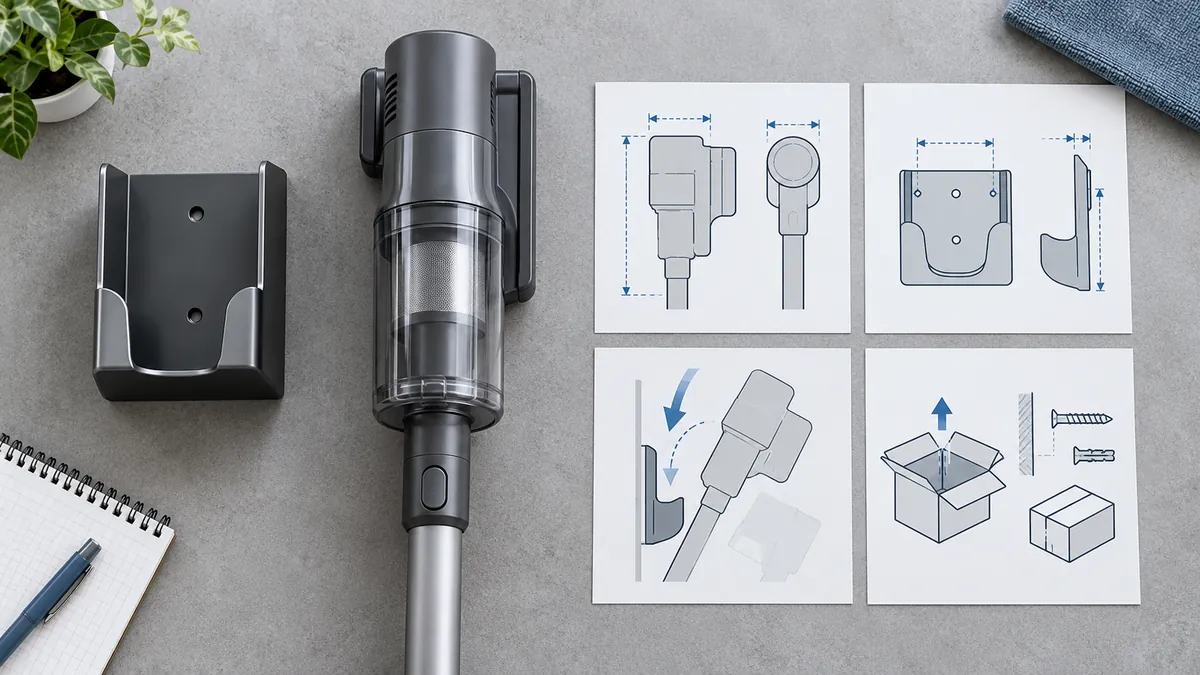
For cordless vacuum wall mount compatibility, keep the approved matrix and the physical sample result together through RFQ, packaging, and production changes.
- [ ] Is the product explicitly a passive holder, or does the scope include charging or electrical parts?
- [ ] Are the vacuum brand, model code, generation/revision, and physical reference sample recorded?
- [ ] Does each compatibility claim map to a specific tested model configuration?
- [ ] Are support/contact points, clearances, and the insertion/removal path defined?
- [ ] Are included accessories and cable-storage claims clear?
- [ ] Does the sample match the intended production drawing, finish, pads, and assembly?
- [ ] Are wall attachment, fastener supply, installation responsibility, and wall-type assumptions separate from appliance fit?
- [ ] Are the result, photos, unresolved cases, and approval owner documented?
- [ ] Do packaging, instructions, listing copy, and private-label claims use the same approved model list?
- [ ] Is there a change-control step for a new vacuum generation, revised holder, finish, pad, or supplier route?
Foire aux questions
Does one wall holder fit every cordless vacuum?
Not by default. Body, handle, support feature, control position, accessories, and revision can differ. Treat “universal” as a claim that needs a defined model scope and representative evidence, not as a substitute for a fit matrix.
Is a wall holder the same as a charging dock?
No. A passive holder stores an appliance mechanically. A charging dock or holder with wiring adds electrical and charging requirements that need separate design, compatibility, and safety review. This guide does not validate those functions.
Can a drawing prove the holder fits?
A drawing can define interfaces and help screen dimensions, but physical fit depends on the appliance configuration, tolerances, assembly, and movement. Use a production-representative sample with the named model or an approved reference method before making a compatibility claim.
Who chooses the wall screws or anchors?
The buyer should state whether the holder supplier includes fasteners and who selects them for each installation. Wall construction varies; a bracket’s fit to a vacuum does not establish that a particular fastener is suitable for every wall.
Review a Metal Holder Drawing and Fit Plan
For an adjacent home-storage OEM inquiry, share the passive holder drawing or sample, named appliance models, finish and packaging requirements. Model compatibility must be verified against the buyer’s own product samples and criteria.
Fabrication pour compte de tiers / Marque de distributeur
Transformez ce guide d'approvisionnement en cahier des charges
Indiquez-nous le produit souhaité, ses dimensions, sa finition, la quantité commandée et vos exigences en matière d'emballage. Votre équipe recevra une analyse pratique de la faisabilité de la fabrication avant l'établissement du devis.
 English
 Español
 Português
 Français
 Deutsch
 العربية