

Bathroom hardware set component availability is limited by the approved component that can supply the fewest complete kits, after compatible stock, quality status, and existing commitments are reconciled. Buyers should calculate this potential quantity from one fixed BOM, then confirm production, inspection, packaging, and release status separately. A component count is not a shipment promise, and stock in a different finish or revision should not be added merely because it shares a part name.

What does “complete sets available” mean?
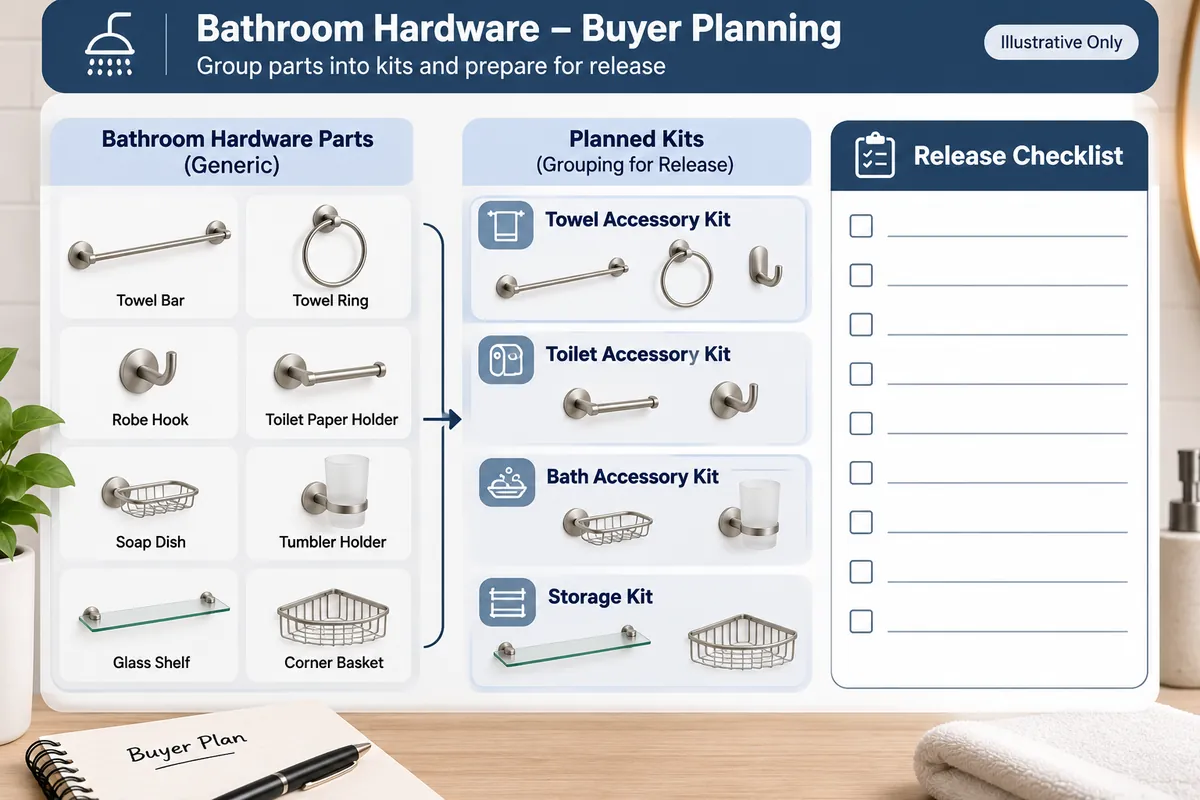
A bathroom hardware order may contain a metal accessory, a bracket, fasteners, an insert, instructions, and protective packaging. The exact BOM depends on the approved SKU. A supplier may have many pieces of one component but not enough of another component to make the requested number of complete sets. For an importer, the useful question is not whether one part is “in stock”; it is how many complete, compatible sets can be allocated from a defined inventory snapshot.
Official inventory software documentation describes kit availability in terms of required components and quantities. For example, Odoo’s official kit documentation explains component-based availability in that system, while SOS Inventory’s official help describes per-kit BOM quantities and component-derived availability for its product. The details of a particular system do not prove that Koitor uses that software or that every factory manages inventory the same way. The general arithmetic is straightforward, but its inputs need clear definitions. “Available” must say whether it means physically received, usable, uncommitted, and quality-released stock. A purchase order that has not arrived is not the same as on-hand inventory, and a part under inspection or rework should not automatically count as usable.
This calculation is different from defining the BOM. A product’s engineering or manufacturing BOM identifies which components belong to an item and how many are required; a current availability check applies that BOM to a dated stock and commitment record. The distinction matters when buyers are checking order readiness rather than deciding what the set contains. For static BOM differences, see the separate engineering and manufacturing BOM guide. A bathroom hardware set component availability result is valid only for the selected BOM revision and stock snapshot it names.
How is bathroom hardware set component availability calculated?
For one fixed kit revision with no alternative components, record for each required component: the usable quantity available for this calculation and the number of units needed per kit. Divide the available quantity by the per-kit requirement and round down to a whole kit. The smallest result across all required components is the component-limited quantity.
For example, imagine an illustrative set requires one basket, two brackets, four screws, one instruction sheet, and one carton. Assume the dated stock record shows 240 baskets, 460 compatible brackets, 1,200 screws, 180 approved instruction sheets, and 210 cartons after commitments and quality holds have been applied. These hypothetical quantities yield limits of 240, 230, 300, 180, and 210 sets respectively. The limiting result is 180 potential complete sets because the instruction sheets reach that limit first. These figures are for explanation only; they do not describe Koitor stock, a real BOM, or a normal order.
The calculation can be written as: for each required component i, calculate floor(available quantity for i ÷ quantity required per kit for i); then take the minimum result. Use consistent units. A bracket counted as each cannot be divided by a set quantity recorded as pairs without first reconciling the unit definition. If the component list uses metres, kilograms, or a packaging multiple, convert only through an agreed, documented unit of measure.
| Illustrative component | Quantity per set | Usable quantity in example | Component limit |
|---|---|---|---|
| Basket | 1 | 240 | 240 sets |
| Brackets | 2 | 460 | 230 sets |
| Screws | 4 | 1,200 | 300 sets |
| Approved instruction sheet | 1 | 180 | 180 sets |
| Carton | 1 | 210 | 210 sets |
The smallest component limit is a planning ceiling under these assumptions. It is not a production capacity, finished goods count, release quantity, or ship date. If instructions arrive later, recalculate the full component list; the next limiting item may change.
Which stock should count as usable and compatible?
Start with the approved SKU and revision. Each line should identify the component code, specification or source, finish, and unit of measure. If a part has more than one finish or revision, list each separately unless the responsible product owner has approved interchangeability. A visually similar screw or bracket is not automatically an acceptable substitute.
Then define the stock status used in the calculation. Depending on the parties’ inventory convention, quantities may be separated into physically received, quality-held, rejected, rework, allocated, committed, and available balances. The same quantity should not be subtracted twice. If an “available” field already excludes order commitments, do not subtract the same commitments again. If the system reports gross on-hand stock, document how holds and allocations are removed to produce the usable figure.
Use a timestamp and location. A warehouse count from Monday may not represent Tuesday after receipts, picks, or another customer allocation. If components are in different locations or lots, confirm that they can be used for the same buyer order and meet the approved revision and finish. A forecast receipt or open purchase order should be listed separately with its expected date and current status; it should not be silently included as stock on hand.
Quality status is part of availability. A component awaiting inspection, rejected, or under rework should not be treated as released solely because it is physically present. The supplier and buyer should agree what counts as accepted stock for the calculation and who controls disposition. If a lot is partly approved, only the approved quantity should enter the usable balance, and the supporting status should be traceable.
How should shared components and prebuilt sets be handled?
The simple minimum formula assumes one fixed kit, no alternatives, and component quantities that are not simultaneously promised elsewhere. When several SKUs share a bracket, screw, or carton, their independent theoretical maxima cannot all be committed at once. The actual order allocation must be agreed and each use of shared stock counted once.
For example, if two kits each use the same approved bracket, calculate the allocation across both orders according to the agreed priorities. Do not calculate each SKU’s maximum from the full shared bracket count and then add those maximums together. That would promise the same units twice. A responsible planner should identify all relevant orders, component consumption, and approved substitutions before stating a combined quantity.
Prebuilt finished sets need separate treatment. If a set has already consumed its components, do not count both the finished set and those consumed loose components as available quantity. Keep finished goods and loose parts in separate rows. If a finished set is partially disassembled or requires rework, it should be counted according to an agreed status and not as both a complete kit and reusable stock.
Alternative components need approved logic. If a product permits two brackets or several carton options, do not combine their quantities unless substitution is permitted for the exact order and product revision. A component shortage does not authorize the supplier to change materials, finishes, instructions, or packaging. Written buyer approval and controlled documentation should govern any substitution.
What evidence turns a theoretical quantity into a release quantity?
Component arithmetic answers only the potential kit count from the stated stock snapshot. It does not prove that the production order has been completed. The supplier should separately confirm assembly status, required inspections, quality disposition, packaging, labeling, carton count, and release authorization. If a set is assembled, it should be counted in the appropriate finished-goods status rather than conflated with loose components.
Buyers should distinguish several stages: component-limited potential; quantity allocated to the order; quantity assembled or otherwise prepared; quantity that passed required inspection; quantity packed and identified; and quantity formally released for shipment. These stages may produce different values. The buyer should ask which stage a supplier’s number represents and what evidence supports it. A term such as “ready” can be ambiguous unless the parties define it.
Use a dated supplier worksheet. It can include the approved set revision, component IDs, per-kit quantities, physical receipt, holds, rework, other commitments, usable quantity, limiting component, potential sets, prebuilt units, assembly status, inspection status, packaging status, final release quantity, and open dependencies. Identify the person or system responsible for each number. This makes it possible to resolve a shortage without exposing another customer’s confidential order detail.
An allocation calculation does not alter contract terms or authorize a partial shipment. If the component ceiling is below the purchase quantity, buyer and supplier should agree the next step: wait for supply, approve an alternative, split the order, or revise the quantity. Those are commercial decisions requiring mutual agreement, not outputs of the formula.
Which inventory mistakes commonly distort the calculation?
One error is counting a component in the wrong finish or revision. The count may be numerically correct but irrelevant to the approved set. Keep incompatible inventory separate until the product owner has documented an acceptable substitution.
Another error is treating a future receipt as available stock. A supplier may expect a shipment, but until it is received and its status is known, the quantity is not equivalent to physically usable stock. Show the forecast separately and update the calculation when actual receipt is confirmed.
A third error is double counting shared stock. One bracket may appear in several product BOMs. Each open order must consume the shared balance once under the agreed allocation. Independent maximum calculations for each SKU can overstate the total.
Buyers should also avoid double-subtracting commitments. If a system’s available balance already excludes reservations, subtracting them again understates stock. If it provides only gross on-hand, failure to account for other allocations overstates stock. The report should say which convention is used.
Finally, do not turn the minimum component result into a shipment promise. Assembly, inspection, packaging, labeling, and logistics may still be incomplete. A component-limited count is a planning indicator; the buyer still needs the relevant release evidence.
How can a bathroom hardware supplier support the check?
Koitor Hardware is a family-owned bathroom and home storage hardware factory. Its project scope may include metal product fabrication, bought-in components, assembly, finish, and packaging preparation as confirmed for a specific order. No claim is made here about a particular ERP, live warehouse balance, stock availability, production capacity, or schedule. Actual availability must come from authorized, order-specific supplier records.
For a useful reconciliation, the buyer and supplier should work from the same approved kit revision and component list. The buyer can provide its target complete-set quantity and identify any required finish, packaging, labeling, or inspection conditions. The supplier can then report the relevant component and order statuses within the confirmed project scope. If data cannot be verified, the number should be marked pending rather than represented as confirmed stock.
The bathroom hardware kit configuration guide covers what belongs in a product kit and how mounting scope can be defined. It does not answer the current inventory calculation described here. For a supplier discussion, review Koitor’s custom bathroom hardware scope and provide the approved SKU, requested complete-set quantity, and relevant component revision. A project-specific check still requires current records and confirmation from the responsible parties.
What should a supplier availability request include?
- Approved SKU, kit revision, finish, and complete BOM.
- Quantity per set and controlled unit for every component.
- Requested complete-set quantity and required date, without assuming stock.
- Dated inventory snapshot and location for the calculation.
- Definition of usable balance, quality holds, rework, and commitments.
- Compatible revisions and approved alternatives, if any.
- Shared-component allocation across all relevant orders.
- Finished sets listed separately from loose components already consumed.
- Assembly, inspection, packaging, labeling, and release status.
- Limiting item, open dependencies, responsible owner, and update timing.
Foire aux questions
What is the limiting component in a kit calculation?
It is the required component that yields the fewest complete kits after available quantity is divided by the quantity needed per kit and rounded down.
Should a purchase order count as available stock?
Not as physically received stock. List expected receipts separately and update the calculation after receipt and applicable status checks.
Can I add component-limited quantities from two shared SKUs?
Not without an allocation plan. Shared components cannot be promised independently to multiple SKUs from the same balance.
Does enough component stock mean the order is ready to ship?
No. Assembly, inspection, packaging, labeling, and formal release may still be pending.
Does Koitor publish live stock or ERP availability through this guide?
No. The article makes no claim about Koitor’s inventory system or current stock. Any quantity must be confirmed from authorized records for the actual project.
Discuss a Bathroom Hardware Order Brief
Share the approved kit revision, requested complete-set quantity, and component or packaging dependencies for a project-specific supplier discussion.
Fabrication pour compte de tiers / Marque de distributeur
Transformez ce guide d'approvisionnement en cahier des charges
Indiquez-nous le produit souhaité, ses dimensions, sa finition, la quantité commandée et vos exigences en matière d'emballage. Votre équipe recevra une analyse pratique de la faisabilité de la fabrication avant l'établissement du devis.


 English
 Español
 Português
 Français
 Deutsch
 العربية