
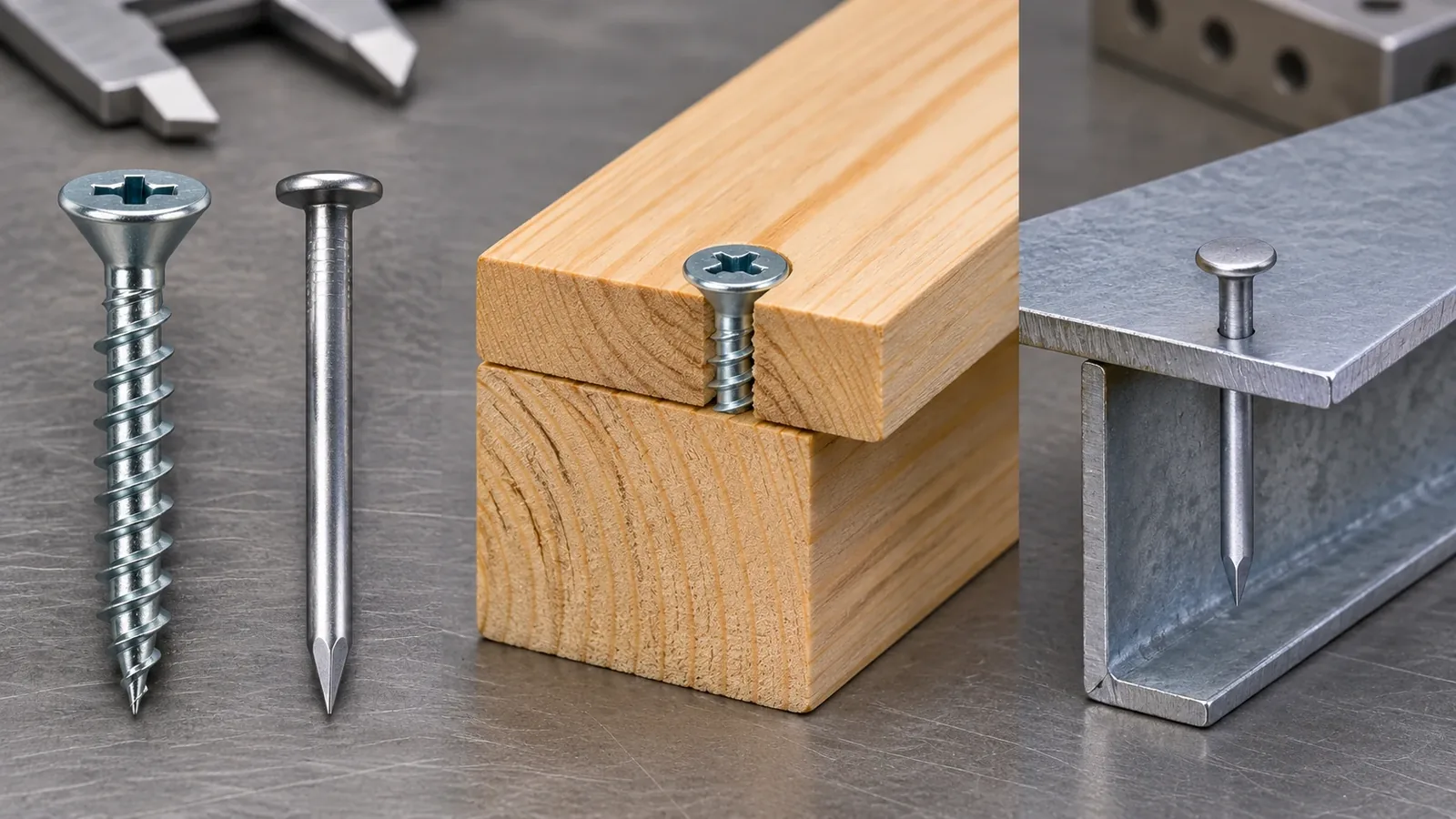
Screw vs nail is a comparison of fastener families, not an approval to replace one specified connection with another. A typical screw has a helical thread intended to engage a compatible receiver or material; a nail is generally driven into a receiving material and may have a smooth, ringed or otherwise shaped shank. Those broad descriptions help buyers understand how the fasteners differ, but actual products vary. The required connection depends on geometry, materials, installation method, product design and the project’s approved specification.
For bathroom and home-storage hardware buyers, the practical question is whether a fastener matches the intended attachment and receiver. A screw described for a particular material is not automatically suitable for every panel or metal component, and a nail family name does not establish a connection capacity. Head style, shank, point, diameter, length, coating, receiver material and access can matter. The buyer should confirm the specified fastener and avoid approving substitutions from generic labels or a presumed strength ranking.
This guide explains the main engagement distinction and how to review a proposed connection. It does not provide a structural fastening recipe, load rating or installation instruction. For building or safety-critical connections, use the applicable design, manufacturer instructions and qualified engineering approval.
How a screw engages a connection
A screw has a helical thread around its shank. Depending on its design and application, the thread may engage a preformed thread in a component or form engagement in a receiving material. Screws vary by head, drive, thread form, point, shank, length and intended substrate. The word “screw” alone does not identify those features.
A machine screw is commonly paired with a threaded receiver such as a nut or tapped feature, while other screw families are designed for different receivers. The actual fastener specification governs. Do not assume that a screw’s thread will create an appropriate connection in any material simply because it can be driven into it. Substrate, thickness, edge distance, pilot or receiver design, fastener dimensions and product function are all relevant to a real engineering decision.
A screw head and drive also play distinct roles. The head transfers contact into the part or joint; the drive interface accepts a compatible tool. Drive profile does not describe receiver engagement. A screw can have different head and drive combinations while retaining a threaded shank. A buyer should record each attribute that matters on the drawing or bill of materials rather than using one descriptor as shorthand for the entire connection.
How a nail engages a connection
A nail is generally driven into a receiving material. Its shank may be smooth or include features such as rings or other geometry. Some maker catalogs distinguish connector nails by shank design and intended use; those are product-specific categories. The broad word “nail” does not establish a material, head form, corrosion property, connection capacity or approved application.
A nail does not normally rely on the same threaded engagement concept as a screw, though a nail shank may be deliberately shaped to affect its interaction with the receiver. Buyers should use the specific product data and project specification rather than assuming all nails are smooth or that every grooved nail is equivalent. An exact product and approved application are required before performance statements are made.
A nail’s head, shank, point and coating can vary. The receiver material and connection design still determine suitability. A product maker’s catalog can explain its own product families; it cannot approve a different project, material or use without the relevant evidence.
Screw vs nail: compare the connection attributes
| Attribute | Screw family | Nail family | Buyer verification |
|---|---|---|---|
| Typical engagement concept | Threaded engagement with an intended receiver or material | Driven shank interacts with the receiving material | Confirm the design-specific receiver and application |
| Shank | Helical thread is a defining feature | May be smooth or include product-specific shank geometry | Use exact product data |
| Installation concept | Turned into or through a compatible connection | Driven into a compatible receiver | Follow authorized instructions |
| Head and tool interface | Head and drive vary independently | Head and driving interface vary by product | Specify head, drive or tool only when relevant |
| Substitution basis | Must match the defined connection and requirements | Must match the defined connection and requirements | Obtain approval for the actual product and use |
This table is descriptive, not a comparative test. It does not rank one family above another. A screw may be specified for a particular metal assembly; a nail may be specified for a particular connector or substrate. The fastener supplier’s product category and the project designer’s connection approval remain essential.
The terms “wood screw,” “machine screw,” “connector screw,” “nail” or “connector nail” each narrow a broad family in different ways. They still do not replace dimensions and application details. Confirm exact material, coating, thread or shank, head, length, receiver and drawing reference where those requirements are relevant.

Why a family label cannot approve a substitution
A proposed change from screw to nail changes more than the fastener name. It may change the receiver, assembly sequence, component geometry, access, inspection method and documentation. The buyer must know which design authority can approve such a change. A supplier may propose an alternative, but the supplier’s proposal alone does not amend a buyer’s controlled specification.
The reverse is also true. Replacing a nail with a screw may require a threaded receiver or another design provision that does not exist in the original part. A screw can introduce different head and drive requirements. The product may need a nut, tapped hole, insert or other component. Each of these changes needs review rather than a quick substitution based on availability.
An exception may be permitted by the design owner where the project supports it. The approval should identify the original and proposed fastener, affected drawing or SKU, the technical reason, supporting evidence, any revised inspection method and the effective revision. Keep the approval with the product record. Do not treat a generic industry comparison as evidence that the change is safe, compliant or performance-equivalent.
For a metal storage rack, the fastener may interact with a threaded insert, bracket, panel or another part. Its behavior depends on that actual assembly. Related galling concerns are covered separately in the stainless steel fastener galling guide for metal storage racks. The article does not decide which fastener should be used in a given rack or approve a change.
What to inspect in a fastener proposal
When a supplier proposes an alternative, collect enough detail to compare the actual products. Start with manufacturer and part number, drawing revision, fastener family, dimensions and material or coating as specified. For a screw, identify thread and receiver requirements, head and drive where applicable. For a nail, identify shank and head features relevant to the connection and receiver. Ask for current product documentation and intended application limits.
Then inspect the receiving parts. Is there a threaded feature, through-hole, panel, bracket or connector? What thickness and material are specified? Is the proposed fastener compatible with the available geometry and assembly access? If the connection depends on a separate insert or nut, make sure the proposal addresses that component too.
The review should also consider the product stage. An early prototype may use a temporary fastener for fit evaluation, while a production configuration may need an approved bill-of-materials item. Mark temporary arrangements clearly so they are not mistaken for the release configuration. If a sample is used to evaluate a change, record its identity and whether it represents production-intent parts.
The maker’s documentation can support product identity and intended use. It does not replace the project designer’s approval. If a product catalogue describes connector nails or screws for a particular construction context, do not transfer that claim to a different material or bathroom hardware connection without evidence. The exact application is the boundary.
How buyers should document the connection
A clear fastener record ties the component to the product drawing and receiver. Include:
- Product and assembly revision.
- Fastener manufacturer and exact part number.
- Family and material details supported by the specification.
- Head, drive and shank or thread fields relevant to fit.
- Receiver or mating-part identity and revision.
- Assembly instructions or approved process reference.
- Applicable inspection or acceptance evidence.
- Substitution approval, if any, and its scope.
This record helps prevent two different teams from using “screw” or “nail” as shorthand for different parts. It also makes it easier to evaluate a supplier’s proposed change. If an item cannot be identified, mark it as pending rather than infer it from a photograph.
For custom hardware, drawings and samples are the basis for a meaningful discussion. A buyer should share the controlled connection detail, mating component, intended function and any actual acceptance requirement. Koitor’s manufacturing role is limited to confirmed OEM scope; the home-storage hardware manufacturer page explains the business context. Contact the factory with the project-specific drawing or sample through Koitor’s contact page.
Common comparison mistakes
Assuming screws are always stronger. No universal family ranking follows from the names. Product design, receiver, material and application evidence matter.
Assuming nails are always temporary or only for wood. Nail families vary, and some are specified as connectors in product-maker catalogs. The exact intended receiver and design must be verified.
Treating a screw’s drive as its thread. The drive accepts the tool; the thread interacts with the receiver. Record these as separate attributes.
Assuming a grooved nail is equivalent to a threaded screw. A particular shank feature does not automatically produce the same connection behavior as a screw thread. Compare the exact design and obtain approval.
Using fastener length as a complete specification. Length alone does not define diameter, thread or shank, head, material, receiver fit or performance.
Approving a swap because both products fit the same visible hole. A similar fit does not establish connection equivalence or buyer acceptance. Confirm the design and the actual criteria.
Borrowing claims from a different construction context. A fastener maker’s application statements have a defined product and scope. Do not transfer them to a different substrate or hardware design without appropriate evidence.
Leaving the mating part out of the review. The fastener and receiver form a connection. A comparison that describes only the fastener may miss a required nut, insert, thread or panel characteristic.
Is a screw always removable and a nail permanent?
Both can be removed in some circumstances, and removal may affect the receiver or surrounding part. The broad comparison is about engagement and specified connection, not a universal reversibility rule.
Can a screw replace a nail?
Only if the project’s responsible design authority approves the specific alternative for the actual receiver and application. Generic family comparisons do not approve substitutions.
Are all nails smooth-shank?
No. Product families include different shank designs. Verify the exact maker’s product and application information.
Are connector nails interchangeable with screws?
Do not assume interchangeability. Their designs and intended connection contexts differ. Confirm the exact project requirements and obtain authorized approval.
Does a screw require a threaded receiver?
Not every screw application uses a pre-threaded receiver; some screw families are designed for other receiving materials. The exact fastener and substrate determine the design.
How should an importer specify a connection?
Identify the fastener, receiver, product revision, application requirement and evidence needed. Keep any proposed substitution under the buyer’s design-change approval process.
Map the receiver before comparing fasteners
A connection review starts by identifying the parts that receive and retain the fastener. A screw may engage an existing thread, a nut, an insert, a formed feature or a receiving material specified for that screw family. A nail is driven into a compatible receiving material or connector under its maker’s stated use. The descriptions are broad and do not establish whether a particular substrate or geometry is approved. A buyer should use the drawing and exact supplier documentation to establish the actual receiver.
For a sheet-metal assembly, the receiver may be a nut, threaded insert, tapped hole, clip or another designed feature. The fastener choice can affect the mating component and assembly access. For a panel-based product, the receiver may be a wood-based panel or another material, with its own thickness and edge conditions. A comparison that does not identify the receiver leaves out one half of the connection. Do not infer suitability from the fact that a fastener can be physically inserted into a hole.
When comparing a proposed substitution, ask whether the receiving feature exists in the current design and whether its geometry is controlled in the drawing. If a screw requires a different insert or a nail needs a specified connector, those components and their revisions must be included in the proposal. A buyer should not accept an unlisted mating component as an invisible detail; it can change fit, manufacturing sequence, inspection and recordkeeping.
Distinguish fastener attributes that influence identification
Fastener family is only one identifier. Diameter, length, head form, drive, thread or shank pattern, point, material, coating and lot or part number may be relevant to the purchase. Not all these fields need to be specified for every application. The design owner determines which attributes are critical, and the buyer should preserve them in the purchase specification when they affect the approved connection.
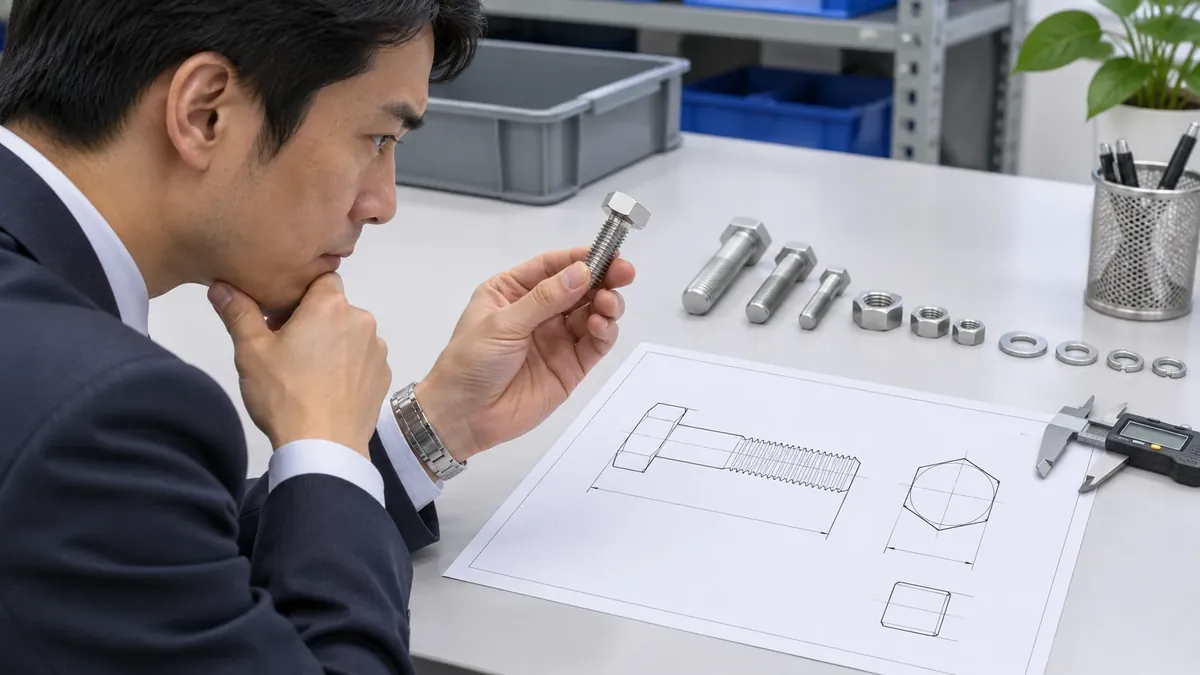
A screw head and drive can be confused with its threaded shank. The head determines how the screw bears or sits in the part according to its design; the drive determines how a compatible tool engages it; the thread interacts with the receiver. Nails have their own head, point and shank attributes. When the buyer changes one feature, do not assume the others remain equivalent. Request an updated drawing or product data for the exact proposed part.
Surface treatment also should not be inferred from family names. A fastener may have a specified material or coating, and compatibility with the surrounding materials and environment may matter. If corrosion, appearance or chemical compatibility is an acceptance concern, state the requirement and request the evidence appropriate to that project. This article does not rank coatings, grades or suppliers and does not claim that a visual check establishes the base material.
Part-number changes can be minor administrative updates or can reflect meaningful product revisions. Compare the actual manufacturer document and drawing history, not only the text of a description. If the supplier cannot confirm that the new item meets the approved specification, mark the substitution pending and ask the responsible engineer or buyer to decide. Avoid treating a familiar label as proof of sameness.
Keep sample evaluation within the approved question
A sample can help establish whether the proposed fastener physically fits the prototype and whether the assembly can be reviewed in the intended orientation. It does not automatically establish final connection performance or production acceptance. Record what the sample demonstrates: fit, appearance, access, head seating or another explicitly defined point. Keep untested conclusions out of the report.
If the sample differs from the released drawing, identify the difference and prevent the sample from being mistaken for a production-approved configuration. A prototype can use a temporary fastener for evaluation, but it should be labeled and controlled so it is not copied into a purchase order without approval. The final bill of materials should state the production fastener and reference its revision or maker part number as needed.
When a buyer requests a test, agree the method, sample identity and acceptance criteria in advance with the responsible technical owner. Do not select a generic “strength test” from a fastener family comparison. The relevant test could depend on the actual receiver and intended use; no universal screw-versus-nail test is appropriate for every assembly. If an external standard or project code governs the connection, verify its current text and applicability before relying on it.
An observation of a failed or loose sample should be recorded neutrally. Note the fastener part, receiver, assembly revision, observed condition and method of review. Do not declare the fastener family responsible before examining the interface and process records. Potential causes can include incorrect part selection, a receiver mismatch, assembly variation, damaged components or other factors. The engineering and quality teams determine the cause from evidence.
Route questions to the responsible role
A fastener supplier can confirm its product dimensions and published intended-use information. The product designer or authorized engineering owner decides whether a connection is suitable for the product. Procurement controls the commercial part and approved source; quality defines or applies the acceptance records; production follows its authorized work instructions. These roles may sit in different teams. The buyer should direct each question to the owner who can answer it.
This division helps prevent an informal supplier comment from becoming a design release. A seller’s product recommendation may help identify candidates, but it is not necessarily approval for a buyer’s specific product. If the supplier states a performance claim, request the exact evidence, sample and scope behind it. Then obtain the project authority’s decision and record the final disposition.
For a multi-SKU range, do not assume one screw or nail decision applies to every item. Similar-looking products can use different receiver designs, panel materials or assembly access. Maintain a fastener-to-product mapping and state where a common part is intentionally shared. If the buyer changes packaging or assembly instructions but not the connection, document that boundary to avoid unintentionally reopening unrelated design decisions.
Compare the specified connection, not a slogan
Screw vs nail is most useful as a starting vocabulary comparison. Screws generally use threaded engagement with an intended receiver, while nails are driven into a receiving material and may have different shank forms. Both families vary by design. Neither label establishes universal strength, suitability or equivalence.
For a real metal hardware connection, identify the fastener and mating parts on the controlled drawing, check the exact supplier product and route changes to the authorized design owner. Preserve product scope, sample revision and approval evidence. For an OEM project question, see the Koitor home-storage hardware manufacturer page ou contacter Koitor.
Review a Custom Hardware Connection
Share the controlled drawing or sample, fastener and mating-part details, and the exact change or fit question for project review.
Fabrication pour compte de tiers / Marque de distributeur
Transformez ce guide d'approvisionnement en cahier des charges
Indiquez-nous le produit souhaité, ses dimensions, sa finition, la quantité commandée et vos exigences en matière d'emballage. Votre équipe recevra une analyse pratique de la faisabilité de la fabrication avant l'établissement du devis.


 English
 Español
 Português
 Français
 Deutsch
 العربية