

When sourcing a blind corner pull out left right system, identify whether the selected model is handed or non-handed, then freeze the cabinet opening, adjacent obstruction, door arrangement, and extraction sequence in the order documents. A left-door/blind-right cabinet is not the same interface as a right-door/blind-left cabinet, but some product families are designed to fit either orientation. The supplier’s current model drawing and an assembled sample—not a generic “left” or “right” label—should decide compatibility.
What decision does handing control?
A blind-corner cabinet has an accessible opening on one side and a concealed volume behind the neighboring cabinet on the other. A storage mechanism has to pass through the opening and reveal items that would otherwise remain difficult to reach. The cabinet’s handedness describes where that opening and hidden area sit relative to the user; it does not, by itself, tell a buyer how every basket or shelf will move.
In supplier catalogs, “left” and “right” may describe the door side, the blind side, the mounting orientation, the mechanism, or a model-specific product code. Those descriptions can be easy to reverse when a buyer views a cabinet from the front while a supplier’s drawing is oriented from inside the box. A mirrored part can look nearly identical on a quotation image and still be wrong for the cabinet opening or the intended movement.
For blind corner pull out left right selection, the buyer should therefore treat the words as a starting label—not as a complete fit instruction—and tie them to the drawing and exact model revision.
The useful procurement question is therefore not simply “Is this a left-hand unit?” It is: “For this exact cabinet geometry, which side is open, which side is concealed, which assembly is mounted where, and what sequence should the user see when the door and storage mechanism move?” Record those relationships in a drawing or orientation sketch before the supplier confirms a model number.
Is every blind-corner pull-out handed?
No. Product families differ. Some accessories are offered in left- and right-hand versions; other designs are described by their manufacturer as suitable for both orientations or as non-handed. Even within a category, the motion can differ: a mechanism may pivot, slide, rotate, or combine motions. Those are model-specific construction details, not interchangeable assumptions for every blind-corner unit.
For example, Rev-A-Shelf’s cabinet-application information distinguishes a left door with the blind area to the right from a right door with the blind area to the left. Its product information also shows that some optimizer models are offered for either orientation. This is a helpful illustration of why buyers should check the selected series and installation instructions rather than apply a universal rule. It does not establish that another supplier’s unit has the same handedness, dimensions, or movement.
The distinction matters when a product assortment contains multiple cabinet configurations. A distributor may keep one universal model, separate left/right SKUs, or a model family with different mounting and basket arrangements. Each approach can be workable if the selection rule is explicit. The risk appears when the catalog wording, carton label, drawing, and actual sample do not use the same orientation convention.
Which cabinet and product inputs should the RFQ include?
Start with the cabinet as built, not with the accessory name. Ask the cabinet maker or buyer to provide a front view and an interior view, and mark the viewing direction. The record should identify the accessible door opening, the concealed side, whether the cabinet is framed or frameless, and whether the opening includes a drawer above or beside the door. If the cabinet is part of a continuous run, show the neighboring cabinet or other obstruction that creates the blind space.
Next, collect the supplier’s required fit inputs. Depending on the model, those may include clear opening width, internal depth, usable height, door and frame position, hinge intrusion, shelves, plumbing or other obstacles, and the space needed for the mechanism’s full travel. Do not substitute a nominal cabinet width for the supplier’s stated measurement points. Different manufacturers may define a cabinet size, minimum opening, or usable clearance differently.
Ask the component supplier to identify the exact series, model, revision, handing convention, mounting location, and compatible cabinet construction. Request the current installation instructions and drawing that apply to the quoted SKU. If the supplier proposes an alternative model, ask for a marked comparison rather than assuming that a similar appearance means equivalent motion or fit.
| RFQ input | Evidence to request | Why the buyer needs it |
|---|---|---|
| Cabinet orientation | Front and interior views marked with open side and blind side | Prevents left/right terms being interpreted from opposite viewpoints |
| Cabinet construction | Frame/frameless type, door or drawer arrangement, and adjacent obstruction | Affects the available opening and mounting interface |
| Usable envelope | Supplier-defined width, depth, height, and obstruction measurements | Confirms the quoted model against the actual installation space |
| Product identity | Supplier, series, SKU, revision, and handing designation | Keeps the sample, quotation, order, and carton label aligned |
| Motion sequence | Installation instructions and a demonstration on the intended cabinet | Shows whether the assembly clears the door and reveals the intended storage area |
How should buyers describe the opening and movement?
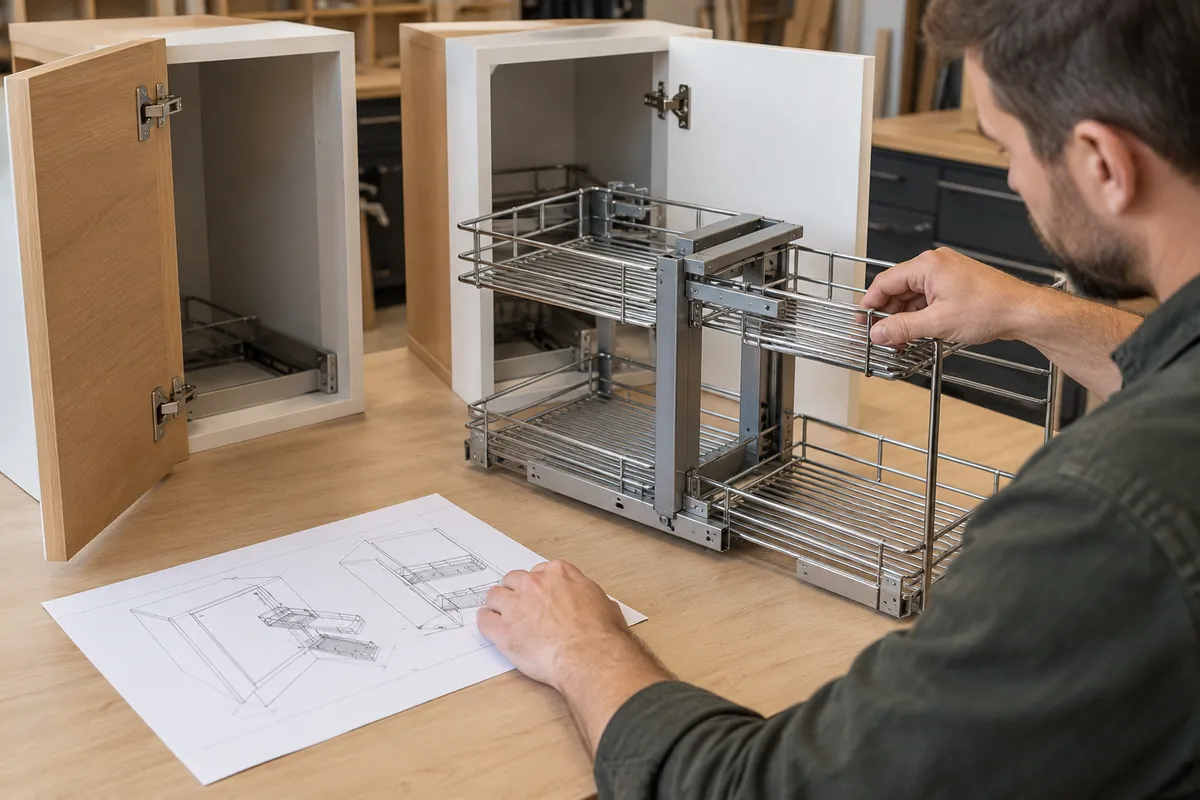
Use a small orientation sketch that the buyer and supplier can both annotate. Mark the viewer standing in front of the cabinet, the door side, the concealed side, and any fixed neighboring panel. Then describe the expected sequence in plain language: which panel opens first, whether the storage unit is attached to the door or to the cabinet body, what moves with the door, and what should become accessible after the movement.
Avoid relying on a single catalog photograph. A product image may show a standard orientation, a staged view, or only part of the travel. It may not expose the cabinet frame, neighboring cabinet, hinge position, or internal obstruction that determines fit. Ask for a plan view or installation drawing when the product’s movement is not clear. The drawing should identify the product orientation and the relevant mating surfaces, not merely provide an overall product silhouette.
For a supplier comparison, use the same cabinet-side inputs for every quotation. Ask each supplier to confirm one of three outcomes: the quoted model fits the stated orientation; it fits only after a listed cabinet change; or the supplier cannot confirm compatibility without further information. This makes differences visible early. It also helps a buying team separate a true product limitation from a missing measurement or ambiguous left/right convention.

What should the buyer verify on a sample?
Approve the complete assembly in a representative cabinet mock-up or in the intended cabinet—not just a loose basket or a component laid on a table. The sample should use the quoted model and revision, the actual intended handing, the proposed mounting position, and the relevant door or frame construction. Record any temporary shims, omitted shelves, or cabinet modifications used during the fit check. If the sample only works after an undocumented adjustment, the approval is not transferable to production.
Run the movement at a normal operating pace and observe the whole path. Check whether the door opens without striking the basket, neighboring cabinet, or hardware. Confirm whether the mechanism moves in the intended order and whether stored contents can be reached without an unexpected obstruction. Look at the farthest travel position as well as the closed position. A configuration can appear correct while shut but reveal interference once the assembly swings or slides.
Record what the check demonstrates and what it does not. A sample review can confirm the fit and movement of that specific assembly in the tested cabinet configuration. It does not prove universal compatibility across all cabinet widths, brands, door thicknesses, installation variations, or future revisions. It also does not replace the component supplier’s technical limits or installation instructions.
For repeat orders, preserve the approved orientation sketch, cabinet drawing, model and revision, installation instructions, sample photographs, observed clearances, and any accepted deviation. Tie those records to the purchase order and incoming inspection reference. If the supplier changes the model, basket arrangement, mounting bracket, or instructions, ask whether the approved motion and fit evidence remains applicable. Do not silently carry an old approval forward to a changed interface.
What mistakes create avoidable sourcing problems?
Using left/right without a viewpoint. A buyer writes “left-hand” on an email, while the supplier interprets the term from the other side of the cabinet. Add a marked view and describe open and concealed sides in words.
Assuming every model has a mirrored pair. Some models are designed for a single orientation, while others may accommodate either side. Ask the supplier to state whether the quoted model is handed, reversible, or non-handed and to point to the matching instruction sheet.
Quoting from nominal cabinet dimensions. A cabinet’s advertised width does not guarantee the same clear opening after frames, doors, hinges, shelves, or neighboring units are considered. Use the supplier’s exact measurement method and show the obstructions.
Approving a component instead of the installed assembly. A basket can look correct on a workbench while its support, mounting point, or path conflicts with the cabinet. Review the assembled sample in context.
Treating a substitution as a color or finish change only. A different mechanism or mounting arrangement may change orientation, travel, installation order, or required clearance. Keep the model and revision visible in the approval record.
Expecting a catalog photo to prove compatibility. Marketing photography is not a cabinet-specific fit report. Ask for the current drawing, installation guidance, and evidence for the intended configuration.
How can an OEM partner support an adjacent hardware assortment?
Cabinet organizers and specialized pull-out mechanisms are often purchased components with their own qualified suppliers. Koitor’s content here is buyer education; it does not claim that Koitor currently manufactures blind-corner mechanisms or provides specialist hinge testing. When a project combines such fittings with metal storage products, the buyer can still coordinate the interfaces: identify which supplier owns each component, what cabinet-side data is shared, and who approves the assembled result.
For metal baskets or related storage parts, a custom metal hardware manufacturer can review the buyer’s drawing or sample for the metal component within its verified scope, discuss forming, joining, finish and packaging considerations, and communicate how a requested change affects the part being supplied. A specialist fitting supplier should confirm its own model compatibility and performance requirements. Clear ownership prevents one vendor’s sample approval from being treated as approval of another vendor’s mechanism.
Buyers developing a broader home-storage assortment can review Koitor’s OEM home-storage hardware et fabrication sur mesure de paniers de rangement en métal information for relevant metal-product scope. The key is to state what is purchased from a specialist supplier and what metal part is being developed with the OEM factory; do not combine those responsibilities into a vague “one supplier confirms everything” assumption.
Buyer checklist before requesting a quotation
- Mark the cabinet from the user’s front view and identify the open side and concealed side.
- Identify framed or frameless construction and show adjacent cabinets, doors, drawers, shelves, and known obstructions.
- Supply the required internal measurements using the supplier’s named measurement points.
- Ask whether the specific model is left-handed, right-handed, reversible, or non-handed.
- Confirm the supplier, model, revision, mounting arrangement, and applicable installation instructions.
- Describe the intended door and mechanism movement in order; request clarification where the sequence is not obvious.
- Ask for a representative assembled sample or mock-up using the actual cabinet configuration.
- Record the tested fit, observed interference, accepted modifications, and approving person.
- Keep the approved drawing, sample reference, quotation, order, and carton identity linked.
- Re-open the approval if the model, revision, cabinet geometry, or mounting arrangement changes.
Foire aux questions
Does “left-hand” always mean the door is on the left?
No universal convention should be assumed. Some product pages define handing by the cabinet door side, while other labels may refer to the blind area or a mechanism orientation. For blind corner pull out left right ordering, use the supplier’s current drawing and installation instructions, and mark the cabinet from the user’s viewpoint.
Can one blind-corner organizer fit both left- and right-hand cabinets?
Some supplier product families are described as fitting either orientation, while other models have separate left- and right-hand versions. Verify the exact quoted model and revision; do not generalize a capability from one series to another.
Are cabinet width and depth enough to confirm fit?
Usually not by themselves. The usable opening, frame, door, hinge intrusion, adjacent cabinet, shelves, and the mechanism’s travel may affect the installation. Follow the selected supplier’s measurement instructions and confirm the assembly in the intended configuration.
Does a sample approval guarantee every future installation will work?
No. It records evidence for the model, revision, and cabinet configuration actually tested. Preserve those conditions and re-evaluate when the product, cabinet geometry, or installation changes.
Collaborez avec Koitor Hardware
For a project combining metal storage products with purchased cabinet fittings, share the relevant drawing or sample and identify which component needs review. Koitor can discuss the metal-product portion and coordinate clear interface information without representing itself as the specialist fitting designer or test authority.
Clarify the cabinet-side interface
Send the cabinet orientation, relevant metal-product drawing or sample, and purchased fitting model so each supplier’s review scope is clear.
Fabrication pour compte de tiers / Marque de distributeur
Transformez ce guide d'approvisionnement en cahier des charges
Indiquez-nous le produit souhaité, ses dimensions, sa finition, la quantité commandée et vos exigences en matière d'emballage. Votre équipe recevra une analyse pratique de la faisabilité de la fabrication avant l'établissement du devis.

 English
 Español
 Português
 Français
 Deutsch
 العربية