
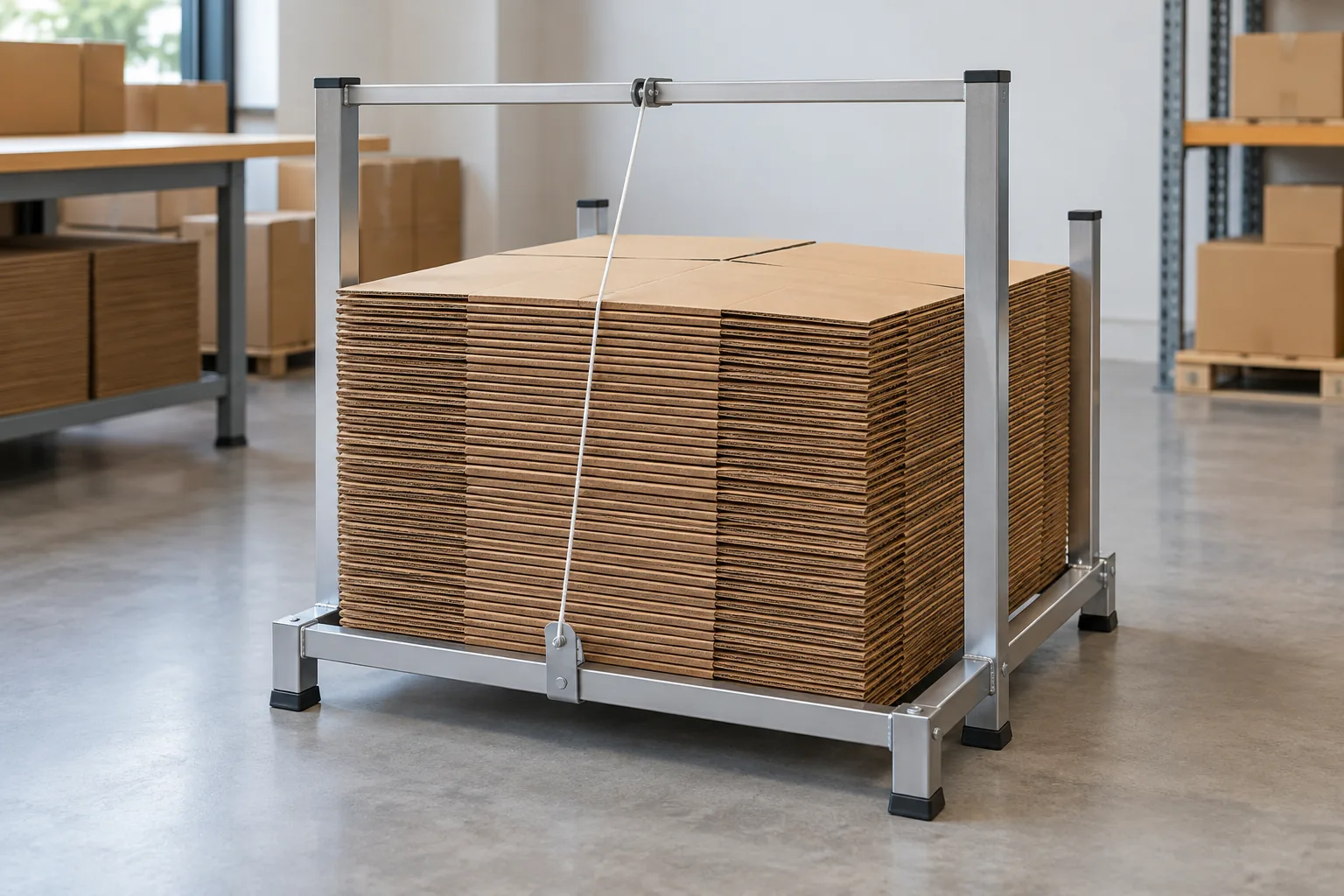
Cardboard stocker bundling clearance is a fit-and-access decision: importers must check the actual flattened cartons, intended stack envelope, tie path and removal sequence together. A frame that accepts loose cartons may not leave enough access to pass a strap or cord around the stack after loading. Buyers should provide real carton samples and approve the complete operation with the selected frame rather than infer capacity or fit from an outside dimension.
What does the stocker need to hold?
First define what “cardboard” means in the product offer. The target could be flattened retail cartons, used shipping boxes, inserts or a defined packaging return stream. Each has different panel geometry, thickness, flaps and fold direction. A product page may use a broad category label, but the buyer’s order needs a specific carton family or an explicitly bounded range.
Collect a representative group of flattened cartons from the intended source. Record their length, width, folded thickness and orientation, along with any tab, flap or panel that extends beyond the main stack. If cartons arrive from multiple suppliers, note which variants are included in the same assortment. A single perfectly flattened sample does not reflect every real carton condition, so the buyer should define which normal variations matter and how they will be assessed.
Describe how cartons are added. Are they placed one at a time, dropped into an open frame, or inserted from the side? Does the operator keep the print side facing a particular direction? Is there a preferred orientation to line up the panels? This sequence affects access and the way the stack rests on supports. It does not establish a safe capacity or a compaction rating; those require separate product-specific evidence.
The buyer should also define the point at which a bundle is made. If cartons are tied while still in the stocker, the frame must permit access beneath or around the loaded stack. If the bundle is removed before tying, the support structure and retrieval opening become the main constraints. These workflows should not be mixed in a supplier drawing without a clear decision about which operation the product supports.
How should flattened-carton fit be measured?
Measure the loaded stack as it is actually supplied and handled. Record the longest panel, widest panel, folded thickness, maximum intended stack height and any irregularity at seams or flaps. Identify whether the frame is expected to hold a tight aligned stack or accept a looser range. Do not provide a single “carton size” if panel lengths differ by orientation.
Draw a top, side and end view of the stack inside the frame. Show the support points, retaining features, side rails and any gap through which the bundle will be tied. Mark the usable envelope separately from the outer frame size. If the frame has wheels or raised supports, include their location in the drawing and the intended operating surface. The supplier should not infer usable volume from the frame footprint alone.
An official Yamazaki Home cardboard stocker product page describes a specific frame architecture with elevated supports and a passage intended to let cord be routed while cartons remain in place. It also identifies product-specific materials and purchased caster components. The example shows why the operation can depend on the underside and support arrangement; it does not define a universal capacity, carton range or safe tying method for other designs.
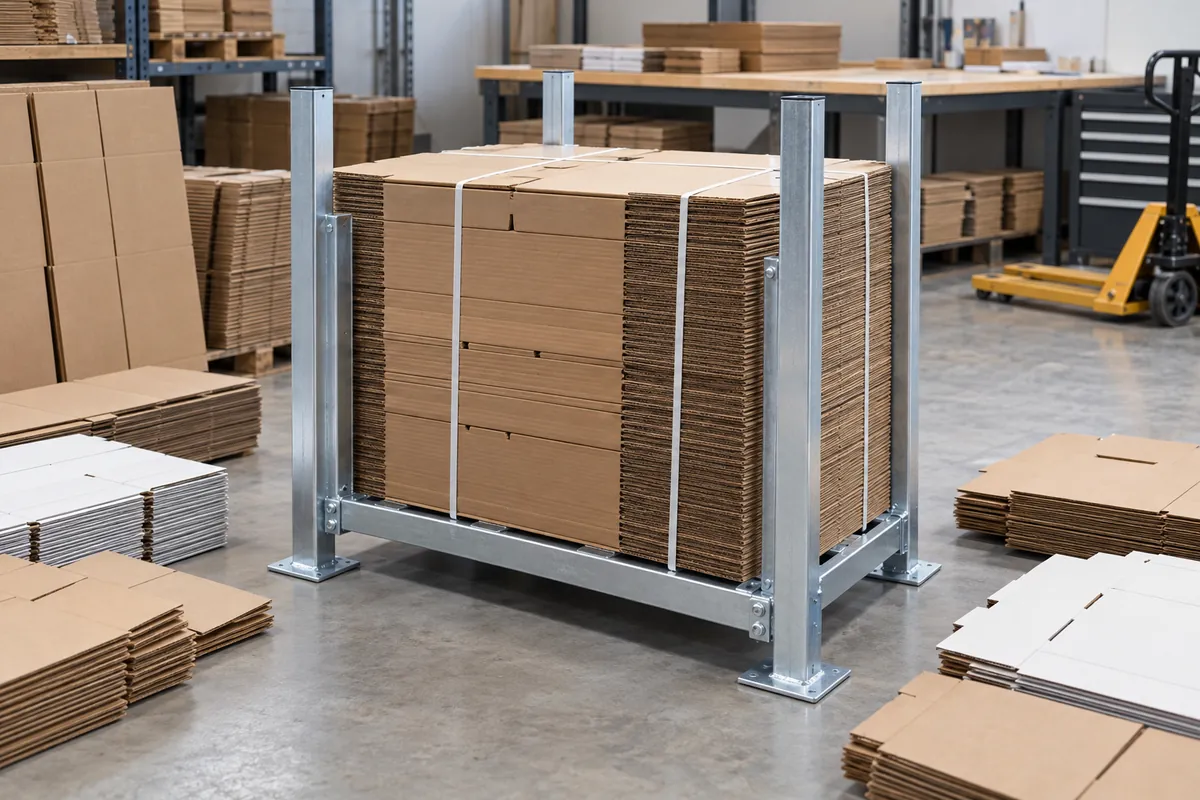
Use the process image to plan the physical review. Load the flattened carton references in the intended orientation, then inspect where the panels bear on the frame. Check whether protruding flaps snag on a rail and whether the stack remains accessible at the intended tie point. If the frame is moved on casters, review movement separately from the tie operation and use the buyer’s defined handling method.
What does bundling clearance require?
Bundling clearance is the space required to bring a specified tie material or tool around the intended stack, close it and remove the secured bundle. Buyers should identify the method: string, paper band, strap or another material. Specify who supplies it, its approximate section or width, the intended route and whether the knot, buckle or joint must pass through the same opening.
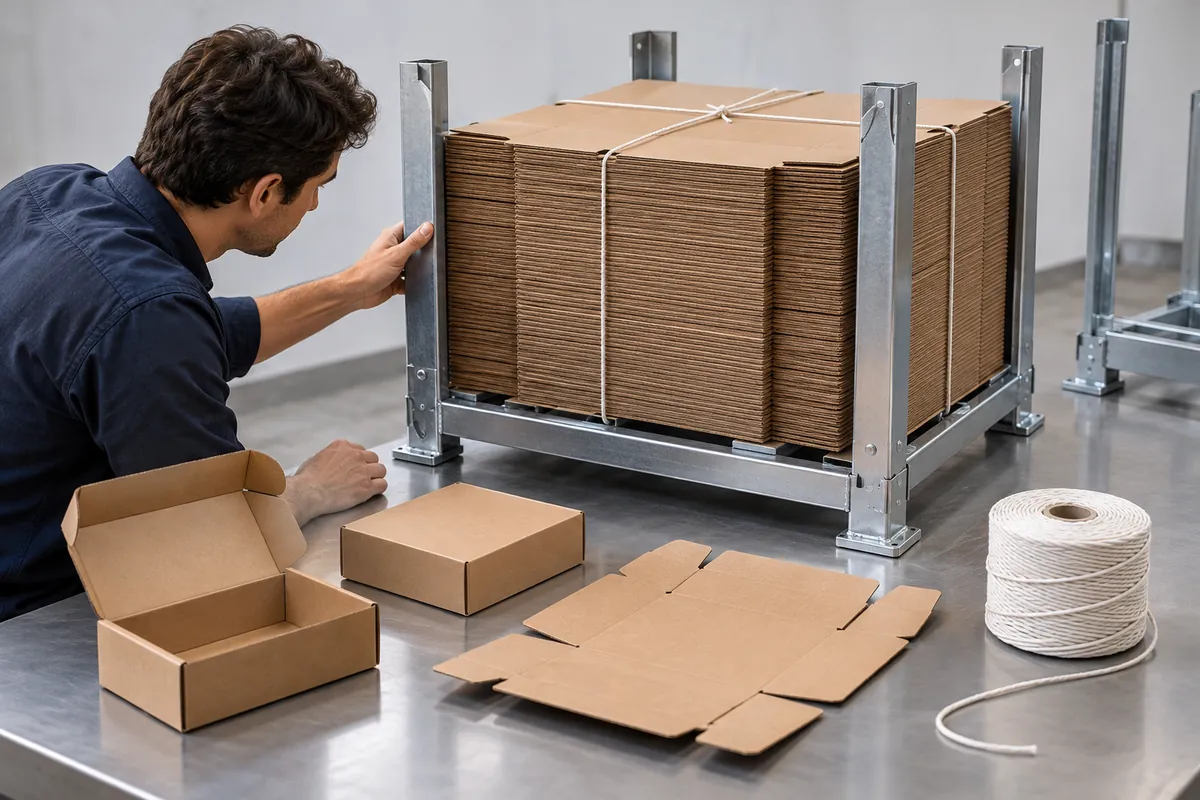
If tying occurs while cartons remain supported, the sample check should follow that exact sequence. Load the agreed stack, pass the tie through the defined route, bring both ends to the user, secure it, and then determine whether the bundle can be lifted out without cutting or disturbing the tie. Record whether a second person, tool or alternate orientation is required. Do not claim that the frame compresses cartons or makes bundling safer unless such a result is specifically supported.
A support bar placed too close to the stack can block the tie route. A rail that is low enough to retain panels may also obstruct a hand or a knot. Conversely, a large opening can affect how the stack rests. These are competing design considerations, not a simple rule that more clearance is always better. The buyer should identify the preferred support locations and tie path on a drawing and validate them with the target cartons.
The removal path should be reviewed after tying. Confirm the dimensions of the bundle, the opening through which it exits, the direction of lift or pull, and whether wheels, handles or surrounding walls restrict movement. If a buyer expects the tied bundle to remain within the stocker, state that separately. A frame designed to store loose panels is not automatically a cart for moving tied bundles.
Which dimensions and components should the RFQ capture?
The RFQ should list carton references, target loaded envelope, support heights, tie material and route, removal direction, installation location, caster or fixed-base configuration and package contents. If wheels are included, record their model and mounting pattern. Avoid inventing wheel load or rolling performance from a product image; ask for supplier documentation if those properties matter to the purchase.
| Décision de l'acheteur | Specification input | Exemples de preuves |
|---|---|---|
| Carton set | Panel dimensions, fold and thickness | Named flattened carton models loaded |
| Stack envelope | Intended maximum arrangement and orientation | Full stack fits within defined frame clearances |
| Support layout | Contact positions and retaining rails | Panels rest at intended points without snagging |
| Tie route | Tie type, width and path | Tie installed and secured with access preserved |
| Removal | Bundle size and direction of exit | Bundle can follow the agreed removal route |
| Mobility | Fixed or caster configuration and floor | Components match the drawing; handling separately reviewed |
| Package scope | Frame, ties, tools and instructions | Listed contents agree with the shipment configuration |
The drawing should distinguish the frame footprint, usable carton space, tie openings and wheel envelope. Identify the datum for each dimension and highlight those that govern fit. If cartons are revised, the buyer should compare the new panels with the controlled envelope and reopen the review when the tie or removal path changes.
How should the sample and operating method be approved?
Use a staged sample review. First inspect the empty frame for the specified finish, joints, supports, fasteners and assembled orientation. Next load cartons and observe where they contact the frame. Then perform the tie sequence with the chosen material. Finally remove the bundle and reset the frame if that is part of the intended operation. Record each stage separately so a pass on storage fit is not misrepresented as a pass on bundling or movement.
The review form should identify the carton models and revisions, number of panels in the stack, tie material, installation location and operators or tools used. Do not write “holds X boxes” unless the buyer’s intended unit count and supplier’s evidence support the wording. If cartons vary in condition, specify representative samples and the defined acceptance limits.
For a commercial product, instructions should show the approved loading orientation and tie route. Make clear whether the stocker itself is stationary or mobile during tying. If wheels are present, the buyer should state how they are controlled during loading and bundling. An illustrative instruction can prevent confusion, but it does not replace a supplier-backed safety assessment where one is required.
Maintain a revision record linking the approved sample, drawing, carton references and tie procedure. If the supplier moves a support bar or changes wheel placement, review the affected interfaces again. If a carton vendor changes flute construction or folded layout, confirm that the former envelope is still representative. This is practical change control rather than a guarantee that every returned carton behaves alike.
What manufacturing and packaging issues need attention?
A metal frame can include formed rails, cross supports, joints, surface finish and purchased casters. The supplier should confirm which parts it manufactures, which parts it buys, and how the assembly is inspected. A change to support height can affect carton clearance; a change to a crossbar can affect the tie path. Those interactions should be evaluated against the drawing and sample.
Finish review should include surfaces that touch carton panels and any edge near the tie route. The buyer should specify visible condition and packaging protection based on the expected market. Do not infer abrasion resistance or a particular life from a color or finish label. Inspect the product with cartons to identify any contact that could mark printed panels, then decide whether that matters to the commercial use.
Packaging should protect the frame, wheels and small hardware while preventing the assembled components from shifting. If the unit ships partially assembled, the instructions should identify each bag and the correct installation point. If the buyer also packs ties or labels, show their location in the carton. A package sample should be checked for loose parts and for compatibility with receiving and warehouse identification procedures.
Koitor’s metal storage rack manufacturing page describes a documented related product area, not a claim that it currently sells cardboard stockers. Buyers can provide carton samples, a tie route and a drawing through contacter Koitor to request a feasibility review for the metal frame. Any caster sourcing, capacity or safe-use statement must be confirmed for the actual project.
A cardboard stocker bundling clearance record should identify the exact tie material, support geometry and bundle removal path reviewed.
What mistakes can make the selected frame unusable?
One mistake is measuring only the carton before it is folded. The stocker holds the flattened panel arrangement, so its outline and thickness should be taken in that state. Record which folds, tabs or seams extend beyond the main footprint.
Another is validating storage without validating the intended bundle. Cartons can fit within an open frame while a crossbar blocks the strap or the operator’s hand. Test the tie route with the full intended stack and selected tie material.
A third is treating a support opening as a universal tying feature. The opening may suit one cord or band but not another width, connector or knot. Identify the consumable and test it in the actual path.
A fourth is assuming a mobile base can carry a tied bundle. Storage, tying and movement are separate operating states. Define whether the frame is moved loaded, whether the bundle leaves the frame, and what evidence is required for any transport claim.
A fifth is leaving carton variability to the frame supplier. Carton suppliers may change panel dimensions or folding patterns; the importer should maintain reference samples and notify the frame supplier when those interfaces move.
Keep each cardboard stocker bundling clearance decision attached to carton and frame revisions, not a generic capacity statement.
What should the buyer checklist include?
Before requesting a quotation, define the flattened carton family, target stack envelope, support and tie operation, frame location, mobility, material/finish and package. Include physical carton samples or dimensioned drawings. Identify whether the frame is sold with casters and what parts are supplied separately.
Before sample approval, load the reference cartons, inspect support points, route and secure the tie, remove the intended bundle, check the frame after unloading, and record the configuration. Freeze the carton and frame revisions. Before shipment, reconcile assembly instructions, wheels, fasteners, labels and carton identification against the approved configuration.
Does carton fit prove that the stocker supports in-place bundling?
No. The tie route, hand access, support placement and removal path need separate review with the full intended stack.
Should the buyer specify the tie material?
Yes. Its width, path and end connection affect clearance. Use the actual tie or an agreed controlled reference in the sample review.
Does the frame’s material or appearance establish capacity?
No. Capacity requires a model-specific engineering basis and stated conditions. Do not infer it from a photograph or material name.
What if the carton supplier changes its box design?
Compare the revised flattened carton against the recorded envelope and tie path. Reopen the fit review if the fold, panel or stack dimensions change materially.
Reference example: Yamazaki Home cardboard stocker documents one particular support and tying-access architecture; confirm the current model data directly.
Discuss a metal storage-frame concept
Share the flattened-carton references, tie path and frame drawing. Koitor can confirm whether the metal frame is within its documented scope before any current product capability is assumed.
Fabrication pour compte de tiers / Marque de distributeur
Transformez ce guide d'approvisionnement en cahier des charges
Indiquez-nous le produit souhaité, ses dimensions, sa finition, la quantité commandée et vos exigences en matière d'emballage. Votre équipe recevra une analyse pratique de la faisabilité de la fabrication avant l'établissement du devis.

 English
 Español
 Português
 Français
 Deutsch
 العربية