
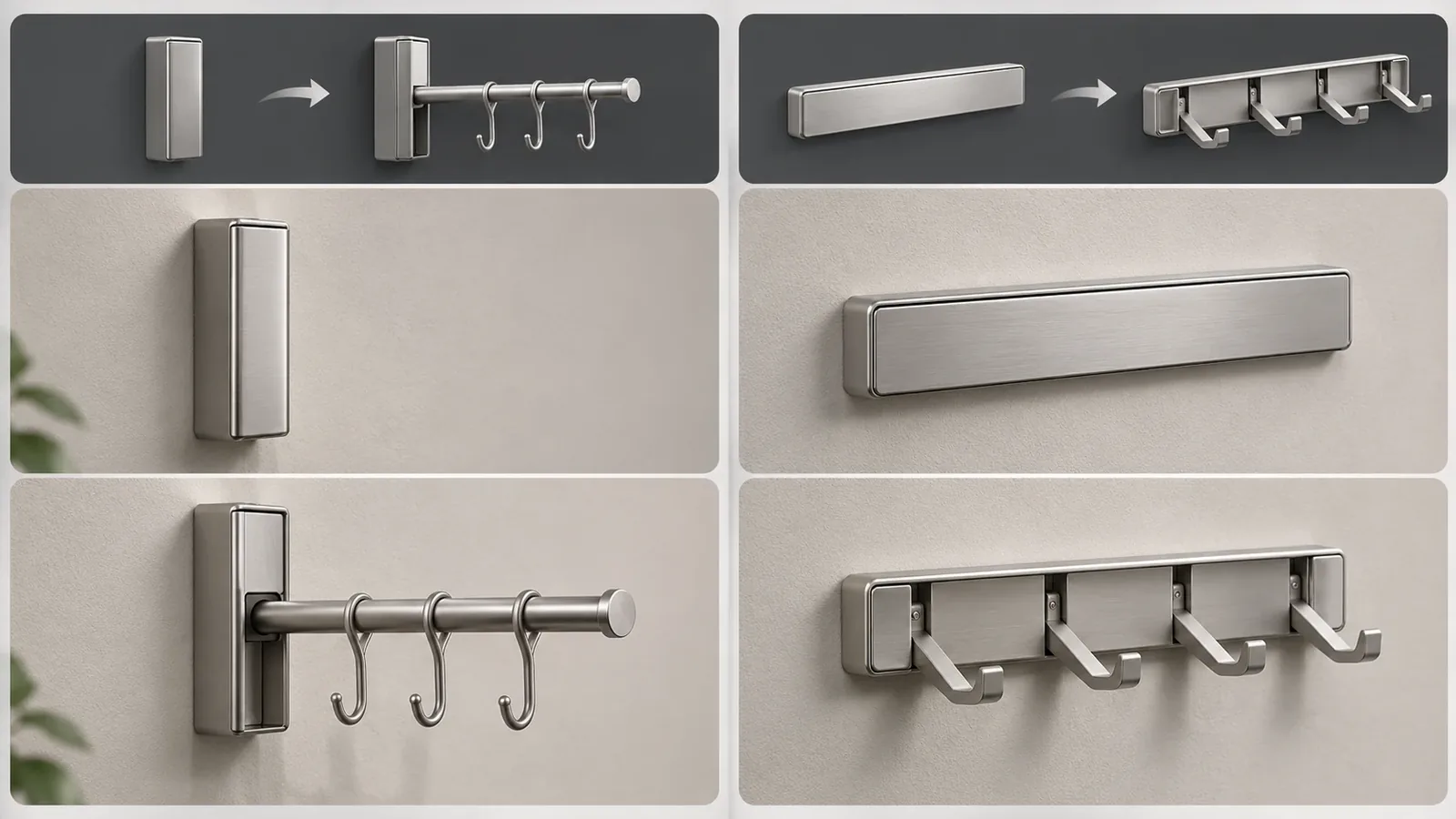
Short answer: A retractable hook is not one defined mechanism. A product may use a rod that is pulled outward for hanging and pushed back when unused, or hooks that fold into grooves in a wall rail. Before ordering, identify the exact movement, parked and deployed states, occupied projection, mounting interface and supplied hardware for the selected model. Ask for the current maker instruction and drawing. The word “retractable” alone does not prove automatic return, a spring, a lock, equivalent wall preparation or a shared load rating.
This guide is a product-architecture and RFQ comparison. It does not prescribe installation holes, fasteners, wall backing, cavity dimensions, load limits, pinch protection, child safety, accessible-route clearances or cycle life. Those questions require current documentation for the exact product and review by the responsible supplier, installer or qualified project designer.
Two current product descriptions illustrate the distinction. Allied Brass’s MD-22 is described as a rod that pulls out for hanging and pushes back when not used; its page identifies its own wall opening and supplied fastening arrangement. Umbra’s Flip 5 describes several hooks that stow into grooves in a wall rail. Those are different documented architectures. The cited MD-22 installation PDFs were not accessible during research, and Umbra’s instruction link required sign-in; therefore, no unseen dimension or installation detail is adopted here. See the Allied Brass MD-22 product description et Umbra Flip 5 product page. These examples do not establish that Koitor manufactures either mechanism or that their components are interchangeable.
What the term retractable does and does not tell a buyer
“Retractable hook” is a search phrase, not a complete product specification. It may refer to a pull-out rod, a pivoting hook, a rail with fold-away hooks or another arrangement. Buyers should translate the word into a movement sequence: what moves, who moves it, where it parks, what remains visible and how the item is returned to its unused state. If the buyer cannot describe the operation, the supplier should identify the exact model and demonstrate it before the phrase is used in an RFQ or listing.
A pull-out rod and a fold-in hook rail can both reduce the visible projection when not in use, yet their structures and installation questions differ. In the cited MD-22 description, the rod is extended and pushed back. In the Flip 5 description, hooks stow into grooves in a wall rail. The term “retractable” does not show whether a member slides, pivots or folds, nor whether it has a self-return mechanism. Do not infer a spring or latch just because a product moves to a parked position.
The buyer should identify which product the user will hang. A long garment, towel, robe or bag may interact with a rod differently from a fixed hook. A wall hook may be intended to hold one item at a time; a multi-hook rail may create multiple hanging points. These are use-case descriptions, not load conclusions. The exact item, arrangement and any performance statement must be supported by the product maker’s information.
Also separate storage geometry from installation scope. A hook that parks close to a wall may still use a particular bracket or fastener package. A fold-in rail may have a visible mounting plate and a different wall interface. A short parked projection does not establish the required substrate, internal cavity or backing. Obtain current instructions for the selected model and route installation decisions to the responsible professional. The example pages establish movement concepts only; they do not provide a universal installation rule.
Compare pull-out and fold-in movement in both states
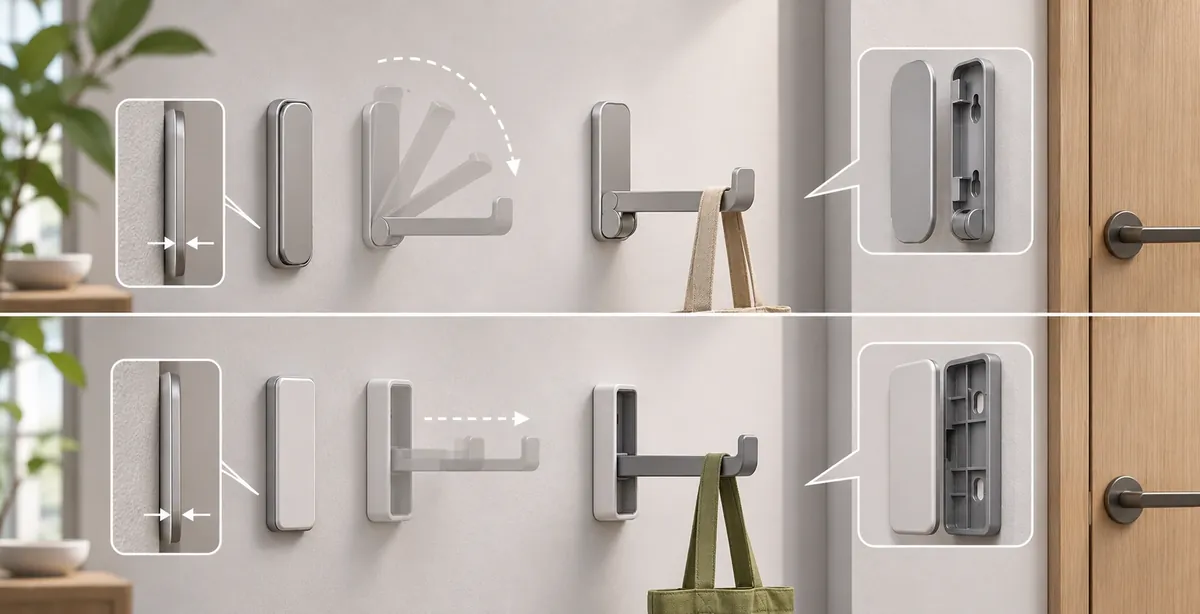
A retractable hook should be reviewed in at least two states: deployed for use and parked when not in use. Some products may have intermediate positions that matter to the buyer. Record those only when the supplier identifies them in current documentation or the sample demonstrably uses them. Do not assume a movement is self-locking, self-returning or safe at an intermediate angle without evidence.
For a pull-out rod, ask what part travels, which direction it moves and what the maker says its endpoint is. The cited Allied Brass description supports a pull-out/push-back movement and points to a maker-specific wall arrangement. It does not authorize copying a drilling value, fastener or wall suitability claim from an unavailable installation PDF. The buyer should request the current document and confirm its revision before release.
For a fold-in rail, ask how many hooks move, whether each hook has its own parked groove, and how the maker describes the rail’s deployed and stowed states. Umbra’s Flip 5 page describes multiple hooks stowing into grooves. It does not demonstrate a return spring or define the requirements for another rail. The page also includes a nonmetal rail component, so buyers must identify the supplier and material responsibility for that part rather than treating it as a metal hook specification.
Review the hanging item’s path as well as the hook’s motion. Does a garment need to be lifted above the hook, slipped over a rod end or placed onto a fixed point? Does the moving member need room to extend away from a door, cabinet or adjacent accessory? Which item remains on the product while it is returned to the parked state? Ask the supplier or product designer to confirm the allowed operating sequence for the exact model; do not invent a sequence based on a photograph.
| Selection field | Pull-out rod example | Fold-in rail example | Buyer evidence to retain |
|---|---|---|---|
| Documented motion | Rod described as pulled out and pushed back | Hooks described as stowing into rail grooves | Current maker description and model |
| Moving element | Rod or extension identified by the supplier | Individual hooks and rail identified by the supplier | Drawing or sample label |
| Parked state | Position and visible projection to confirm | Folded hook position to confirm | Maker datum or measured sample |
| Deployed state | Extension and intended hanging use to confirm | Hook position and intended use to confirm | Exact product instruction |
| Wall interface | Maker-specific opening and fasteners may be listed | Rail-specific mounting details to obtain | Current model/revision document |
| Unresolved assumptions | No automatic return inferred | No spring or lock inferred | Responsible supplier’s answer |
Match the parked and deployed envelope to the location
A product’s parked appearance is only one part of the selection. Buyers should establish how far it projects when stowed, how much space it occupies when deployed, and whether the intended hanging item creates a larger envelope. The datum and measurement method matter. A supplier’s published projection may describe only the metal part, not a garment or bag placed on it. If a value is important to a cabinet, doorway or circulation layout, ask what the maker’s dimension includes.
Map nearby boundaries before approving a model. Consider a wall corner, door swing, cabinet front, towel bar, mirror, furniture edge or other fixed item. The buyer’s actual site or product drawing should determine which relationships need review. Do not turn a general “space saving” phrase into a claim that every model fits every narrow location. A retractable design can still occupy space when extended or when a garment is hanging from it.
Use the same location sketch for each candidate. Show the proposed mounting zone, nearby fixed edges and the intended hanging item. Then record whether the supplier has provided both states, only a parked dimension or no dimension at all. Mark missing information as unresolved. A model with a short visible parked profile cannot be compared meaningfully with another model if one maker measures from the wall plate and another measures from the tip of the hook.
Where a buyer uses a sample, identify its model and revision. Observe the product in the installed or mounting-board condition specified by the maker. If the exact instructions are unavailable, do not improvise holes or anchors to force the sample into a trial. Ask the supplier for the current installation document, and have the responsible installer determine whether the wall or substrate is suitable. This boundary prevents a product comparison from becoming an unsupported installation guide.
Evaluate installation evidence and supplied hardware
The installation record should answer which components and documents belong to the exact SKU. Ask whether a bracket, plate, fastener, template, cover or accessory is included, and which parts are supplied by someone else. Confirm the current instruction revision and whether the model requires a particular substrate or prepared opening. If the manufacturer provides no current document, treat installation compatibility as open rather than substituting an instruction from a similar product.
A quote should also distinguish the hook or rail from its installation service. The product supplier may provide hardware and instructions but may not inspect the buyer’s wall. The installer or project designer may own substrate assessment and fixing decisions. A retailer may control the customer-facing mounting claim. Record these roles so that a supplier’s product description is not mistaken for a site-specific installation approval.
For a project with a metal rail and nonmetal trim or support, identify who supplies and controls each material. Umbra’s named rail includes a nonmetal element; this illustrates that a wall-hook system can cross component boundaries, but it does not authorize claiming that Koitor makes the wood rail or that a generic metal version is equivalent. The purchase file should name the exact parts and suppliers involved.
Do not use one maker’s fastener statement for another hook. Do not copy an unseen PDF’s hole pattern or infer a backing requirement from a product photograph. The retrieved MD-22 PDFs were unavailable, and the Flip 5 instruction link could not be accessed without sign-in. The practical next step for a real order is to obtain the selected maker’s current installation package, verify its revision and have the qualified installer interpret it for the actual wall.
Control sample approval, changes and product claims
The sample approval should record the selected model, supplier, revision, movement architecture and observed positions. Use photographs or a brief clip to show the stowed and deployed states with the sample identity visible. Note whether the demonstration followed the maker’s supplied instruction. If the model’s documentation is missing, label installation questions open. Do not mark the entire product approved based on an appearance review alone.
If the buyer compares several designs, keep the samples separate and use a common question sheet. One model may have an identified replacement tip; another may have multiple hooks folding into a rail. Those differences affect parts scope, service and packaging. They do not automatically establish one product as stronger or more durable. A separate load or cycle requirement would need its own specification, method and evidence from the responsible product team.
At drawing release, connect the model reference to the sample, BOM, wall-interface document and approved product image. If a supplier changes the moving element, rail material, attachment package or model revision, ask which checks must be repeated. If the change affects the wall interface, the installation document should be reviewed again. If it changes the parked projection or hook path, revisit the location comparison. This is a targeted change-control process, not a presumption that every revision changes every property.
Product copy should use the movement the maker actually documents. “Pull-out rod” and “fold-in hook rail” communicate more than a generic “retractable” label. Avoid “automatically returns,” “safe for every wall,” “space-saving in every room,” or a load value unless the exact model’s documentation supports it. If the buyer wants a claim about a particular installation surface, obtain current model-specific and substrate-specific evidence rather than applying a category-wide statement.
For a distributor assortment, assign a separate SKU or clearly named option to each movement architecture. A customer who orders a wall rail with hooks folding into grooves should not receive a pull-out rod merely because both products were listed as “retractable.” Keep the model, mounting package and included parts in the item master, and make the description specific enough that sales and service teams can distinguish the products without relying on a lifestyle image. If a family contains several versions, state which version is shown and which accessories belong to each.
Replacement planning should preserve the moving component as well as the visible hook. A replacement rod tip, folding hook or wall rail may be a separate part with its own manufacturer reference. The existence of a replaceable tip on one named product does not mean every tip can be replaced or that an unrelated part fits it. Ask the original maker which components are serviceable, how they are identified and whether a changed component affects the current instruction. Do not publish a universal repair or replacement method based on a product description.
The sample record should capture the product’s condition before and after operation. Record whether the sample was new, previously assembled or altered, and whether every supplied part was present. Note if the hook binds, rubs or fails to reach the maker-described state, but do not diagnose the cause without the responsible technical review. A movement observation can help explain a discrepancy; it does not establish wear life, rated load or safety performance. Keep a separate field for tests that were not performed.
When several locations are planned, a buyer can use one location row per installation condition. List the wall reference, adjacent cabinet or door, selected model, parked projection evidence, deployed path evidence and installation-document status. If some locations are not yet designed, mark the installation review open. This avoids turning one sample wall into approval for every wall type or opening in a project. Where a public building or accessible route has specific design criteria, the qualified project professional must define and approve those criteria; this article does not provide accessibility measurements.
An option comparison should also preserve what the supplier has not confirmed. If the page shows a product but no current mounting instruction is available, the buyer can select it provisionally for appearance while keeping installation feasibility unresolved. If a maker supplies dimensions but not a drawing datum, ask what those values measure. Do not convert a missing answer into a buyer-authored drilling template. The next action is to request the current installation package and route it to the party responsible for the wall.
Finally, keep the commercial record aligned with the physical shipment. The quote, order confirmation, carton label and sample should identify the same model and component package. If the supplier substitutes a rail material, fastener set or movement mechanism, compare the change against the approved file before using the old artwork or instructions. A changed finish alone may have a different review scope from a changed mechanism, but both changes need to be recorded if they alter what the customer receives. Clear traceability supports later reorders without implying a quality result that was never assessed.
Include the instruction and identification plan in the launch file. The retailer or installer should be able to identify the exact product before consulting a mounting document, particularly where a family contains both pull-out and fold-in options. A model name on the carton, a part reference on the BOM and the revision on the maker instruction should agree. If the supplier packages loose fasteners or accessories, list them clearly so that the buyer can distinguish an included part from an item that must be obtained separately.
If a market requires translated instructions or customer-facing installation content, assign the translation and technical review to an identified owner. A translation should not add a wall type, fastener choice or safety claim that the source maker did not approve. The buyer can use the movement comparison in this guide to select a product, but only the responsible manufacturer’s current documentation should define model-specific installation. This keeps a useful buying decision from turning into improvised installation advice.
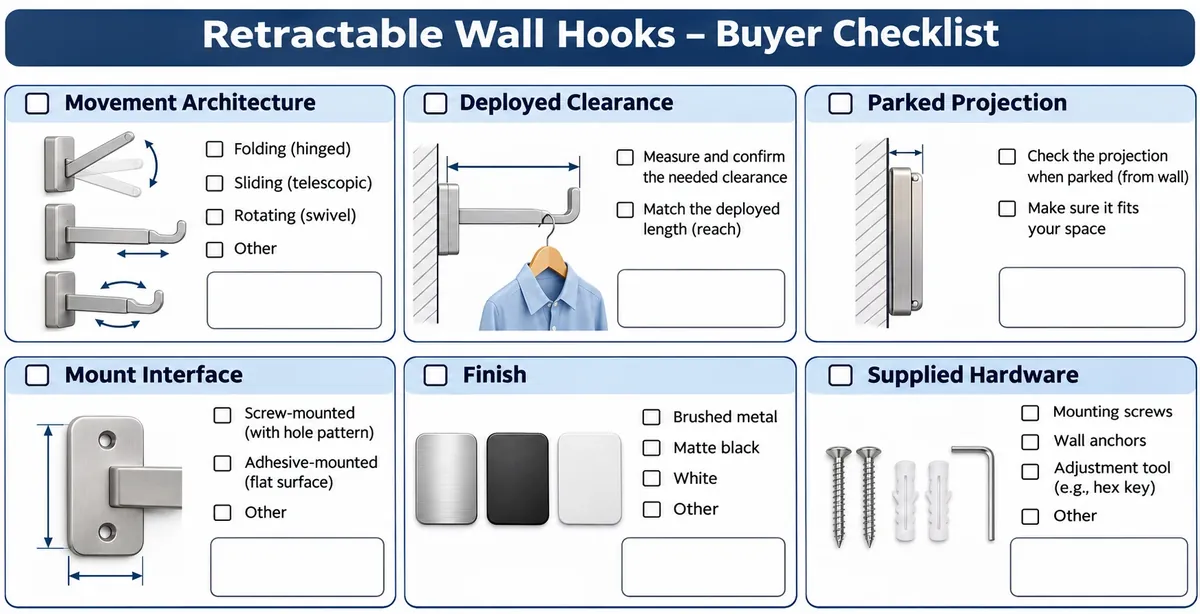
Buyer checklist before order release
- Identify the exact supplier, model and current revision.
- State whether the selected architecture pulls out, folds in or uses another movement.
- Name the moving member and its documented parked and deployed states.
- Confirm whether any automatic return, latch or intermediate state is actually documented.
- Record the parked and deployed envelopes with the maker’s datum.
- Compare the design with the actual wall, door, cabinet and hanging-item boundaries.
- Obtain the current installation instructions and supplied fastener list.
- Assign substrate review and installation responsibility to the qualified party.
- List metal, nonmetal and bought-in components separately.
- Link the approved sample, drawing, BOM and customer-facing product claims.
Does retractable mean the hook returns automatically?
No. It describes a movement or stowed condition but does not, by itself, identify a spring or automatic return. Check the exact maker’s description and instructions.
Is a fold-in hook rail the same as a pull-out rod?
No. They are different documented architectures. Select the motion and hanging task intended for the product, then review the matching installation evidence.
Does a small parked projection prove the installation is simple?
No. Parked appearance does not establish the wall interface, substrate requirements, fastener scope or installation service. Obtain current documentation for the exact model.
Can the MD-22 or Flip 5 instruction be used for a similar-looking model?
Do not assume so. Use the exact manufacturer, model and revision. Similar appearance does not establish a common mounting interface or operating method.
Does Koitor manufacture the complete retractable mechanism?
This article makes no such claim. It discusses sourcing decisions and does not establish Koitor’s manufacture of the cited products, spring mechanisms, wood rail or complete retractable-hook SKU.
For broader project context, see Koitor’s OEM home-storage hardware scope. Buyers can share a selected drawing and defined metal scope for an initial project discussion.
Review a Defined Home-Storage Hardware Scope
Share the selected model, movement, installation documents, defined metal parts, finish and packaging needs. Koitor can first confirm whether that metal scope fits its current capabilities before quotation.
Fabrication pour compte de tiers / Marque de distributeur
Transformez ce guide d'approvisionnement en cahier des charges
Indiquez-nous le produit souhaité, ses dimensions, sa finition, la quantité commandée et vos exigences en matière d'emballage. Votre équipe recevra une analyse pratique de la faisabilité de la fabrication avant l'établissement du devis.


 English
 Español
 Português
 Français
 Deutsch
 العربية