

Chest freezer wire basket ledge fit depends on the actual support points and clearances inside the intended freezer, not on the basket’s nominal outside width alone. OEM buyers should define where both side hangers rest, how the basket sits in the front-to-back direction, how far it may move, and whether it lifts out without catching the rim or lid. Approve a representative basket in the intended cabinet or a dimensionally controlled interface mock-up before releasing production.
Why can a basket that looks close still fail to fit?
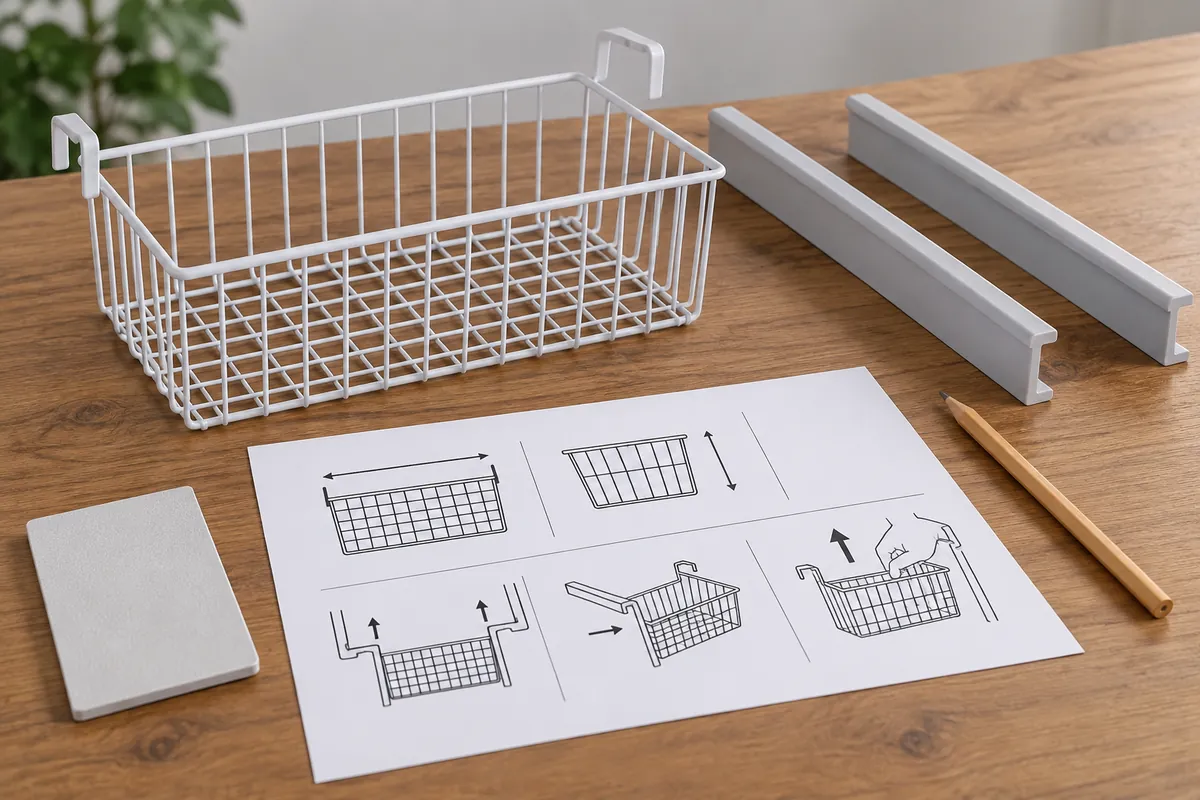
A wire basket is an interface part. Its upper side rails, bent hanger ends, or separate hooks carry the basket onto support ledges, rails, or a sliding frame. A replacement can have a plausible overall width and still rock, bind, sit at an angle, collide with an interior wall, or be difficult to remove if the support geometry differs. Two products described as chest-freezer baskets may use different arrangements, so the appliance model and intended mounting system matter.
The first buyer question is not simply ‘What is the freezer width?’ It is ‘Which surfaces support the basket, and how is the basket intended to move?’ A static basket resting on two side ledges is not interchangeable by assumption with a basket that clips to a sliding rail or hangs from a separate frame. The drawing should identify the support contact and travel condition so the supplier does not infer the wrong construction from a product photograph.
Public appliance materials show that basket arrangements and removal methods vary by model. Whirlpool’s support material describes chest-freezer baskets and separate sliding-basket arrangements, while GE product specifications distinguish lift-out/sliding basket configurations and rail features. Those sources are examples of variation, not universal dimensions or a substitute for the target model’s drawing and physical inspection. Buyers should confirm the exact unit or interface reference for the program.
A useful development setup includes the intended freezer, a representative cabinet liner or ledge mock-up, and a controlled basket sample. If no appliance is available, the buyer can provide measured ledge locations and profiles, photos with scale references, and a written description of the basket’s lift-out or sliding motion. A generic cabinet opening dimension is not enough if the basket hooks engage local ledges that are offset, radiused, or interrupted.
For the sourcing file, label the review as chest freezer wire basket ledge fit and tie that label to the specific appliance interface, not to a broad promise that the basket fits every freezer.

Which interface dimensions belong in the drawing or RFQ?
Dimension the features that locate and support the basket before adding cosmetic detail. At minimum, define the left-to-right spacing between support surfaces, the front-to-back position of each support, the ledge or rail width available for engagement, and the vertical relationship between support and basket rim. Identify which surfaces establish the measurement origin. If the left and right sides are not symmetric, specify each side rather than implying a mirror condition.
The basket envelope matters too, but it should be connected to the interface. Record outside width at the relevant height, basket depth, rim or handle projection, and maximum vertical envelope. Include the front/rear orientation and the location of stops, clips, or end details that prevent unwanted travel. If the basket must pass through a narrowed opening to be removed, show that movement envelope rather than only its installed position.
A drawing package should distinguish nominal dimensions from critical-to-fit dimensions. Mark the support spacing and contact geometry as functional. Define the inspection method or indicate the mating fixture where appropriate. Avoid assigning tight tolerances to every wire location; control the features that determine seating, stability, retrieval, and clearance. Tolerances should be agreed from the design’s function, supplier process capability, and buyer quality plan—not copied from an unrelated appliance.
Provide the appliance make/model and model revision when legally and commercially appropriate, but keep the drawing itself as the production reference. Product model numbers can be revised, regional variants can differ, and replacement parts may serve only a defined set of units. A version-controlled interface drawing and signed sample record give the buyer and factory a common basis when the appliance reference alone is ambiguous.
How should buyers check clearance and movement?
Check fit in a sequence that separates seating from movement. First place the empty basket on both supports and confirm that the intended contact points engage at the same time. Observe rocking, skew, unintended tilt, and any gap that changes the resting position. Then apply the agreed representative load only if a project requirement defines it; do not infer a load rating from a visual fit check.
Next, move the basket through its intended range. For a lift-out type, raise and remove it along the expected path. For a sliding design, move it across the intended rails or frame and confirm that the stops and clearances work as designed. Check the lid sweep, nearby wall or liner surfaces, and access around the rim. A basket that seats but cannot be removed without scraping may still be unacceptable for the buyer’s use case.
Use the actual finish on the approval sample when finish thickness or edge coverage could affect engagement. Inspect the hanger bends, welds, protective caps, and cut wire ends for interference or damage to the support surface. If a coating or plating operation changes the contact envelope, assess the finished component rather than relying only on a bare-metal prototype. This is a project-specific fit check, not proof of corrosion, temperature, or long-term durability performance.
Record the conditions: appliance or mock-up ID, sample revision, finished state, basket orientation, movement path, inspection tools, and observed result. Photographs can show where contact occurs, but they do not replace key dimensions. If a sample needs hand pressure to seat, document that condition and agree a correction or acceptance decision before authorizing a batch.
| Buyer requirement | What to define or inspect | Pourquoi est-ce important ? |
|---|---|---|
| Support interface | Both ledge/rail locations, spacing, profile and contact zone | Confirms the basket is carried by the intended features |
| Installed envelope | Width, depth, rim projections and front/rear orientation | Prevents wall, lid or neighboring-part interference |
| Movement | Lift-out, slide path, stops and removal direction | Checks access and retention as well as static seating |
| Finished sample | Coating/plating state, welds, edge protection and fit | Surfaces and assembly can change the contact condition |
| Approval record | Appliance/mock-up reference, revision, method and result | Keeps repeat orders tied to the agreed interface |
What product and process details can change the fit?
Wire diameter, bend radius, forming sequence, weld position, and assembly fixture can all influence the final shape of a metal basket. A change in a support hook angle may matter more to seating than a small variation in a nonfunctional interior cross-wire. Buyers should identify critical-to-fit areas on the drawing and ask the manufacturer how those areas will be formed and checked. That discussion is more useful than a general request for ‘tight dimensions’ with no functional hierarchy.
Welded wire assemblies can shift during joining or finishing. A basket that is square before welding may move after the full fabrication route. The approval sample should therefore represent the production-intent sequence as closely as practical. If a pilot sample uses temporary fixtures, different joining, or unfinished wire, record that limitation and plan the appropriate confirmation before mass production.
Material and finish selection should be stated independently of fit. Name the required material form and finish system only when the project specification supports it. Do not assume that stainless steel, plated steel, or coated steel is universally suitable for every freezer environment. If a finish change is proposed, confirm its appearance, contact fit, edge coverage, and care requirements against buyer-defined expectations.
Packaging is another interface after production: hanger ends can bend or baskets can be distorted if parts shift in transit. Define orientation, separators, protection at projecting hooks, and how samples are checked after packing. For repeat orders, compare the received item against the approved reference and report discrepancies with batch identification. Packaging validation should follow the actual distribution route and buyer requirements rather than an unsupported claim that a package has passed a particular test.
How can an OEM sample plan reduce redesign risk?
Start with an RFQ pack that includes the target product context, interface sketch or drawing, relevant appliance reference, finish expectation, order volume range, and packaging destination. If the buyer has only a physical sample, label its orientation, identify critical contact points, and clarify which dimensions may be changed. A sample without a written reference can be copied incorrectly because the supplier may not know which details are functional and which are incidental.
For the first sample, review the unloaded seating and removal path before discussing appearance-only improvements. Confirm the drawing revision and note deviations. If a change to hanger geometry is needed, update the controlled drawing and re-approve the revised interface; do not rely solely on a verbal instruction or an unlabelled photo. Small-batch trial orders can help buyers evaluate a program, subject to the product’s requirements and agreed quantity.
A practical approval sequence is: drawing review, initial formed sample, finished sample, fit trial, and written release. Not every project needs a separate stage for every checkpoint, but buyers should decide which evidence is required before production. The factory and buyer can agree how to handle samples that are dimensionally acceptable but awkward to install, or samples that fit one freezer but not a family of target models.
If the basket is intended for multiple appliance models, treat compatibility as a defined matrix. List each approved model or interface family, identify measured variation, and test a representative boundary condition where the design calls for it. Do not advertise universal fit unless the buyer has validated that claim across the specified population. A clear scope protects the product listing, customer expectations, and the supplier’s production reference. The approved chest freezer wire basket ledge fit record should state every validated interface and every exclusion.
What should buyers put on the fit-approval checklist?
The checklist should make the fit decision repeatable for engineering, sourcing, quality, and the supplier. Keep each item observable and connect it to a drawing feature or intended use. The following prompts are a starting framework; the buyer should tailor them to the basket type and actual appliance interface.
- Identify the exact appliance, cabinet, rail frame, or controlled mock-up used for approval.
- Show both side supports and the intended contact points in the drawing or annotated photo.
- Record functional support spacing, hanger geometry, front/rear orientation, and basket envelope.
- Confirm both sides seat together without unintended rocking, skew, or interference.
- Demonstrate the required lift-out or slide path, stops, lid clearance, and retrieval access.
- Inspect a production-intent finished sample, including welds, edges, and protective features.
- Note sample revision, finish state, inspection method, deviations, and written approval owner.
- For multi-model claims, list the validated models/interfaces and exclude untested variants.
Foire aux questions
Buyers often use ‘fits’ as a single pass/fail word, but a useful approval also defines support, position, movement, and the exact appliance or interface being approved. These answers are a framework for an RFQ and sample review; they are not a substitute for a product-specific drawing.
Is overall basket width enough to confirm compatibility?
No. Overall width does not establish ledge spacing, support profile, front-to-back position, hanger shape, or removal clearance. Compare functional contact features with the intended appliance or an approved interface fixture.
Should an OEM supplier design for every chest freezer?
Not without a defined compatibility scope. Buyers should identify models or interface families and validate the stated population. Universal-fit language should not be assumed from one sample.
What if the buyer cannot send the freezer?
Provide a controlled drawing, measured support locations and profiles, orientation, travel path, clear photographs with scale references, and any relevant model information. Agree a mock-up method and verify the production-intent sample before release.
Can a prototype confirm finished-part fit?
Only to the extent that it represents the production geometry and finish. A bare or hand-formed sample may not represent the final contact envelope, weld position, or coating condition; record those limitations and require confirmation where necessary.
Does this checklist establish a load rating?
No. Load capacity requires a separately defined requirement and suitable test method. A seating and movement review confirms interface behavior under its stated conditions only.
References
- Whirlpool Product Help: Installing the Shelves and Baskets — model-specific examples of freezer basket installation and removal.
- Whirlpool Product Help: Installing Sliding Baskets — illustrates a distinct rail-based basket configuration.
- GE Appliances FCM25DTWH specifications — an example of lift-out/sliding baskets and second-level rails.
Review a Wire Basket Interface Before Quotation
Share the target appliance reference, interface drawing or physical sample, required finish, order scope, and packaging needs. Koitor Hardware is a family-owned custom metal hardware factory focused on bathroom and home storage products; any adjacent-category project must be reviewed for fit with the actual manufacturing brief.
Fabrication pour compte de tiers / Marque de distributeur
Transformez ce guide d'approvisionnement en cahier des charges
Indiquez-nous le produit souhaité, ses dimensions, sa finition, la quantité commandée et vos exigences en matière d'emballage. Votre équipe recevra une analyse pratique de la faisabilité de la fabrication avant l'établissement du devis.

 English
 Español
 Português
 Français
 Deutsch
 العربية