

For closet shelf rod continuous hanger travel, review the entire rod run with every support, joint, end condition, and adjoining shelf in the intended configuration. A system may be designed to let hangers move along a continuous path, but a support location or connection can interrupt that movement. Buyers should confirm the supplier’s design intent and demonstrate the selected layout with representative hangers and the exact shelf-and-rod components before approving an assortment.
What does continuous hanger travel mean for a buyer?
In a wardrobe shelf and rod system, a continuous rod run is intended to provide a usable path along which hangers can be moved. The phrase does not by itself define how long the run is, whether there are joints, where supports sit, or how much clearance exists around a hanger. It also does not mean every system uses an identical support arrangement. The system supplier’s drawing and installation guidance should define the product-specific configuration.
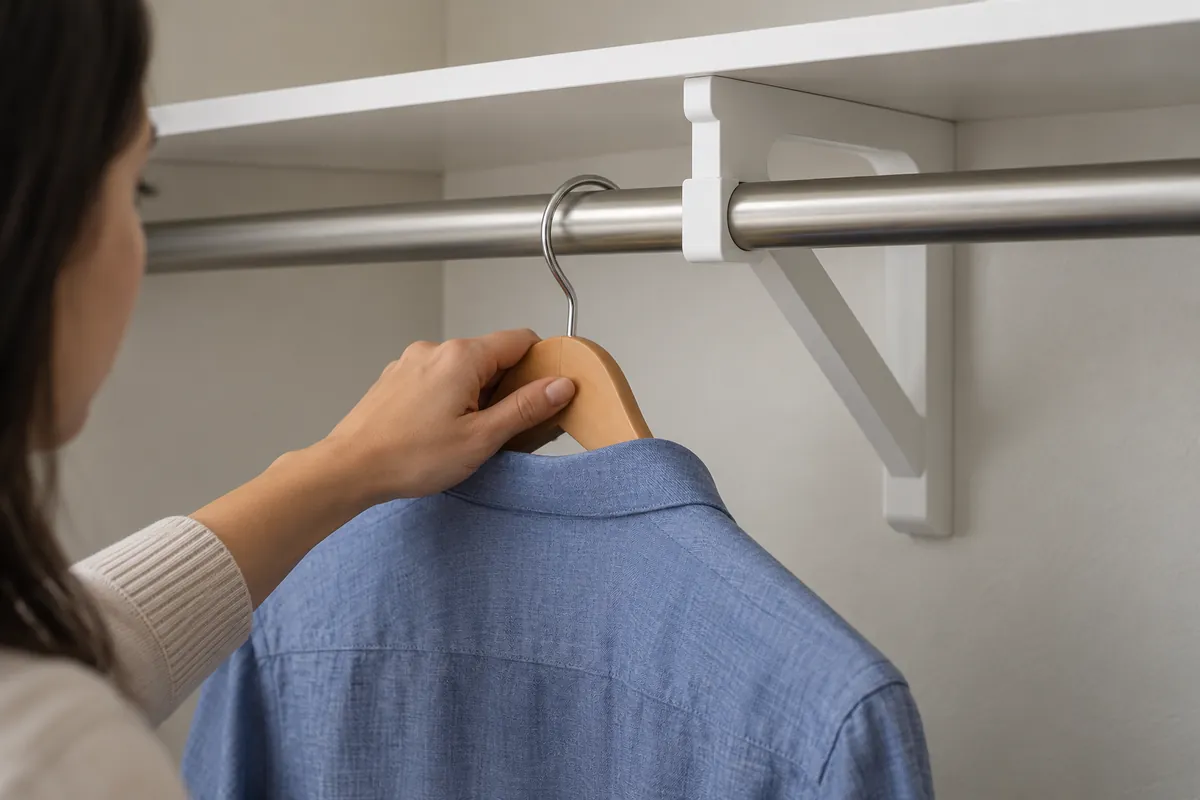
The purchasing question is whether a buyer’s chosen layout preserves the requested movement across the relevant span. A support bracket may sit below, above, or around the rod depending on the design. A connector may join pieces, and an end fitting may stop hangers from leaving the run. Their positions can change access even if the rod remains structurally supported. The buyer should therefore discuss both support and movement instead of specifying only “continuous rod.”
Manufacturer planning material identifies systems that support continuous hanger movement. That signals a feature to consider, not a universal promise for every closet system. For closet shelf rod continuous hanger travel, the buyer needs to identify what is intended to move, over which section, and what stationary components define its limits. The answer should be visible in the approved layout.
Which layout details should the RFQ show?
Provide a front elevation of the closet section and a plan or side view that identifies the shelf, rod, supports, joints, and nearby walls or cabinet dividers. Mark the left and right ends as viewed by the intended user. State whether the buyer expects hangers to pass a support, whether a support is meant to divide the run, or whether the hanger movement is limited to a segment. If the requirement is unclear, ask the product team to specify the use case before requesting a quote.
Identify the rod model and profile, shelf model, support part numbers, and any connectors or end stops. Ask the supplier to define its measurement points and installation requirements. Do not assume that a nominal rod length equals usable travel; end conditions and support details may reduce the clear section available to hangers. Record supplier-defined dimensions directly on the drawing.
| RFQ item | What to identify | Pourquoi est-ce important ? |
|---|---|---|
| Intended travel | The section hangers should traverse and any intentional limits | Separates the requested user function from a vague feature label |
| Rod identity | Profile, model, joint or connector, and revision | Ensures the quote and sample use the same rod components |
| Support layout | Bracket type, position, and relationship to the rod | Reveals possible interruption or obstruction in the path |
| Shelf interface | Shelf position, support, and clearances around the rod | Shows whether adjacent parts conflict with hangers or garments |
| End conditions | End stops, end caps, walls, or cabinet dividers | Defines where hangers can start, stop, or be removed |
| Confirmation method | Supplier drawing, installation instructions, and sample layout | Creates evidence for approval and later change review |
Ask the supplier whether supports can be repositioned within the system and what conditions that depends on. Do not move or omit a support to create more travel unless the system supplier approves the alternative. The article does not establish load capacity or structural safety requirements; those must come from the responsible system supplier and the project specification.
How should competing system proposals be compared?
Compare complete layouts, not isolated rod lengths. One proposal may use a single rod span with supports placed outside the requested movement zone; another may include a joint or support within it. The supplier may consider an interruption acceptable or necessary under its design. The buyer should state the required user function and ask the supplier to confirm the intended hanger path instead of assuming either arrangement is equivalent.
| Proposal detail | Buyer question | Evidence to retain |
|---|---|---|
| One uninterrupted rod segment | Does the system drawing show the requested clear movement area? | Identified rod profile, end conditions, and support layout |
| Joined rod sections | Where is the joint, and is it intended to be traversed by hangers? | Connector identity and supplier confirmation for the selected model |
| Intermediate support | Does the support obstruct or intentionally divide travel? | Drawing showing the support position and defined movement zones |
| End stop or cap | Can hangers pass it, or is it meant to retain them at the end? | Part identity, installation instruction, and sample observation |
These categories are comparison prompts, not a recommendation to remove supports or use a particular joint. The supplier’s approved product system governs which layouts are available. If two offers use different components, compare the exact part identities and installation instructions before judging the user experience or cost.
In a multi-SKU program, identify which layouts share components and which have different support or end arrangements. A distributor may need one uninterrupted span for one closet and separated zones for another. Catalog pages should make those distinctions clear. If the buyer cannot understand the travel area from the supplier’s drawing, ask for an annotated elevation or demonstration sample before placing a production order.
How can the hanger path be reviewed on a sample?
Build the sample using the rod, shelf, supports, connectors, end parts, and installation sequence specified for the quoted model. Confirm labels and revisions before assembly. If the mock-up uses a temporary support or a different wall spacing, record the difference so the sample is not mistaken for the final layout.
Use representative hangers intended for the product context. Move them along the defined span in the same direction a user would. Observe where movement stops or is constrained: support, joint, end stop, wall, shelf, or adjacent cabinet structure. Do not force a hanger past an obstruction or modify the system during the check. If the path does not match the requirement, document the actual condition and ask the supplier whether the drawing, assembly, or product selection should change.

The sample should represent the specific model and support spacing that will be ordered. A short demonstration section may show how a connector works but may not prove the full installation layout. Where the complete run is too large to assemble, agree on which interfaces the demonstration covers and what supplier documentation applies to the remaining span. Do not claim full-length performance based on a partial mock-up without qualification.
Record the layout, hanger type used for the demonstration, movement boundaries, observed interruptions, and any accepted limits. The record should say what was not tested. This keeps the approval useful for procurement while avoiding an unsupported statement about every hanger, garment, installation, or future product revision.
What should the approval and change record contain?
Tie the accepted travel requirement to the system drawing, rod and shelf identities, support positions, joint, end conditions, and sample reference. Identify who confirms the buyer’s intended movement and who confirms the system supplier’s installation requirements. If a support intentionally divides the span, show the boundary rather than calling the rod continuous without explanation.
Define changes that require review: a different rod section, connector, support location, shelf height, end stop, wall layout, or product revision. A new component may be visually similar while changing the useful path. Ask the supplier to compare the revised drawing with the approval record and state whether the original sample remains representative. Keep the decision with the item master, purchase order, and product instructions.
For private-label products, align the product description, photography, instruction sheet, and quotation. Avoid claiming “continuous travel” if the depicted layout includes an interruption that a user cannot pass. If the feature applies only to a particular model or configuration, identify that scope in the SKU and product documentation. This prevents marketing language from outliving a design change.
When the supplier proposes an alternate configuration to improve price or availability, ask which user requirements remain met and which conditions change. A substitution should not be approved solely because the rod length or finish appears similar. The product team should decide whether the new movement path is acceptable, while the supplier confirms the correct assembly for its system.
What sourcing errors should be avoided?
Do not specify only an overall rod length. Do not assume every support can be passed by a hanger. Do not assume a joint is invisible or traversable because it appears small in a photo. Do not omit an end component without checking whether it defines the movement boundary. Each assumption can cause a product listing and the physical closet layout to describe different functions.
Avoid transferring one supplier’s layout or claims to a different system. A similar profile does not prove compatible supports, joints, or installation instructions. Do not move an intermediate bracket simply to create more travel unless the supplier confirms the resulting arrangement. If the product team requires a clear span, state that requirement explicitly and have the system supplier mark the drawing.
Do not confuse a physical demonstration with a quantified performance test. Hanger movement observed in one sample does not establish strength, load capacity, or durability. Those claims require their own defined criteria and supplier evidence. Preserve the scope of the fit review in the approval record so it is not later interpreted as a broader validation.
How does this fit a broader storage assortment?
Closet shelf-and-rod systems may be purchased alongside metal storage baskets or other organization products. This article covers buyer specification of a purchased system feature. It does not claim that Koitor manufactures the rod system described here. A custom metal hardware manufacturer can clarify the drawing and boundary for its own metal component, while the specialist system supplier remains responsible for the purchased rod and support configuration.
Buyers can review Koitor’s OEM home-storage hardware et fabrication sur mesure de rayonnages métalliques de stockage pages for related metal-product sourcing context. When a project combines a purchased closet system with a separately sourced basket or rack, identify how the components meet and which supplier approves each part. Clear boundaries prevent a buyer from treating one sample review as authorization for another supplier’s system.
For a supplier comparison, share the intended closet layout, defined movement zone, relevant component drawings, and unresolved questions. Ask the rod-system supplier to confirm its own requirements, and ask the metal product supplier to review only the part within its scope. That creates a more useful quote and a cleaner approval record than a general request for “compatible accessories.”
Foire aux questions
Does continuous hanger travel mean hangers cross every support?
Not necessarily. The term needs a product-specific definition. Confirm the support locations, joints, and intended movement zone on the supplier’s drawing and sample.
Is closet shelf rod continuous hanger travel determined by rod length?
No. Supports, connectors, end parts, walls, and shelf layout can affect the usable path. Specify the movement requirement and verify the complete system.
Should an intermediate support be moved to improve travel?
Only with the responsible supplier’s approval. A support may be required by the system design. Ask for an approved alternate layout rather than modifying it informally.
What evidence should the importer request?
Request a component drawing, installation instructions, part identities, support layout, and sample demonstration on a representative configuration.
Can a short sample demonstrate a full closet run?
It can show selected interfaces, but the approval should state what the sample covered and what relies on supplier documentation. Do not represent a partial setup as a full-length test.
Do hanger travel checks establish load performance?
No. A movement review documents observed access conditions only. Load and durability claims require separate methods and evidence.
What if the supplier uses a joint between rod sections?
Identify the connector and its position, then ask whether the supplier intends hangers to cross it. Review the configuration on the selected system rather than assuming equivalence.
How should a distributor describe a limited travel zone?
Show the boundaries on the drawing or instructions and use product language that matches that scope. Avoid implying uninterrupted movement beyond the approved area.
When is a new sample review necessary?
Reassess after changes to the rod, support positions, connector, end parts, shelf layout, or system revision that may affect the intended movement.
Who owns approval of the rod system?
The specialist rod-system supplier confirms its product and installation requirements. The buyer approves the requested user function and assembled configuration.
Clarify a closet-system interface
Share the closet elevation, rod and support models, and desired movement span so the product configuration can be reviewed against the buyer requirement.
Clarify the storage-system interface
Send the rod layout and related metal-product drawing or sample, with the supplier responsibility for each component identified.
Fabrication pour compte de tiers / Marque de distributeur
Transformez ce guide d'approvisionnement en cahier des charges
Indiquez-nous le produit souhaité, ses dimensions, sa finition, la quantité commandée et vos exigences en matière d'emballage. Votre équipe recevra une analyse pratique de la faisabilité de la fabrication avant l'établissement du devis.


 English
 Español
 Português
 Français
 Deutsch
 العربية