

A metal bread box for a private-label program should be approved against one defined lid architecture, outside and usable inside dimensions, opening travel, countertop placement, finish/component set, and export carton. A product photograph alone cannot show whether the lid clears an overhead cabinet or how much of the nominal footprint is usable inside. The importer should freeze the exact SKU and review the production-intent sample and pack-out before order release; no universal capacity or bread-preservation claim follows from the product category.
What sourcing problem does this checklist solve?
“Bread box” covers multiple forms: a roll-top door that retracts into the body, a hinged cover that swings up or back, a lift-off lid, or a mixed-material configuration. These differences affect how a customer accesses the interior, where the unit can sit on a counter, what parts need protection, and what the supplier must quote. They do not establish which architecture is best for every retailer.
A buyer comparing quotations needs to know whether the quoted models solve the same use case. One supplier may quote a compact unit with a roll-top front; another may quote a taller hinged model with a wood or bamboo lid. Exterior width does not tell the buyer the usable internal length, and a closed product photo does not reveal the space required to open the lid.
The practical answer is to select the intended configuration first, then compare dimensions and component lists on that same basis. The sample review should verify operation, counter fit, finish expectations, and actual pack-out. This article is a B2B specification and approval aid. It is not consumer buying advice, a storage-performance study, or evidence that a particular design preserves bread longer.
Which lid architecture and SKU should the buyer quote?
Start the RFQ by naming the mechanism the buyer wants evaluated, or ask the supplier to list the available alternatives separately. For each proposal, record whether the lid rolls, hinges, lifts off, slides, or combines more than one movement. Then identify the handle, stops, rails, hinges, dampers, feet, pads, inserts, or mixed-material pieces included with that exact model.
This matters because two similarly shaped countertop products can have different part sets and clearances. A hinged lid may need swing space above or behind the body. A roll-top may travel through side channels and need unobstructed movement along its path. A lift-off lid needs a place to set it down and room to lift it clear. These are geometry checks for the quoted sample, not statements about durability or superiority.
Manufacturer specifications provide examples of variation. The WESCO Breadboy listing describes one powder-coated steel-sheet body with a swivelling lid, rear ventilation and stated overall dimensions. Metaltex’s Bready page describes a different mixed-material product with a polypropylene container and a reversible wood lid. These named configurations help buyers identify the fields to request; they do not define a universal metal bread bin or an approved Koitor product.
How should dimensions and counter clearance be recorded?
Ask the supplier to separate exterior dimensions from usable interior space. Record height, width, and depth with the unit closed, plus the internal length, width, and height that remain after accounting for the lid channels, hinge hardware, folded edges, handle, or other parts. If internal dimensions are unavailable, ask the supplier to measure the chosen sample and label the measurement points.
Next, map lid travel to the intended retail placement. Record the counter footprint, the gap to any overhead cabinet or shelf, and the movement envelope needed to open and close the mechanism. For a roll-top, note the direction and full path of travel. For a hinged top, note the highest point and rearward swing. For a removable lid, confirm how it is lifted and where a user could set it. Use the buyer’s own counter or cabinet envelope when available rather than relying on a generic “fits most kitchens” statement.
| RFQ field | What to record for the quoted SKU | Why the buyer needs it |
|---|---|---|
| Exterior closed size | Height × width × depth and measurement datums | Counter footprint, shelf planning and product listing |
| Usable interior | Internal length × width × height, with obstructions noted | Product-fit comparison for the buyer’s intended assortment |
| Lid movement | Architecture, travel path, highest/outermost open point | Clearance above, behind, or in front of the unit |
| Included components | Handle, hinges/rails, feet, pads, inserts and mixed materials | Quote comparability, assembly, labeling and replacement scope |
| Finish and color | Buyer-approved description, revision and cosmetic faces | Sample match and production identification |
| Packed configuration | Unit carton, outer carton, quantity and protection arrangement | Warehouse, shipping and packaging review |
The phrase “capacity” can refer to an internal measurement, a number of packages, or a manufacturer’s suggested use. Ask what the claim means and which model it applies to. If the buyer wants to state a loaf or package fit, define the representative items and verify them against measured internal space in the agreed orientation. Do not treat a product-family photo or an exterior size as proof of fit.

What material, finish, and component details belong in the sample record?
For a metal bread box, list the body material and finish only when the supplier has identified them for the offered model. A broad label such as “metal” does not identify a grade, coating system, thickness, or suitability for a particular claim. If the private-label program requires documents for materials or coatings used near food, request applicable evidence for the exact SKU and intended market from the responsible supplier. This article does not establish food-contact compliance.
Review the cosmetic areas the buyer will see: outer panels, edges, lid, handle, seams, underside, and any visible fixing points. Agree on the color reference and how sample approval is recorded. Check whether a wooden, bamboo, plastic, glass, rubber, or adhesive part is included and who supplies it. A mixed-material lid or foot pad can affect the SKU, packaging, care instructions, and supplier responsibility.
Observe the opening and closing motion on the sample. Note whether the cover follows the intended path, whether it rubs against the body, and whether any edge or fastener catches during the agreed check. Define acceptance in buyer and supplier language. A hand-operated review of one sample does not prove long-term cycle life, coating adhesion, food safety, or performance in an untested environment.
Do not prescribe ventilation holes or openings as a universal feature. Product makers describe airflow differently, and a statement on a named model’s product page is not evidence that another design preserves bread, prevents mold, or extends shelf life. If a buyer’s product brief includes an opening or vent pattern, specify its location and appearance, then verify it on the sample. Keep any consumer-use claim tied to a substantiated model-specific basis.
How do packaging and artwork affect quote comparability?
Record the inner or retail box separately from the outer master carton. Ask how the unit is oriented, what separates the lid from the body, how any glass or mixed-material parts are protected, which accessories are bagged separately, and how many retail units are placed in each master carton. Confirm whether declared carton dimensions refer to the inner box or the shipping carton.
A supplier may propose a different pack count or a partly disassembled unit to reduce carton volume. That can change the customer’s assembly steps, the protection points, the label location, or the contents that need to be reconciled at receiving. Review a representative packed sample or documented pack-out and link it to the same model code and drawing revision used for the quotation.
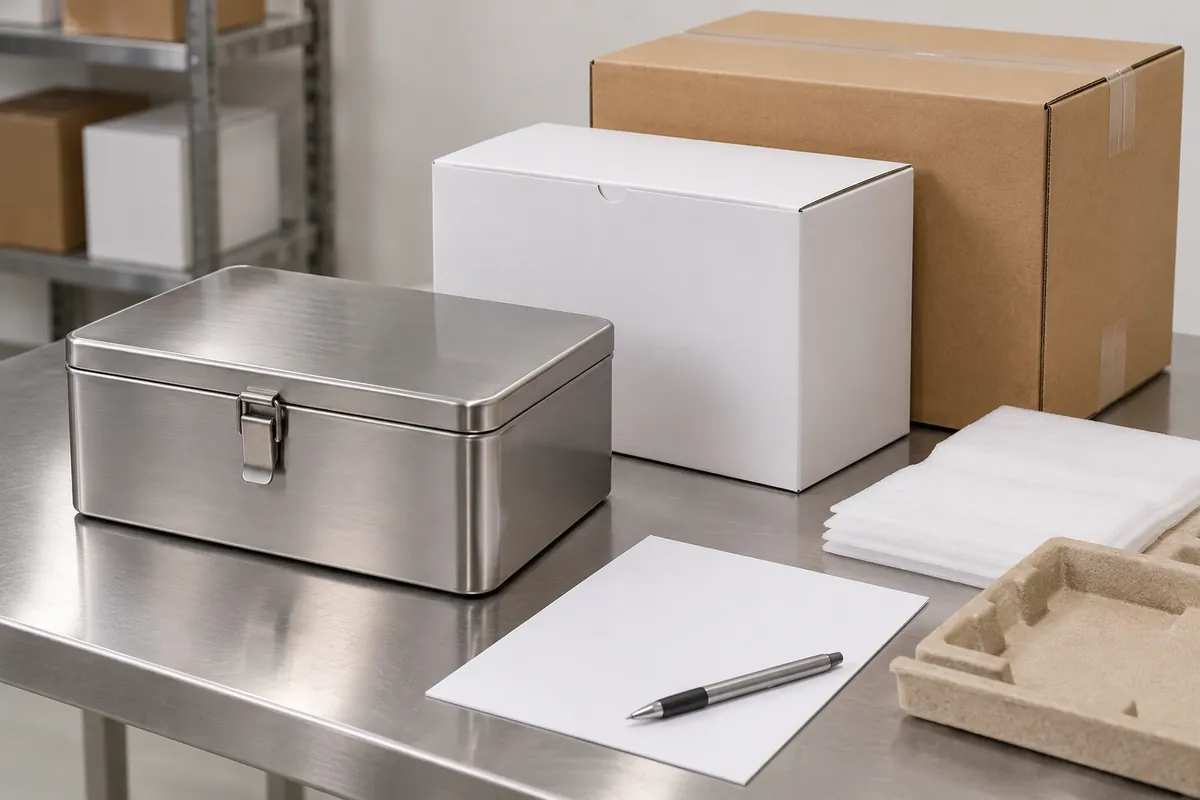
Artwork should identify the approved SKU and configuration, not a product-family image that conceals a different lid, handle, finish, or component set. If the buyer changes the finish, material combination, lid hardware, accessory list, or carton count after sample approval, reopen the relevant sample and packaging checks before production release.
What should the buyer check before approving the sample?
Use a short record that makes the model, inspection, and order reference easy to connect:
- Identify the sample: model code, revision, finish, lid type, included components, and supplier quotation line.
- Check closed dimensions: outside height, width, depth, feet, handles, and any protruding part.
- Check usable interior: agreed inside measurement points and any obstruction from lid channels, hinges, or folded seams.
- Check the opening envelope: movement path and clearance against the buyer’s intended counter/cabinet space.
- Operate the mechanism: open and close as instructed; note any contact, binding, looseness, or difference from the approved drawing without assigning an unsupported service-life result.
- Review surfaces and parts: verify the named color/finish, cosmetic surfaces, edges, component list, and any document requirement the buyer has specified.
- Check pack-out: compare accessory count, protection, labels, retail box, and outer-carton dimensions with the RFQ.
- Freeze the record: save dated photos, measurements, sample disposition, open questions, and any deviation agreed for the purchase order.
Common mistakes to avoid
- Comparing a roll-top quote with a hinged-lid quote as if the opening path were identical.
- Treating exterior dimensions as the inside space available for the buyer’s product-fit claim.
- Accepting “large capacity” without a defined measurement or representative fit check.
- Assuming every model needs the same ventilation pattern or makes the same freshness claim.
- Treating a product page’s food-contact, care, or coating statement as evidence for a different supplier’s configuration.
- Approving a decorated sales sample while leaving production finish, parts, label, carton, or pack count unspecified.
Buyer checklist before requesting a quotation
Provide the supplier with:
- target market and sales channel, and the buyer-defined product assortment;
- preferred lid architecture or a request for alternatives quoted separately;
- maximum counter footprint and available opening clearance, if known;
- target exterior envelope and requested usable interior dimensions;
- proposed body, lid, handle, feet, pads, or other mixed-material components;
- buyer-approved finish/color reference and visible cosmetic faces;
- sample quantity, drawing/photo reference, model code and revision expectations;
- any compliance documentation the buyer needs for its own intended claim and market;
- retail box, master-carton dimensions, pack count, protection, and assembly state;
- the buyer’s acceptance notes, required sample photos, and change-control contact.
A comparison sheet should keep assumptions visible. If the supplier cannot yet provide an internal dimension or carton size, mark the field “to be measured” or “pending sample,” rather than filling it with an estimate. This keeps unlike offers from appearing comparable simply because both use the same category label.
Foire aux questions
Are roll-top and hinged bread boxes interchangeable for a countertop program?
No. They have different movement paths and may need different space above, behind, or in front of the unit. Compare each exact configuration against the buyer’s placement envelope and sample.
Should the product specification list internal dimensions?
Yes, when the buyer needs to support a product-fit statement. Ask the supplier to state the measurement points and confirm them on the selected sample. Keep internal usable space distinct from outside dimensions.
Does a ventilation feature prove that bread stays fresh longer?
No. A feature description by itself is not a controlled result for a different product or use condition. Avoid a preservation, mold-prevention, or shelf-life claim unless its evidence applies to the exact product and wording.
What is most important in metal bread box sample approval?
Tie the lid type, opening envelope, interior measurement, finish, components, carton, and revision to one record. A sample review confirms only the items actually checked on that sample.
Does Koitor currently manufacture bread boxes?
Koitor’s approved product information does not confirm a bread-box SKU or food-contact capability. This article provides buyer-side sourcing guidance; confirm project scope and any required documentation before assuming a quotation is available.
[Sources reviewed: WESCO Breadboy product information; Metaltex Bready product page; Brabantia Roll-Top Bread Bin product sheet; Brabantia LiftTop Bread Bin product sheet. Product details apply only to the named models and documents.]
Discuss a Home-Storage Project
Have a metal home-storage product brief?
Share the drawing or sample and required product scope. Koitor can first confirm whether the request fits its current verified manufacturing capabilities.
Fabrication pour compte de tiers / Marque de distributeur
Transformez ce guide d'approvisionnement en cahier des charges
Indiquez-nous le produit souhaité, ses dimensions, sa finition, la quantité commandée et vos exigences en matière d'emballage. Votre équipe recevra une analyse pratique de la faisabilité de la fabrication avant l'établissement du devis.


 English
 Español
 Português
 Français
 Deutsch
 العربية