

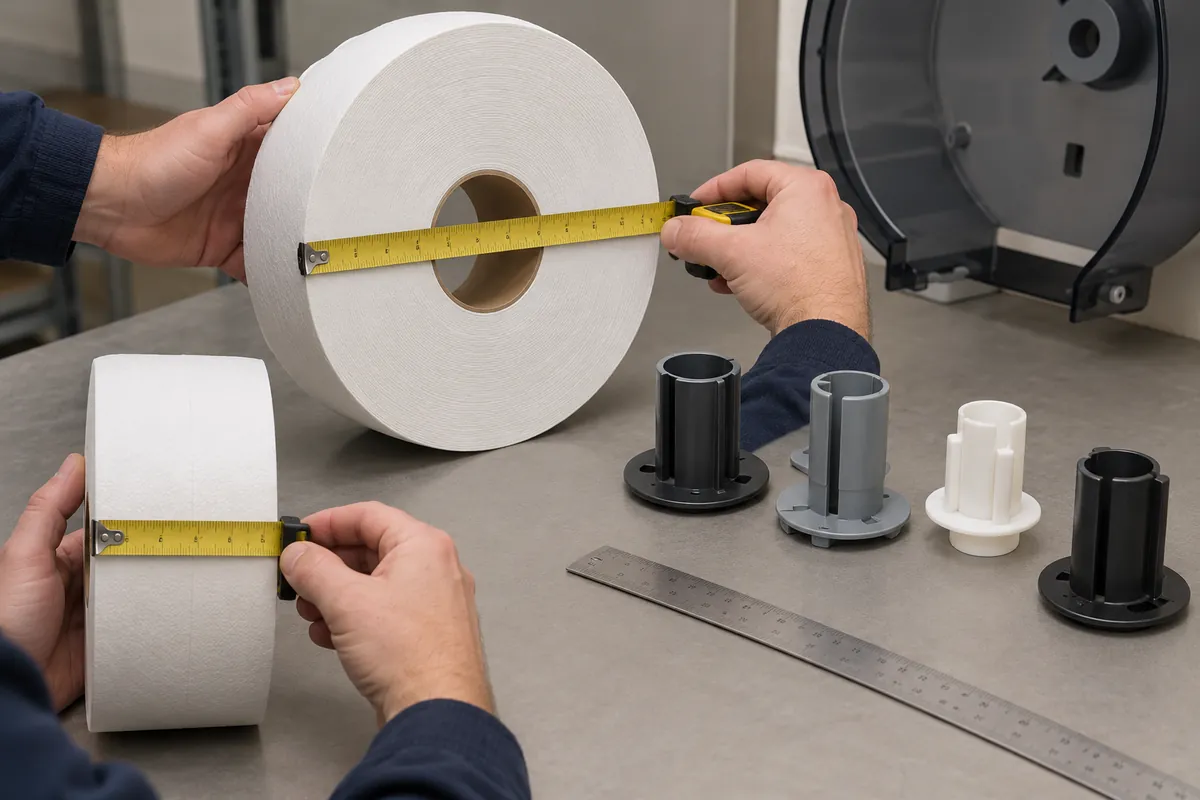
Commercial toilet tissue dispenser refill compatibility starts with the actual roll, not the broad “jumbo” label. Before approving an enclosed dispenser, buyers should record the tissue roll’s outside diameter, face width and core, identify the spindle or adapter, confirm how the cover opens, and observe the replacement route in the installed location. They should also assign responsibility for the lock or key, spare rolls and refill procedure. Manufacturer sheets show that dispensers differ in roll dimensions and internal fittings; those model-specific specifications are not universal.
Which Roll Measurements Should the RFQ Include?
Ask the tissue supplier for the exact roll code and technical data. Record outside diameter at the intended supply condition, face width, core inside diameter and the presence of a coreless or adapter-based design. If the project may use more than one brand, list each proposed SKU rather than writing “standard jumbo roll.” Packaging data may show the case size but not the roll’s installed dimensions, so request the roll specification or a physical sample.
The dispenser’s spindle or support arrangement should be documented. Does it use a fixed spindle, a removable bar, an adapter or a defined combination? Does the roll sit between side supports, and are any tabs or retaining features used? A product drawing and refill sample can answer those questions better than a product title. Do not assume a core of similar appearance will fit.
Record whether the holder is intended for one roll or a changeover arrangement. If a reserve roll is stored inside, establish how the used roll is removed, when the reserve becomes available and whether the cover closes with the selected roll loaded. Catalog capacities should be tied to the exact product model and roll type. They do not predict the number of days between service visits.
| Refill attribute | Buyer evidence | Pourquoi est-ce important ? |
|---|---|---|
| Roll outside diameter | Roll SKU data or physical sample | Checks enclosure clearance |
| Face width | Manufacturer specification | Confirms side-to-side fit |
| Core inside diameter | Core measurement and profile | Determines spindle or adapter fit |
| Roll construction | Standard core, coreless or proprietary | Identifies support requirements |
| Roll count | Primary and reserve quantity | Affects storage and service sequence |
| Refill source | Supplier, SKU and approved alternatives | Controls continuity and substitutions |
For commercial toilet tissue dispenser refill compatibility, retain the roll identifier alongside the dispenser model. This creates a traceable pair for quotation, sample approval and replenishment instead of relying on a generic product category name.
How Should the Sample Be Tested?
Use the intended tissue roll in the production-intent dispenser or the exact model under consideration. Install the roll in the documented orientation, check side and front clearance, close the cover and operate the dispenser as its manufacturer instructs. Observe whether the tissue can rotate or feed as intended and whether the roll contacts the enclosure. These checks apply only to the sample configuration tested.
Open and close the cover with the unit mounted in the project position or a representative mock-up. Check whether the service person can reach the spindle, remove the core and place the replacement roll without colliding with a partition return, fixture or adjacent dispenser. If the unit uses a key or lock, confirm who receives and manages it. A lock may control access to the enclosure; it does not by itself establish theft prevention or tamper resistance.
Build a refill approval worksheet
Keep one row for each tissue SKU and each dispenser revision. Record the measured roll diameter, face width and core, the dispenser’s stated supported range, the spindle or adapter used, and the sample result. Mark whether each value comes from a supplier document, a buyer measurement or an open assumption. This helps the team distinguish a measured fact from a vendor’s general compatibility statement. If two tissue products are approved, do not collapse them into a single “universal” row; show the specific pairings.
When no physical roll sample is available, ask the tissue vendor to confirm the dimensions and ask the dispenser supplier to identify its fit basis in writing. Keep approval conditional until the real pair is tested if the unresolved dimensions could affect fit or feeding. This sequence makes commercial toilet tissue dispenser refill compatibility a documented interface decision, not an inference from product names.
Do not use a sample demonstration to claim jam-free performance, universal roll compatibility or dispensing capacity across all brands. If the project requires an operating or cycle test, define the roll, loading method, duration, method and acceptance criteria with the supplier. The record should state what was tested and what was not.
What Service and Lock Details Need Ownership?
A facility dispenser can be bought once but refilled repeatedly. Identify the person or team responsible for ordering tissue, holding keys, replacing rolls and escalating a jam or damaged cover. Ask the supplier whether the key is included, whether a replacement key can be ordered and how it is identified. Do not assume that a “standard key” is shared among models or sites.
Check the refill sightline if the enclosure has a viewing slot or indicator. A window may help staff see the roll, but it does not guarantee accurate service timing. State what staff should use as the replenishment cue and who checks it. If a reserve roll is included, confirm the exact transition procedure and the roll-size limits for both positions.
The operating path should be included in the project plan. A cover can open fully on a workbench but be obstructed by a partition, wall return or neighboring fixture. Show the open-door position and the service person’s access zone where relevant. Ask whether the dispenser is intended for surface or recessed installation and keep the mounting detail with the approval record.
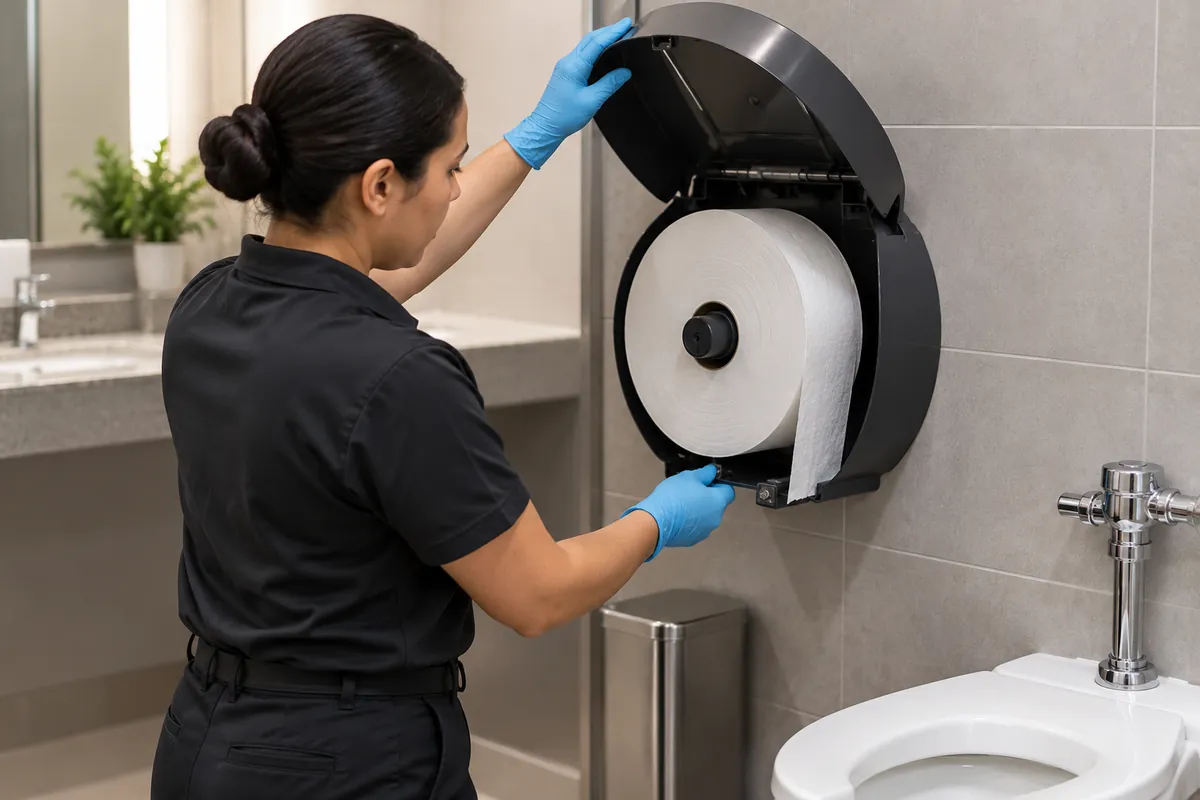
If multiple buildings share the dispenser, store roll SKUs, keys and model revisions in one maintenance reference. A different tissue supplier may change outside diameter, core or width even when the package still calls its product “jumbo.” Treat a substitute roll as a new interface check; the phrase alone does not establish fit.
How Do Mounting and Enclosure Types Affect Selection?
An open roll holder and an enclosed, keyed dispenser solve different operational problems. An open holder may provide direct access and simpler visual checking. An enclosed dispenser adds a cover, support geometry and access control but requires a planned opening and refill route. This article focuses on the enclosed facility dispenser; it does not restate the separate open-holder question of roll clearance and rotation.
For surface mounting, record the installed projection, hole pattern and nearby clearances. For recessed installation, obtain the cutout, cavity depth and framing requirements from the exact model documentation. The project designer or installer should confirm the wall construction, concealed services and fixing choice. A dispenser’s supplied hardware is not automatically suitable for every surface.
The buyer should compare the entire enclosure and service scope: body material, finish description, door or cover, hinge, lock, spindle, adapter, supplied key, mounting hardware and packaging. A stainless appearance does not prove grade or performance. Request the evidence relevant to any specific material, finish or security requirement rather than inferring it from appearance.
How Can Distributors Compare Quotes Fairly?
Normalize the offered tissue reference, dispenser model, mounting, lock/key, roll count and included components. Ask each supplier to state the roll dimensions and core assumed for its compatibility claim. Identify whether tissue is part of the offer or buyer-supplied. If one quote includes an adapter and another does not, the commercial scopes differ.
Request a drawing, refill sample or supplier sheet with model-specific dimensions. Ask suppliers to list exclusions, approved roll alternatives, maintenance parts and packaging. For private label, align item code, drawing revision, key reference and carton labels. The facility’s refill SKU should appear in its own purchasing record even where the dispenser supplier does not sell tissue.
Attach the product sample approval to the facility standard and room schedule. For a multi-site program, use one row per building or dispenser model where roll formats or mounting differ. This allows a buyer to identify whether a proposed change is a substitute within the approved interface or a different system requiring review.
What Common Procurement Errors Should Be Avoided?
Using “jumbo” as a dimension. Specify outside diameter, width and core from a named tissue product.
Checking the roll without closing the cover. The enclosure clearance and lock position matter.
Ignoring adapters. A similar core may still need a different support or spindle.
Approving from a tabletop alone. The installed service opening may be blocked.
Treating a lock as a performance guarantee. Confirm lock and key scope without unsupported security claims.
Assuming a reserve roll is universal. Verify both stored and active roll positions against the actual SKU.
Allowing a tissue substitution without review. Recheck the interface whenever roll geometry or core changes.
Mixing capacity with service interval. A roll count does not establish occupancy use or maintenance timing.
What Can Koitor Confirm?
Koitor is a family-owned custom metal hardware factory with confirmed experience in bathroom and home-storage hardware, drawing and sample review, metal forming, finishing, assembly and packaging. This supports general discussion of metal enclosures, mounting details and buyer sample preparation. It does not confirm current manufacture of jumbo tissue dispensers, locks, keys, plastic spindles, tissue supply or facility service programs.
A project-specific request should include a dispenser drawing or sample, roll SKU and dimensions, mounting type, finish, target market, quantity and requested evidence. Koitor must first confirm whether the proposed product scope fits its current production capabilities. No universal compatibility, dispensing performance, security or compliance claim should be made without product-specific support.
For related project documentation, see the commercial washroom submittal checklist and the custom bathroom hardware overview. They provide adjacent buying context, not evidence of a Koitor tissue dispenser SKU. A project inquiry can be sent through the contact page.
For phased installations, identify which building or floor receives each dispenser and tissue revision. A supplier change midway through the project can introduce a different roll geometry or spindle. Keep the approved alternatives and receipt records with the room schedule so facilities staff can reorder the validated combination later.
Buyer Checklist Before Approval
- Name the exact dispenser model, product code and revision.
- Identify the tissue roll supplier, SKU and approved alternate list.
- Record roll outside diameter, width and core inside diameter.
- Confirm core type and spindle or adapter arrangement.
- State primary and reserve roll requirements, if applicable.
- Load and remove the actual roll from the sample.
- Close and lock the cover with the selected refill installed.
- Check feed or rotation only under the supplier’s documented procedure.
- Review service access after installation, including door-opening clearance.
- Assign key, tissue stock and maintenance responsibilities.
- Confirm surface/recessed mounting and site fixing ownership.
- Match the approved sample, drawing, refill SKU and carton identification.
- Define which roll or dispenser changes require another fit review.
Foire aux questions
Does any jumbo toilet tissue roll fit an enclosed dispenser?
No. Roll outside diameter, width and core vary. Verify the exact roll SKU with the selected dispenser or use a sample pair.
Is core diameter enough to confirm fit?
Not always. Roll width, outside diameter, core profile and the dispenser spindle or adapter also matter. Record all relevant dimensions.
Does a viewing slot show when the dispenser must be refilled?
It may help staff inspect the roll, but the project should define its service routine. Do not treat a window as an automatic stock signal.
Does an included key prove the dispenser is secure?
No. It shows only that the specific offer includes a key or lock feature as documented. Security claims need separate, product-specific support.
Should a reserve roll be approved separately?
Yes. Confirm that each stored roll position accepts the named refill and that the documented transition procedure works for the model.
What should a buyer send with an RFQ?
Provide roll data, dispenser requirements, installation type, room layout, quantities, finish, key/service expectations and any defined test or documentation requirement.
Discuss a Commercial Washroom Hardware Project
Share the dispenser drawing or sample, exact roll data, mounting conditions, finish and project quantity. Koitor can first confirm whether the proposed scope matches its current capabilities.
Fabrication pour compte de tiers / Marque de distributeur
Transformez ce guide d'approvisionnement en cahier des charges
Indiquez-nous le produit souhaité, ses dimensions, sa finition, la quantité commandée et vos exigences en matière d'emballage. Votre équipe recevra une analyse pratique de la faisabilité de la fabrication avant l'établissement du devis.


 English
 Español
 Português
 Français
 Deutsch
 العربية