
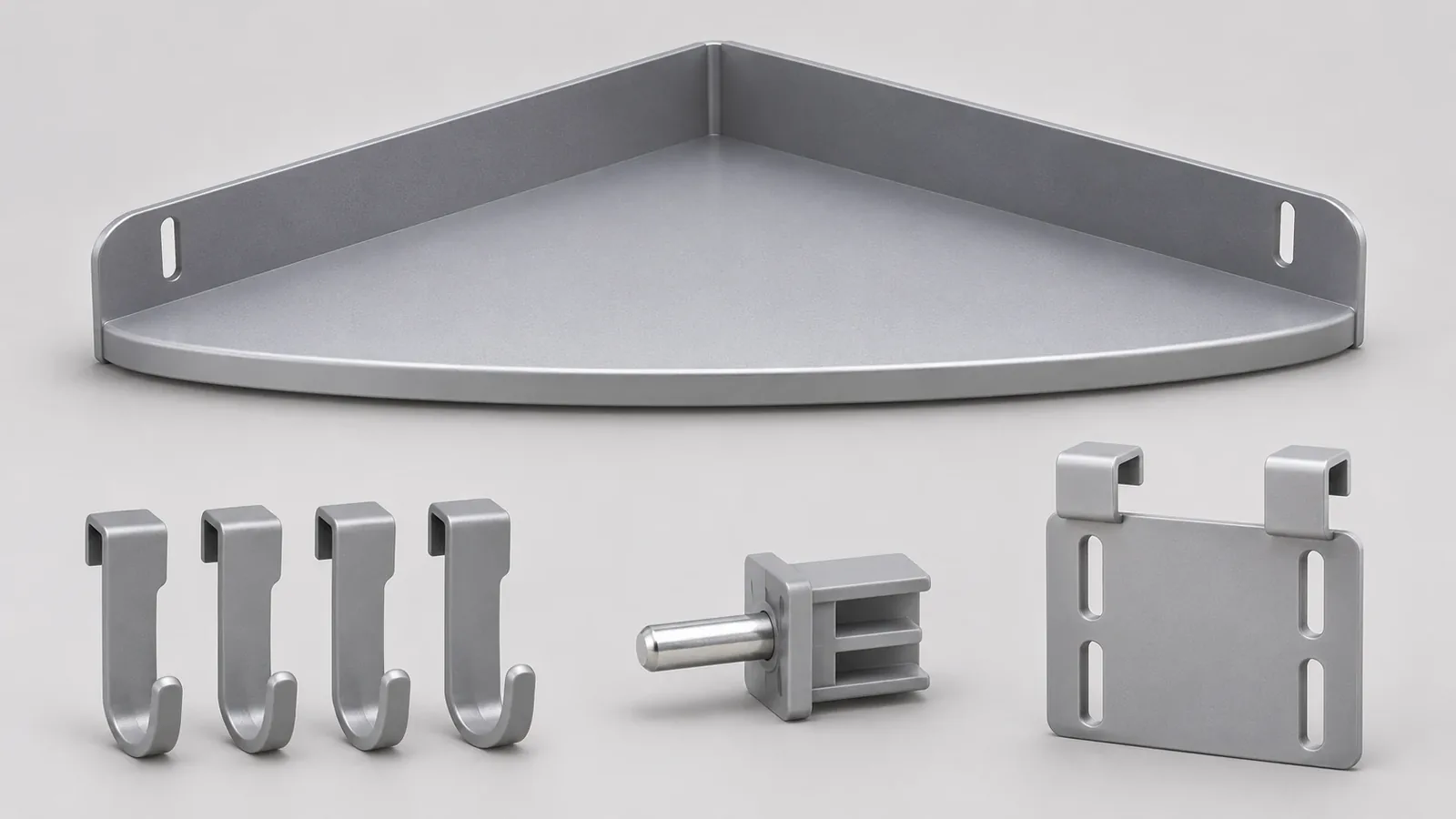
A cubicle shelf mounting kit should be specified by separating the parts that hold accessories, connect to the shelf, and attach the assembly to the intended panel. Those functions may appear together in one product listing, but they are not necessarily the same interface or included supply item. Before comparing a shelf-only offer with a kit, identify each component, its mating feature, the supplier responsible for it, and the current evidence that applies to the target partition.
This is a buyer guide to component roles and supply scope. It is not an installation tutorial, partition-engineering assessment, load calculation, retrofit recommendation, or damage-free removal guarantee. A manual for a named plastic shelf does not validate another shelf material or a custom metal assembly.

What problem does a cubicle shelf mounting kit solve?
The buyer needs to define what is included in the kit and how each part relates to the next. A shelf with accessory hooks may include one interface for hanging items, another for connecting the shelf body to an adapter, and a separate arrangement for attaching the assembly to a panel.
When a purchasing brief says only “cubicle shelf with hooks,” the supplier may quote a shelf and accessory hooks but no approved panel-mounting component. Another supplier may include a connector or pin assembly without documenting which partition the product is intended to attach to. Unless each role is identified, the buyer cannot compare the offers on equal terms or finalize a product instruction sheet.
An original 2023 Officemate manual reviewed for this topic distinguishes accessory hooks from the shelf-back pin/keyhole interface. The drawing shows them as separate parts, and the prose describes the accessory hooks and shelf connection separately. That is evidence for role separation in the named product. It does not document every partition surface, validate a different pin, or establish that a custom metal shelf can use the same mechanism.
The third interface—the actual attachment to the target panel—needs its own current product-specific evidence. A product name containing “cubicle” does not identify every permitted partition construction or prove that the assembly will fit all office panels. This guide therefore treats panel attachment as an item to confirm, rather than filling in a universal answer from a retailer listing or a picture.
The key buying question is: Which parts are accessory hooks, which parts connect to the shelf, and what approved component attaches the final assembly to the specified panel? Keep the answer connected to exact model numbers, drawings, included parts, and supplier responsibility.
What should buyers identify in the kit before requesting a quote?
Describe the kit as a sequence of component roles and mating interfaces. Then ask the supplier to identify the exact part number and evidence for each row.
Use a component-role schedule with at least these fields:
- Drawing callout: identify the part shown on the assembly drawing or approved product reference.
- Exact identity: capture the maker, model, revision, and material where the source documents them.
- Intended function: mark whether the component holds an accessory, engages the shelf body, or attaches to a panel.
- Mating feature: state which hole, keyhole, edge, or other interface the component is intended to meet, using the maker’s terminology.
- Supply scope: record whether the part is included, optional, separately ordered, or buyer-supplied.
- Responsible supplier: identify who owns the component specification and who confirms its application.
- Evidence record: attach the current drawing or instruction, or mark the requirement unresolved.
This schedule helps buyers see whether a quotation covers a complete assembly or only one portion. It also avoids using visible hook count as a proxy for a complete mounting kit.
| Component role | What the buyer should identify | Question to resolve |
|---|---|---|
| Accessory hook | Exact part and intended accessory-holding role | Is it part of the shelf package or an optional accessory? |
| Shelf connector or adapter | Part that engages a feature on the shelf body | Which exact shelf model and mating feature does the maker document? |
| Panel attachment | Complete part or arrangement intended to meet the target panel | Which panel construction and model-specific instructions are covered? |
| Shelf body | Material, model, revision, and connector interface | Is the evidence for this shelf body or a different product? |
| Instructions and package | Included documentation, fasteners, and kit boundaries | Does the package identify every component and its role? |
The last column is deliberate: if the supplier cannot identify a supported interface, label it “open” instead of inferring a fit. The buyer can still request a quotation for the confirmed parts while holding the unresolved panel connection outside the approved product claim.
How do the accessory hook and shelf connector differ?
An accessory hook supports an item that the product is intended to hold; a shelf connector joins a feature on the shelf body to another part of the assembly. The two functions can be shown in one manual but remain separate procurement questions.
Le VerticalMate cubicle corner shelf product page identifies a named shelf product and describes its accessory context. The related VerticalMate cubicle shelf page gives broader mounting-context language. The original 2023 product manual was visually reviewed as a one-page document and shows accessories and shelf-back engagement as separate parts.
That evidence supports a role-based reading of the named assembly. It does not prove that every panel attachment is interchangeable, that the listed models work on every partition, or that a similar pin or keyhole is appropriate for a different shelf material. The source product is plastic; it is an example for understanding component boundaries, not evidence that Koitor makes the product or that the mechanism can be transferred to metal.
For a metal shelf concept, the buyer should ask the responsible supplier to identify the metal shelf’s own mating feature and the approved panel-attachment component. The pin shown in a plastic product’s manual is not automatically suitable for a custom metal shelf. A new interface may require its own design review, drawings, sample approval, and system evidence.
How should panel attachment be confirmed?
Confirm panel attachment through current instructions or written model-specific clarification from the responsible product maker. Do not infer substrate suitability from the words “cubicle shelf,” a generic photograph, an accessory hook, or a connector that only engages the shelf body.
The panel may be supplied by a separate partition manufacturer, while the accessory kit comes from another source. The person assembling a private-label assortment may not control the panel specification. The buyer should therefore record the panel brand or reference, the panel construction information available to the project, the exact shelf model, and the current maker documentation that connects them.
Do not treat an online retailer description as engineering approval. Retail copy can help identify search language or product variants, but the research pack does not adopt retailer claims about magnets, over-panel hangers, removal without damage, or load capacity. Those statements require relevant primary evidence for the actual model and panel before they appear in buyer-facing claims.
Do not publish an installation sequence copied from the manual as if it applied to a different assembly. The approved article uses the manual to distinguish part roles, not to instruct buyers to handle pins, drill, cut, or modify a partition. The final arrangement and any installation method remain with the product maker and the relevant partition specialist.

For purchasing, record who will provide the panel information and who will approve the attachment. If this evidence is unavailable, quote the identified shelf and accessories as a partial scope, state that the panel interface remains unconfirmed, and do not describe the kit as universally compatible.
An open panel-interface row does not have to stop every sourcing activity. It does mean that the offer should be divided into confirmed and unconfirmed scope. A buyer may request a budgetary price for the shelf body and named accessories while keeping the panel-mounting claim out of the approved product description. The supplier should state whether any attachment component is included, excluded, or awaiting confirmation. The purchase order should not silently turn a partial quotation into a complete compatible kit.
Before sample approval, make sure the sample identity matches the approved part schedule. A sample label should identify the shelf model, connector, accessory hooks, and any included attachment component. If the sample differs from the product page or manual, record that difference and ask the manufacturer to reconcile it. Do not assume the sample represents a later production revision unless the supplier confirms the revision relationship.
Private-label teams should use the same controlled scope in artwork and instructions. Claims such as “fits all cubicles,” “no damage,” or a specific capacity should not be added without model-specific evidence. If an attachment interface is not confirmed, artwork can identify the product family while clearly limiting the application statement to the approved configurations. Merchandising, sourcing, and quality teams should review the same part list so that an accessory hook is not accidentally described as the mounting component.
How should quotations distinguish a shelf from a complete kit?
A useful quotation separates the shelf body, accessory hooks, shelf connector, panel attachment parts, and documentation. The supplier should state which components are included and which are optional or buyer-supplied.
| Quote line | Include in the comparison | Hold open if unclear |
|---|---|---|
| Shelf body | Exact product identity, material, finish, and model revision | Alternate material or altered connector design |
| Accessory hooks | Quantity and model where documented | Whether hooks are included in the base item |
| Shelf-back connector | Exact adapter or pin identity and mating feature | Compatibility with a different shelf body |
| Panel attachment | Named part, panel scope, and current documentation | Suitability for an unspecified partition |
| Packaging and instructions | Supplied documents, parts list, and retail package scope | Whether the instructions match the quoted revision |
| Private-label elements | Artwork, labels, and approved wording | Unsupported fit, load, or removal claims |
When a supplier quotes “one kit,” request a parts list. The term may refer to a shelf plus hooks, a shelf plus a mounting adapter, or a broader package. Unless the quotation enumerates the items, two offers that both use “kit” may still cover different components.
Packaging should preserve the same distinction. The label, instruction sheet, and included-parts list should identify the shelf, accessories, connector, and any confirmed panel attachment separately. If an attachment part is buyer-supplied, say so in the package documentation rather than showing it as if it were included. If the supplier changes a connector or shelf revision, update the product record and instructions before the next order. That helps warehouse and customer-service teams identify which part is missing when the box is opened and prevents an optional accessory from being presented as a required mounting part.
Ask suppliers to flag any assumed panel type, substituted connector, missing instruction, or change from the reference sample. The accepted sample, packaging artwork, order confirmation, and user-facing instructions should refer to the same product revision and scope.
What should buyers avoid assuming?
The buyer should distinguish observed product details from conclusions about another assembly. The manual’s drawing is useful for the named product’s component roles; it does not provide a universal cubicle-shelf specification.
Do not assume the visible hooks mount the shelf to the partition. Accessory hooks and panel attachment are different rows in the parts schedule. Ask the manufacturer to identify the mounting component separately.
Do not assume “cubicle” identifies the supplied mounting kit. The term describes a broad setting, not necessarily the complete panel interface, exact panel family, or included parts.
Do not infer panel capacity from pin engagement. A connector fitting a shelf feature does not establish panel suitability, load capacity, or product safety. Obtain evidence from the responsible product maker for the complete configuration.
Do not transfer a plastic-product manual to a custom metal shelf. The material, connector, geometry, and assembly can differ. A drawing for one named product is not approval for a design that uses a different shelf body.
Do not advertise damage-free removal without evidence. The researched primary source does not substantiate a universal no-damage result for all panels. Treat removal behavior as a model- and substrate-specific claim that needs appropriate documentation.
Do not add a magnet or over-panel option based only on a retail listing. Such alternatives were discovery leads, not approved primary technical evidence for this article. A buyer considering them should obtain current maker data for the exact solution.
Do not treat a sample as a load test. A fit observation may confirm that the sample matches the approved reference; it does not establish the capacity or durability of another panel, accessory, or product variation.
Do not collapse supplier responsibility. The shelf maker, connector supplier, partition maker, and metal fabricator may control different parts. The RFQ should say who approves each interface and which party supplies each component.
Buyer handoff and next steps
How can Koitor support a related metal component inquiry?
Koitor Hardware can discuss metal component drawings, fabrication, finishing, basic assembly, and packaging within its approved bathroom and home-storage hardware scope. This does not establish that Koitor manufactures plastic shelves, cubicle systems, proprietary pin mechanisms, or panel attachment components.
If a buyer is developing a metal shelf or carrier, identify the proposed metal part and its mating interface separately from the complete partition system. Share the drawing or physical sample, model references for bought-in parts, requested material and finish, quantity, and packaging. Koitor can confirm whether the defined metal component is within current capability before preparing a quotation.
The partition maker or system supplier should remain responsible for its panel attachment instructions and performance scope. If another supplier provides a pin, hook, or adapter, identify that supplier and its part number in the parts schedule. A metal fabricator’s drawing review does not validate a proprietary mechanism or the end-use panel.
Small-batch OEM production may be relevant when the buyer is evaluating a clearly defined storage component or custom metal part. MOQ, sample timing, production lead time, and packaging depend on product and order details. Ask Koitor to confirm the current scope and quotation assumptions rather than treating a general capability statement as proof that the cited shelf kit is available.
Le OEM home-storage hardware scope provides the appropriate starting context for a defined metal component inquiry. Keep bought-in panel attachments and unverified system claims outside the metal quotation unless the responsible supplier confirms them.
Liste de contrôle à l'intention de l'acheteur avant de demander un devis
Include enough information to define each interface and the supply boundary:
- Exact shelf product, model, revision, and material.
- Accessory hook model, quantity, and whether it is included or optional.
- Shelf-back connector or adapter model and its documented mating feature.
- Intended panel brand, reference, and construction information available to the project.
- Current maker evidence that addresses the final panel attachment.
- A drawing or authorized photo that identifies each component without exposing confidential details.
- Parts list showing supplier responsibility and buyer-supplied items.
- Requested finish, quantity, private-label packaging, and instruction requirements.
- Open questions for the shelf maker, attachment supplier, or partition maker.
- Product claims that require approval before artwork or online listing.
For sample approval, state which model and revision are under review and what the inspection is intended to confirm. Do not treat that review as proof of capacity, damage-free removal, compatibility with every panel, or compliance unless the responsible maker provides the appropriate evidence.
For a multi-vendor project, assign an owner to each interface rather than asking one supplier to confirm the entire assembly by assumption. The shelf maker can identify its own shelf connection and accessory options; the partition or panel supplier can define the permitted attachment; the kit assembler can state which parts are included. The 2023 Officemate manual is useful for separating accessory hooks from a shelf-back pin/keyhole connection in that named plastic product. It does not establish the attachment method for a different partition or a custom metal shelf.
A configuration record should preserve the exact shelf model, panel type or approved reference, connector model, accessory-hook model, and document revision. Mark each relationship as confirmed by a current source, sample-reviewed, or unresolved. If a document only shows how an accessory attaches to the shelf, do not treat it as evidence for how the shelf attaches to the panel. If the supplier’s drawing omits a mating part, request it before describing the kit as complete.
For a replacement or private-label program, retain the sample identifier and a parts list that matches the quotation. Ask the kit supplier to identify exclusions such as panel-specific attachment hardware or separately ordered hooks. A retailer’s product image can help locate the product family but cannot establish carton contents or fit across panel constructions. Do not infer a universal pin, keyhole, clamp, or adhesive arrangement from the category name.
The approval record should also identify who owns changes. If the shelf, connector, panel attachment or accessory changes, reopen only the affected interface and require the responsible maker to confirm its scope. This prevents an approved hook substitution from being mistaken for approval of the panel attachment. No installation, removal, partition-damage or load conclusion should be added unless current evidence for the exact product and panel supports it.
A cubicle shelf mounting kit should list the accessory, shelf connector, and panel-attachment scope as separate items when the suppliers document them separately.
Foire aux questions
Do the visible accessory hooks mount the shelf to the partition?
Not necessarily. The 2023 manual reviewed for the named Officemate product shows accessory hooks separately from the shelf-back pin/keyhole engagement. Buyers should identify the panel attachment as its own component and confirm it against current model documentation.
Does the word “cubicle” identify the supplied mounting kit?
No. The product name does not list every part included in the package or prove suitability for each partition. Request a complete parts list and current application instructions for the selected model.
Does a pin that fits the shelf prove panel capacity?
No. Engagement with the shelf body is only one interface. It does not establish suitability for the final panel or a load rating. The responsible product and partition suppliers must document the complete application.
Can a plastic-shelf manual validate a custom metal shelf?
No. The manual is a model-specific example for distinguishing component roles. A metal shelf may have different geometry, material, and attachment requirements and needs its own approved interface documentation.
Collaborez avec Koitor Hardware
Define the Metal Shelf and Bought-In Interfaces
Share the metal shelf drawing, bought-in connector references, target panel information, quantity, finish, and packaging scope. Koitor can confirm whether a defined metal component fits its manufacturing scope; the shelf-system and partition suppliers must confirm their own attachment parts and instructions.
Fabrication pour compte de tiers / Marque de distributeur
Transformez ce guide d'approvisionnement en cahier des charges
Indiquez-nous le produit souhaité, ses dimensions, sa finition, la quantité commandée et vos exigences en matière d'emballage. Votre équipe recevra une analyse pratique de la faisabilité de la fabrication avant l'établissement du devis.

 English
 Español
 Português
 Français
 Deutsch
 العربية