
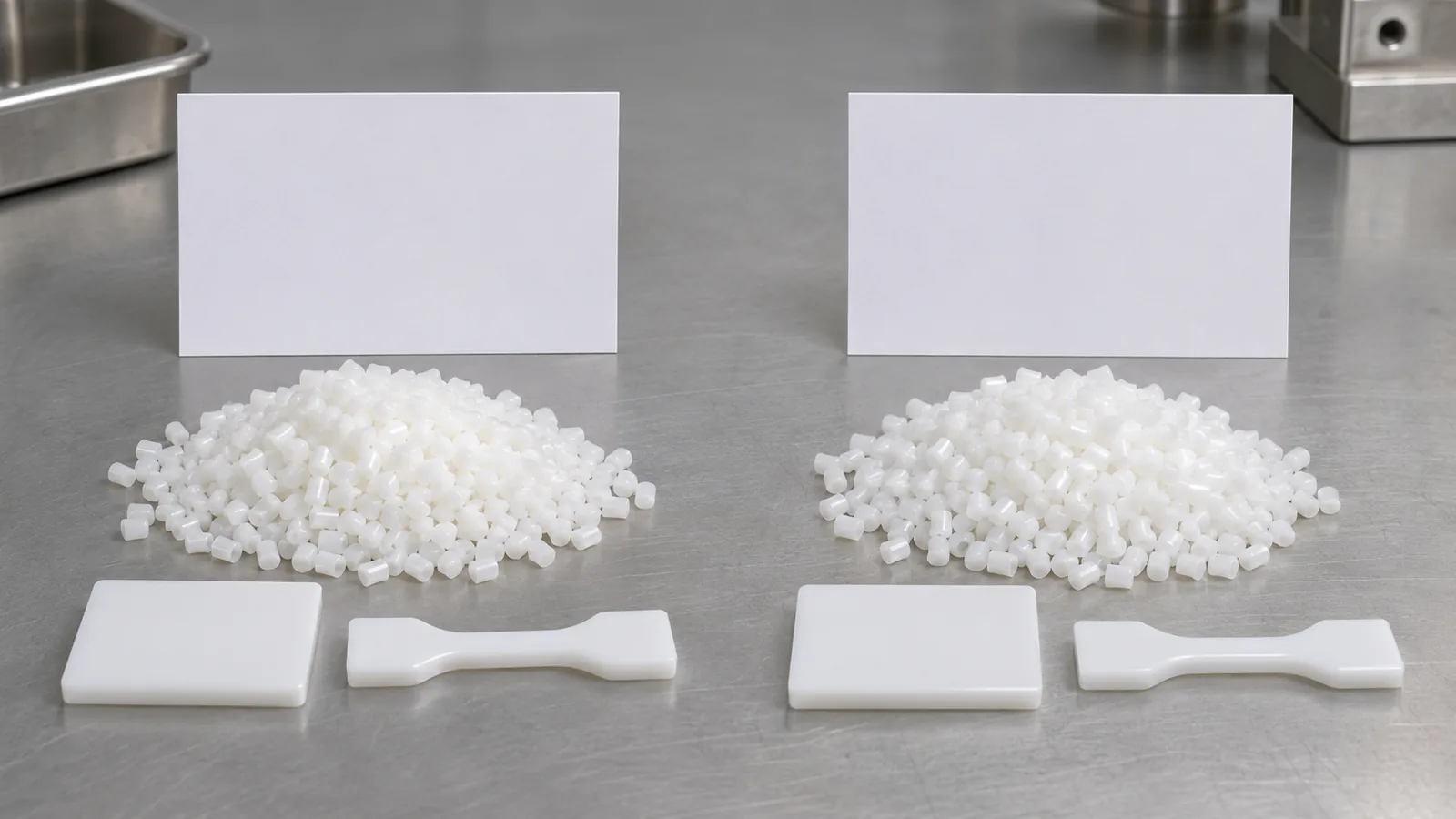
Delrin vs acetal is often a misleading “versus” comparison because Delrin is a brand of acetal homopolymer, while acetal is a broader polymer family that includes homopolymer and copolymer grades. A buyer comparing quotations should first determine whether “acetal” is being used as a generic family name, a specific grade, or a copolymer proposal. The brand name and the family name are not automatically competing material identities, and neither label alone identifies the exact product or proves its suitability for a component.
This distinction matters when a supplier quotes an acetal spacer, guide, insert, roller, or other polymer part for a bathroom or home-storage hardware assembly. One quote may specify Delrin by grade; another may say only “acetal.” The second line leaves important questions open: Is it homopolymer or copolymer? Which manufacturer and grade? What product form and process? What documents support the offer? Until these questions are answered, a buyer cannot make a like-for-like comparison.
Decode the words before comparing the materials
Acetal, also called polyoxymethylene or POM, describes a polymer family. Within that family, buyers commonly encounter homopolymer and copolymer material forms. Delrin is a specific brand associated with acetal homopolymer (POM-H). Other suppliers offer acetal grades under their own product names, including copolymer grades. Thus a Delrin item can also be described as acetal, but not every acetal grade is Delrin.
The word “acetal” on a purchase line may be used informally to refer to the family, but the buyer must not assume it identifies POM-H or POM-C. A product description can be incomplete even when it sounds technically familiar. Record the exact manufacturer, grade code, material subfamily, form, and revision from the supplier. If the grade is proprietary or the supplier cannot disclose a detail, identify that limit and ask what evidence can still support the project requirement.
A simple identity tree is useful:
- Polymer family: acetal / polyoxymethylene (POM).
- Subfamily: homopolymer or copolymer, where specified.
- Brand or commercial grade: Delrin or another identified supplier product.
- Formulation: fillers, modifiers, color, or other grade-specific details where applicable.
- Product form and route: molded component, machined stock shape, or another supplied form.
- Part and revision: the actual geometry and controlled drawing linked to the quote.
The tree prevents a false equivalence between a brand and a generic material category. It also prevents the reverse error: assuming that every non-Delrin acetal quote must be a different subfamily. The actual grade documentation controls.
What does the Delrin name establish?
The Delrin brand owner’s material information identifies its products as acetal homopolymer grades and describes the brand’s grade families. This is useful for brand and polymer identity. It does not justify importing promotional superlatives, specific performance rankings, certifications, or application approvals into a separate project unless the relevant grade documents and project evidence support them.
A brand name on a quote may make material identity more specific than a generic “acetal” line, but it still may not be complete enough for a purchase decision. The buyer may need the exact grade code, color, product form, manufacturer document revision, and part-level specification. Different grades within a brand portfolio can serve different purposes. Do not treat the brand itself as the complete part number or as proof that an offered component is made from an approved grade.
Likewise, the word “homopolymer” does not mean every homopolymer product is identical. Grade, processing, fillers or modifiers, geometry, surface, and product route can affect which data is relevant. The terms POM-H and POM-C help distinguish polymer subfamilies, but do not alone define a finished component’s dimensions, quality, or performance.
A buyer’s identification matrix
Use a matrix to clarify what each supplier’s words actually mean.
| Quote wording | Possible meaning | What remains unresolved | Buyer follow-up |
|---|---|---|---|
| Delrin | Branded acetal homopolymer product | Exact grade, color, form, part revision and current document | Request maker, full grade code, data sheet and drawing reference |
| Acetal | Generic POM family description or a particular supplier grade | Homopolymer or copolymer, manufacturer and grade | Ask supplier to define the subfamily and exact grade |
| POM | Broad polymer-family abbreviation | Subfamily, grade, formulation and brand | Request complete commercial identification |
| POM-H | Acetal homopolymer description | Exact grade and any formulation details | Link the designation to manufacturer documentation |
| POM-C | Acetal copolymer description | Exact grade and any formulation details | Link the designation to manufacturer documentation |
| “Equivalent to Delrin” | Supplier’s proposed comparison | Which grade, data, conditions and properties form the basis | Obtain a side-by-side comparison and deviation statement |
| “Acetal plastic” | General material wording | Whether it identifies a specific product at all | Treat as incomplete until supplier clarifies |
A table like this does not certify material identity. It shows which questions need an answer before the quote can be compared. If a supplier’s terms differ from the buyer’s internal terms, preserve both labels and ask for the relationship in writing rather than silently translating them.
Homopolymer and copolymer: keep the claim within evidence
Homopolymer and copolymer refer to differences in polymer structure. A supplier or brand owner may describe specific material families and their intended grades. Buyers can use that information to ask better questions, but should avoid using generic online descriptions as a substitute for the data on an exact part.
A common source of confusion is the assumption that there is one universal performance winner between homopolymer and copolymer. That is too broad. Any comparison depends on exact grades, product route, dimensions, test methods, operating conditions, and the requirement being evaluated. A general comparison article or supplier marketing page cannot decide whether a component in a particular assembly should be changed.
Boedeker’s acetal/Delrin explanation describes the relationship between the broader acetal family and the Delrin brand. Delrin’s brand-owner material describes the brand’s homopolymer identity and grade families. Use these for naming and identity context. Avoid treating their promotional claims, general values, or examples as acceptance evidence for another supplier’s material or a finished product.
If a buyer needs to compare a potential copolymer replacement with an approved Delrin grade, state the specific properties or function that the project requires. Ask for current manufacturer information for both exact grades, including test method and conditions. If the documents differ, record the difference. Do not manufacture a ranking by selecting one favorable number from each source or assuming a family name resolves every engineering consideration.
Product form and component geometry matter
The same polymer family can appear in different forms: molded parts, machined stock, rods, plates, or other shapes. Process route and geometry affect the relevance of data. A stock-shape supplier’s reference may not describe a molded clip with thin walls, ribs, holes, or snap features. A molded sample may not represent a machined reference. The buyer should connect material documentation to the actual part and its production route.
Geometry also defines what the component must do. A spacer might maintain separation; a guide might constrain movement; an insert might support a fastening interface; a roller may participate in a moving assembly. These examples are hypothetical and do not claim that Koitor manufactures or supplies those polymer parts. The required evidence depends on the defined function and the actual design.
For every material proposal, distinguish:
- Material identity: Which manufacturer and grade is it?
- Formulation: Which subfamily, filler, modifier, or color applies?
- Part geometry: Which drawing revision and critical interfaces?
- Manufacturing route: Which process and product form are represented by the data?
- Operating conditions: Which environment, movement, contact, and loading apply?
- Acceptance decision: Which specific criterion determines whether the proposal is acceptable?
If any row is unknown, the supplier comparison is incomplete. The buyer may still proceed with a preliminary commercial estimate, but it should not mark the material as technically approved.
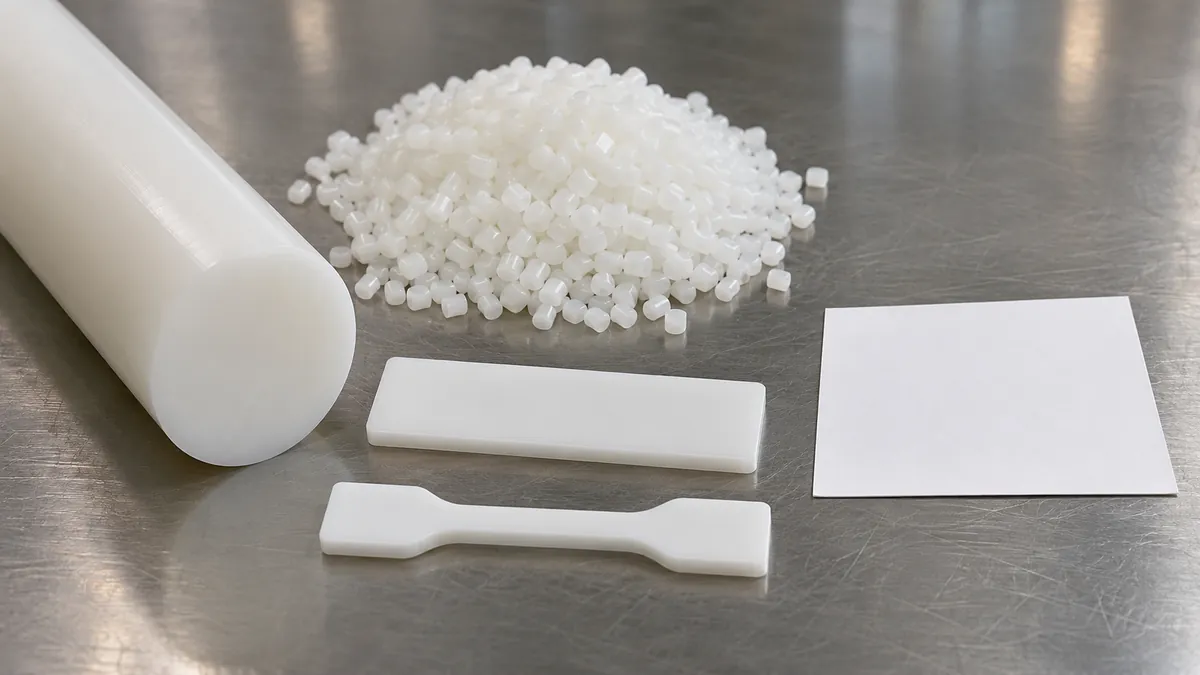
How to specify acetal in an RFQ
A Delrin vs acetal quote comparison should therefore begin by decoding each line item and preserving the supplier’s exact material terminology.
A good specification can be exact or performance-based, depending on what the project controls. If the design requires a specific brand and grade, name it and include the manufacturer code and revision. If alternatives are allowed, state how an alternative may be proposed, what information is required, which deviations need review, and who approves a change. Avoid a vague “or equivalent” phrase without defining the evidence and approval route.
A component-level RFQ can include:
- Part number, drawing number and revision.
- Polymer family and subfamily, if known and required.
- Brand, manufacturer and full grade code when a specific material is required.
- Color, appearance and any approved sample reference.
- Product form and manufacturing route relevant to the proposal.
- Critical dimensions and mating interfaces.
- Function of the component in the assembly.
- Any material properties or tests that the design owner has identified as relevant.
- Required test method, specimen condition, units and acceptance basis when applicable.
- Lot, supplier and document traceability expected by the buyer.
- Change notification, deviation review and approval owner.
- Sample and packaging requirements for the actual order.
This list is not a universal standard or a recommendation to add unnecessary data requirements. Use only the fields that matter to the component and decision. The purpose is to make the supplier’s offer comparable and to prevent the words “Delrin” and “acetal” from hiding a material or process change.
When the buyer permits alternatives
If alternatives are allowed, ask suppliers to submit a formal proposal with exact grade identity and a list of differences. A useful comparison records the approved reference, the proposed alternative, evidence source, condition, affected part features, and the review decision. Mark each item as matched, different, or unknown. “Supplier says equivalent” should not be the final result; it should lead to evidence and review.
A potential substitute can be held for clarification, rejected, or accepted by the designated technical owner. Purchasing may negotiate price and availability, but it should not infer a technical approval from commercial terms. The approval should be linked to the drawing or bill-of-material revision and the relevant purchase order or lot, so reorders follow the same decision.
Sample review and material traceability
A physical sample can help review shape, dimensions, surface appearance, and assembly fit. It does not by itself prove whether the material is Delrin, another POM homopolymer, a copolymer, or a different substance. If the sample has no traceable label or documentation, describe it as unidentified. Do not turn an unmarked sample into a controlled material standard without an approved identification process.
When a sample is submitted, record who supplied it, date, part revision, material designation, stated grade, and which review question it addresses. If the buyer approves a sample for fit, state that the approval applies to fit only unless it explicitly covers material and other requirements. This avoids a later assumption that one visual inspection approved all properties.
For production orders, connect the material declaration or relevant document to the actual supplier and lot as required by the buyer’s controls. A generic product brochure is not the same as a lot-linked record. The necessary traceability level depends on the project. No particular certificate, laboratory test, or regulatory status should be assumed without project-specific evidence.
If material identification is critical, ask the responsible quality or engineering owner to select an appropriate verification method. This article does not prescribe a test, because the correct method depends on the question and the material. Confirm the supplier’s evidence scope rather than assuming that every data sheet or certificate proves the delivered part’s identity.
Common buyer mistakes
Treating Delrin and acetal as mutually exclusive
A Delrin part is an acetal product, but not every acetal is Delrin. The “versus” phrasing can obscure a brand-versus-family comparison. First determine what the supplier means by each line item.
Treating generic acetal as a complete grade
The family name may omit homopolymer/copolymer, manufacturer, commercial code, formulation, and form. Ask for those details before comparing offers.
Assuming POM-H means one identical product
The subfamily designation narrows the identity but does not establish exact grade, formulation, process, or part performance. Preserve the full manufacturer grade code.
Assuming POM-C is always a substitute
A copolymer designation alone does not prove that it meets an approved part requirement. The material and geometry must be compared against the actual function and acceptance criteria.
Choosing by a generic property ranking
General online comparisons may discuss broad tendencies, but they do not establish how an exact part will perform. Avoid adopting numerical or promotional claims outside their documented scope.
Using documents from the wrong product form
A stock-shape document may not describe a molded part, and a generic resin data sheet may not capture the finished geometry. Ask whether the cited data applies to the offered product form.
Approving a change because the part looks the same
Appearance cannot identify the polymer family or grade. A visually similar sample may have different material, process, or lot history. Tie the sample to controlled documents.
Allowing “equivalent” to bypass change control
Equivalence is a technical claim that needs a basis and approval. Capture the exact alternative, differences, evidence, reviewer, and affected revision.
How a custom metal hardware supplier can help
A custom metal hardware manufacturer can discuss the metal part around a bought-in polymer component: interface dimensions, mounting features, drawing clarity, fabrication, finish, assembly access, and packaging when these tasks fall within confirmed capabilities. Koitor Hardware is a family-owned custom metal bathroom and home-storage hardware factory with customization based on buyer drawings or physical samples and direct communication.
That positioning does not mean Koitor manufactures acetal, produces Delrin resin, molds every plastic component, provides accredited material tests, or approves polymer-grade substitutions. Buyers should identify the supplier responsible for the polymer part and separate that scope from the metal hardware quote. If a project needs a custom metal component to fit an externally sourced polymer part, provide the controlled drawing, sample identity, interface dimensions, target quantity, finish, and packaging requirements for project-specific review.
A small-batch development discussion can help clarify what information is missing before a quotation or sample stage. Whether any requested process or part is within the actual project’s scope must be confirmed. This article does not promise a price, MOQ, lead time, tooling approach, production capacity, or outcome. Keep the exact material and approval responsibility visible in the RFQ.
For a related material test-method question, see the plastic impact test comparison for hardware buyers; it does not establish an acetal grade or a substitution decision. Those topics are related, but they answer different buyer questions.
When catalog terminology is inconsistent, ask the supplier to map its commercial wording to polymer family, subfamily, and grade in a written response. Preserve the original wording next to that clarification. This makes future quote reviews more reliable and prevents the buyer from replacing a brand name with a broad family term in a way that changes the scope of the order.
Liste de contrôle à l'intention de l'acheteur avant de demander un devis
- Does the line item identify a brand, a polymer family, a subfamily, or a complete grade?
- If it says Delrin, what exact manufacturer grade and revision is offered?
- If it says acetal, is the offer POM-H, POM-C, or another explicitly identified grade?
- What manufacturer, code, color, formulation, and product form apply?
- Is the material data current and tied to the offered product form?
- What part function and geometry does the material serve?
- Which dimensions and interfaces are controlled on the drawing?
- Are proposed properties tied to a stated test method and condition?
- Is an alternative allowed, and what evidence supports the proposal?
- Who reviews and approves a material or supplier change?
- How will the sample, supplier, grade, lot and drawing revision remain linked?
- Which unanswered issue should be held for the material supplier or technical owner?
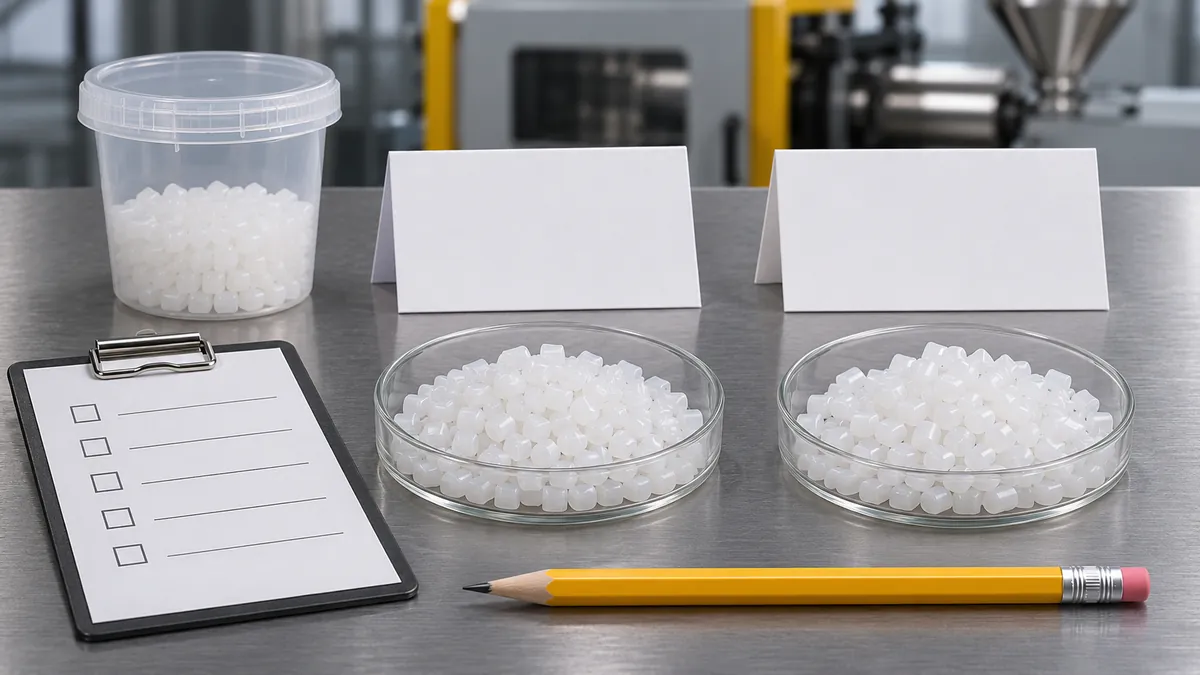
For a delrin vs acetal request, preserve the supplier wording and ask how it maps to polymer family, subfamily, and grade. The mapping is more useful than an unsupported ranking.
Foire aux questions
Is Delrin the same as acetal?
Delrin is a brand of acetal homopolymer. Acetal is a broader polymer family, so a Delrin product can be described as acetal, but a generic acetal offer is not automatically Delrin.
What is the difference between Delrin and generic acetal?
“Delrin” identifies a brand’s acetal homopolymer product range. “Acetal” may be used as a family name or to describe a supplier’s particular grade. Ask for the exact manufacturer, subfamily, and grade to resolve the difference.
Is Delrin POM-H or POM-C?
Delrin is identified by its brand owner as acetal homopolymer (POM-H). Other acetal products can include copolymer grades. The exact grade documentation should be checked for a quoted component.
Is POM-H always better than POM-C?
No universal winner should be inferred from the subfamily terms. The exact grade, component geometry, product form, conditions, and project requirement determine what is relevant. Compare current maker data and obtain a project-specific technical review.
Can any acetal replace Delrin?
Not automatically. A supplier may propose an alternative, but exact grade, formulation, product form, dimensions, evidence, and approval must be reviewed. Do not treat the family name as interchangeability approval.
Does the material name prove the part’s quality?
No. A name identifies only part of the material scope. It does not prove dimensions, lot identity, processing, appearance, or functional performance of the finished component.
What should an RFQ say if I accept alternatives?
State the approved reference, the permitted proposal process, the exact documents and differences suppliers must submit, the required part-level evidence, and the person authorized to approve a change. Avoid a vague “or equivalent” statement without a review path.
Can I identify acetal by looking at a sample?
Appearance alone is not a reliable way to distinguish a brand or subfamily. Link the sample to supplier records and grade documentation, and use a qualified verification approach if material identity needs independent confirmation.
Collaborez avec Koitor Hardware
If a custom metal hardware project includes a bought-in acetal component, share the drawing or traceable sample, the metal interface dimensions, intended use, and the unresolved scope question. Koitor can discuss the confirmed metal product work; acetal identity and grade approval must be supported by the material supplier and the responsible technical owner.
Discuss material and component scope with Koitor Hardware.
Send your drawing, sample, target quantity, finish, packaging, and project questions for a scope discussion.
Fabrication pour compte de tiers / Marque de distributeur
Transformez ce guide d'approvisionnement en cahier des charges
Indiquez-nous le produit souhaité, ses dimensions, sa finition, la quantité commandée et vos exigences en matière d'emballage. Votre équipe recevra une analyse pratique de la faisabilité de la fabrication avant l'établissement du devis.


 English
 Español
 Português
 Français
 Deutsch
 العربية