
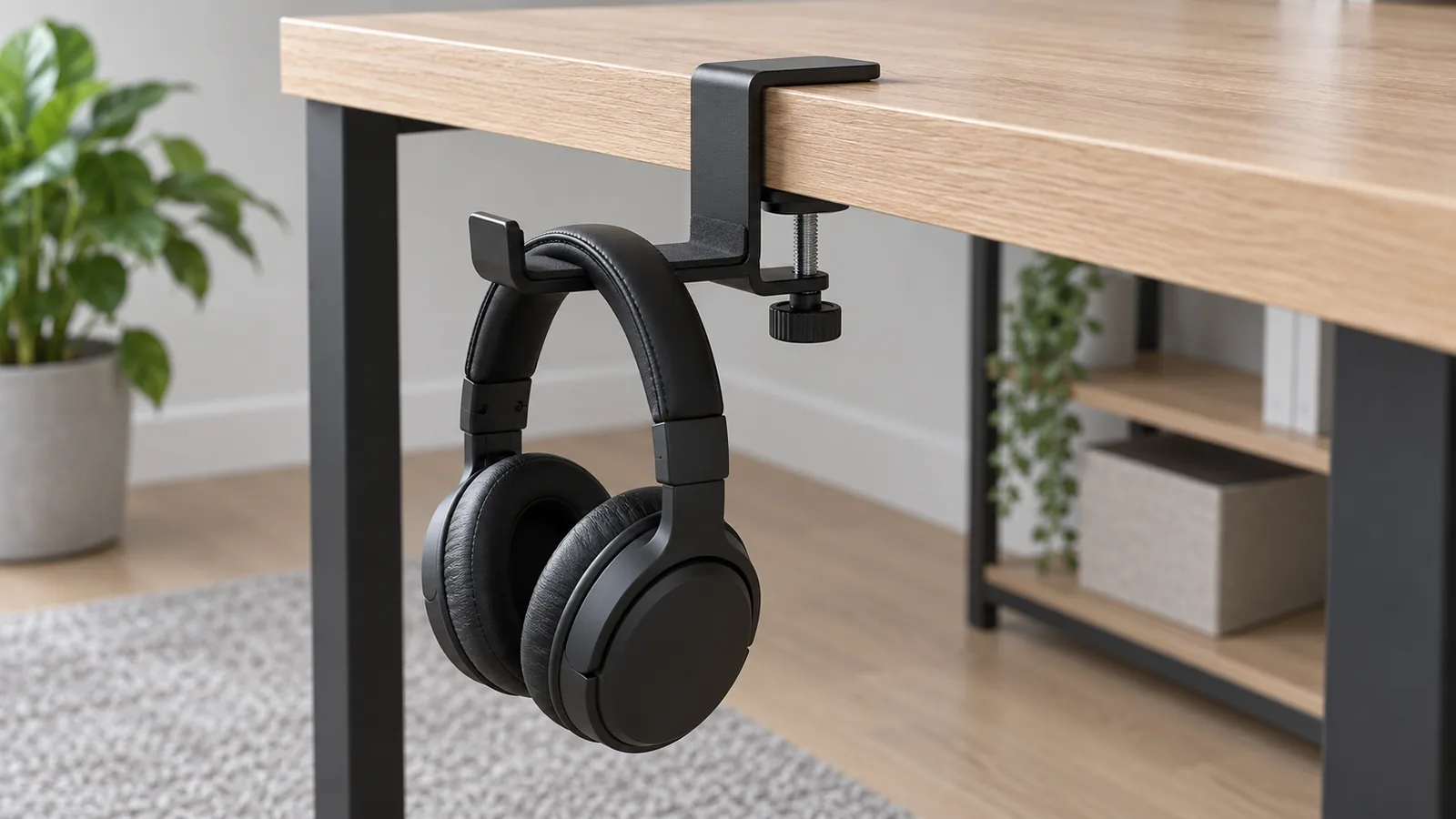
A desk clamp headphone holder should be approved against a defined range of desk edges and the intended headphone assortment, not against the phrase “universal fit.” Before requesting a quotation, record the desktop thickness and edge profiles, available clearance below the desk, clamp opening and adjustment travel, contact-pad arrangement, hook geometry, included parts, finish, and packaging configuration. Then check a production-intent sample against the same desk mock-ups and headphone references named in the specification. The result is a comparable SKU record; it is not proof of a universal load rating or long-term service life.
Why is “a clamp-on headphone holder” not a complete RFQ description?
A product name identifies a category, but it does not tell a supplier which desktop edges the buyer intends to serve. A clamp may have a stated opening range yet still conflict with a thick apron, cable tray, rounded front, bevel, desk mat, or other feature beneath or around the edge. A hook may fit one headband profile while contacting another in a different way. If the buyer compares quotations without recording those details, two visually similar offers may represent different configurations. That is why a desk clamp headphone holder should be specified by interface and intended assortment rather than by a category label alone.
Build the request around the interface and intended assortment. A buyer can provide a top-and-side photograph of representative desk edges, a simple dimensioned sketch, the desired finish, and the headphone styles used for review. If multiple versions are planned, list the desktop range and holder configuration for each SKU rather than expecting one sample to represent every use case.
The question is not whether a supplier calls a clamp “universal.” The useful question is: which defined desk profiles and headphone examples did the supplier review, and what evidence records that fit? That framing helps product teams compare the same requirements across factories without importing an unsupported performance claim into the catalog.
Which desk measurements belong in the specification?
Record more than desktop thickness. Measure the desk edge at the intended clamp position and note the material and shape that the clamp will contact. A simple profile table can prevent a mismatch that a single maximum-thickness number would miss.
| Desk-edge detail | What the buyer should record | Why it changes the sample review |
|---|---|---|
| Top thickness | Minimum and maximum intended thickness, measured at the fit location | Establishes whether the clamp opening and adjustment travel cover the planned range |
| Front edge | Square, rounded, beveled, chamfered, or built-up edge | Changes the contact area and how the clamp sits |
| Underside | Apron, rail, drawer, cable tray, frame, or open space | Determines whether the screw, lower jaw, and hand can reach the mounting point |
| Surface | Wood veneer, laminate, painted finish, glass, or another specified surface | Helps the buyer review pad placement and contact conditions without assuming damage protection |
| Added layers | Desk mat, protective sheet, or permanent edge strip, if part of intended use | Changes the effective thickness or the surface at the contact point |
| Position | Distance from corner, wall, monitor arm, cable bundle, or other obstruction | Confirms whether the clamp can be installed where the buyer expects it |
Do not convert these measurements into a broad compatibility promise unless the supplier has defined and validated the exact range. The buyer should decide whether a product is intended for a single reference desk, several named desk profiles, or a stated dimensional interval. If a sample is checked on only one desktop, the approval record should say so.
How should clamp geometry and underside clearance be checked?
Ask for a drawing or dimensioned specification that shows the clamp opening, jaw depth, screw travel, maximum and minimum opening, and the shape of the contact faces. A buyer needs to know where the clamp sits relative to the desk front and where the adjustment screw occupies space below the top. A product that fits the measured thickness may still be unusable if the underside jaw reaches a drawer rail or the screw cannot be turned beside a cable tray.
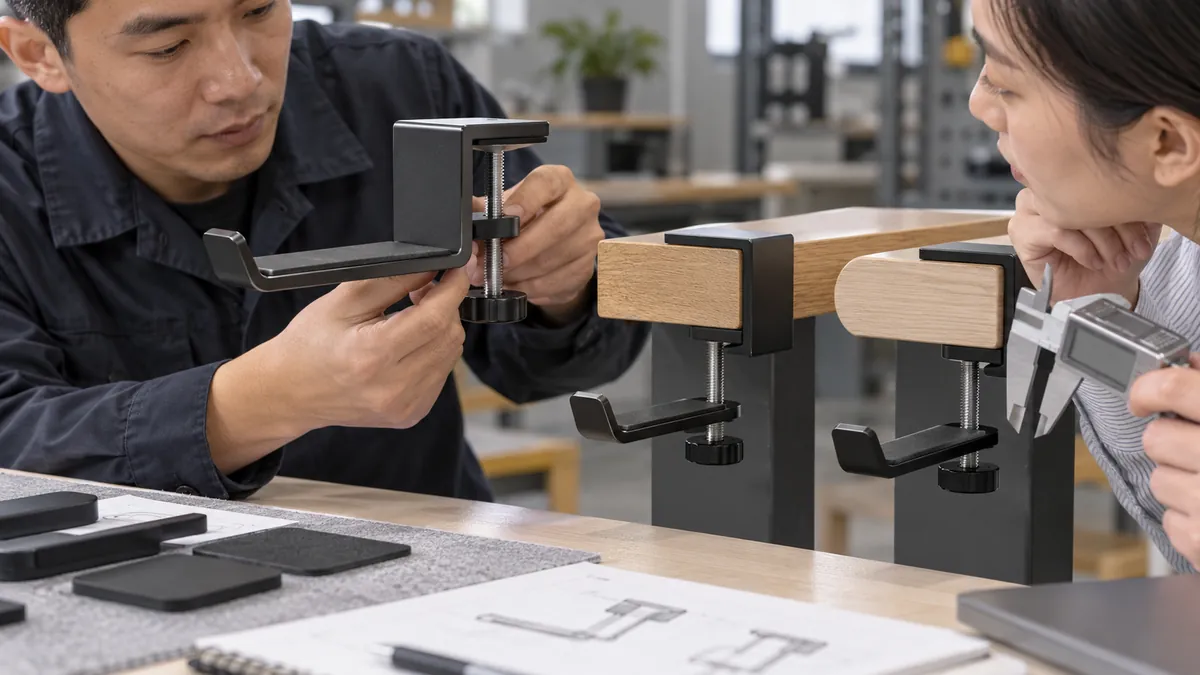
Use representative desk-edge mock-ups during sample approval. Include the thickest and thinnest intended profiles only when those are actual target cases, plus any unusual bevel or underside obstruction included in the assortment. Fit the sample in the intended mounting position. Record whether the clamp seats as designed, whether the screw can be adjusted through its required travel, and whether the hook stays in the planned location. Describe observations; do not infer safe capacity from a short installation check.
A sample matrix might include:
| Reference profile | Thickness / shape | Underside condition | Sample revision | Result and notes |
|---|---|---|---|---|
| Desk A | Buyer-measured | Open edge | Supplier sample version | Record clamp seating and clearance |
| Desk B | Buyer-measured | Apron nearby | Supplier sample version | Record interference, if any |
| Desk C | Buyer-measured | Rounded or beveled | Supplier sample version | Record contact and alignment |
Photographs should show the clamp from above, the front, and below. Include a scale or measurement record where the buyer needs to compare dimensions, but keep the accepted measurement method and tolerances in the drawing or inspection plan. A photo can help identify which setup was reviewed; it does not replace the controlled specification.
What should the buyer specify about contact pads and desk surfaces?
The RFQ should identify whether contact pads are required, where they are placed, which material or supplier specification applies, and whether the pad is replaceable. Buyers should also ask the supplier to identify the surfaces that contact the desk and the headset. If a coating, insert, rubber-like pad, or silicone component is included, name it in the bill of materials or product description instead of relying on a generic phrase such as “soft protection.”
Do not promise that a pad prevents marks, slipping, finish change, or damage on every surface. Desk finishes vary, and the effect depends on the exact material, pressure, cleanliness, exposure time, and use. If surface protection is a product claim, the responsible supplier should provide evidence for the named surface and test conditions. The importer should define what constitutes an acceptable visible change and who evaluates it.
Also check that the pad is positioned consistently and cannot obscure a critical interface or reduce the intended clamp engagement. For a painted or powder-coated metal holder, the buyer can ask which surfaces are finished and whether edges or contact points require a different treatment. Those are specification questions; they do not establish a particular coating quality or corrosion performance without model-specific evidence.
Does the hook fit every headphone style?
No single hook profile should be assumed to suit every headphone. List representative products by headband width, cushion shape, folding joints, cable routing, and any features that affect how the headset rests. Where exact branded models cannot be shared, the buyer can supply anonymized dimensioned profiles or physical reference samples, subject to applicable confidentiality terms.
Inspect the hook’s width, depth, edge radius, orientation, and any retaining lip against the intended headband. Confirm whether the product is designed for one headset or for additional objects such as bags or cables. If the seller proposes a rotating hook, removable insert, cup holder, cable slot, or other option, specify whether it is part of the quoted configuration and how that option affects the footprint and packing.
The selected contact position matters as much as the hook’s outer dimensions. A narrow or sharp contact edge can interact differently with padded, flat, or suspended headbands. The buyer should record where the headset rests and inspect for visible pressure points during the agreed sample review. Do not turn that observation into a claim about long-term material wear unless an appropriate test supports it.
A published product specification is useful as an example of SKU variation, not a general design rule. For instance, Stedman lists one desk-mount hanger’s clamp opening as 0.5 to 1.75 inches (12.7 to 44.4 mm), while LUMI lists a different clamp-on holder with its own configuration, materials, dimensions, and stated features. Those are vendor descriptions for named models. They do not establish a universal fit range, a common industry standard, or the right dimension for another buyer’s product. Stedman DHH product specifications, LUMI HPS01-9 product page.
Which material, finish, and construction details should be confirmed?
Ask the supplier to identify the material and finish for the quoted model and revision. A buyer should not infer a grade from a product photograph or assume that two black holders use the same substrate, forming method, surface preparation, or coating. If the product includes more than one material, such as metal plus a polymer pad, request a component-level description and identify which changes require buyer approval.
Check the drawing for bend locations, formed edges, joints, fasteners, and visible surfaces. Review the sample for burrs, sharp edges, loose fasteners, incomplete coverage, visible scratches, misalignment, and differences between the drawing and physical configuration. Agree which surfaces are cosmetic and how the supplier should identify them in production. A visual sample check can find visible differences; it cannot establish hidden material composition, coating adhesion, strength, or cycle life.
For a private-label range, clarify color reference, sheen, texture, and allowed variation with an approved physical or documented reference. Confirm whether any logo, label, or packaging artwork is included, and who approves it. If a product includes a bought-in pad or screw, list the part number or approved description so that a later substitution does not silently change the interface.
What evidence should be requested for load or movement claims?
A buyer may need evidence for a stated load, repeated adjustment, rotation, or movement claim, but those values must belong to the named product configuration and test method. Ask the responsible supplier to identify the sample or production revision tested, fixture and setup, applied condition, acceptance criteria, and test result. If the buyer’s market, retailer, or technical team requires a particular method, agree it before ordering samples.
A one-time fit check is not a load test. A short static hold does not by itself describe repeated clamp adjustment, long-term wear, surface interaction, or the effect of a particular desktop. A locked screw or a thick-looking metal part does not prove that the complete assembly performs to a given rating. Do not copy another vendor’s published load figure into a new product listing.
If no project-specific evidence exists, phrase the catalog around verified dimensions and components rather than unverified performance. The importer can list the exact compatible profile range that was checked and state the conditions of that check, but should avoid “fits every desk,” “damage-proof,” “heavy-duty,” or lifetime language without adequate substantiation.
How should a production-intent sample be approved?
A sample approval should tie together the drawing, the buyer’s reference profiles, the selected options, and the packaging configuration. Ask the supplier to label each sample with a model or revision code. Keep a copy of the drawing and note the sample date, material/finish description, included pads and fasteners, and all observed differences. If a change is requested after review, identify which interface or evidence must be checked again.
A useful review sequence is:
- Confirm that the physical sample matches the quoted model and drawing revision.
- Fit the holder to each named desk-edge mock-up in the matrix.
- Check clamp opening, screw reach, lower-jaw access, and clearance around nearby aprons or trays.
- Hang the named representative headset or dimensional profile and note how it sits on the hook.
- Check that pads, inserts, fasteners, and optional features match the bill of materials.
- Photograph the approved setup and record observations and unresolved requirements.
- Compare the final retail or export pack with the approved sample and the carton plan.
An approval record should distinguish “reviewed and accepted for the stated configuration” from “tested to a published performance method.” If the buyer has not tested load, cycling, surface interaction, or durability, do not let an approval stamp imply that those claims were verified. Keep open items visible and assign an owner and due date before moving to a production release.
What should the buyer include in the retail and export pack review?
The package should protect the holder’s visible surfaces and prevent loose parts from being separated from the unit, but the pack design must be evaluated for the actual configuration and shipping route. Record whether the holder ships assembled or disassembled, which fasteners or tool are included, how the clamp is immobilized, and how the finish is separated from other metal components. Request the unit-pack dimensions, pack quantity, inner-pack arrangement, export-carton dimensions, and any required SKU or barcode information.
Review the unpacking sequence with the product. A protruding screw, hook, or adjustable part may contact another unit if there is no internal separation. The buyer should check whether instructions identify the included components and whether the physical parts list matches the package. These observations should be tied to the exact revision. Do not claim that a visual carton check proves transit protection; use the buyer’s established packaging test or route-specific acceptance method when required.
For a private-label program, approval should also cover the text and image on the retail pack. A depiction of “universal fit,” a load figure, surface-protection promise, or compatibility chart should be consistent with evidence for the exact SKU. Ask who owns translation, artwork approval, and any destination-market review.
What mistakes make quotes difficult to compare?
The most common process error is asking for a price before identifying the desk range and included configuration. That invites suppliers to quote different clamp openings, pads, hook sizes, accessories, finishes, or pack contents under one generic product name. A cheaper quotation may simply omit the option that made another sample fit the buyer’s intended desk.
Other avoidable mistakes include:
- Providing only a desktop thickness while omitting edge shape and underside obstructions.
- Assuming a clamp that fits one desk will fit a complete retail assortment.
- Approving the sample without the target headphone or a representative dimensioned profile.
- Leaving pad material and placement out of the specification.
- Treating a seller’s load number as a project test result for another design.
- Allowing a post-approval change to a screw, pad, coating, or hook without a documented review.
- Comparing unit prices while ignoring included hardware, assembly, retail packaging, and carton data.
- Using “universal” in product copy without a controlled compatibility matrix.
- Treating an attractive image or sample as evidence of production consistency.
A quotation comparison sheet can list one row per supplier and one column per feature: usable desk range, opening and adjustment, underside clearance, contact pads, hook configuration, included parts, finish, packaging, sample status, and evidence supplied. Mark missing information as “not confirmed” rather than filling the gap with an assumption.
How can a metal OEM partner support buyer review?
A qualified manufacturing partner can help translate a drawing, reference sample, finish request, and packaging requirement into a clear RFQ record. For metal hardware, questions about formed geometry, joining, visible surfaces, assembly sequence, and packing can affect whether a sample reflects the intended revision. A buyer can ask the supplier to flag unclear dimensions or conflicts before the sample is approved.
Koitor Hardware is a family-owned custom metal hardware factory focused on bathroom and home storage hardware. Its documented work includes metal forming and joining, finishing, assembly, packaging preparation, and drawing or sample review. This is relevant as general buyer-education context; it does not mean Koitor currently manufactures desk-clamp headphone holders, clamp mechanisms, accessory pads, or headset products. Any supplier capability for a specific item must be confirmed for that project.
A small-batch OEM process can be useful when a buyer wants to review a proposed configuration before scaling an order, but the buyer should still define the exact sample, change-control, and acceptance requirements. A discussion with a factory is not a substitute for qualified product engineering or independent testing where the product’s claims require it. For a related example of specifying an office product around desk fit and pack-out, see the Metal Monitor Riser OEM importer specification guide. For Koitor’s confirmed category scope, see the OEM home storage hardware page.
What should the RFQ and sample-approval checklist contain?
Before requesting a quotation, send a complete product and fit brief. At minimum, include:
- Intended desk thickness range and the measurement locations.
- Desk-edge profiles, materials, surface types, and underside obstructions.
- Required clamp opening, jaw depth, screw travel, and installation clearance.
- Contact-pad location, material description, replaceability, and approval method.
- Hook width, depth, edge profile, orientation, and any optional movement or accessory feature.
- Representative headphone models or anonymized dimensioned profiles.
- Required material, finish, color reference, cosmetic surfaces, and revision identifier.
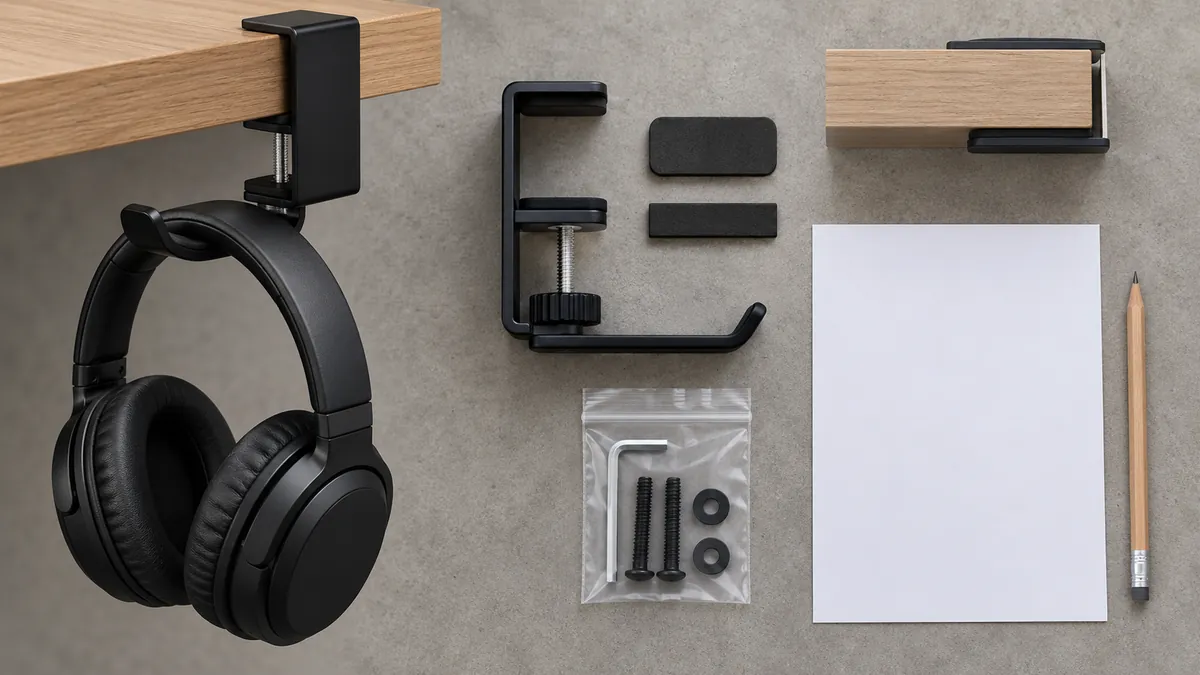
- Included fasteners, tools, pads, instructions, and retail components.
- Sample quantity, sample review date, test method where a claim requires evidence, and approval owner.
- Unit-pack and export-carton dimensions, packing quantity, and private-label artwork responsibilities.
- Target order quantity and destination market for the quotation.
- A list of supplier assumptions and items that remain unconfirmed.
Use this list to compare supplier responses. A desk clamp headphone holder should have one recorded set of fit and configuration inputs before quotations are compared. If a supplier proposes an alternative material or clamp architecture, ask for a revised drawing and identify which desk profiles, headphone interfaces, and claims need another review. Do not approve a substitution by email description alone when it changes a critical fit interface.
Foire aux questions
What is the most important measurement for a desk-clamp headphone holder?
Desktop thickness is one important input, but buyers should also record edge shape, underside clearance, nearby aprons or trays, and the exact mounting position. A thickness range alone does not describe every physical interface.
Should an importer request a “universal” clamp?
The word is not a substitute for a compatibility record. Ask for the actual opening and adjustment range, identify the desk profiles that matter, and review a sample against representative mock-ups. Use a defined, evidence-backed compatibility statement in product copy.
Does a sample fit check prove the holder’s load capacity?
No. A fit check confirms that the sample can be installed on the stated reference profile under the review conditions. Load capacity, repeated adjustment, durability, or surface interaction require the responsible supplier’s project-specific evidence and agreed test method.
Can Koitor supply this headphone holder?
Koitor’s documented focus is bathroom and home-storage metal hardware. Current manufacture of headphone holders or clamp mechanisms is not confirmed. Buyers should confirm the exact product, process, and testing capability with any proposed supplier before requesting a production quotation.
Sources and evidence limits
Published supplier pages illustrate model-specific variation. Stedman lists a clamp opening range for one desk-mount hanger; LUMI describes a different clamp-on model and its named features. These vendor pages support the point that configuration details vary by model. They are not independent engineering standards and do not establish what a different supplier’s product can do. The research pack also reviewed a Delock product datasheet; it was not used to make universal or comparative performance claims.
Community discussions in the research pack are qualitative examples of fit and clearance questions. They do not establish complaint frequency among importers, manufacturing defect rates, or a Koitor customer pattern. The buyer should base a product claim on evidence for the exact model, revision, desk profile, and test condition.
Discuss a Metal Hardware Specification
Share a drawing, sample, finish reference, or packaging requirement for a project within Koitor’s confirmed bathroom and home-storage hardware scope. Current desk-clamp headphone-holder production and product-specific performance testing are not confirmed.
Fabrication pour compte de tiers / Marque de distributeur
Transformez ce guide d'approvisionnement en cahier des charges
Indiquez-nous le produit souhaité, ses dimensions, sa finition, la quantité commandée et vos exigences en matière d'emballage. Votre équipe recevra une analyse pratique de la faisabilité de la fabrication avant l'établissement du devis.

 English
 Español
 Português
 Français
 Deutsch
 العربية