
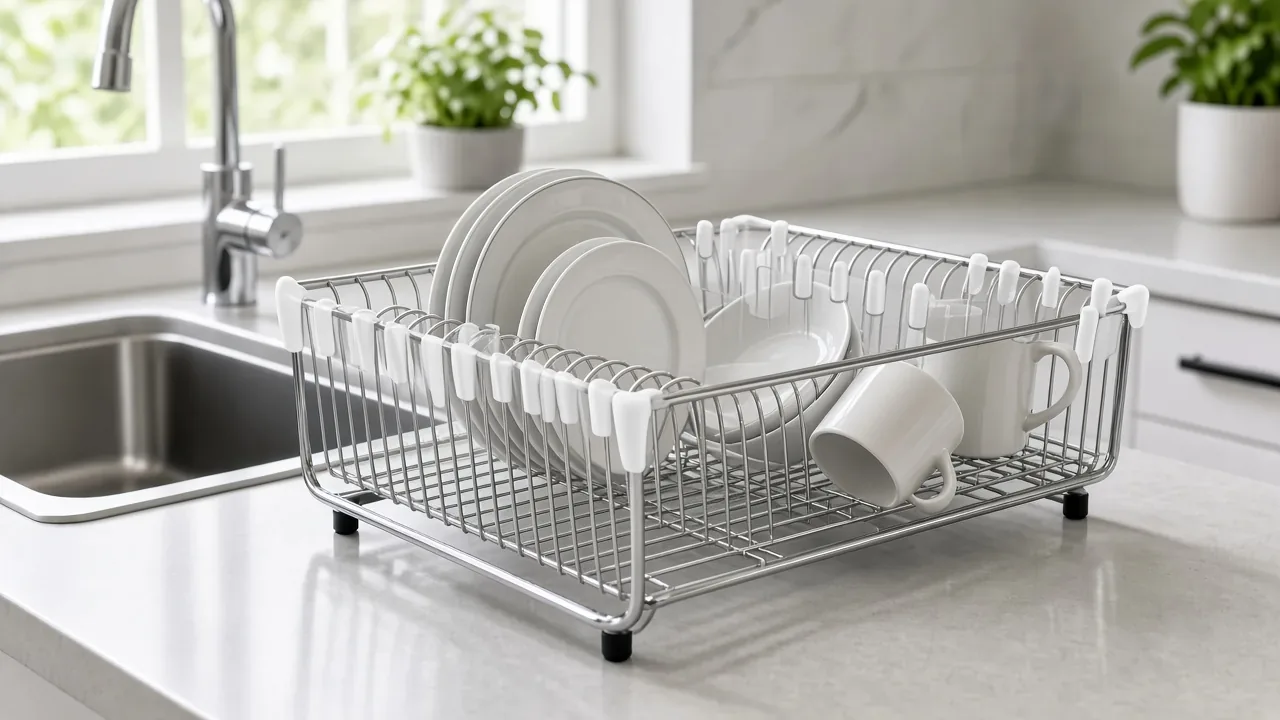
Dish drying rack plate support tip caps should be frozen for tine fit, pack retention, and plate protection before a pretty rack photo is treated as a finished specification. Importers who approve a chrome frame and leave the tine ends bare, or who use a random cap from a bin, will meet chipped plates, missing caps in the carton, or caps that pop off after the first wash cycle in a customer’s sink area.
This page owns the caps on plate-support tines: how they fit the wire end, how they stay on through packing and ordinary use, and how they protect plate edges.
It does not reopen a utensil-cylinder fit, and it does not rewrite counter rubber feet. Live neighbors already cover dish-rack utensil-cylinder fit and dish-drying-rack rubber foot pads; those pages are not in the internal-link file used here and are not hyperlinked. Keep cylinder and foot standards in their own files, and keep this file on tine tip caps.
Kitchen sink dish rack drainage design remains the drainage neighbor and should not be asked to carry cap specifications. Custom kitchen storage rack manufacturing is the general factory conversation. Shore hardness for rubber hardware pads et rubber compression set for mounting pads are method neighbors if a project uses hardness or compression notes; this page does not publish Koitor default values, and it does not treat ASTM D2240 as a factory number.
What fit has to be frozen on the tine, not guessed from a bin cap?
Write the tine end: diameter, end condition (cut, dressed, coined, or otherwise), and whether the cap is a push-on, a molded-on, or another stated hold. A cap that only “looks about right” on a sample tine may be loose on a production cut end that is slightly smaller or sharper.
Family racks that use more than one wire diameter need more than one cap, or a deliberately designed cap that has been checked on each diameter. A single inherited cap from a thinner tine will float on a thicker tine, or split.
Do not treat a foot pad, a bumper, or a cylinder insert as a tip cap because they sat in the same rubber tray. The geometry and the job are different.
How should retention and plate protection be written?
Retention should be checked after packing and after a practical wet-and-dry cycle written as a project method, because many caps first go missing in the carton or after the first week at a sink. A cap that stays on the table sample and falls off in the mail is not a specified cap.
Plate protection should be described as preventing a bare metal tine end from hitting a plate edge at the support point. It is not a chip-proof claim for all ceramics, and it is not a hardness boast. If a project uses a hardness or compression value, keep it in the project file and use the method neighbors for context.
| Cap decision | What to freeze | Typical failure if it is informal | How to check it |
|---|---|---|---|
| Tine fit | Wire diameter, end condition, and the cap hold method | A bin cap fits the sample and splits or floats on production ends | Fit check on production-intent cut ends, not only on a dressed show tine |
| Retention | That the cap stays on through pack and a practical use cycle | Caps in the bag, or empty tines on arrival, or caps lost after first wash | Open-box count plus a project wet-and-dry or handling check |
| Plate protection | The intent to cover the metal end at the plate-support point | A short cap that leaves a metal rim, or a slogan that plates will never chip | A practical plate-edge contact check on the actual tine layout |
| Count and BOM | How many caps per rack, including spare policy if any | A rack with ten tines ships with eight caps | A pack count against the BOM, same habit as any kit |
| Not these other parts | Tip caps stay separate from feet and from utensil-cylinder inserts | A foot or a cup is substituted because the rubber color matches | Visual standard and a separate drawing or bag line for each part |
What this file should leave to neighboring rack pages
Drainage slots, drip paths, and whether a rack should sit in a sink or on a counter belong in the drainage neighbor. Foot compression and slip on a counter belong in the foot-pad file. Utensil-cylinder inner fit belongs in the cylinder file. This page may mention those parts only to keep them out of the cap bag.
What the factory can control, and what it cannot promise
A factory can fit and count caps, check retention by a written method, and cover the metal ends on the plate-support tines. It cannot honestly promise that no plate will ever chip, or that a cap material will last a stated number of years, unless a separate project test exists.
Koitor can review tip-cap specifications as a family-owned China OEM manufacturer of bathroom and home-storage metal hardware, including kitchen drying racks. Commercial durability slogans and default Shore numbers stay outside this page.
Buyer checklist for dish drying rack plate support tip caps
Walk this list before you seal a rack sample, and again when a wire end or a cap vendor changes.
- Write the tine diameter, the end condition, and the cap hold method.
- Check fit on production-intent ends, not only on a dressed sample tine.
- Count caps against the BOM, including any spare rule.
- Check that caps stay on through packing and a practical project use cycle.
- Confirm the metal end is actually covered at the plate-support point.
- Write plate-protection intent without a chip-proof slogan.
- Keep feet and utensil-cylinder parts on their own lines and in their own files.
- If hardness or compression is used, keep the value in the project file and use the method neighbors; do not invent a Koitor default.
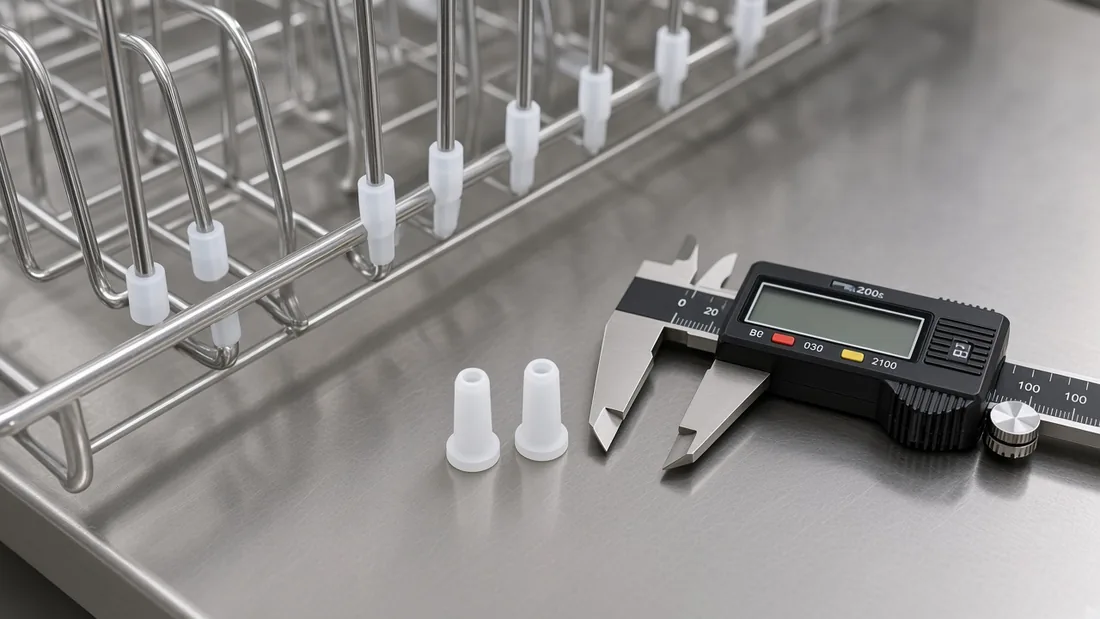
- Do not copy a caliper reading from a photo; this file’s process image uses a blank display on purpose.
- Re-approve caps when the wire diameter, the end dress, or the cap material changes.
Cut ends that are left sharp will cut a thin cap from the inside. If production end-dress is lighter than the sample, the cap that survived the sample will fail later. Either freeze the end-dress as part of the cap fit, or choose a cap that can take the production end. Do not leave end-dress as an unstated courtesy.
Weld spatter or a slightly mushroomed tine end after a process change will also ruin fit. A cap approval should travel with a note about the end’s allowed condition, the same way a hole approval travels with a deburr note.
Some racks use plate tines and cup tines of different lengths. If both get caps, check both. A cap that stays on a short tine may pry off a long tine that sees more plate leverage. Layout is part of retention, not only rubber tightness.
Open-box audits should look for caps already hiding in the carton corners or in a folded towel, not only for empty tines. A cap that left the tine in transit is a retention failure even if it is still “in the box.”
Dishwasher or hot-water intent, if the listing encourages it, should appear in the project cycle. If the rack is not intended for a dishwasher, the sheet should not show one, and the cap cycle can stay with sink-side wet and dry. Do not test one way and market the other.
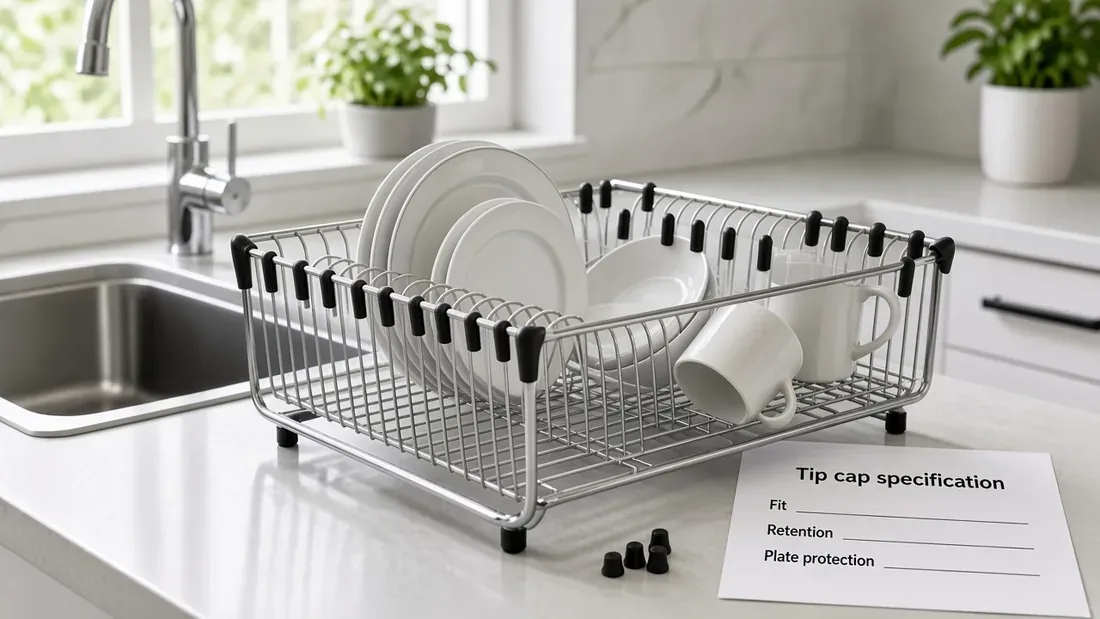
Color is again a retail choice. Clear caps show the metal end if they are short; black caps hide a short seat until a plate finds the metal. Approve coverage by feel and by a close look, not only by a handsome dark cap in a catalog shot.
A spare cap taped to the frame is useful only if the spare matches the production cap and the sheet explains it. A spare in a different size is worse than no spare. Count and identity belong on the spare too.
If caps are applied by hand at the end of the line, write a presence check after application, because it is easy to miss a back tine. If caps are molded on, write what happens when a molded cap is damaged: rework, scrap, or a stated repair that is actually approved.
Do not use a kitchen lifestyle photo with plates already stacked as the only evidence of protection. The photo hides whether the metal end is covered. A close-up of the tine end, with and without a plate, belongs in the internal file.
Chemical cleaners and oils can swell or slip some materials. If a project fears that, add it as a project note. This article does not claim chemical resistance and does not borrow a cleaning-chemical standard.
Replacement sales of caps should name the rack or the tine diameter, not only “dish rack caps.” Mixed replacement bags will create the same fit failures as mixed production bins.
When a factory changes wire supplier, re-check the cap, even if the nominal diameter is unchanged. Nominal is not the production end you will ship. The same habit applies when a cap vendor changes.
Children’s plates, stoneware, and thin glass will not fail in the same way, and this page will not rank them. The specification is coverage of the metal end and a practical project check, not a promise to every plate in a kitchen.
Keep drainage honest. A cap should not block a drain path the drainage file already approved, and a drainage hole should not be asked to hold a cap. If a cap design changes drip behavior, look at the drainage neighbor rather than inventing a new water story here.
Foot pads can share a material family with caps and still need different heights, holes, and compression checks. Store them as two BOM lines. Incoming inspectors should have two pictures, not one tray labeled “rubber bits.”
Utensil cylinders often use a different insert or a different fit problem, including inner diameter and utensil height. Do not let a cylinder insert drawing get stapled to the cap page because both are “small plastic parts on a dish rack.”
If a listing image shows caps and production later drops them to save cost, that is a product change and a customer-expectation change, not a silent cost-down. Treat it like any other BOM cut-in, and do not ship mixed cartons without a written rule.
When fit, count, retention, and coverage are written, dish drying rack plate support tip caps can be sourced and inspected without borrowing a foot or a cylinder standard. When they are not written, the rack is still a set of metal points under a stack of plates.
A first-article pack should include one complete cap count, one photograph of a covered tine end, and a note of the end-dress used. That small packet will save later arguments about whether a returned bare tine was ever capped.
If the rack ships nested, nesting can pull caps off the lower unit. Check a nested pack, not only a single-unit wrap. A cap standard that ignores nesting will pass the lab and fail the container.
Label the inner bag, if caps travel in a bag, with the same identity as the BOM line. Loose caps in a mixed hardware bag will be treated as spares for feet or for another SKU.
Avoid any displayed measurement in product images used as standards. If a caliper appears in a process photo, the display should stay blank, as it does in the process image on this page, so no one treats a picture as a diameter.
A short incoming method can be taught in minutes: count, tug, and look at coverage. Teach it with the sealed sample on the table. Staff should not have to invent a severity language; they should compare to the sample and to the written hold method.
If a cap leaves a dark mark on a wet plate, that is a staining or transfer note for the project, not a reason to drop protection. Decide in the project file; do not ignore marks, and do not jump to an unproven material boast.
Write the cap standard in the same packet as the rack drawing and the foot standard, with clear headings so a reviewer can find tines without reading the foot page twice. Clarity is part of quality, not only rubber chemistry.
Tine layout that fans plates at a steeper angle puts more sideways load on some caps. If you change the layout, re-check retention on the outer tines, not only on a center tine that sees a straight load.
A chromed tine and a powder-coated tine of the same nominal wire may not accept the same cap, because coating thickness and end-dress change the real diameter. Approve the cap on the finished tine you will ship, not on a bare wire coupon.
If caps are shipped as a separate bag for the customer to fit, write that as a different product rule, including a warning that bare tines should not be used until caps are fitted. This page prefers factory-fitted caps unless a written bag rule exists.
Do not let a merchandising team remove caps from a showroom rack “because they look busy.” A showroom bare tine trains buyers to accept a risk the specification already refused. Keep show units consistent with the sealed pack.
When a returned rack arrives with missing caps, aftersales should record whether the tine end is damaged, whether caps are in the carton, and whether the user washed the rack in a dishwasher against the sheet. That record helps process owners without turning this file into a returns map.
A short production sample of cut tine ends, kept with the sealed cap, lets a pack auditor compare a new lot’s ends without walking to the welding cell. Refresh that sample when end-dress changes, and retire the old ends so they cannot become a false standard.
If two rack SKUs share a cap, keep a matrix of tine diameters and end conditions that the shared cap has actually passed. Shared caps that were only passed on one SKU are unofficial hopes, not a family standard.
Write a modest close-out on the first production lot: cap count correct, coverage correct, no caps loose in the carton, nested pack still retains caps. That close-out is more useful than a long material essay without a lot result.
If a retailer wants a premium look with metal-looking caps, still check coverage and retention. A painted or plated cap that looks metallic can hide a short seat even more than a black cap. Look at the tine end, do not trust the shine.
Workers who wear gloves on the line may not feel a loose cap the way a bare-hand inspector would. If gloves are standard, the tug check should be demonstrated with those gloves, or a second bare-hand audit should be written. Feel is part of the method.
Do not store spare caps in an open hopper beside spare feet. Hoppers mix parts. Use marked bins or bags, and audit the bin identity when a new bag is opened.
A modest note in the user sheet can tell people not to pull caps off to “clean under them” with a knife. That habit both loses caps and scratches plates with the newly bared tine. One line is enough; this is not a legal warning page.
Once the tine end, the cap hold, the count, and the nested-pack retention are written, a buyer can compare two factories on the same cap standard instead of on two different lucky samples. That comparison is the point of freezing dish drying rack plate support tip caps before the catalog photo is treated as the finished specification for the rack that will actually be packed, nested, and later shipped onward to the importer or buyer receiving warehouse dock.
Foire aux questions
Can we use the rubber foot as the tip cap if the diameter looks close?
No. Feet and tip caps have different jobs, different retention, and different drawings. Keep them as separate lines even if the material family is similar.
How is this different from a utensil-cylinder fit page?
Cylinder fit is about the cup or tube that holds utensils. This file is about caps on plate-support tine ends. They can exist on the same rack and should not share a specification.
Will tip caps stop plates from chipping?
They are meant to cover the metal end at the support point. This page does not promise chip-proof performance for all plates or all use.
Do we need a Shore hardness number to buy caps?
Not automatically. If you use a number, keep it as a project value and use a stated method family. This article does not publish a Koitor default.
What if caps are present in the carton but not on the tines?
Treat that as a retention or application failure, not as a pass on presence. Caps have to be on the tines they are meant to cover, unless a written spare rule says otherwise and the tines are still covered.
Should drainage design include the caps?
Only to make sure a cap does not undo an approved drip path. Drainage stays in the drainage neighbor; caps stay in this file.
Collaborez avec Koitor Hardware
Need plate-support tip caps specified for fit, retention, and coverage, separate from feet and cylinders?
Send Koitor the rack photos, the tine-end detail, and any current caps. Our team can review fit and pack retention, and can also discuss the hardware construction and small-batch OEM options.
Fabrication pour compte de tiers / Marque de distributeur
Transformez ce guide d'approvisionnement en cahier des charges
Indiquez-nous le produit souhaité, ses dimensions, sa finition, la quantité commandée et vos exigences en matière d'emballage. Votre équipe recevra une analyse pratique de la faisabilité de la fabrication avant l'établissement du devis.


 English
 Español
 Português
 Français
 Deutsch
 العربية