

A printed plate count is a test claim, not a marketing adjective. Dish drying rack tine pitch, tine angle, a named reference plate, and a loaded-life splay check must be frozen before a listing may say how many plates the rack holds. Counting the tines and dividing by two is not a method, because thin salad plates, thick stoneware, and chargers do not share the same slot. If those items are not written, the count should stay off the artwork.
This guide is for importers and private-label teams writing a countertop wire dish drying rack specification. It does not own tip-cap protection, wine-glass holders, utensil-cup fit, rust at welds, or roll-up ledge fit. Koitor Hardware, a family-owned China OEM manufacturer of kitchen and home-storage metal hardware, can review a tine and plate-count brief with a drawing or a sample; the buyer still has to name the plate and the claim.
Why “holds X plates” is a substantiation problem, not an adjective
Shoppers compare plate counts. Returns often describe leaning plates, chipped rims, or tines that opened after a week, not “wrong pitch.” The factory, meanwhile, can ship a rack whose tines look tidy in an empty photo and still fail a filled count on the plates the brand actually sells with the set.
A count without a reference plate is not substantiated. Advertising claims need a reasonable basis before they are made; the U.S. FTC Policy Statement Regarding Advertising Substantiation is a useful reminder of that duty, not a Koitor laboratory result. The file should say which plate was used, how the rack was filled, and whether the tines still held that count after a use check.
Do not treat drainage, roll-up fit, or rust acceptance as substitutes. Kitchen sink dish rack drainage design helps when water path and drip trays are the question. Roll-up sink drying rack ledge fit is a different structure and a different mount. This page stays on tine geometry and the plate-count claim.
Worked example: artwork says “holds 16 plates.” The photo uses very thin plates leaned in every other slot. A buyer’s stoneware set only fits ten before the rims climb. The count was never wrong as a photo trick; it was wrong as a claim, because the reference plate was not named.
Worked example: a first article holds twelve named plates. After a week of daily loading, the outer tines have a permanent set and the twelfth plate falls inward. The pitch on the drawing was still correct. The splay check was missing.
Outer tines are often structural. If the count includes the two end slots, say so, and check those slots. If the ends are only guards, do not count them.
Which tine pitch and angle measurements belong on the finished sample?
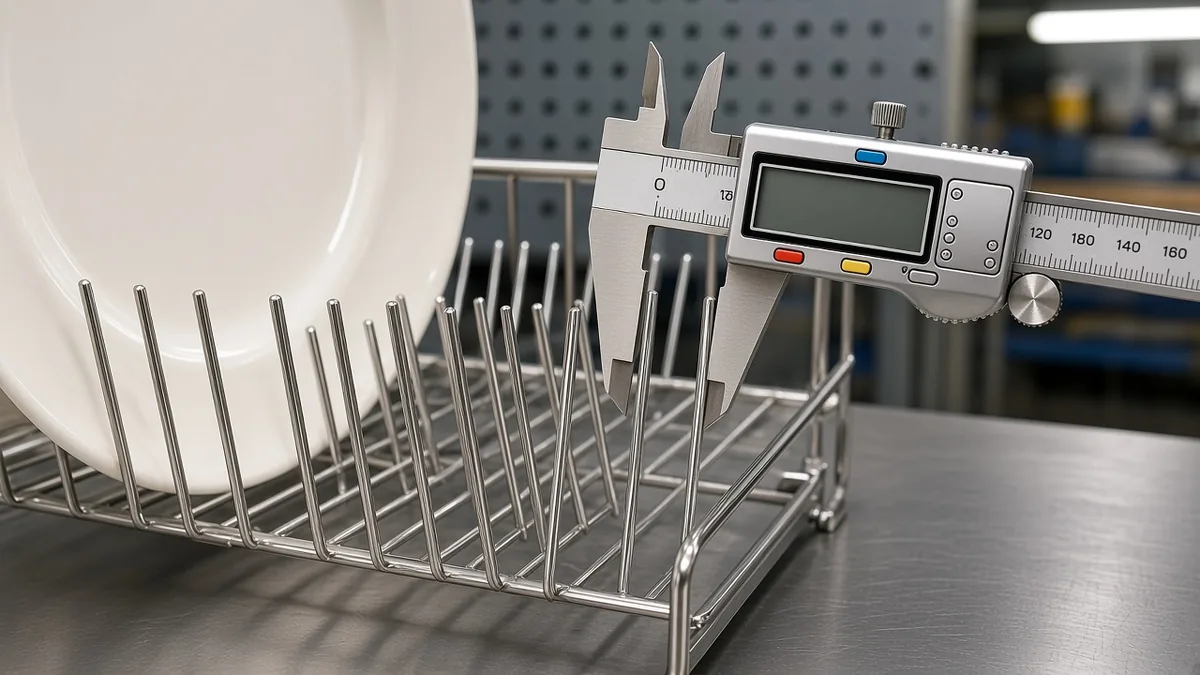
Measure dish drying rack tine pitch on the finished, coated rack, center to center, in the zone where plates will sit. Do not measure only the wire fixture before welding or only a bare rack before coating. Powder or plating can add thickness and can pull a tine slightly off the design angle.
Write the datum: which row of tines, at what height from the bottom grid, and whether you measure the front rank, the back rank, or both. A rack with two ranks can have a different pitch on the back row. If the claim uses both ranks, both belong in the file.
Tine angle should be recorded on the finished sample as well, because a tine that is too upright will let a plate flop, and a tine that is too raked will shrink the usable slot. Use a simple protractor, a gauge, or an overlay against a retained first article. Keep the method in its own clause, not inside a sampling-plan sentence.
If a project needs a numeric pitch, agree it on the sample and write it as a project figure with a plus-and-minus tolerance. Do not invent a Koitor standard pitch in this article or on the carton. Empty drawings that say “equal spacing” are not enough once a count is printed.
Coating build at the tine tip can also change how a plate seats, even when center-to-center pitch is unchanged. If the program uses tip caps, treat cap fit and plate-edge protection as a separate check. This file only asks whether the slot still accepts the named plate after the cap is on, if caps are part of the SKU.
Custom kitchen storage rack manufacturing can quote a dish rack, but only if the inquiry lists the tine pitch method, the reference plate, and the intended count. A request that only says “holds a lot of plates” is not yet a claim file.
How should a reference plate and fill sequence be named?
Name a reference plate by diameter or length, thickness or rim type, and material family: for example a glazed dinner plate of a stated diameter and a stated thickness, or a project-supplied plate that will be retained. If the brand will sell the rack with a house plate, use that plate. If the brand will not, pick one conservative plate and say so, then list exclusions for thicker or larger plates.
Fill sequence matters. A count that only works when plates are alternated left and right, or when every other slot is left empty, is not the same as a count that fills every slot. Write the sequence you will photograph and the sequence you will accept in a sample check. If the lifestyle photo uses a sparse fill, the artwork should not imply a dense fill.
Record whether plates may lean on each other. Some racks are designed for a slight lean; others are not. If leaning is required to hit the count, say so, and check rim contact so the claim does not hide chipping.
Do not mix glassware, lids, or chargers into the dinner-plate count unless the file names them. A charger that sits only in the end bays is not “plus two plates.” A lid that uses the bowl well is not a plate. Keep those items in an exclusion or in a separate accessory count.
If more than one plate type will be claimed — for example ten dinner plates plus four side plates — write two counts and two fill maps, or write one combined map. A single number that secretly mixes sizes will fail as soon as a shopper uses one size only.
Retain the reference plate, or retain a simple gauge that represents its thickness and diameter. A verbal “standard dinner plate” will drift between offices and seasons.
| Claim element | What to freeze | What a sample should show | What to keep off artwork until then |
|---|---|---|---|
| Tine pitch | Center-to-center method on the finished coated rack, with a stated datum | Pitch holds across the claimed slots, including outer tines if they are counted | A count based only on an empty beauty photo |
| Tine angle | Finished angle or an overlay against the retained first article | Plates sit in the named attitude without climbing or flopping | A rake that exists only on the uncoated prototype |
| Reference plate | Diameter or length, thickness or rim, and whether it is a retained project plate | The named plate fills the claimed slots in the written sequence | “Holds X plates” with no plate named in the file |
| Fill sequence | Every slot, every other slot, or a drawn map, including lean rules | The photograph and the check use the same map | A sparse photo used to support a dense count |
| Splay or set | A loaded-life or set check after the named fill, with a limit you can inspect | Tines do not take a permanent set that loses a slot | A first-day count that does not survive a week of use |
| Exclusions | Chargers, stoneware, lids, or other items not in the count | Those items are absent from the count line, or they have their own line | A silent claim that “fits all plates” |
What splay or permanent-set check keeps the count honest after use?
A first-article fill is not the end of the claim. Tines can open, twist, or take a set after repeated loading, especially at the outer ends and at any tine that was over-bent in forming.
Write a simple use check: fill the named plates in the named sequence, leave them for an agreed period or cycle them on and off for an agreed number of times, then see whether the last plate still sits and whether pitch or angle has moved beyond the project limit.
Do not invent a kilogram load or a Koitor cycle count here. The condition should be named in the project file: the plates, the sequence, and the number of fills or the hold time you will actually run. A qualitative “after a week of normal kitchen use on the named plates” is safer than a made-up endurance badge, as long as “normal” is then spelled out for the sample room.
Inspect welds or wire joints at the tine roots after the check. A tine that stayed in pitch but cracked at the root is not an accept, even if the count still looks complete. Coating cracks at the root also belong in the note, because they are often the first visible sign of set.
Keep the splay measurement method separate from any sampling plan. You may later agree a lot check using a scheme such as ISO 2859-1, but that scheme does not define pitch. Define accept and reject first, then, if needed, agree how many racks in a lot are measured.
If the rack is sold as a set with a drain board or a utensil cup, do not let those parts steal tine slots in the photo. A cup that blocks two end tines reduces the real count. Either move the cup in the fill map or reduce the claim.
A folding or collapsing rack, if that is the SKU, needs the same pitch check in the open position after a stated number of folds. Do not assume the tines return to the first-article angle. That is still this decision, not a latch-material file.
Which exclusions and neighbor checks belong off this artwork line?
Keep chargers, extra-thick stoneware, oversized pasta bowls, and pot lids off a dinner-plate count unless they were named and filled. “Fits most plates” is still a claim. If you have not checked the exception, exclude it.
Tip caps, if used, protect edges; they do not create a count. Wine-glass holders, if offered, are a different interface. Utensil cylinders and cutlery cups are a different fit. Rust at weld nuggets or cut ends is a different acceptance file. None of those pages should be rewritten here, and a pass on any of them does not approve a plate count.
Photography should use the reference plate, or should be captioned so a shopper is not shown a thin-plate fill as if it were stoneware. A hero image that hides the back rank can also hide a pitch problem. Keep at least one straight-on photo of a full claimed fill.
If the listing will be translated, keep the number and the plate description together. A translation that drops the plate size and keeps the number is a new, weaker claim.
Buyer checklist for dish drying rack tine pitch and plate counts
Use this list before a plate-count line is approved for a wire dish drying rack.
- Write the intended count as a claim that needs a method, not as an adjective on an empty rack photo.
- Measure tine pitch and tine angle on the finished coated sample, with a stated datum, and keep that method out of any sampling-plan clause.
- Name a reference plate by size and thickness, or retain a project plate, and use it in the sample fill.
- Write the fill sequence, including whether every slot is used and whether plates may lean.
- State whether outer tines are counted or are only guards.
- Run a splay or permanent-set check after the named fill, and inspect tine roots as well as pitch.
- Exclude chargers, thick stoneware, lids, or other items that were not in the fill, or give them their own line.
- Do not let a utensil cup, a drain-board shot, or a sparse lifestyle fill silently change the count.
- Keep the count off artwork until the plate, the sequence, and the splay check exist.
- Do not treat drainage, roll-up ledge fit, tip caps, or rust acceptance as a substitute for this file.

Koitor can review a tine and count brief as part of fabrication de rayonnages de rangement sur mesure pour cuisines. Send the drawing or the sample, the intended count sentence, the reference plate, and the fill map.
Small-batch customization is possible depending on the product. MOQ can start from 100 pcs depending on the product, samples usually take 5–7 working days after details are confirmed, and bulk production usually takes 4–6 weeks depending on the project. A tine-pitch change may need a new forming fixture; that is a project discussion, not a free revision inside an old count.
A family-owned factory can hold a tine fixture and a retained rack, but it cannot honestly promise that every later plate in a shopper’s cupboard will fit. The buyer still owns the reference plate and the exclusions.
Incoming lots should include a pitch or overlay check on the finished tines, not only a carton count of racks. A later fixture repair, a later coating shop, or a later wire lot can reopen the count. Tick the pitch against the retained rack or gauge.
If a distributor asks for a “compact” version with a shorter frame and the same count, treat it as a new pitch file. Compressing the frame almost always changes the slots.
Retail bundles that add a second rack or a cutting board should not reuse the first count without a new fill. A board that occupies the front rank changes the usable tines.
Do not use a field chip story as proof of pitch. Chipping can come from missing tip caps, from rough rims, or from a lean that was never written. Investigate the slot and the plate before you change the count.
When the finished pitch, the angle, the named plate, the fill map, and the splay check are written, a plate-count sentence can be considered. If the file only says “large capacity,” dish drying rack tine pitch is still open.
Warehouse stacking can bend tall tines if racks are nested without a protector. A bent inbound tine will fail the first incoming overlay even when the factory first article was good. Write a nest or separator note, and inspect a few racks from the top and the bottom of a carton.
A second plant should not inherit the count by email. Overlay the tines, fill the retained plate, and rerun the set check before the listing is reused.
Instruction sheets that show a fill map should match the claim. A map that shows ten plates while the title shows sixteen is a file error, not a styling choice.
If the rack will be photographed for a marketplace A-plus module, use the same reference plate as the first article. A studio stylist who swaps in thinner plates is rewriting the claim.
Wire diameter and temper affect splay, but they are inputs to this check, not a substitute for it. A thicker wire can still be formed to a pitch that does not accept the named plate. Freeze the geometry and the fill, then discuss wire as a project change if the set check fails.
End-of-line photos from the factory should include a filled rack, not only an empty rack on a sweep. An empty photo cannot support a count file at incoming.
Private-label teams sometimes inherit a count from a source listing in another market. That inherited number is not a method. Refill the retained plate on the actual tool and finish you will buy, even if the source photo looks identical. A different coating shop can move a tine enough to lose a slot at the end of the row.
If the rack will sit against a backsplash, check the fill with the rack in that position. A tine that clears on an open table can interfere with a tall backsplash or a window sill, and the last plates will be the ones that climb. Write that setting in the sample note when the listing shows the rack tight to a wall.
Do not use a cereal-bowl fill as a secret substitute for the dinner-plate count. Bowls often use the lower well, not the tine slots. If bowls are part of the merchandising story, give them their own line and their own well map, and leave the plate count honest.
Foire aux questions
Can I get the plate count by dividing the tines by two?
No. That ignores plate thickness, tine angle, outer guards, and later splay. Name a plate and fill the rack.
Does a tip cap change the count?
It can change how a plate seats, but cap retention is a separate check. After caps are fitted, still fill the named plate and see whether the count holds.
What if my brand sells both thin plates and stoneware?
Write two counts, or write one conservative count and exclude the thicker plate. Do not print a single number that only works on the thin plate.
Is a first-article fill enough?
It is not enough if tines can take a set. Add a simple loaded-life or cycle check and inspect the roots.
Can a roll-up rack use this same file?
No. A roll-up ledge-fit rack is a different structure. Use the roll-up fit page for that SKU, and write a different method if it even has tines.
What should a first sample include?
The finished coated rack, the reference plate or its dimensions, a fill map, and photos of a full claimed fill. An empty beauty shot is not a count sample.
Collaborez avec Koitor Hardware
Need a dish-rack plate-count brief reviewed?
Send Koitor the drawing or sample, the intended plate-count sentence, and the reference-plate details. Our team can review tine geometry, the fill map, and small-batch OEM options before quotation.
Fabrication pour compte de tiers / Marque de distributeur
Transformez ce guide d'approvisionnement en cahier des charges
Indiquez-nous le produit souhaité, ses dimensions, sa finition, la quantité commandée et vos exigences en matière d'emballage. Votre équipe recevra une analyse pratique de la faisabilité de la fabrication avant l'établissement du devis.


 English
 Español
 Português
 Français
 Deutsch
 العربية