
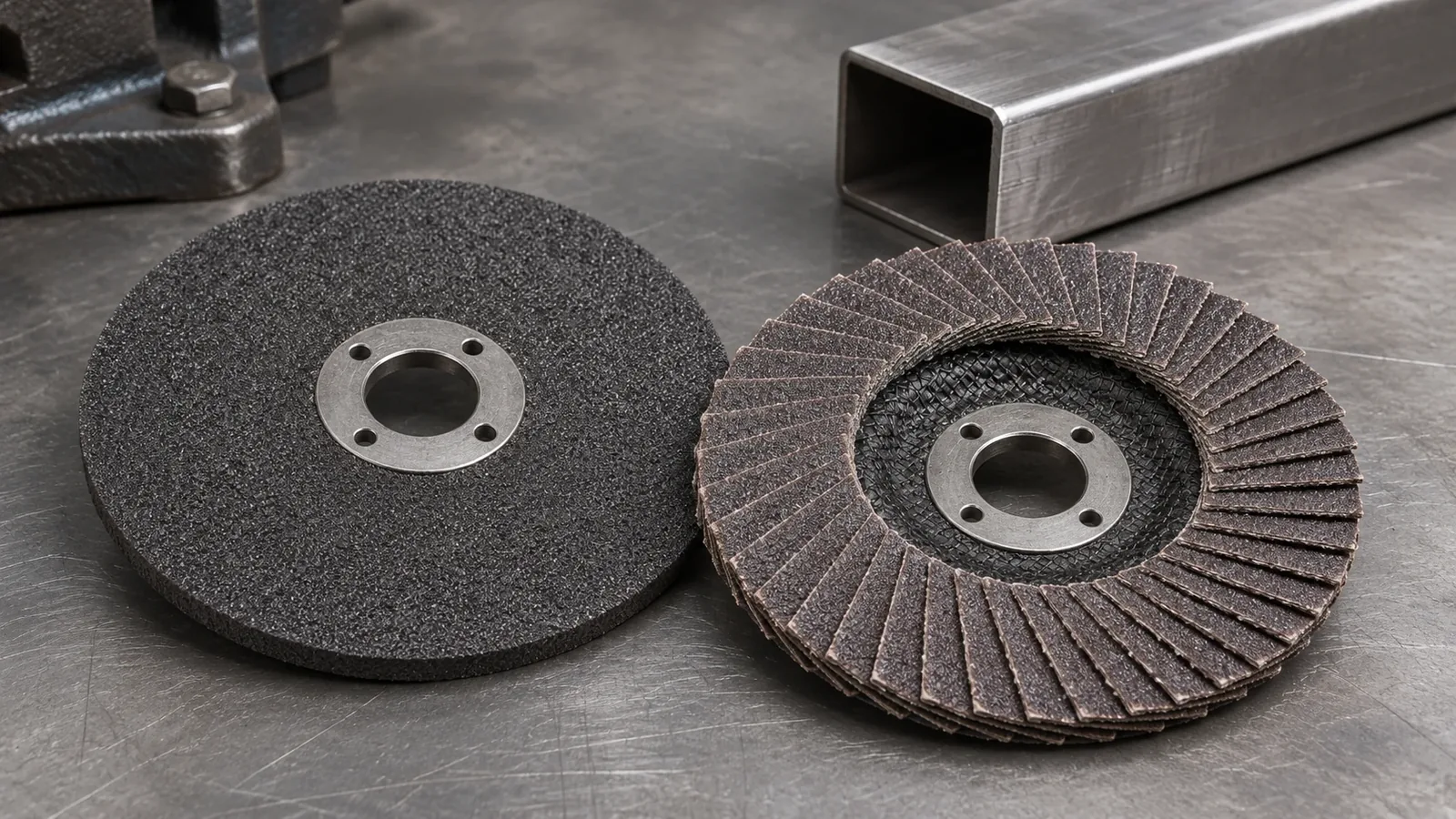
A flap disc vs grinding disc comparison starts with how each abrasive is built. A bonded grinding disc holds abrasive grains in a bonded working body, while a flap disc places overlapping abrasive-coated cloth segments around a supporting backing plate. A flap disc vs grinding disc review starts with construction, but the products can share abrasive grain types and their tasks can overlap, so the name alone does not decide whether a particular wheel is suitable for a metal part. A buyer should identify the exact construction, workpiece task, desired result, and product-maker instructions before specifying a finishing route.
What Buyer Decision Does This Comparison Support?
This comparison helps a buyer or product developer understand tool architecture before reviewing a metal-finishing quotation or process description. It does not provide a machine setting, personal protective equipment instruction, or a universal ranking of tools. The relevant purchasing question is whether the proposed abrasive construction matches the described work on a particular part and whether the supplier can identify the exact product and its applicable instructions.
A supplier may summarize a process as “grind and polish” or list a flap disc in a tooling note. Those shorthand phrases can hide important distinctions. A bonded disc and a coated-abrasive flap disc are not identical simply because both are round and attach to a power tool. One has a consolidated abrasive body; the other has layered coated strips. Each carries abrasive material differently and has its own wear behavior.
For a bathroom or home-storage hardware buyer, the result may affect a cosmetic edge, a weld area, or the transition between two surfaces. The buyer’s role is to specify the part and appearance requirement clearly, ask which operation is being proposed, and agree on how the finished component will be reviewed. The exact abrasive choice belongs to the responsible manufacturing team, following the abrasive and machine maker’s instructions.
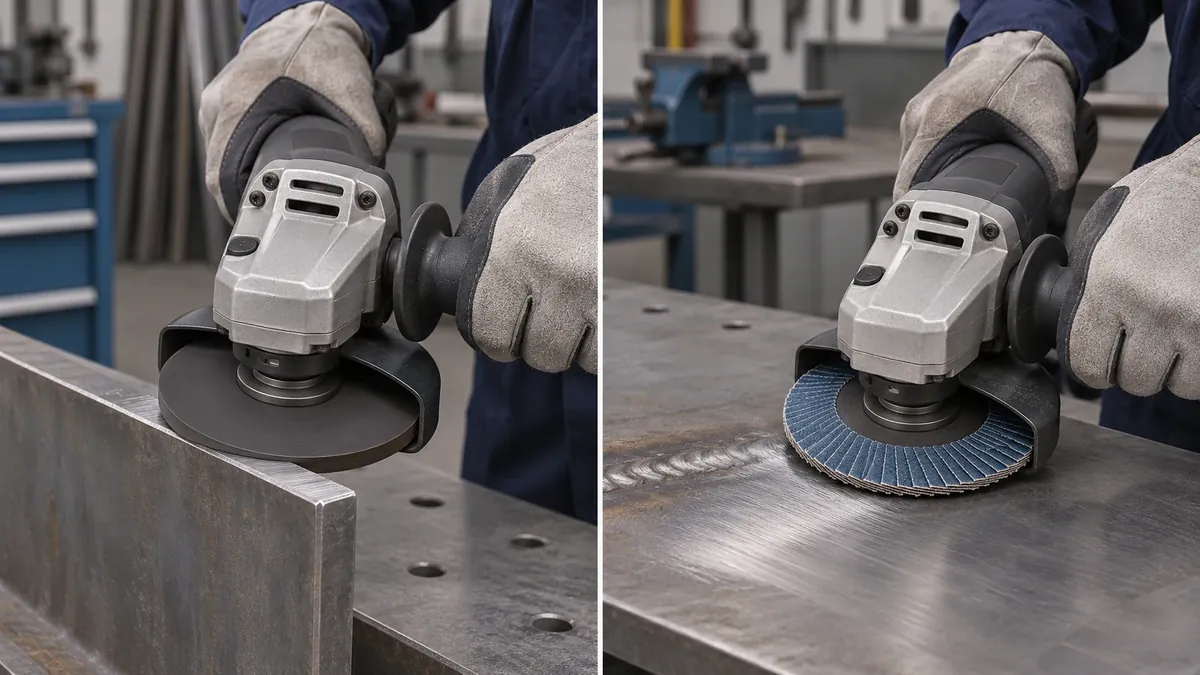
How Are the Two Abrasive Discs Constructed?
A bonded grinding wheel is made by combining abrasive grain with a bond and other formulation ingredients, then forming a working body. Norton’s overview describes the manufacture of grinding wheels from resins, fillers, and grain. In use, the abrasive grains and bond make up the disc’s working structure. The wheel does not consist of cloth flaps laid over a backing plate.
A conventional flap disc is a coated-abrasive product. Abrasive grains are attached to cloth pieces, and those pieces overlap around a supporting backing plate. Weiler describes the layered construction and discusses variations such as flat or conical shapes and different flap arrangements. A flap disc therefore has at least two distinct structural elements for a buyer to identify: the abrasive-coated flaps and the support beneath them.
The difference can be represented in a role map:
| Component or role | Bonded grinding disc | Flap disc |
|---|---|---|
| Abrasive carrier | Grain distributed through a bonded working body | Grain attached to cloth flaps |
| Arrangement | Consolidated disc-shaped body | Overlapping coated strips around a backing plate |
| Support role | The bond and wheel body hold the abrasive structure together | A separate backing plate supports the flap arrangement |
| Wear consideration | Grain and bond wear as a bonded product | Exposed coated cloth changes as the overlapping flaps wear |
| Buyer identification | Exact wheel type, specification, and manufacturer information | Exact flap-disc construction, shape, backing, and manufacturer information |
| What the construction does not prove | A guaranteed removal rate or finish | A guaranteed finish, life, or superiority |
This table describes construction at a general level. Abrasive makers offer product variations, and those variations should be identified from the product documentation rather than inferred from color, shape, or a photograph. A flap disc may use different backing and flap configurations. A bonded wheel may also vary by grain, bond, and product class. The names are useful first clues, not complete specifications.
How Do the Wear Structures Differ?
The way abrasive material is presented changes as each product wears, but the details remain product-specific. In a flap disc, overlapping strips of coated cloth expose working abrasive across the face. As one portion wears, more of the layered surface may become exposed. In a bonded disc, grains remain part of the bonded body, and the wheel’s wear behavior depends on its construction and the work conditions. Do not summarize this as “one renews and the other does not”; that would overstate the contrast.
A useful conceptual comparison is:
bonded body → grain and bond form one working structure
coated cloth flaps → overlapping strips and backing plate form a layered structure
The second construction can present coated abrasive material through its flaps; the first presents a bonded abrasive body. Neither sequence predicts a fixed service life, a constant cutting rate, heat generation, or a guaranteed surface appearance. Those outcomes depend on the exact abrasive product, workpiece, operation, equipment, and how the maker says it should be used.
The distinction also prevents an easy identity mistake. “Fiberglass” can appear in descriptions of a reinforced grinding wheel or in a flap-disc backing plate. The presence of a shared material somewhere in two discs does not make the entire product architecture the same. A buyer should ask what the fiberglass or other support element does in the named product, not use that one term as a complete product classification.
Does One Disc Always Remove More Material?
No universal answer follows from the product names alone. Norton’s overview discusses grinding wheels and flap discs among options for weld grinding and other metal-removal work, showing that real applications can overlap. A distinction between stock removal and blending can help frame a process discussion, but it is not a rule that each product has only one possible job.
For example, a manufacturing team might describe two possible paths for a metal part:
- If a feature requires substantial stock removal, the team may evaluate an appropriate grinding product for that defined operation.
- If the remaining feature is modest and the requirement includes blending, a team may evaluate a flap-disc route for the particular part.
- A process may also involve separate removal and finishing steps rather than asking one abrasive to accomplish every stage.
These are conditional descriptions, not instructions to grind a weld flush or change a production method. A weld’s function, drawing, material, geometry, acceptance criteria, and responsible engineer matter. The abrasive product maker’s instructions and the equipment maker’s instructions also apply. The existence of an abrasive choice does not authorize a buyer to alter a structural weld or remove material beyond the agreed drawing.
A flap disc can remove metal; a grinding wheel can be used in a range of processes defined by its maker. The important distinction for a sourcing team is not a slogan like “rough versus fine.” It is the actual product structure, the operation being proposed, and the way the finished feature will be evaluated.
What Finishing Task Should a Buyer Describe?
Buyers should describe the required condition of the part rather than simply selecting an abrasive by name. Examples of useful information include the affected surface, the dimension or feature that must remain, the appearance expectation, the location of a weld or edge, and whether the component is cosmetic or functional. If a buyer does not know which abrasive route is appropriate, the request can ask the supplier to propose one and identify its assumptions.
The following task map helps start that conversation:
| Part condition or requirement | Question to discuss with the manufacturer | Why the question matters |
|---|---|---|
| A raised feature remains | Is material removal required, and what feature must remain? | The amount and location of removal can affect the part geometry |
| A visible weld area needs refinement | What surface appearance and weld acceptance are specified? | Appearance and structural acceptance are separate requirements |
| An edge must meet a profile | Which dimensions or edge breaks are controlled on the drawing? | A finishing step can change an edge or adjoining face |
| A broad surface shows marks | Is the requirement visual, dimensional, or both? | A finish description should not be reduced to a grit name |
| A supplier proposes a substitution | What exact product replaces the named abrasive and how is the process approved? | Similar product names do not prove equivalent construction or result |
| The buyer has only a sample | Which areas of the sample are critical and how will they be compared? | A sample can guide review but may not contain a complete acceptance specification |
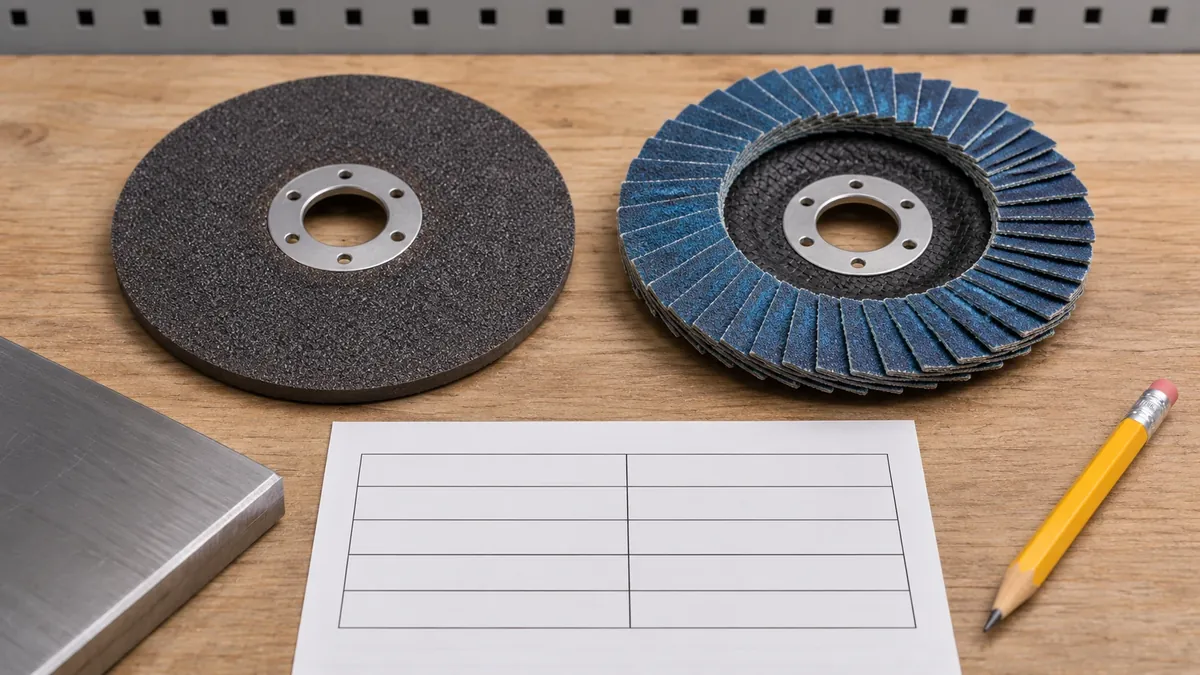
A drawing should identify critical geometry and cosmetic faces where practical. A sample should be marked or documented so that the reviewer knows which edges and surfaces matter. When the buyer requests a change, the manufacturer should explain whether the current process can achieve the revised requirement and what additional sample or inspection discussion is needed. Do not use “smooth finish” as a replacement for all dimensions or acceptance criteria.
Flap Disc vs Grinding Disc: How Should Buyers Compare Product Offers?
A buyer can compare offers with a short, source-based list instead of an unsupported winner table. Ask each supplier to identify the exact disc and operation, then compare the stated specification and scope. If two offers use different tool types, the cost comparison should include the full process and inspection needs rather than only the unit cost of an abrasive disc.
Check these fields:
- Product identity: manufacturer, product name, disc type, and any specification needed to distinguish the item.
- Construction : bonded working body or coated cloth flaps with a backing plate.
- Abrasive description: the grain or product family as stated by the maker; avoid inferring performance from a grain name alone.
- Operation: which feature is being removed, blended, or otherwise finished.
- Part scope: material, geometry, cosmetic faces, and any drawing-controlled edges.
- Maker instructions: applicable product and equipment instructions for the proposed use.
- Acceptance: how the finished part will be checked against the drawing or approved sample.
- Contrôle des modifications : who must approve a substitution before it affects production parts.
Do not compare a disc’s published life, removal rate, angle, or process setting unless the supplier has supplied reliable evidence that the statement applies to the exact product and conditions. The research for this article does not establish universal numerical values. It also does not identify a Koitor abrasive brand, machine, shop process, production rate, or finishing result.
How Does the Abrasive Choice Affect a Metal Hardware Part?
The abrasive is one stage in a product’s manufacturing route. A finished metal accessory may also depend on forming, welding, joint design, polishing, coating, assembly, and inspection. A local grinding operation can affect material near an edge or weld, while a blending operation can affect how a visible transition appears. The exact effect is part- and process-specific.
For sourcing, separate three questions:
- What geometry must the component retain? Use the drawing and sample to identify holes, edges, mating surfaces, and dimensions that cannot be casually altered.
- What appearance is expected? Describe the visible face and acceptable appearance using a shared sample, reference, or written requirement.
- What evidence confirms acceptance? Agree on the appropriate inspection record or sample review without inventing a test standard.
These questions are often more useful than asking whether a flap disc or a grinding disc is “better.” A disc can be correctly identified and still be unsuitable for a particular operation. A process can remove a protrusion but also leave a visible mark, change a profile, or require a later finishing stage. A tool name does not establish the acceptance result.
Koitor Hardware is a family-owned custom metal hardware factory focused on bathroom and home-storage products. Its approved manufacturing discussion can cover drawings, samples, metal structure, welding, grinding, polishing, surface finishing, assembly, and packaging preparation. That does not establish that Koitor uses a particular abrasive disc or that every production site uses a stated process. Buyers should ask the actual manufacturing supplier to confirm the process proposed for their part.
How Should a Supplier Explain a Proposed Process Change?
A process change should be described in terms the buyer can connect to the product. If a supplier changes from a bonded wheel to a flap disc, or changes the abrasive product within the same general class, ask what is changing and which part feature is affected. A product substitution can change the working structure even when the operation is described with the same verb.
A useful supplier response should identify:
- the current and proposed abrasive product;
- the feature or surface affected;
- whether the operation changes removal, blending, or the sequence of those steps;
- whether any drawing dimension, edge, weld, or cosmetic face is affected;
- what sample, document, or inspection review is proposed before the change is accepted.
Do not treat this list as a certification protocol or a requirement for a particular test. It is a practical change discussion. The supplier may have to consult the abrasive manufacturer or responsible engineer for product-specific instructions. Where a part has a functional weld or critical dimension, the buyer should not approve a change based only on a photograph.
If a coating, polish, or finish is applied later, the supplier should also discuss whether the proposed change alters the prepared surface that enters the next operation. This is a planning question, not a general claim that one abrasive leaves a specific surface roughness. A controlled sample can help the buyer and supplier discuss the visible result, provided the sample’s material, revision, and process scope are recorded.
What Are Common Buyer Mistakes?
Assuming the two discs are opposites
The products differ in architecture, but the task boundary is not absolute. A buyer who assumes that only a flap disc can blend or only a grinding wheel can remove metal may overlook the actual maker guidance and process context.
Classifying by shape or color
A round disc can be bonded or coated, and color is not a reliable identity code across suppliers. Confirm the exact product rather than infer type from an image.
Treating a shared grain as proof of equivalence
Two discs may use related grain families while presenting them through different structures. The carrier, backing, bond, and product construction still matter.
Assuming backing material defines the whole tool
A reinforcement or backing element may occur in more than one product type. Ask what function that element serves in each product.
Leaving the finish requirement vague
“Grind smooth” does not define which dimension, edge, weld, or cosmetic face must be preserved. Tie the request to a drawing, sample, or other agreed acceptance description.
Recommending a process from a search result
A general guide is useful for understanding product classes, but it cannot replace current instructions for the actual disc and machine. Do not copy an angle, pressure, speed, or safety procedure from a generic article into a production specification.
Treating the visible result as proof of weld acceptance
A smooth-looking surface does not automatically establish the structural or dimensional condition of a weld. The buyer should separate cosmetic review from the relevant functional acceptance criteria and involve the responsible engineer when required.
Approving a substitution without a record
If the supplier changes a disc type or operation, record the affected part revision and agree on whether a sample or review is needed. A verbal statement that the new tool is “equivalent” leaves the comparison undefined.
What Should Importers Include in a Finishing RFQ?
An importer can make an RFQ more actionable by listing the product and the required result in buyer language. Attach a current drawing and sample where available, mark cosmetic faces, identify edges that must retain their shape, and specify how a sample will be reviewed. Ask the supplier to explain proposed grinding or blending steps without requiring a particular abrasive if the buyer has no technical basis for choosing one.
The RFQ should cover:
- part name, drawing revision, material, and finish;
- locations of welds, edges, visible surfaces, and mating features;
- required dimensions or profile limits already on the drawing;
- the appearance reference or approved sample;
- proposed finishing step and exact abrasive product, if specified;
- responsibility for abrasive and equipment instructions;
- inspection approach and sample approval responsibilities;
- approval required for a process or abrasive substitution;
- packaging requirements that prevent finished parts from rubbing or being damaged after acceptance.
The buyer should avoid inserting unsupported cycle-time or life expectations. If a supplier quotes a process, the quotation can state the assumptions and identify who will resolve open technical questions. For customized bathroom and home-storage hardware, a clear RFQ helps the manufacturing team review the part and packaging together.
Buyer Checklist Before Requesting a Quotation
- Identify the component and drawing revision.
- Mark the welds, edges, and cosmetic faces that matter.
- State which dimensions or profiles must remain unchanged.
- Provide an approved sample or a clear appearance reference where available.
- Ask the supplier to identify the exact abrasive product and construction.
- Separate material removal from blending or final appearance requirements.
- Request current product and machine instructions from the responsible supplier.
- Agree how a sample will be reviewed before a process change is accepted.
- Do not infer performance from disc color, shape, or a shared grain name.
- Keep cosmetic inspection separate from structural weld acceptance.
- Include packaging expectations for the finished metal component.
- Record all process substitutions against the relevant drawing or sample revision.
Foire aux questions
What is the main difference between a flap disc and a grinding disc?
A bonded grinding disc has abrasive grains held in a bonded working body. A conventional flap disc has abrasive-coated cloth pieces arranged in overlapping layers on a supporting plate. Compare the exact manufacturer product because both classes include design variations.
Is a flap disc only for finishing?
No. Manufacturer guidance includes overlap in metal-removal and blending applications. The exact task depends on the product, part, and maker instructions. The label alone does not establish a universal dividing line.
Does a grinding disc always remove more material?
The names alone do not prove a removal rate. Product construction, operation, workpiece, and conditions matter. Do not make a universal performance comparison without applicable product-specific evidence.
Can a flap disc and grinding disc use the same abrasive grain?
Related or similar grain families can appear in different abrasive products. That does not make the disc constructions equivalent because the grains may be carried in different working structures.
Does a flap disc always leave a better finish?
No. A finish result depends on the product and the defined operation. The buyer should agree on an appearance or sample review rather than rely on a general product label.
Can a supplier substitute a flap disc for a bonded wheel without approval?
The project’s change-control process determines approval. The buyer should ask what feature and process are affected and whether a sample or review is needed before the substitution is accepted.
Does a smooth ground weld prove that the weld is acceptable?
No. Appearance alone does not prove weld integrity or conformance to a drawing. Keep visual finishing requirements separate from functional or engineering acceptance.
Technical Sources and Further Reading
- Norton Abrasives: Right Angle Grinding Abrasives—Know Your Options describes bonded grinding-wheel construction and notes overlapping application areas for grinding wheels and flap discs.
- Weiler Abrasives: Guide to Flap Discs describes coated cloth flaps, backing support, and product variations. Product-specific claims and instructions remain with the manufacturer.
- For a custom metal hardware project, contact Koitor through the verified Koitor contact page with the drawing, sample, and finish requirement.
Collaborez avec Koitor Hardware
Discuss a Metal Hardware Finishing Requirement
Share the drawing revision, sample, material, weld locations, cosmetic faces, finish expectations, and packaging plan for a bathroom or home-storage hardware project. Koitor can discuss product structure and manufacturing scope; abrasive selection and operating instructions remain with the responsible manufacturing and product suppliers.
Fabrication pour compte de tiers / Marque de distributeur
Transformez ce guide d'approvisionnement en cahier des charges
Indiquez-nous le produit souhaité, ses dimensions, sa finition, la quantité commandée et vos exigences en matière d'emballage. Votre équipe recevra une analyse pratique de la faisabilité de la fabrication avant l'établissement du devis.
 English
 Español
 Português
 Français
 Deutsch
 العربية