
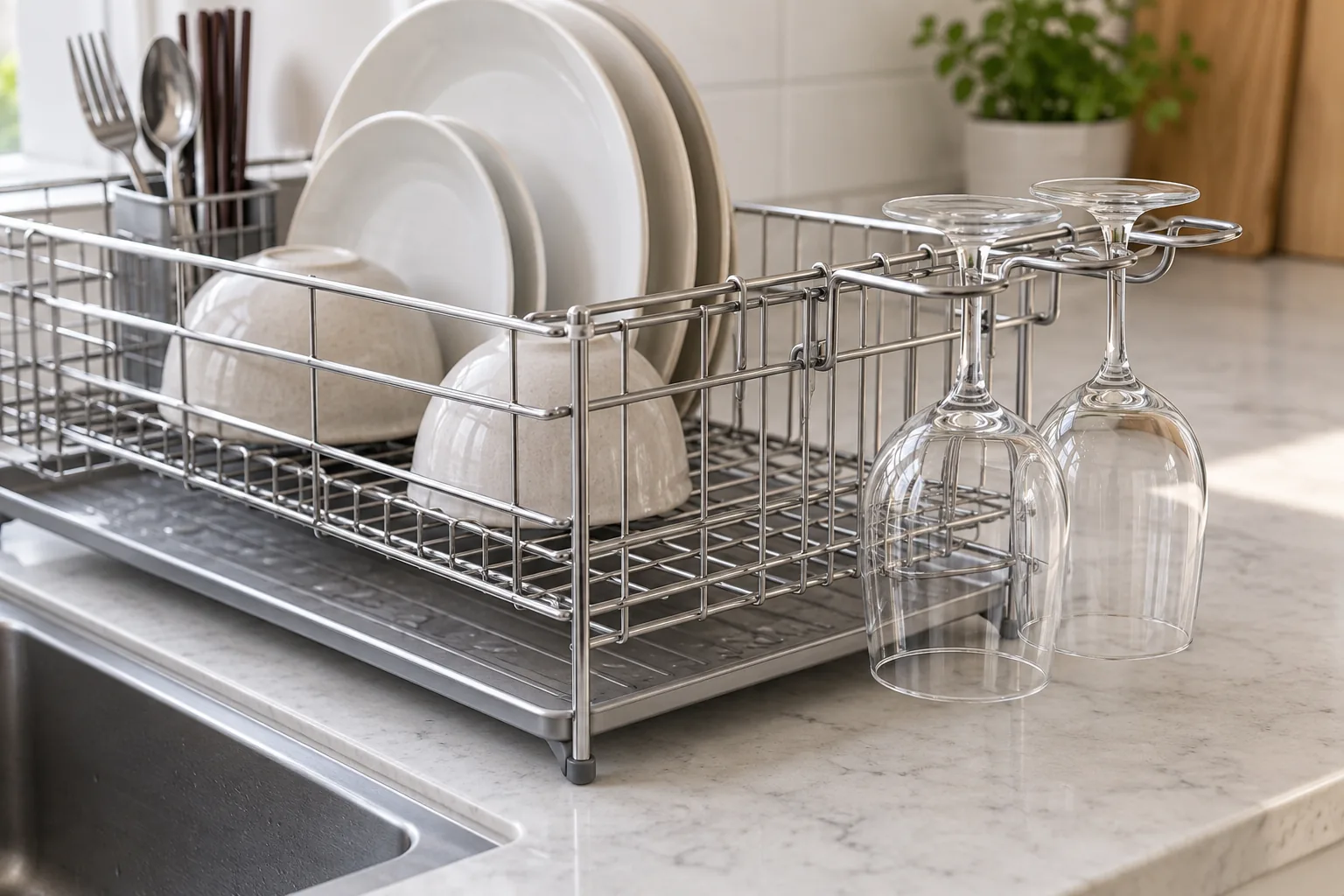
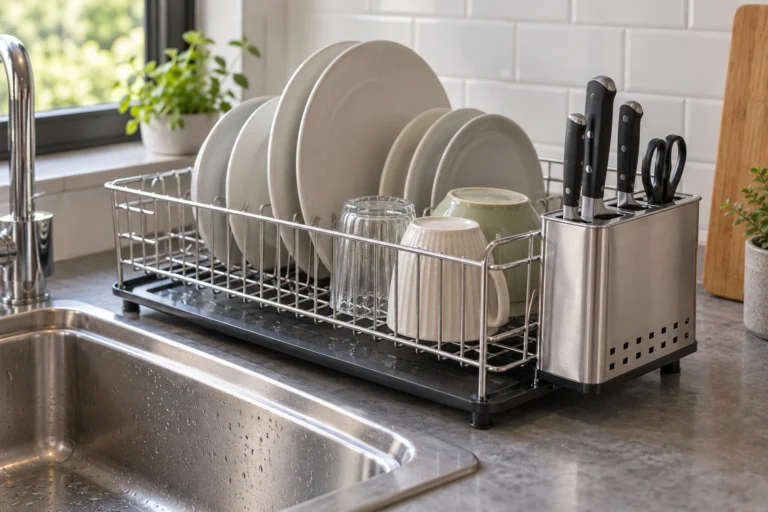
To evaluate dish rack wine glass holder fit, OEM buyers should approve the holder against the actual glass assortment, the rack’s side-frame interface, and the intended drip path—not rely on a generic “fits wine glasses” description. Before production, identify which glasses the accessory is meant to support, how each glass contacts the holder, how the module joins the rack, and where water from the inverted glass is expected to fall. Then record the representative sample and acceptance observations so the buyer, supplier, and inspector are checking the same configuration.
This short video shows the product or manufacturing context discussed in this guide.
This is a product-specification and sample-approval guide for a side-mounted accessory on a countertop dish rack. It is not a guide to under-cabinet stemware rails, dishwasher racks, or a universal glass-capacity claim. A successful sample fit check answers a limited geometry question; it does not establish a load rating, long-term durability, or safety for every glass.
Why is side-holder fit a separate buyer decision?
A side glass holder can look like a small wire add-on, but its usable fit depends on several parts working together: the glass shape, the support loop, the attachment to the rack frame, and the available space beside the rack. A glass may sit in a loop but project beyond the tray. Another may clear the frame when loaded but be awkward to place or remove. Those are different fit questions and should not be collapsed into a single advertised capacity.
Product examples show that the feature can be designed in different ways. Simplehuman describes a steel-frame dishrack with an integrated wine-glass rack for a stated number of large Bordeaux glasses, and its FAQ says the holder can be detached. Those statements apply to that named model and its configuration; they are not a transferable capacity or design specification for another rack. Jessar’s product listing is another example of a chrome-plated wire rack offered with a dedicated glass holder. These examples help buyers see that the holder may be integrated or removable, but do not establish a universal attachment or fit standard.
The distinction from a cabinet-mounted stemware rail matters too. An under-cabinet rail typically supports the glass by its foot while the bowl hangs below the cabinet. A countertop dish-rack module may use a side frame and loops positioned to hold glass feet or stems over a tray. Drawings and product descriptions should show which arrangement is intended instead of using “glass rack” as if all systems shared the same interface.
Define the intended glass assortment before setting dimensions
“Wine glass” covers a wide range of bowl diameters, stem lengths, foot sizes, and overall heights. A holder approved with one sample may not fit a wider bowl, a larger foot, or a shorter stem from a different assortment. The buyer’s first task is to define the intended fit window, not to guess one universal loop size.
Good dish rack wine glass holder fit starts with named glass references and a visible contact plan. That makes it possible to distinguish a loop that merely looks large enough from a design that has been checked against the buyer’s actual assortment.
Build a representative list with actual glass models or clearly identified samples. For each glass, record the features that interact with the proposed holder: foot diameter and thickness, stem diameter and length, bowl width, overall height, and the orientation used for storage. If the assortment also includes stemless glasses or handled cups, decide whether those are explicitly excluded or need a separate support design; do not assume a wine-glass loop will accommodate them.
| Sample-fit input | What the buyer should record | Pourquoi est-ce important ? |
|---|---|---|
| Glass identity | Model, supplier, sample ID, or controlled drawing | Keeps approval tied to a traceable reference |
| Foot and stem | Foot diameter/thickness and stem diameter/length at contact points | Shows whether the holder can support the intended glass without forcing it into place |
| Bowl and total height | Maximum bowl width and overall height | Helps check clearance from the rack, neighboring glasses, counter, and nearby accessories |
| Placement direction | How the glass is inserted, seated, and removed | Reveals whether the frame or an adjacent glass blocks normal handling |
| Intended range | Included and excluded glass profiles | Prevents one sample from being treated as approval for every glass in the market |
Use dimensions from the actual glass samples where possible. If a buyer is working from a proposed assortment rather than physical samples, label the dimensions as preliminary and make sample approval conditional on the final glass references. The point is not to collect measurements for their own sake; it is to give product engineering and the supplier enough information to design and review the contact geometry.
Specify the holder-to-frame interface
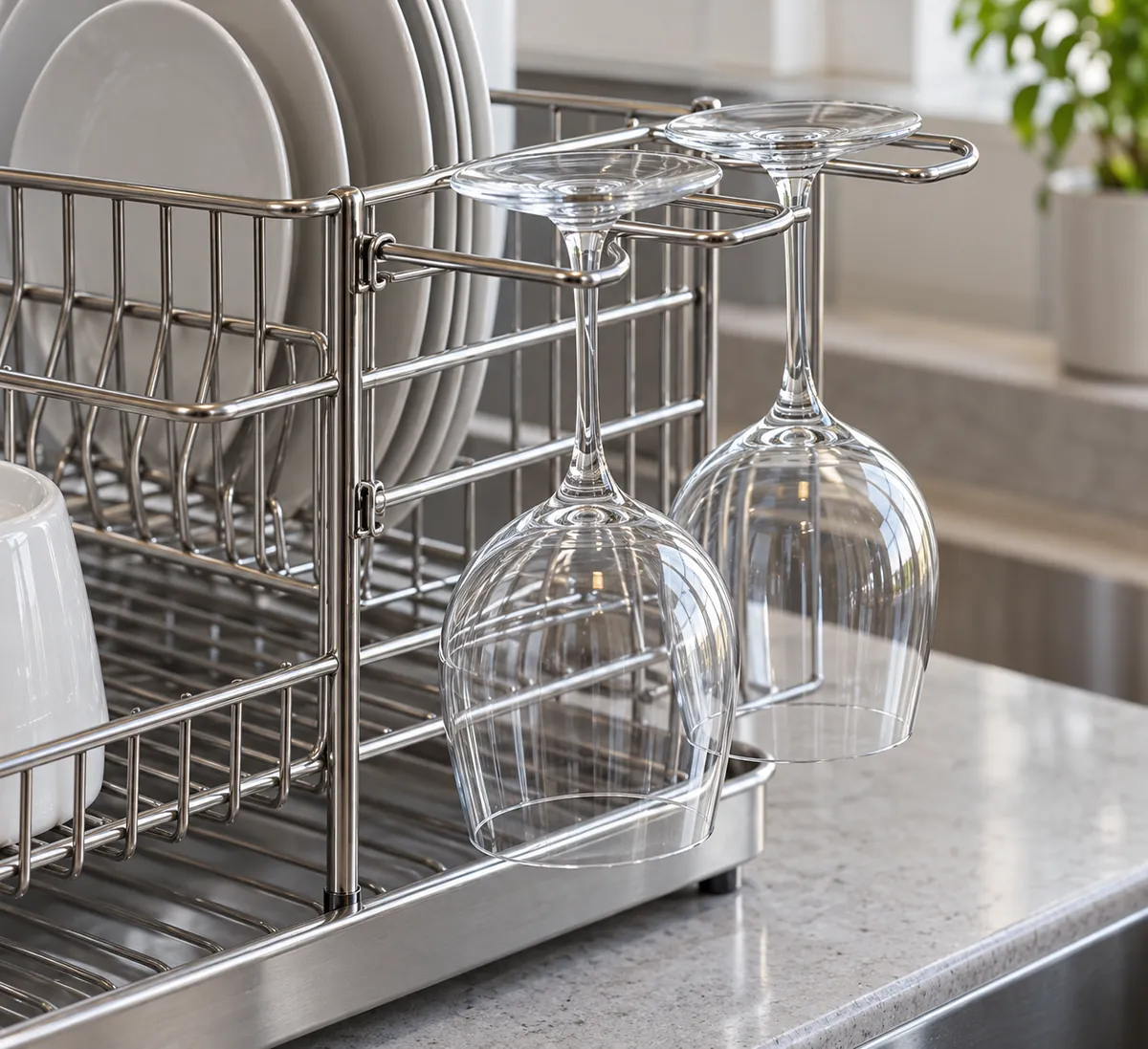
The product drawing should show the side module in its assembled position, not only as a detached accessory. Identify the rack rail or frame members that carry the holder, the attachment method, the finished gap between support wires, the projection from the rack, and any removable or adjustable connection. Call out the relevant dimensions from agreed datums so the supplier can distinguish a glass-fit dimension from an assembly location.
During review, confirm the intended support points. The glass should rest where the design specifies—such as its foot or stem—without being pinched against another wire or forced into an opening. The buyer and supplier should agree whether the module is welded, clipped, hooked, or otherwise retained; do not infer the connection method from a product photo. If the holder is detachable, document how it is installed and removed, how it is oriented, and which version of the rack it fits.
The finish and joining details should be reviewed on the assembled sample. Check visible contact areas, exposed wire ends, weld or attachment appearance, and whether the finishing process changes a clearance that matters to glass placement. Inspection criteria should be practical and linked to the approved drawing and sample. Avoid imposing a tolerance without considering the part geometry and measurement method, and avoid claiming that an attractive joint alone proves strength.
For quote comparison, give each supplier the same glass references, drawing revision, finish requirements, and attachment concept. Ask them to list any assumptions about the supported glass range or module configuration. A response based on different assumptions can look comparable in price while describing a different product.
Check placement, retention, and removal with a sample
Use the production-intent rack and representative glasses for the approval review. The review should follow ordinary user handling rather than an improvised stress test. Place each glass in the intended orientation, observe which parts of the holder it contacts, and remove it along the expected path. Note whether the glass must be twisted or pushed against a neighboring rail, whether two adjacent glasses interfere, or whether loading one position changes access to another.
Record observations, not unsupported performance claims. A buyer can document that each named glass was placed and removed in a particular configuration without visible interference during that review. That record does not prove resistance to impact, a lifetime cycle count, or suitability for every glass that shares a marketing label. If the project requires load, vibration, or repeated-cycle testing, define the method, sample size, acceptance criteria, and responsible test party separately.
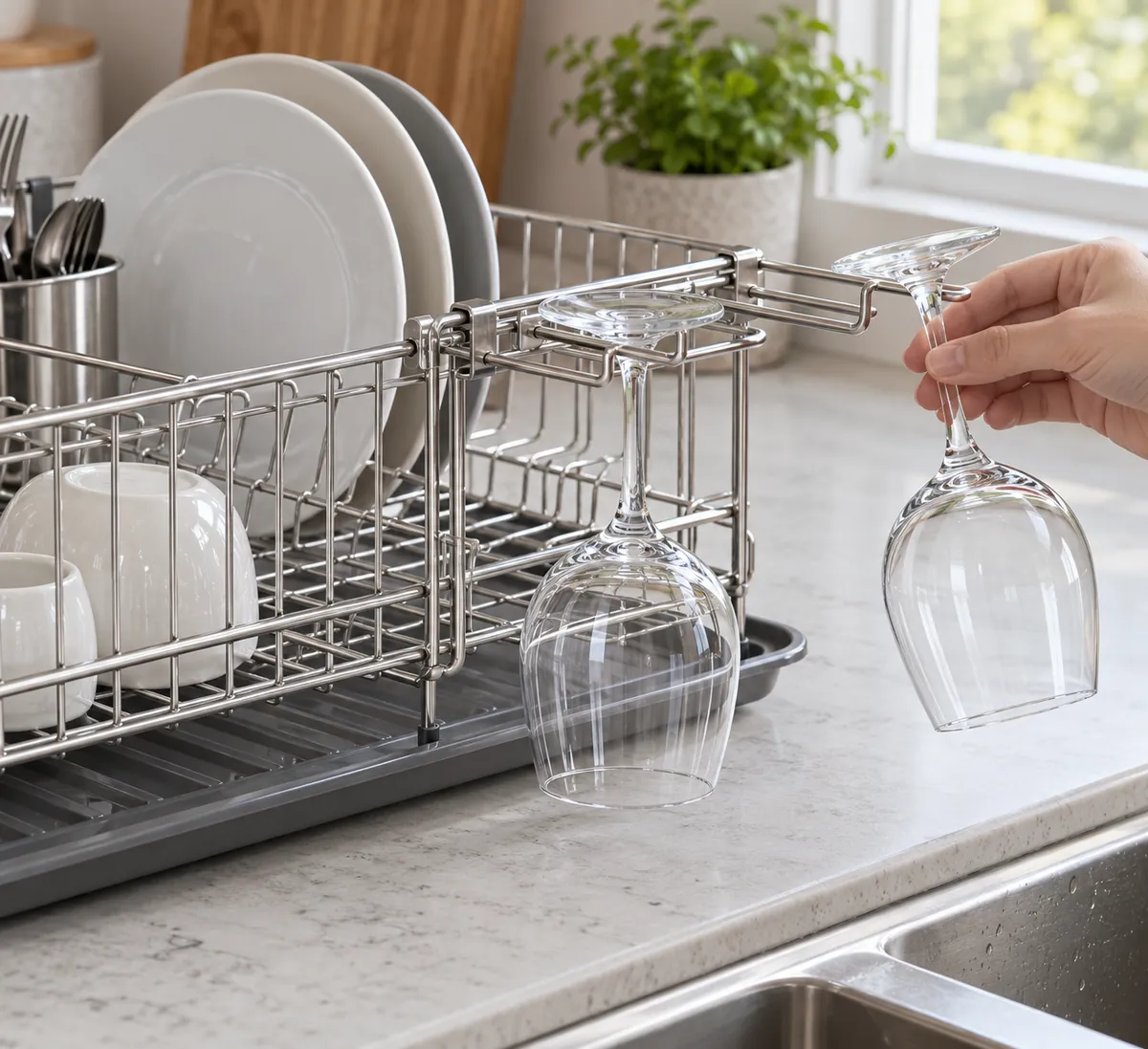
The sample sheet should include the rack model and revision, glass reference, finish, holder version, placement orientation, contact points, clearance observations, and reviewer/date. Photographing the loaded and unloaded positions can make the approved condition easier to reproduce. If a product change affects the side rail, holder geometry, glass assortment, finish build, or tray layout, assess whether the approved fit record still applies before carrying it forward.
| Review step | Record | Escalate when |
|---|---|---|
| Seat each intended glass | Contact points and seating orientation | Glass must be forced, pinched, or supported at an unintended point |
| Load neighboring positions | Clearance and access between glasses | Glasses collide or prevent ordinary placement/removal |
| Remove each glass | Removal direction and any obstruction | A neighboring part blocks the agreed handling path |
| Recheck the holder | Visible movement, deformation, or finish marks during the agreed check | The attachment changes or the glass contacts an unintended edge |
| Identify the approved setup | Rack revision, holder version, glass references, and dated photos | Sample or drawing identity cannot be matched to the production version |
These are sample-review prompts, not universal pass/fail limits. Define acceptance with the product team for the intended market and glass set; do not turn a single informal demonstration into a durability certification.
Map the drip path and surrounding clearances
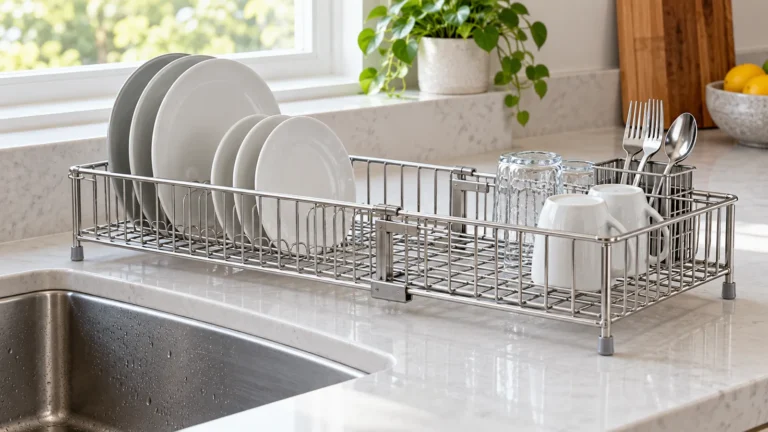
The glass-holder location affects where residual water lands. A glass positioned outside the drip tray may direct water to the countertop even if it fits the loop. Another position may overlap the rack’s collector but conflict with the tray edge or a rotating drain component. Review the installed arrangement from the side and above, then trace the likely drip area relative to the actual tray, drainboard, sink, and counter edge.
Use the final rack and tray configuration during this check. Note whether the tray is removable, whether its edge sits below the glass footprint, and whether the holder can be installed in more than one position. If a product uses a movable or swiveling drain feature, check the relevant positions specified for the SKU. A visual review can identify a likely mismatch, but it does not prove a leak-free or hygienic outcome; actual drainage behavior depends on the product and use conditions.
The fit drawing or approval record can include a top-view projection of the holder and glass footprint against the tray boundary. Mark the areas that should be over the collector and any allowed overhang. If the accessory’s location changes, repeat the clearance review rather than assuming the existing drainage review covers the new geometry. This is where the side-holder decision differs from a general drainage-system design: the question is whether this particular glass position works with that rack’s collector footprint.
What to include in the RFQ and inspection plan
An RFQ that only says “add a wine-glass holder” leaves too much open to interpretation. Include the intended glass assortment, an interface drawing or annotated product sketch, the desired number and arrangement of holder positions, the attachment concept if already decided, the finished dimensions that control fit, the tray and drain configuration, and the sample-approval records required before production.
Ask the supplier to identify any design assumptions or unresolved compatibility questions before quoting. The buyer should also clarify who supplies or approves the glass references, whether the holder is included in the packed product, how detachable parts are protected, and how changes to the holder or rack frame will be controlled. These details affect sample work, assembly, packaging, and inspection; they should not be left to an ambiguous product name.
For incoming or pre-shipment inspection, link the check to the approved model and revision. Inspect the presence and orientation of the holder, the agreed visual/joint criteria, and selected dimensions using the specified method. A quick fit check using the designated reference glass may be appropriate if agreed, but it should not replace the full sample approval or be described as proof of lifetime reliability. Keep appearance, fit, drainage, and documentation as separate check categories so a pass in one does not hide an unresolved issue in another.
Koitor’s verified metal and wire-hardware manufacturing knowledge supports discussion of frame geometry, joining, finishing, and sample review. Current production of this exact dish-rack glass-holder SKU, glassware expertise, and laboratory testing are not confirmed. Buyers should confirm the project-specific design, materials, tests, and component responsibilities with the actual supplier before treating any option as a proven capability.
Common specification mistakes to avoid
- Approving by glass name alone. “Wine glass” is a category, not a controlled envelope. Identify the actual samples or the dimensions that define the range.
- Treating one model’s capacity as a general rule. A manufacturer may publish a capacity for a named glass/rack combination. That does not establish the same result for another frame or glass profile.
- Ignoring the frame connection. A loop that looks suitable in isolation may sit differently once attached to the rack. Review the assembled module and its revision.
- Checking fit but not handling. A glass can sit in place yet be awkward to load or remove. Observe the intended placement path with neighboring positions occupied.
- Checking the glass but not the drip footprint. Confirm how the holder relates to the final tray and drain arrangement; do not assume water falls inside the collector.
- Making a durability claim from a sample review. Placement and visual checks are useful but do not substitute for a defined load or cycle test when the project requires one.
A buyer’s approval takeaway
The most reliable way to specify a side-mounted dish-rack glass holder is to make the buyer’s intended assortment and the supplier’s physical interface explicit. Record the glass references, contact geometry, rack connection, installation position, removal path, drip-tray relationship, drawing revision, and sample observations. Use the same information for RFQ comparison, approval, and later production checks. This gives the dish rack wine glass holder fit decision a traceable basis instead of relying on a generic capacity statement.
That approach keeps the decision grounded in the actual product rather than a generic capacity phrase. For a project-specific discussion about metal-frame geometry, finish, and sample review, see Koitor’s OEM home-storage hardware manufacturing information or contact the team with the drawing and intended glass references.
References:
- Simplehuman Steel Frame Dishrack product information — a model-specific example of an integrated glass rack and stated capacity.
- Jessar chrome-plated dish rack product listing — an adjacent wire-rack and glass-holder example.
- Reddit discussion about a dish-rack side loop — anecdotal problem discovery only, not a test or defect-rate source.
Review a kitchen-storage OEM project
Share the rack drawing, intended glass references, and sample-review requirements for a project-specific discussion.
Fabrication pour compte de tiers / Marque de distributeur
Transformez ce guide d'approvisionnement en cahier des charges
Indiquez-nous le produit souhaité, ses dimensions, sa finition, la quantité commandée et vos exigences en matière d'emballage. Votre équipe recevra une analyse pratique de la faisabilité de la fabrication avant l'établissement du devis.
 English
 Español
 Português
 Français
 Deutsch
 العربية