
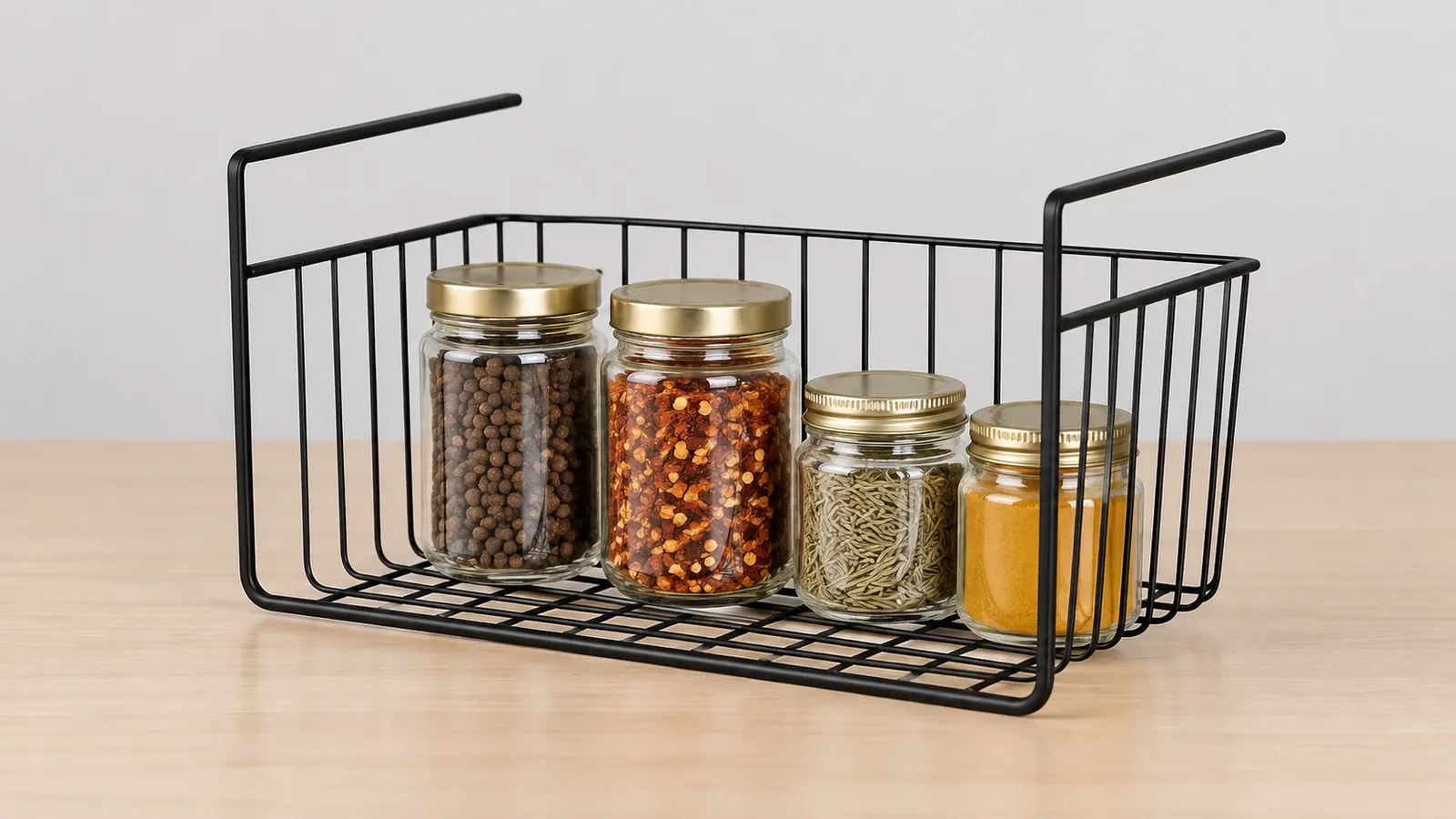
Food contact requirements for metal kitchen storage baskets depend first on how the finished basket is intended to be used. A basket that only holds sealed jars or packaged goods presents a different contact scenario from one marketed to hold loose fruit, bread or other unpackaged food. For an EU-bound product, the importer should define that use, identify every material and finish that could touch food, and ask a qualified food-contact reviewer to determine the applicable evidence before making any compliance claim. A material name or a supplier’s generic certificate cannot replace a review of the finished article and its intended use.
When does a kitchen basket become a food-contact question?
The first buyer task is to describe the actual contact pathway. A wire basket photographed with sealed spice jars may be sold simply as kitchen storage. A similar basket advertised for loose produce may invite direct food contact with coated wires, exposed cut ends, welds or a removable liner. The outer appearance can be nearly identical while the evidence question changes substantially. Marketing copy, packaging illustrations, instructions and foreseeable consumer use should therefore be reviewed together, not after the purchase order has been placed.
Ask the product manager to write a short intended-use statement: what food, if any, may touch which surface; whether that food is packaged; whether contact is repeated; whether the basket is used dry or wet; whether cleaning occurs before or during use; and whether the basket will be sold in a particular EU member state. The statement should distinguish an intended use from a use the importer merely hopes will not occur. If the product page says “fruit basket,” showing unwrapped fruit, a note hidden in the carton that the item is “for packaged food only” creates an obvious inconsistency for review.
Do not infer that every object placed in a kitchen is automatically suitable for food contact. Equally, do not treat “storage basket” as an exemption from discussing contact when the product presentation plainly invites it. The qualified reviewer should assess the facts for the target market. Koitor Hardware can help buyers document basket geometry, visible components and production-relevant material interfaces as part of a drawing and sample review; that manufacturing discussion is separate from a legal determination.
A useful first comparison is between three possible programs. In a sealed-package storage program, the container or wrapper normally separates food from the basket. In an unpackaged dry-food program, the buyer must identify the surfaces and use conditions that the food could contact. In a program involving wet or acidic foods, exposure assumptions may differ again. These are scoping categories, not automatic compliance conclusions. Each program needs its own evidence plan before the buyer promises a use on retail packaging.
Which EU rules should the buyer ask a specialist to review?
The European Commission identifies Regulation (EC) No 1935/2004 as the general framework for food-contact materials and Regulation (EC) No 2023/2006 as the good-manufacturing-practice measure. The Commission also identifies material-specific EU measures for certain categories, including plastics, and notes that national measures may matter where harmonized specific rules do not cover a material. A buyer should use this framework to pose a precise question to a qualified compliance specialist: which rules apply to this finished basket, its separate components and its proposed use in each destination market?
That question is more useful than requesting an unexplained “EU food-safe certificate.” A basket may contain a metal frame, a coating, plastic feet, an adhesive label, a removable tray or a textile liner. Different surfaces may have different roles, and some may never contact food under the stated use. If the buyer adds a plastic liner after approving a bare wire sample, the assessment must be revisited. If the buyer changes the sales image from sealed packages to loose produce, the intended-use statement must be revisited as well.
Do not transfer the detailed rules for plastic materials directly onto bare metal or assume the same declaration and test format applies to every component. The European Commission’s plastic-specific rules are extensive, but the buyer needs an expert to identify the correct basis for the actual metal, coating and any separate liner. This article provides procurement questions, not a legal opinion or an approval of any Koitor product. The specialist should also advise what labeling, traceability and supporting documentation are needed for the proposed sales channel.
Before commissioning tests, write down the product configuration and the question the test is supposed to answer. Otherwise, a report may concern a different finish, different temperature, different contact time or a plastic component that does not even exist in the production version. The report’s laboratory name alone does not show that its specimen, method and intended-use assumptions match the basket being sold. A reviewer should be able to connect the document to a drawing revision, component identity and the finished sample.
Relevant primary reference: European Commission food-contact legislation overview. The buyer should check the current text and destination-market interpretation with a qualified reviewer before making a claim.
What product information belongs in a review package?
The review package should begin with a configuration-controlled drawing or specification. For food contact requirements for metal kitchen storage baskets, identify the basket’s overall shape, wire diameter or sheet thickness where relevant, joints, sharp or cut edges, weld locations, mounting hardware, feet, coating boundaries and any component that can be removed or replaced. The drawing should show the actual production configuration rather than a visually similar catalog image. A supplier sample helps only if the buyer can tell which revision and materials it represents.
List the material identity for each component as supplied, together with the proposed surface finish and any downstream treatment. “Stainless steel” alone does not identify a grade, exact finish or product history. “Powder coated” alone does not identify the coating system or whether the contact-facing surface is coated. If the supplier cannot yet confirm a component, label it open; do not silently fill the gap with an assumption. Koitor’s approved manufacturing knowledge in forming, welding, finishing, assembly and packaging can inform the interface discussion, but the project still needs component-specific confirmation.
The intended-use statement should cover food type and packaging state, direct or indirect contact, likely use duration, temperatures, washing or cleaning instructions, and whether consumers might store moist items in the basket. It should also identify the target country or countries and the product claims proposed for the listing, carton and insert. If the basket is not intended for food contact, document that positioning clearly and check that the product photography and merchandising do not contradict it.
Finally, collect the supplier evidence that actually pertains to the approved configuration: material declarations or mill information when available, coating identity, component source and any relevant test report or expert assessment. The buyer must assess whether these documents are current, traceable and within scope. A report for bare wire does not automatically cover a coated finished basket. A declaration from a raw-material supplier does not by itself resolve every question about welding, finishing, assembly and consumer use.
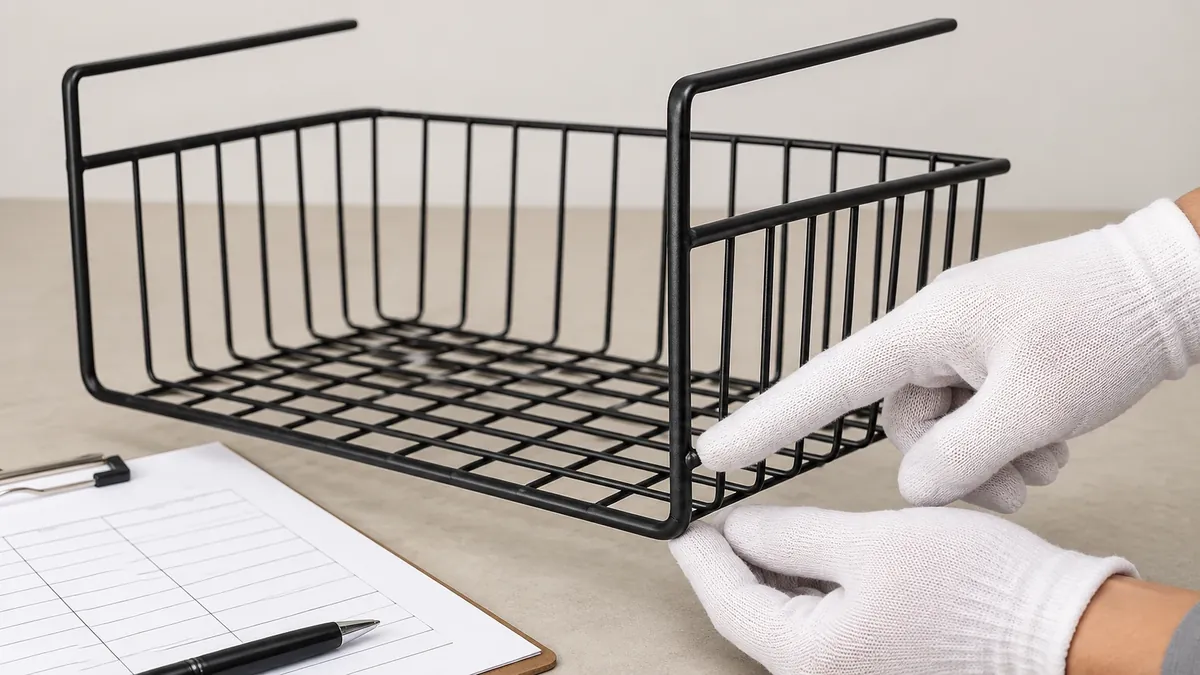
How should buyers separate material, finish and use-case decisions?
A sourcing decision should not collapse the metal substrate, applied finish and use statement into a single “food grade” checkbox. These are separate questions that interact. A buyer could select an appropriate metal grade but add an unreviewed coating. Another buyer could obtain a report for a plastic liner yet change the metal frame finish and marketing claim. The decision table below helps identify who must answer each question before the supplier receives a final specification.
| Decision | What the buyer should provide | What must be confirmed |
|---|---|---|
| Intended use | Packaged or unpackaged food, product images, use and cleaning conditions | Whether the claimed use creates a contact scenario and which surfaces matter |
| Metal structure | Grade/form proposal, wire or sheet specification, joints and edge details | Actual material identity and finished-sample traceability |
| Finish | Coating or plating identity, finish boundaries and exposed edges | Whether the finish is within the reviewed configuration and use |
| Other components | Liner, feet, pads, labels and fastening details | Which pieces can contact food and what evidence applies to each |
| Destination market | EU country, distribution channel and proposed claims | Applicable EU and national requirements, reviewed by a qualified specialist |
| Change control | Drawing revision, approved sample and substitution rules | Whether a change requires renewed evidence or a new review |
For a private-label program, the importer should decide who owns the intended-use statement and who is authorized to approve changes. A manufacturer can quote against a stable specification; it cannot reliably price or document an undefined food-contact claim. The buyer should also decide whether an accessory such as a liner is included in the same SKU or sourced separately. If it is sourced separately, the interface and combined use still need review before a single consumer-facing claim is made.
Koitor Hardware is a family-owned custom metal hardware factory focused on bathroom and home storage hardware. It can discuss wire-basket geometry, forming, welding locations, finishing and packaging with buyers developing a kitchen-storage product. That capability does not mean the company is a certified testing laboratory or that any current basket has been approved for direct food contact. The proper article-to-project transition is a controlled inquiry: send the drawing, use case, destination market and required evidence list for project-specific discussion.
What should sample approval and change control cover?
Approve a representative finished sample, not just a drawing. Compare the sample’s wire route, joints, edges, coating coverage, feet and included accessories with the documentation used by the compliance reviewer. Photograph the contact-facing areas and record the sample version. If a buyer later receives a second sample with a different surface appearance or liner, do not treat the first review as automatically covering it. The review record should say which differences are cosmetic, which are material and which require a specialist’s decision.
Define supplier-initiated change triggers before bulk production: metal grade or source, coating formulation or supplier, weld or post-treatment process, liner material, plastic feet, adhesive, packaging instructions and country-specific claims. Some changes may be immaterial to the food-contact question; others may affect the reviewed configuration. The point is to route each change for assessment rather than guess. A simple change log with drawing revision, component revision, date, reason and approval owner is much more useful than a folder of unrelated certificates.
In incoming inspection, the buyer can check that the carton, SKU, drawing revision and visible components match the approved sample. Material identity or chemical suitability may require records or qualified testing beyond visual inspection. A shiny surface is not proof of grade or food-contact suitability. Nor does a passed visual inspection replace a reviewed use statement. Keep those acceptance layers separate so a later complaint can be traced to the exact question that was answered and the evidence that supported it.
The buyer should also check how the product will be cleaned and stored before retail release. A care instruction that tells users to wash the basket in a way the finish cannot tolerate is a product-development problem even when the underlying metal is appropriate. If wet cleaning is foreseeable, define the exposure and review the actual finished sample. Do not promise corrosion resistance, dishwasher suitability or lifetime performance without relevant project-specific evidence.
Which mistakes make a compliance file look complete but leave the decision open?
One common mistake is to ask for a generic “food-safe” certificate before explaining whether the basket ever touches food. That request invites mismatched paperwork. Another is to accept a report for a material family without checking the exact finished product, coating and accessory set. A third is to review a sample under a sealed-container use case and then publish photographs with loose food. The paperwork may be tidy while the marketed use has changed.
Do not assume that a named grade, a familiar coating color or a supplier’s past project establishes suitability for this SKU. Do not substitute a broad Ubersuggest keyword or consumer “best basket” search for a buyer decision. Search metrics may show little activity for the exact technical question, but an importer still needs to resolve it before claiming an intended use. The relevant deliverable is a documented decision about the finished article, not a high-volume headline.
Be cautious with statements that compress many jurisdictions into one sentence. An EU-bound product may be sold in more than one member state. The European Commission’s general framework is a starting point, while the qualified reviewer identifies any applicable national rules and documentation expectations. The product team should record that decision and the markets covered. If the assortment expands later, a new market or claim should trigger another check.
Finally, keep food-contact review separate from other buyer approvals. Load stability, edge condition, finish appearance, packaging protection and assembly completeness are still important, but passing those checks does not answer the food-contact question. Conversely, a favorable specialist review does not excuse poor sample fit or missing parts. A dependable sourcing file shows each decision, its owner and the evidence that supports it.
What belongs on the buyer’s final RFQ checklist?
Send a complete question set with the inquiry so a potential manufacturer can identify what it can answer and what requires independent review. The first version need not be elaborate, but it must be explicit enough to prevent a different product being quoted. A simple drawing and intended-use statement are more valuable than a long list of unexplained acronyms.
- Define the exact SKU, target buyer, EU destination country or countries, sales channel and product presentation.
- State whether food is packaged or unpackaged and which surfaces could reasonably touch it.
- Provide a drawing or physical sample with wire/sheet dimensions, joints, edges, mounting and accessories.
- List proposed metal, finish, liner, feet, pads, labels and any component whose identity is still open.
- Describe cleaning, wet exposure, temperature and contact assumptions for specialist review.
- Identify the person or qualified organization deciding applicable rules and evidence.
- Agree which material and process changes require notification before substitution.
- Record the approved finished sample, drawing revision, supporting documents and claim wording.
- Separate visual, structural and packaging inspection from the food-contact assessment.
- Request a quotation only against the version whose components and intended use are clear.
When asking Koitor about a custom kitchen basket, the importer can use this checklist to discuss the metalwork and sample version while commissioning a qualified compliance assessment for the intended use. The custom kitchen storage rack manufacturer page explains the broader product-development relationship. The metal storage basket manufacturer page describes the manufacturing category, while the final suitability decision remains specific to the proposed SKU.
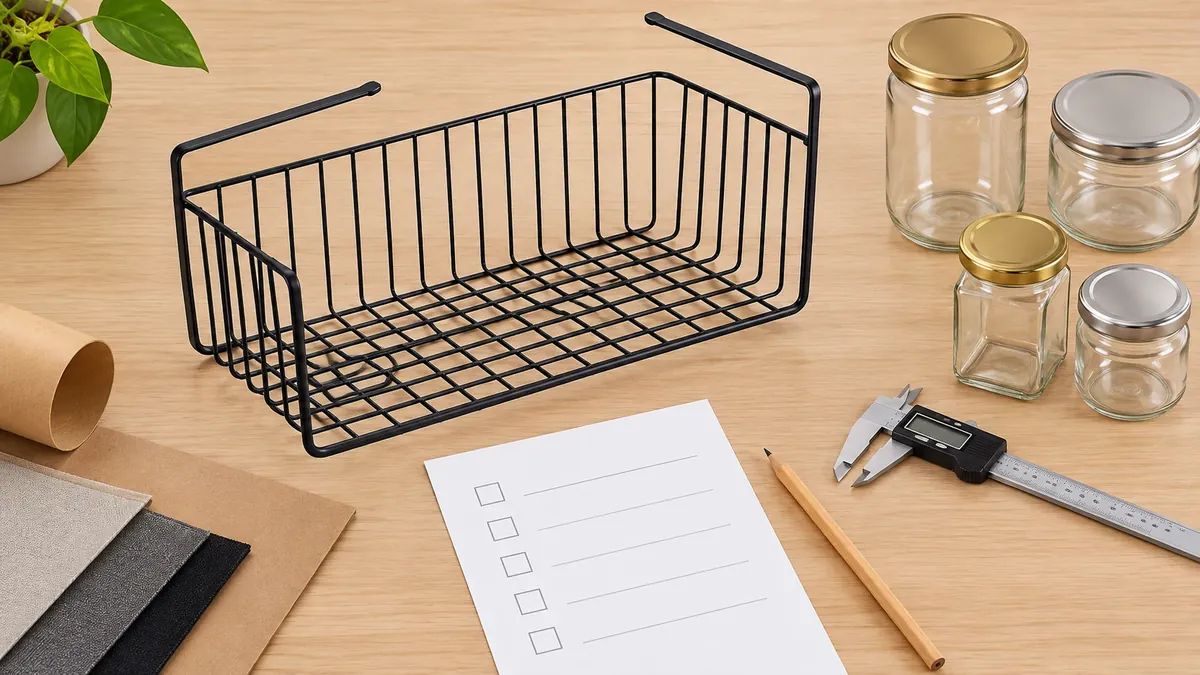
What do buyers ask about metal kitchen basket food-contact review?
Is every metal kitchen basket a food-contact article?
No single label can answer that without the product’s intended and reasonably foreseeable use. Food contact requirements for metal kitchen storage baskets need a defined contact pathway: a basket holding sealed jars differs from one advertised for loose produce. The importer should describe the use and have a qualified reviewer determine what applies.
Does stainless steel alone prove that a basket is suitable for direct food contact?
No. A grade name does not describe every finished component, weld, surface treatment, cleaning exposure or market requirement. Confirm the actual configuration and ask a specialist to review the evidence for the claimed use.
Can a report for a plastic liner cover the whole metal basket?
Not automatically. The report’s specimen, material, conditions and claimed scope must match the component and use being assessed. The combined finished product may present other contact surfaces. Have the reviewer connect each document to the actual SKU.
What changes should trigger another review?
At minimum, route changes to material, coating, liner, contact-facing geometry, finishing, cleaning instructions or marketed use for assessment. The reviewer can decide whether the existing evidence remains applicable; the supplier should not make that assumption silently.
What should an importer send to Koitor before asking for a quote?
Send the drawing or sample, expected basket use, target market, material and finish choices, accessory list, packaging concept and the evidence questions raised by the qualified reviewer. Koitor can then discuss the metal hardware scope against a defined project.
Discuss a defined kitchen basket project
Share the drawing, intended use and component list so the metalwork and sample requirements can be reviewed. Arrange qualified food-contact advice separately before making a market claim.
Fabrication pour compte de tiers / Marque de distributeur
Transformez ce guide d'approvisionnement en cahier des charges
Indiquez-nous le produit souhaité, ses dimensions, sa finition, la quantité commandée et vos exigences en matière d'emballage. Votre équipe recevra une analyse pratique de la faisabilité de la fabrication avant l'établissement du devis.
 English
  Español
  Português
  Français
  Deutsch
  العربية