
Buyer configuration guide | Wall-mounted hair-dryer holders
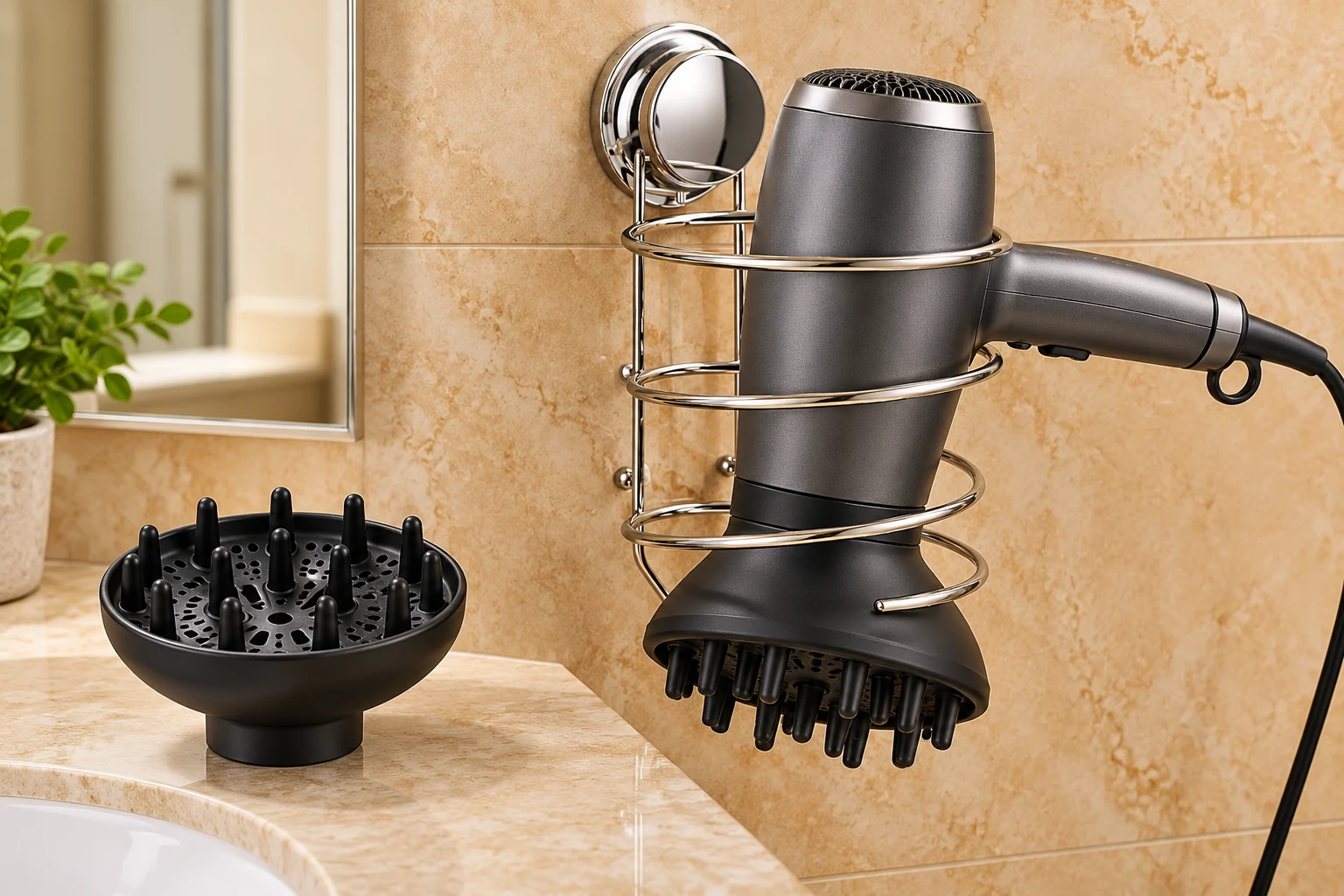
A wall holder designed around a hair dryer body may not accommodate a wide diffuser left on the dryer. A separate attachment position can solve a different storage problem, but it must fit the buyer’s target diffuser and appliance set. A buyer evaluating a hair dryer holder with diffuser storage should choose the intended state first: dryer with diffuser attached, diffuser stored separately, or both configurations. Then dimension the appliance and accessory envelopes, wall projection and insertion path, and approve a sample with real target models.
Why does a standard dryer holder miss diffuser fit?
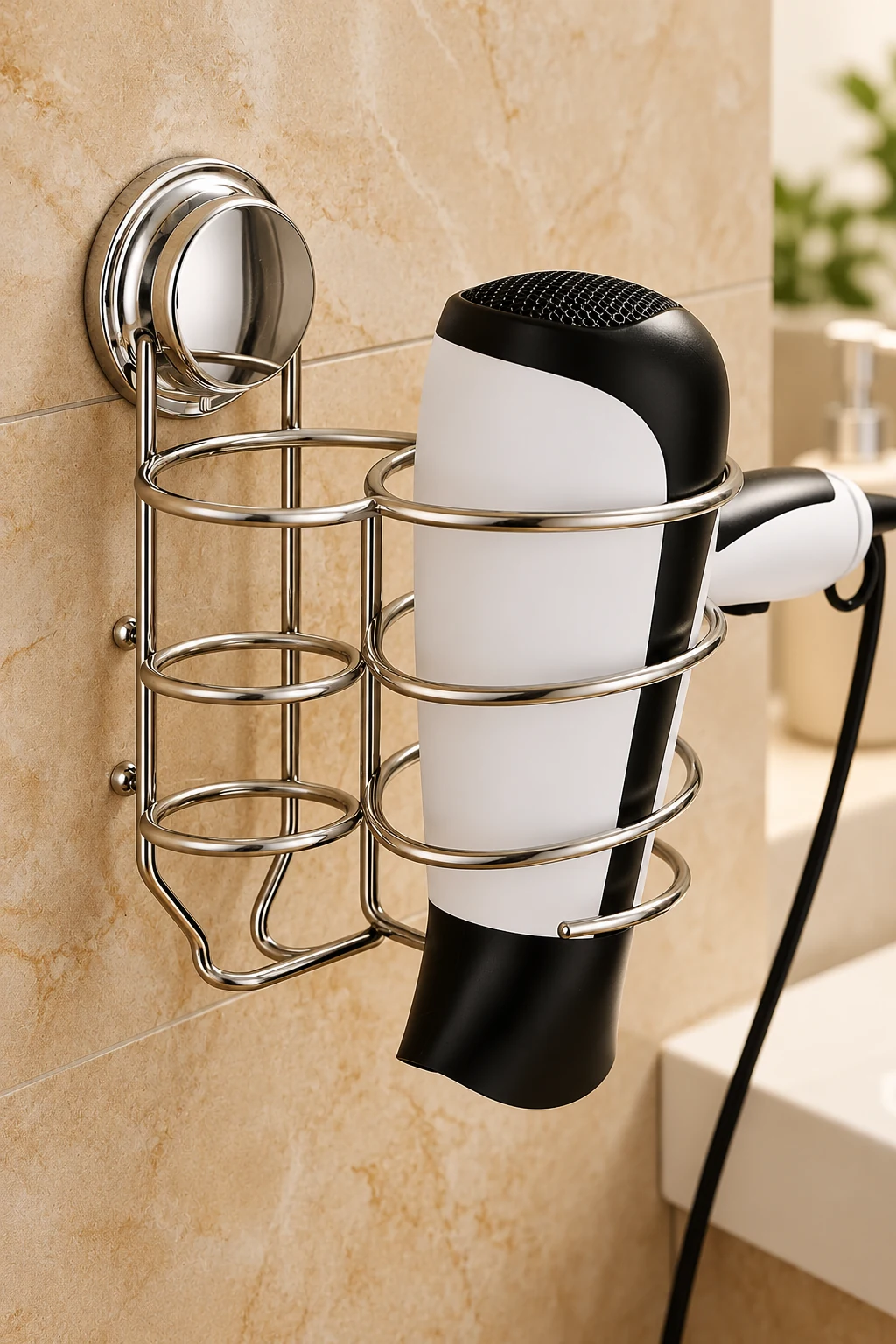
Hair dryers and their attachments vary in barrel diameter, handle direction, diffuser width, nozzle shape and connector profile. A ring may support a narrow barrel but block the diffuser flange. A basket may hold the dryer body but leave too little wall offset for an attachment extending behind it. If the diffuser is removed for storage, the holder still needs a location that keeps the attachment accessible and prevents it from colliding with the handle or cord.
Users have asked for a holder that works while the diffuser remains attached. One discussion explicitly describes that attached-diffuser need; another asks for a separate place to keep a diffuser. A further user report describes holders that do not accommodate an attached diffuser. These posts demonstrate distinct fit questions, not market size, product performance or a universal appliance standard.
First-party product information also shows that holder shape and compatibility can be model-specific. The Bratt Trading catalogue distinguishes ring apertures and compatible dryer models, while Yamazaki’s wall holder documents its own dimensions and accessory orientation. Those examples are not Koitor products and do not establish compatibility with another brand.
For a private-label buyer, “fits a hair dryer” is not a sufficient acceptance statement. The RFQ should identify which dryer and attachment configurations must fit. This keeps the holder drawing, sample review and product copy aligned.
Choose the product configuration before drawing the holder
For a hair dryer holder with diffuser storage, the first decision is whether the diffuser stays attached, receives a separate position, or must be accommodated in both states.
There are at least three useful product briefs. First, the dryer is stored with the diffuser attached; the holder must clear the full combined outline and support the dryer in the intended direction. Second, the diffuser is removed and stored in its own position; the holder needs enough room for both parts and convenient access. Third, the design accepts both arrangements, which requires checking both against the same holder without one blocking the other.
These are different fit goals. A ring sized for the dryer barrel may have enough space for the appliance but no accessory support. A basket that can hold both parts loosely may not keep them separated or accessible. A dedicated cradle may require more wall projection and introduce another metal interface. The buyer should identify which configuration is essential and which is optional before the supplier selects a form.
Avoid assuming that a diffuser is a simple round cup. Its diameter may vary along its depth; prongs, bowl, nozzle neck or connector can create the widest or most interfering point. The attachment may also be asymmetrical. Use the real model or a dimensioned drawing, and state whether the dryer must be stored with the nozzle or concentrator attached as well.
Which dimensions and clearances belong in the RFQ?
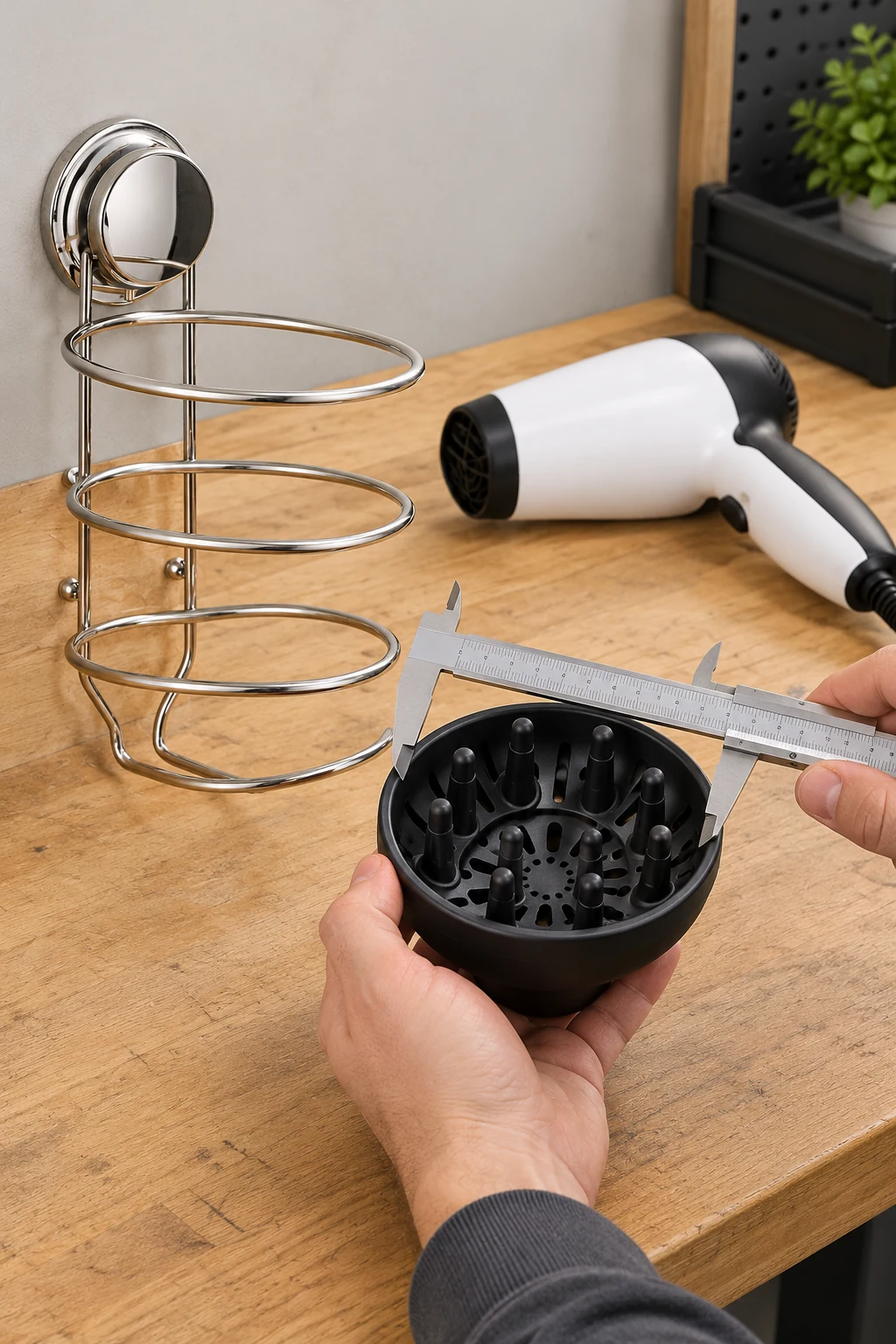
Record the widest outside profile of each dryer body and diffuser, the length from the connector to the farthest point, the handle projection and the cord exit direction. For the attached configuration, measure the combined envelope in the intended orientation. For separate storage, record the accessory’s width and depth at several points and show how it enters or rests in its position. If more than one target model is required, list them individually rather than using the smallest one as a proxy for the entire range.
The holder drawing should identify ring inside diameter or basket clear opening, support contact points, wall offset, overall projection, accessory clearance, cord space and the intended insertion direction. If the dryer is inserted handle-first, show the hand opening and the path around the cord. If the attachment is placed separately, mark its rest surface or retention feature. A front elevation can hide the wall projection problem; include a side view and a top or section view.
| Buyer measurement | Attached-diffuser configuration | Separate-diffuser configuration |
|---|---|---|
| Appliance envelope | Combined dryer and diffuser outline | Dryer body and handle outline |
| Attachment envelope | Connector position and diffuser width | Diffuser width, depth and resting direction |
| Holder opening | Clear ring or cradle opening around combination | Clear dryer-body opening |
| Wall projection | Farthest point from finished wall | Projection of dryer and accessory positions |
| Access | Insertion and removal path for full assembly | Access to each item without collision |
| Cord routing | Cord exit and loop clearance | Cord and plug path when dryer is stored alone |
Values should reflect buyer-supplied appliances and the actual wall installation. The matrix is a specification aid, not a universal compatibility standard.
Check insertion and removal, not just static fit
A dryer can fit within a ring when held by hand and still be awkward to place on the mounted holder. The hand may need to approach from below or turn the handle. An attached diffuser may hit the wall before the dryer is seated. A separate accessory may need more vertical room to be removed than it occupies when resting. Review the full movement path and wall projection with the sample in the intended orientation.
Measure from the finished wall surface. Tile thickness, mounting standoff and suction or adhesive mounting details can change projection. Koitor’s reference hair-dryer basket shows a metal holder style and dryer scale; its mounting and current product configuration do not establish diffuser fit or electrical safety. For a new RFQ, specify the actual wall fixing under consideration and keep appliance clearance as a separate dimension chain.
How should buyers review the metal holder structure?
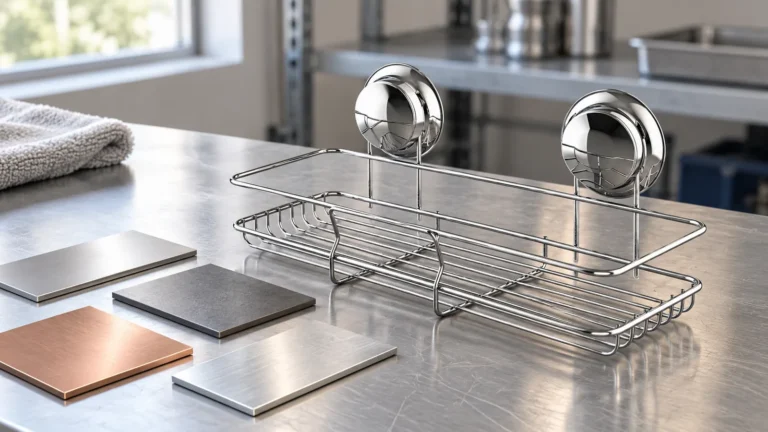
The metal holder must support the intended appliance through a defined contact area while leaving the dryer and attachment accessible. Ring diameter, formed wire path, side supports, basket depth and edge finish affect that interface. A narrow contact point may concentrate pressure on a plastic appliance body; a wider support may obstruct controls or ventilation openings. The buyer and supplier should review the contact points on real samples, without assuming that a generated image or generic appliance shape proves performance.
For a two-position design, decide whether the diffuser is retained by a ring, cradle, basket or simple ledge. Each construction has trade-offs in stability, footprint, drainage/cleaning and ease of removal. The module can be integrated into a formed wire holder or supplied as a separate part. If the attachment position is detachable, define how it connects and whether it can be replaced. Do not imply a universal solution for proprietary connectors.
Finish and contact should be assessed around the handle, barrel and attachment surfaces. Check for burrs, exposed sharp ends, weld marks and coating build-up that interferes with fit. A smooth appearance does not establish that a holder is temperature-resistant, safe for storing a recently used dryer, or appropriate for electrical equipment. This article addresses dimensions and configuration; any heat, electrical, fire or safety statement requires separate design evidence and regulatory review.
The fixture’s wall mounting also affects the fit review. Suction, adhesive, screw-fixed or other mounting options have different surface and installation conditions. Do not combine them as interchangeable in product copy. Verify the actual mounting method on the target wall sample and make clear that this check does not establish heat tolerance or an electrical rating.
What does the sample acceptance matrix look like?
Use a worksheet with rows for each target dryer and diffuser combination. Identify model or sample number, which parts are attached, and where the diffuser is stored. Record pass/fail or observation for insertion, seating, removal, wall clearance, cord routing, contact and accessory access. If a model requires an alternate orientation, note that explicitly. Avoid a single “fits all” result from one appliance.
For the attached configuration, install the diffuser in the intended connector orientation and place the complete appliance on the holder as instructed. Check for contact with the wall, holder rim, cord loop, nearby towel bar or adjacent shelf. Confirm that the controls remain reachable if relevant to the storage position. Do not power the dryer during the sample fit check; fit is the question being evaluated here.
For the separate configuration, place the dryer and diffuser in their respective positions at the same time. Remove each one without lifting or displacing the other. Check if the attachment rests in the intended orientation and does not fall through an opening. If the module is removable, repeat the assembly and note whether its position is consistent. Record the holder’s actual wall offset, not an estimated gap from a photo.
Save photos of each setup with the model identifier and drawing revision. If a fit fails, record which point collides: diffuser bowl, connector, dryer handle, wall, cord, neighboring accessory or holder edge. A clear contact point helps decide whether the correction belongs in ring size, wall offset, accessory position or mounting layout. Avoid broadening the holder until the conflict is understood; a larger opening could weaken support or create a different issue.
How should an OEM buyer manage claims and changes?
The product description should name the included or tested configuration. “Compatible with diffuser” is unclear if some dryers have the diffuser attached and others store it separately. A more specific statement describes which model range or dimension envelope was checked. If compatibility is limited, say so in instructions and online listings. Avoid “universal” unless the buyer has evidence supporting the named range.
Changes that can affect compatibility include ring diameter, basket depth, wall standoff, wire position, mounting plate, finish, accessory cradle and assembly instruction. A new dryer model can also change the widest or longest point. Keep the sample matrix with the drawing revision. When a part changes, recheck the combinations whose clearance or contact could be affected rather than assuming the old approval automatically transfers.
Koitor’s brand profile supports metal bathroom holders and OEM sample development. It does not establish production of the pictured diffuser module, compatibility with cited brands, electrical testing, heat resistance or safety certification. The dryer and diffuser are buyer-supplied appliances. Koitor’s custom bathroom hardware context can support an RFQ discussion about metal holder geometry, but exact project capability and claims should be confirmed with the factory team.
Buyer checklist before approval
Utilisation hair dryer holder with diffuser storage as a model-specific fit requirement and record which appliance samples support the approved configuration.
- Choose attached-diffuser, separate-diffuser or dual configuration.
- List exact target appliances or representative sample IDs.
- Measure dryer, diffuser, handle, connector and cord envelopes.
- Dimension holder opening, wall projection and accessory space.
- Draw the insertion, removal and storage orientation.
- Check both target configurations on one production-intent sample.
- Review contact, clearance, mounting and finish separately.
- Record any model-specific limitation and sample revision.
- Keep electrical, heat and safety claims outside a fit-only review unless separately evidenced.
- Recheck when holder geometry, mounting, finish or target appliance changes.
This gives product teams a repeatable fit decision and a clearer basis for supplier quotation. It does not create an appliance safety approval or prove universal compatibility.
Foire aux questions
Should the diffuser stay attached to the dryer in the holder?
That depends on the intended product configuration. If it must stay attached, test the combined appliance envelope and insertion path. If it stores separately, allocate and test a distinct accessory position.
Is a ring holder enough to confirm diffuser fit?
No. The diffuser’s largest profile and wall projection can interfere even when the dryer barrel fits the ring. Check the full assembled appliance and attachment.
Can a holder fit different dryer brands?
Only within a defined and reviewed size range. Different barrels, handles, diffusers and connectors can change fit. Use named models or a measured envelope, then limit compatibility statements to the evidence.
Does a metal basket prove heat-safe storage?
No. Material alone does not establish a safe storage temperature or electrical suitability. Those claims need separate product-specific design and evidence.
What should an importer send with an RFQ?
Provide the holder concept, target dryers and diffusers, attached or separate configuration, wall mounting method, finish, packaging and a sample acceptance matrix. Include physical appliance samples where possible.
Developing a Custom Metal Hair-Dryer Holder?
Share your holder drawing or sample, target dryer and diffuser models, desired attached or separate storage state, wall mounting concept, finish and order quantity. Koitor can discuss metal-holder geometry and practical OEM development options. Compatibility, electrical and heat-related claims require evidence for the final product.
Fabrication pour compte de tiers / Marque de distributeur
Transformez ce guide d'approvisionnement en cahier des charges
Indiquez-nous le produit souhaité, ses dimensions, sa finition, la quantité commandée et vos exigences en matière d'emballage. Votre équipe recevra une analyse pratique de la faisabilité de la fabrication avant l'établissement du devis.
 English
 Español
 Português
 Français
 Deutsch
 العربية