
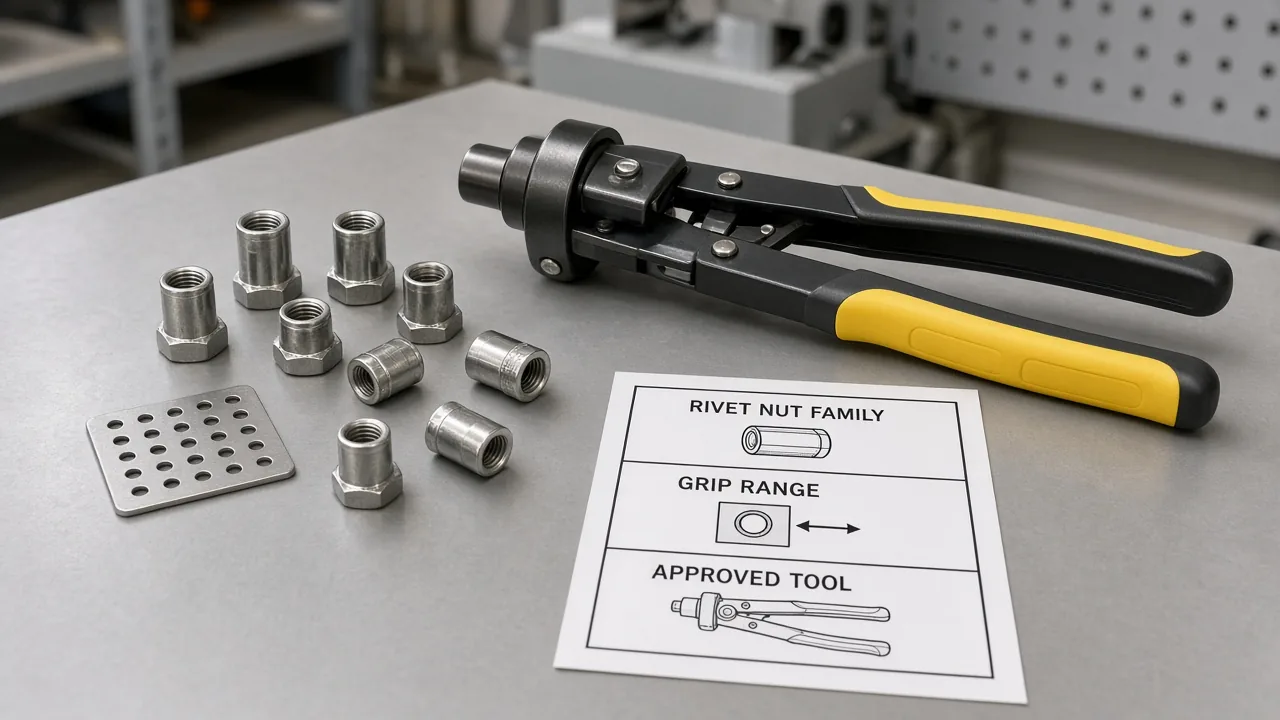
An install sheet can tell a buyer how to install a rivet nut only after the packed rivet-nut family, the grip range and hole, and the approved setting tool are named from the supplier’s setting data. The family is the insert style the carton actually ships. The tool is a purpose-made rivet-nut setter, not an improvised bolt-and-nut setup and not a pop-rivet gun.
Spin-out and setting-stroke procurement belong on the live spin-out RFQ. Rivet-nut versus self-clinching selection, closed-versus-open-end water-ingress, and flow-drill versus rivet-nut tubing comparisons belong on those neighboring files. Joining-rivet first set and pop-rivet removal belong on later articles in this batch. None of those decisions is this rivet-nut first-set sentence, and none should be rewritten as one.
This guide is for importers, distributors, and private-label teams approving first-set wording and kit scope for rivet nuts already in the live OEM library, including inserts used on metal storage and enclosure work as an adjacent line. Koitor Hardware is a family-owned China OEM manufacturer of custom metal bathroom and home storage hardware. Adjacent fastener and storage OEM pages already sit in that published library.
That published-library fact is not a claim that Koitor currently manufactures a named rivet-nut SKU or a rivet-nut tool. Send the insert drawing or setting data, the sheet thickness and hole, and the intended tool family. We can review the wording and the kit scope. We will not issue a universal hole or stroke chart, a torque-out value, or a without-tool method.
What does a how to install a rivet nut file actually freeze?
It freezes the packed rivet-nut family, the documented grip and hole, and the approved setting tool, or an explicit exclusion for any of those fields. It does not freeze a spin-out RFQ, a clinch-selection argument, a joining-rivet first set, a pop-rivet removal, or a without-tool workaround.
Searchers often ask how to install a rivet nut, how to install rivnuts, or how to use a rivet nut tool because they want a setting sequence, or because a shopping page is selling a kit or a gun. That demand is real. For an importer, the usable decision is whether a listing or a setting sheet may say the insert is easy to install, and which family, grip and hole, and approved tool are being promised.
A rivet nut, a rivnut, and a nutsert can be names for the same first-set decision. Use those names as coverage, not as separate WRITE targets and not as a reason to invent a Koitor SKU. How to use a rivet nut tool is also coverage of the approved-tool field, not a shopping target and not borrowed tool-merchandising volume.
How to install rivnuts without a tool, and other without-tool variants, are a hard exclude. This page will not teach an improvised bolt-and-nut method, even as a list of steps to avoid. Lost-tool or missing-tool demand is evidence that the approved tool must be named, not a license to publish a bypass.
Un OEM home storage hardware manufacturer can review whether a setting sentence and a packed family stay together. Matching a finish or a sheet metal job to a collection is not the same as inventing a default grip, a default hole, or a universal stroke. If you are screening this adjacent line, bring the intended family, grip and hole, and tool family with the drawing.
A published “easy to install” claim is only as complete as the named family, the documented grip and hole, and the approved tool. If the photograph shows a setting tool and the carton does not name an approved tool family, or marks it excluded, the sheet has already failed, even if the inserts look familiar.
This file can precede an RFQ. It should not be turned into a catalog page, a spin-out essay, a tool shop, or a without-tool leaflet. Those jobs already have, or should keep, their own files.
Which family, grip and hole, and approved tool must be named first?
Name the packed rivet-nut family first, then the documented grip and hole, then the approved setting tool, or mark any of those fields as documented only on the supplier’s current setting data. Do not start with a stroke sequence, and do not start with a without-tool suggestion.
The packed family is the insert style the carton actually ships, described in the supplier’s terms. The sheet should say so in plain language. “Rivet nut” alone is not a complete family line if the body style, the head style, or the material assumption the setting data uses is left unnamed when the supplier’s data already distinguishes those fields.
Do not invent a factory-universal body-style chart on this page. Closed-versus-open-end water-ingress, when it is a selection question, belongs on the live body-style neighbor, named in prose only if that href is missing from the lock copy. This first-set file may name the body style that is actually packed. It should not reprint that selection RFQ.
Grip range and hole must be taken from the supplier’s setting data, or left named and blank until that data is cited. Do not invent a hole-size or grip chart as a Koitor standard. If a later buyer file names a required grip or hole and cites a source, the sheet may repeat that requirement. Until then, keep the field named and leave the value blank.
The approved setting tool must be a purpose-made rivet-nut setter, named as a tool family or as a supplier-approved class, or explicitly excluded. A pop-rivet gun is not, by itself, that tool. An improvised bolt, nut, and washer setup is not that tool. This page does not claim that Koitor manufactures rivet-nut tools, and it does not merchandize a kit or gun as the thesis.
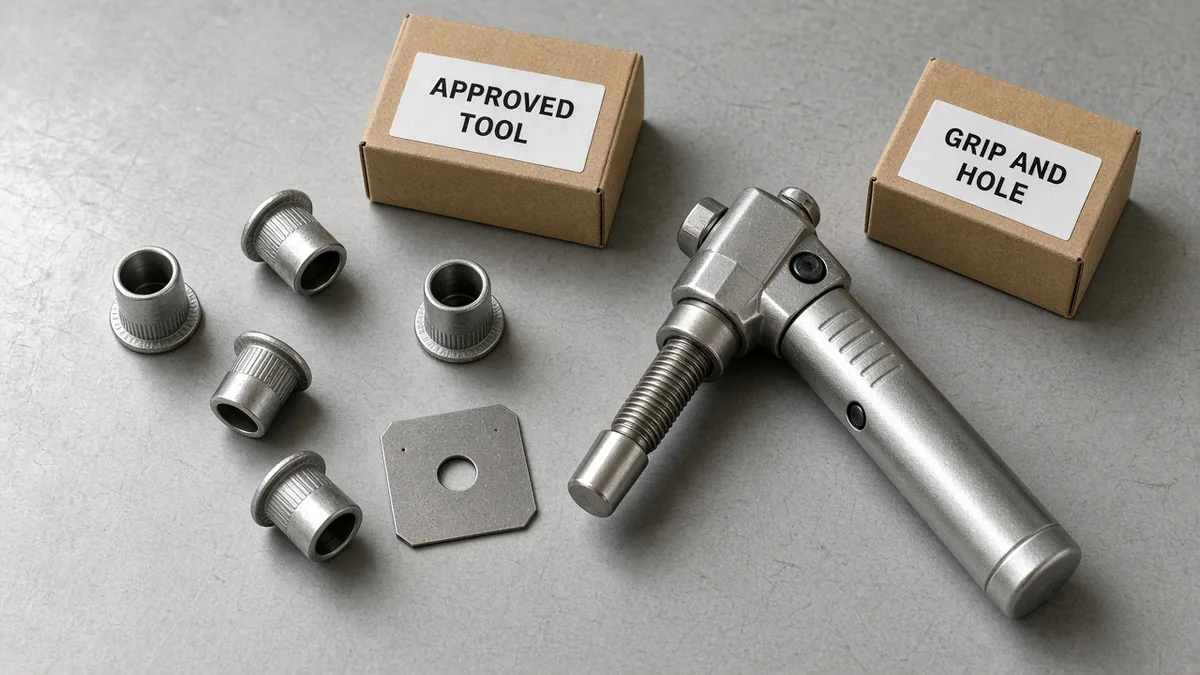
How to install a rivet nut is not completed by pointing at a tool catalog. The setting sheet may name the approved tool family. It should not become a shopping page for a rivet-nut tool, kit, or gun, and it should not borrow those transactional heads as volume.
A custom metal storage rack manufacturer review is useful when the inserts are being specified into a rack or enclosure program. Rack construction is not a substitute for the family, grip, and tool lines. A familiar rack finish does not name the setting data.
What belongs in the setting-sheet kit list, and what must stay out?
The kit should include every part and every data field the easy-to-install sentence assumes. For a first set, that usually means the packed rivet-nut family, the cited grip and hole or a blank field pointed to the setting data, the approved tool family or an explicit exclusion, and the matching instructions.
A hardware kit packing inspection checklist is a useful neighbor when you are comparing the bag to the sheet. That checklist does not invent a stroke or a hole. It only asks whether the named inserts and the named data were packed. Use it as a completeness check, not as a substitute for the family line.
| Field or claim | What must be named | What belongs in the kit or data | What this row is not |
|---|---|---|---|
| Packed rivet-nut family | The insert style the carton actually ships, in the supplier’s terms | The packed inserts and the matching setting instructions | A joining-rivet or pop-rivet first set, or an invented Koitor SKU |
| Grip range and hole | The grip and hole taken from cited setting data, or a named field left blank | Only the values the cited data actually supplies | A factory-universal hole or grip chart, or a borrowed blog table |
| Approved setting tool | A purpose-made rivet-nut setter family, or an explicit exclusion plus a pointer to the supplier’s data | The named tool family, if the program packs or requires one, not a shopping list | A without-tool or improvised bolt-and-nut method, or a pointed pop-rivet gun used as a stand-in |
| Easy to install | The family, grip and hole, and approved tool the sentence is allowed to assume | Nothing beyond that named list and cited data | A stroke or torque-out chart presented as a Koitor standard, or tool merchandising as the thesis |
| Later removal | That removal is a different service mode, not this first set | A pointer to a later removal file only if that mode is separately validated | A destructive removal walkthrough printed on a first-set carton |
Keep spin-out and setting-stroke procurement on the live spin-out RFQ, named in prose only when that href is missing from the lock copy. This first-set file may point there. It should not reprint that RFQ as a stroke chart.
Do not fill a blank hole, stroke, or torque field with a plant default. A blank field, pointed to cited setting data, is safer than an invented number.
Why are without-tool threads not a license to print a bypass?
They are demand evidence, and they are a hard exclude. People search how to install rivnuts without a tool because an approved setter is missing or because a shopping page has trained the query. That demand explains why the approved tool must be named. It is not permission to teach an improvised method.
This page will not describe a without-tool or bolt-and-nut setup, even as a detailed example to avoid. A list of unofficial steps is still a list of unofficial steps. The honest sheet names the approved tool family, or excludes it and points to the supplier’s current setting data, and leaves unofficial methods off the carton.
Tool-kit and tool-gun shopping heads are clues only. They are never targets and never borrowed volume. The setting sheet may name an approved tool family. It should not become merchandising for a gun, and this article does not claim that Koitor manufactures that tool.
Brand-navigational phrases, including phrases built around another company’s insert or tool model, are not this page’s target. Describe the hardware in family, grip, and approved-tool terms. Do not borrow a competitor’s setting video, or that video’s search volume, as a Koitor standard.
Which neighboring insert and rivet files should stay out of this sentence?
Spin-out and setting-stroke procurement stay on the live rivet-nut spin-out file, named in prose only if the lock copy omits that href. Do not invent an address for it, and do not reprint a stroke table as this first-set answer.
Rivet-nuts versus self-clinching nuts, closed-versus-open-end water-ingress, and flow-drilling versus rivet-nut tubing are also live neighbors, named in prose only when they are missing from the lock copy. This first-set file may point to them. It should not absorb those selection or alternative-method files.
How to install rivets, in this same batch, will freeze a joining-rivet family, grip or stack and hole, and an approved rivet-setting tool or method. That is a different family from a rivet nut. Point joining-rivet questions there once that article is published, and do not treat a rivet nut as a joining rivet, or the reverse.
How to remove a pop rivet, also in this batch, is a pop-rivet removal map, not a rivet-nut first set and not a rivet-nut removal unless that mode is separately validated. How to remove a rivet nut is a different service mode and is not this page. Do not print a destructive removal walkthrough on a first-set carton.
Garment, leather, or jeans rivets are out of scope on the joining-rivet and pop-rivet files, and they are out of scope here as well. This is a metal-insert first set, not a garment rivet tutorial.
What should be checked before a listing says the rivet nut is easy to install?
Check the packed family, the cited grip and hole or the honest blank, the approved tool family or exclusion, and the without-tool exclusion before any easy-install sentence is printed. If any of those is missing, the sentence is not ready, even if the inserts photograph well.
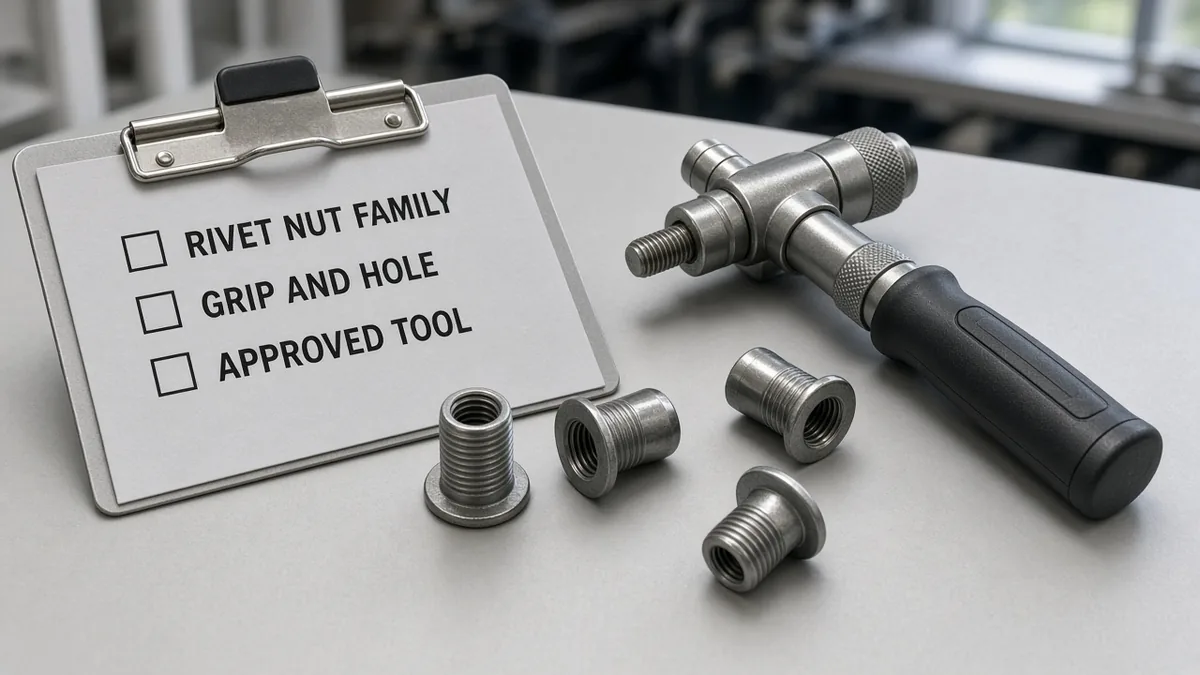
- Name the packed rivet-nut family in the supplier’s terms before any setting sentence is printed, and treat rivnut or nutsert phrasing as coverage of the same decision.
- Name grip range and hole from cited setting data, or keep the field named and blank; do not invent a factory-universal chart.
- Name the approved purpose-made rivet-nut setting tool family, or mark it excluded and point to the supplier’s current setting data.
- Exclude without-tool and improvised bolt-and-nut methods; do not print those paths, and do not treat a missing tool as a license to bypass.
- Do not merchandize a tool, kit, or gun as the thesis, and do not claim that Koitor manufactures rivet-nut tools.
- Keep spin-out, clinch selection, body-style, and flow-drill questions on their neighboring files, named in prose when the lock copy omits those hrefs.
- Keep joining-rivet first set and pop-rivet removal on the companion articles in this batch; do not interchange those families with a rivet nut.
- Keep rivet-nut removal off this first-set carton unless a later, separately validated file owns that mode.
- Do not invent a stroke, torque-out, or interchange value as a Koitor standard, and do not invent a current named insert SKU.
- Revise the easy-to-install line whenever the packed family, the cited data, or the approved tool family changes.
Translations on a bilingual carton should follow the same named fields. A without-tool exclusion that appears only in one language is not an exclusion in the other market. Review both languages against the same cited setting data before the easy-to-install line is translated.
Incoming sample checks can use a simple bag-to-sheet comparison: tick the packed inserts against the named family, and tick the cited grip and hole against the setting data if a value is printed. That check is not a stroke study, and it is not a torque-out trial. It only asks whether the carton can be believed.
If a later order adds a different body style or a different grip beside an existing SKU in the same finish, treat that as a new setting sheet, not as a sticker change on the same bag. The hole, the tool family, and the instructions may all change. An old easy-to-install sentence left on a new grip carton will be believed, and it will be wrong.
The same discipline applies when a hardware-only insert program later adds a complete enclosure or rack offering, or the reverse. The insert may look familiar. The packed list is a new list. Reprint the family, grip, and tool fields before the carton reuses an old easy-to-install line.
How to install a rivet nut is not completed by pointing at a spin-out RFQ or a tool catalog. Those neighbors remain neighbors. The setting sheet is ready only when the packed family, the cited grip and hole, and the approved tool can be believed on their own terms.
If the approved tool family is still unknown at artwork freeze, the honest sheet names the insert family, leaves the tool field blank or points it to the supplier’s setting data, and still excludes unofficial methods. That is not a weaker sheet. It is a sheet that does not invent a tool and does not fill the blank with a without-tool bypass.
Finish and plating can change without changing the packed family, and the packed family can change without changing the finish. Treat those as separate fields. A new zinc or stainless callout is not, by itself, a license to reuse an old grip sentence, and a new grip is not a license to keep last year’s tool line just because the insert head looks familiar.
Sample photographs should not show an improvised bolt next to an approved rivet-nut setter, even as a “do not use” still. Incoming inspection can tick the packed inserts and the cited grip against the setting data without turning the bench into a stroke or torque-out trial. The check is still a completeness check, not a setting study and not a tool demonstration for unofficial methods.
If a project later names a required grip, hole, or approved tool class and cites a source, the setting sheet may repeat that requirement and cite the same source. Until such a source exists, keep the field named and leave the value blank. A blank field is safer than a borrowed hole chart that does not match the packed family.
Foire aux questions
Can the listing say the rivet nut is easy to install?
Only after the packed family, the grip and hole, and the approved tool are named or honestly pointed to cited setting data, and only if unofficial methods are excluded. An easy-install line is not a substitute for a missing tool family or an invented hole chart. This article does not supply a universal stroke or a without-tool method.
Are rivnut and nutsert different first-set files?
No. Those names are coverage of the same rivet-nut first-set decision. Name the packed family in the supplier’s terms. Do not open a second page for each informal name, and do not invent a Koitor SKU from the synonym.
What should the sheet say if the buyer asks how to set a rivet nut without a tool?
Exclude that path and point the buyer to the approved tool family or to the supplier’s current setting data. Do not print a workaround on this page. Without-tool demand is evidence that the approved tool must be named, not a license to teach unofficial setting.
Is this the same file as how to install rivets or how to remove a pop rivet?
No. Joining-rivet first set and pop-rivet removal are companion articles in this batch, and they are different families and different service modes. A rivet nut is not a joining rivet, and this first set is not a removal map.
Should this sheet also choose a clinch nut or a flow-drilled hole instead?
No. Those selection or alternative-method questions sit on neighboring files. This first-set file may point there. It should not reprint those comparisons, and it should not invent a factory preference.
Does Koitor currently offer a named rivet-nut SKU or manufacture setting tools?
This article does not assert a current named production SKU, and it does not claim that Koitor manufactures rivet-nut tools. Adjacent fastener and storage OEM pages already sit in the published library. If you are screening this line, send the intended family, setting data, and tool family for review of wording and kit scope.
Collaborez avec Koitor Hardware
Need a rivet-nut setting sheet reviewed?
Send Koitor the insert drawing or setting data, the sheet thickness and hole, and the intended tool family. Our team can review the wording and the kit scope, without offering a universal stroke or a without-tool method. MOQ can start from about 100 pcs depending on the product; samples usually take 5-7 working days after details are confirmed; bulk production usually takes 4-6 weeks depending on the project.
Fabrication pour compte de tiers / Marque de distributeur
Transformez ce guide d'approvisionnement en cahier des charges
Indiquez-nous le produit souhaité, ses dimensions, sa finition, la quantité commandée et vos exigences en matière d'emballage. Votre équipe recevra une analyse pratique de la faisabilité de la fabrication avant l'établissement du devis.

 English
 Español
 Português
 Français
 Deutsch
 العربية