
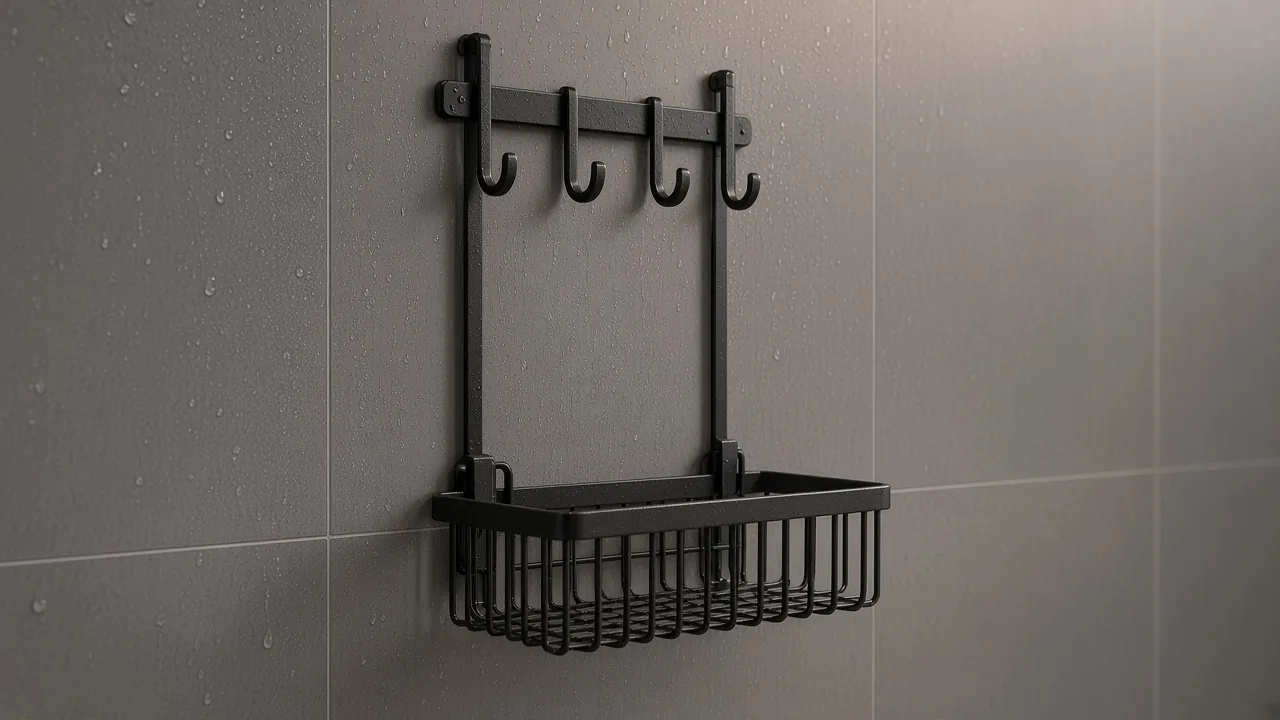
Matte black bathroom hardware field touch up is a planned aftersales control, not a last-minute paint-pen decision made in a store aisle. Importers and private-label teams should decide, before the first bulk shipment leaves, whether a nick on a matte black towel bar, robe hook, or hook rail will be handled by replacing the part, by an approved lot-matched touch-up used only in agreed zones, or by scrapping the piece.
A consumer paint that looks close under showroom lighting often reads as a glossier or flatter patch on a low-sheen collection once the piece is installed next to undamaged neighbors. That mismatch is what this page is written to prevent.
This guide keeps the decision on spare-finish planning for screw-mounted matte black bathroom accessories. It does not replace production adhesion or color-matching work, and it does not invent a Koitor touch-up SKU or a universal “invisible repair” claim.
Why matte black shows nicks that other finishes hide
Low-sheen black finishes hide less edge damage than bright chrome or satin nickel. A small scrape on a polished bar often disappears in reflection. The same scrape on a matte black post or back plate reads as a bright metal line or as a shiny island in a dull field.
The visible problem is usually contrast, not the size of the nick. Installers and retail customers compare the damaged piece with the rest of the collection on the same wall. If a robe hook, a towel bar, and a hook rail shipped from different finish lots, a later touch-up that matches only one of them can still look wrong.
Powder-coated and other applied black films also have thickness. A field repair that sits proud of the film, or that is rubbed through to a different undertone, is often more obvious than the original nick. That is why an untested retail pen is a poor default for a coordinated assortment.
Koitor Hardware is a family-owned China OEM manufacturer of bathroom and home-storage metal hardware. For matte black programs, the practical manufacturing issue is that the same color name can be produced in more than one film system. A buyer who writes only “matte black” on the purchase order has not yet frozen the finish family that a later spare or touch-up must follow.
This page is also not a production adhesion primer. Adhesion, cure, and cross-hatch work belong in the sampling file for the coating itself. Field planning starts after a finish has already been approved, when the question is how a later nick will be handled without breaking the collection.
Cleaner chemistry matters later too. A solvent or abrasive pad that a contractor uses to “blend” a repair can change the sheen around the nick. Cleaner compatibility for powder-coated bathroom hardware is the live neighbor for chemical-care language; this page only notes that an approved field kit must not introduce an untested cleaner.
Should buyers replace the part, approve a touch-up, or scrap the piece?
Start with a three-way decision, not with a shopping list of pens. Replace the part when the nick is on a highly visible face, when the film is broken through to substrate on an edge that will stay wet, or when the assortment is sold as a tightly matched set and a patch would be seen beside an undamaged neighbor.
Approve a limited touch-up only when the zone is agreed in writing, the material is lot-referenced to the shipped finish, and a trial on a hidden edge or a retained sample has already been reviewed under the same lighting the retailer or installer will use. Scrap the piece when the substrate is bent, when the mount is compromised, or when a previous unapproved repair already created a worse patch.
| Situation | Usually replace the part | Limited approved touch-up may be considered | Usually scrap |
|---|---|---|---|
| Location | Front face, hook radius, or bar that sits at eye height | Hidden back-plate edge, underside of a post, or a low-visibility flange lip | Anywhere the mount, thread, or structural wire is damaged |
| Finish condition | Film broken on a visible plane, or sheen already uneven across the lot | Shallow nick, film still present around the zone, lot reference still available | Prior unapproved paint, mixed sheens, or unknown over-paint already on the piece |
| Collection risk | The SKU hangs beside matching pieces in the same wall set | The SKU is a service spare or a less-visible add-on in the same finish family | The piece can no longer represent the sealed finish standard |
| Evidence needed | Photo of the face, lot mark, and a neighboring undamaged piece | Lot card, approved material identity, and a hidden-edge trial record | Photo of the structural damage or of the failed prior repair |
| Who decides | Buyer quality or category owner, not only the installer | Buyer and factory against a written zone map | Buyer quality; do not return a bent part into spare stock |
The table is a starting map, not a promise that every shallow nick may be painted. Many private-label programs simply forbid field paint on visible faces and keep a spare-part buffer instead. That is often the cleaner commercial choice when the assortment is photographed as a matched set.
If the buyer does allow a limited touch-up, write the allowed zones in the same file as the finish standard. “Use your judgment in the field” is how mismatched patches enter a collection. Name the faces that are never repaired in the field, and name the faces where a trial may be proposed.
Do not treat a factory leftover of bulk powder or a retail aerosol as automatically approved. Leftover production material can age, pick up contamination, or belong to a different lot than the shipped goods. Retail aerosols are rarely controlled to the same sheen and undertone as the approved film.

What finish-lot records should travel with the spare program?
A spare-finish program is only as good as the lot trail. If the warehouse can issue a hook from lot A and a touch-up from lot B, the field result is a new mismatch, even if both were once called matte black.
At shipment, record the finish identification the factory actually ran: the powder or other film code if one exists, the color standard name as written on the approved panel, the production lot or batch identifier, and the date the lot was coated. Keep a retained finished sample from that lot, not only a digital photo.
Photos help, but they do not replace a physical panel. Camera white-balance and retailer lighting change how black films look. The retained sample is the object a later spare or touch-up should be compared against, under a lighting condition the parties have described in the file — for example, a stated viewing distance in mixed indoor light, not a single phone flash.
When the same silhouette will be sold in more than one black, separate the records. A soft-matte hook rail and a slightly more satin black towel bar are not one spare pool, even if both are marketed as matte black. Write the finish code on the spare-part SKU, not only on the original production order.
Pour custom bathroom towel rack programs and other screw-mounted collections, the spare list should name the finished part, not only a raw casting or an unfinished bar. A raw spare that will be coated later still needs the same finish code, or the later coat will drift.
If the factory changes the film system after the golden sample, treat it as a finish change, not a paperwork typo. A different powder family, a different supplier of the same color name, or a shift from one black process to another can all move sheen and undertone.
That change should trigger a new sealed finish reference before spare stock is mixed. A later article in this authorized batch covers when a sealed golden sample must be opened again. This page only requires that spare-finish stock follow the current sealed finish, not an older leftover.
Retention time is a project agreement, not a Koitor-invented rule. Many buyers keep retained panels at least through the first warranty window of the program, and they restock the panel when a new finish lot is approved. Write the period in the purchase file rather than assuming the factory will keep every panel indefinitely.
How should an approved field kit be controlled?
If the program allows any field material at all, treat it as a controlled kit, not as a toolbox extra. The kit should identify the finish lot it belongs to, the allowed zones, the application method, and the point at which the installer must stop and request a replacement part instead.
Write the method in short steps. A typical controlled sequence is: clean only with the agreed non-abrasive method, mask adjacent faces, apply the approved material only in the named zone, and compare the result to the retained sample after the agreed dry time. If the sheen or undertone is off, stop. Do not add a second product on top to “fix” the first repair.
Quantity in the kit should be small and lot-bound. A large bottle that outlives the finish lot becomes an uncontrolled color source. When a new finish lot is approved, withdraw or clearly quarantine kit material that belonged to the prior lot.
Training matters as much as the material. A well-specified kit in untrained hands still creates glossy spots. If the buyer’s installers or distributors will perform any approved touch-up, include a short method note and a photograph of a hidden-edge trial that passed. Do not rely on a marketing bullet that says “touch-up included.”
Never approve a kit that requires a cleaner or solvent the finish file has not addressed. Some films soften, bloom, or change sheen when wiped with solvents that are routine in other trades. If the care file is silent, the field kit should be silent too: no extra chemistry.
Label language should stay modest. “Approved lot sample for named hidden zones” is safer than “perfect match” or “invisible repair.” Catalog claims of that kind are hard to defend once two black films sit on the same wall.
Screw-mounted accessories add one more practical limit. Cover flanges and post collars are often the first surfaces that scuff during installation. If those faces are classified as visible, the kit should not become a way to hide poor installation handling. Better packing, better install instructions, and spare flanges may do more than paint.
What the factory can control, and what stays a project agreement
The factory can control how consistently the approved film is applied on a given lot, how parts are packed so they do not rub in transit, and how finish-lot identification is marked on cartons or bags. It can retain a finished sample from the lot and can pack a nominated quantity of spare finished parts when the purchase file asks for them.
The factory cannot honestly promise that every field nick will be invisible, that a later lot will be indistinguishable from an earlier lot without a new standard, or that a third-party pen will match the approved film. Those promises should not appear in a listing or a warranty line unless the program has an authorized, evidenced statement.
Packing and handling deserve a line in the same program file. Matte black films show carton rub and metal-to-metal contact more clearly than many bright finishes. If the collection includes a hook rail with a basket, separate or sleeve the contact points so the basket does not polish bright spots into the rail during transit. That is prevention, not touch-up.
Inspection of incoming goods should look for nicks, rub, and sheen variation under the same lighting rule used for the retained sample. Dimensional checks and sampling frequency are a separate agreement. Do not write a single sentence that mixes a caliper method with an AQL number; keep measurement methods in one place and the sampling plan in another.
When a shipment already contains damaged pieces, photograph the lot mark, the damaged face, and an undamaged neighbor from the same carton if one exists. That evidence is how a buyer later decides replace versus inspect-further. A later page in this batch covers warranty-claim photo packets in more detail; the point here is only that finish-lot identity must be in the photo set.
For a broader view of how fabrication sur mesure de quincaillerie de salle de bains programs are specified, keep the finish standard, the spare list, and the field-kit rule in one buyer file. The inquiry to Koitor can then name the finish code, the retained-sample status, and whether the program wants spare parts, a controlled kit, or a replace-only rule.
Buyer checklist for matte black spare-finish planning
Installation handling is a frequent source of nicks that later get blamed on the film. Cover flanges, post collars, and hook radii pick up tool slips and carton edges. Write a short install note that tells the crew to keep metal tools off the visible faces, and to request a spare rather than improvising a repair. A distributor returns desk should use the same replace-versus-touch-up map so one region does not paint visible faces while another region only issues parts.
If a listing or an installer manual will mention matte black bathroom hardware field touch up at all, the claim should point back to the written zone map and the lot-bound kit, not to a generic promise that nicks can be made to disappear.
Use this list on the sampling or first-bulk file. If an item cannot be answered, the program is not yet ready for a field-repair claim in the listing or the installer manual.
- Name the exact accessories in the matte black collection (for example, hook rail, towel bar, robe hook) and confirm they share one finish code, not only one marketing name.
- State whether visible-face nicks are handled by replacement, by a limited approved touch-up, or by a mix that is written zone by zone.
- Keep a retained finished sample from the current finish lot, labeled with the lot identifier and the approval date.
- Record how the lot identifier will appear on cartons, bags, or part labels so a field photo can capture it.
- If a field kit is allowed, name the material identity, the lot it belongs to, the allowed zones, and the stop rule that sends the installer back to a spare part.
- Forbid untested retail pens, leftover bulk powder, and unlisted solvents in the installer instructions.
- Describe the lighting and viewing condition for comparing a repair or a spare with the retained sample.
- Agree packing contact protection for matte black faces that rub in the carton, especially on hook-and-basket combinations.
- State how long retained panels and lot-bound kit material stay in force, and what happens when a new finish lot is approved.
- Keep any sampling plan for incoming inspection in a separate clause from the finish-comparison method.
- Confirm that installer instructions and distributor return desk use the same replace-versus-touch-up map, including photographs of allowed versus forbidden zones.
- Send the finish standard, retained-sample status, and spare-part intent with the RFQ so quotation can follow the same file the field will later use.
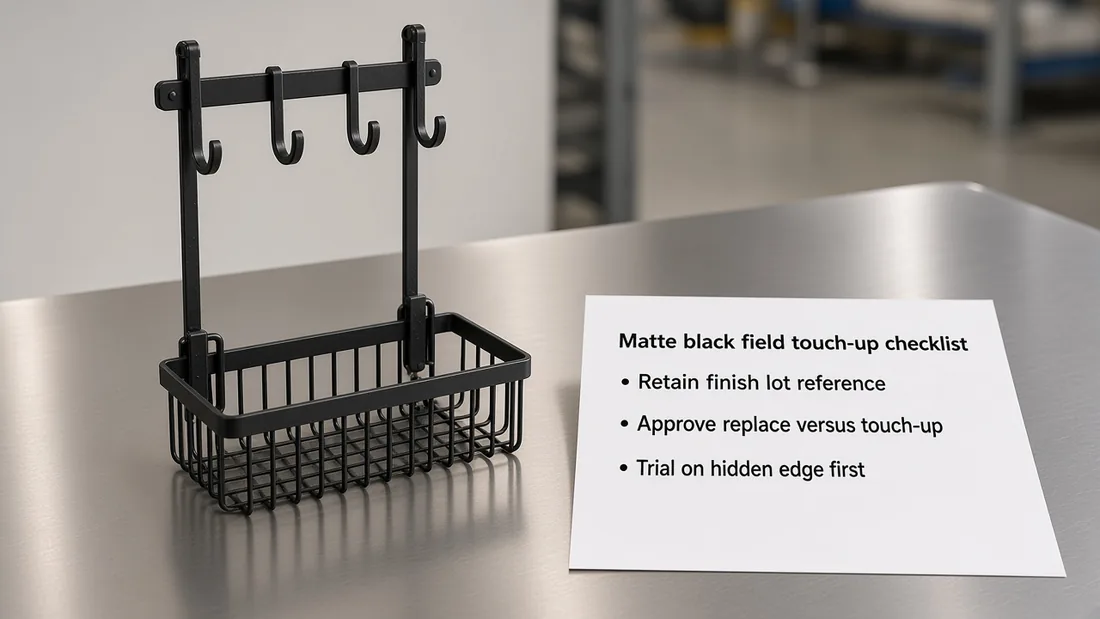
When the file is complete, a buyer can send it with a drawing or a physical sample and ask for a quotation that includes finished spares, a lot-bound kit, or a replace-only rule. The commercial terms for quantity, sample timing, and production lead time stay project-specific. Koitor can review the finish-control intent; it cannot honestly promise a perfect field match on every nick.
Foire aux questions
Is a retail matte black paint pen acceptable for field repairs?
Not unless that exact product has been trialled against the retained sample and written into the program file. Many pens dry to a different sheen or undertone. The default should be replace-the-part or an approved, lot-referenced material in named zones only.
Does matte black bathroom hardware field touch up work on every nick?
No. Visible faces, wet edges with film broken through to substrate, bent parts, and pieces that already carry an unapproved repair are poor candidates. The phrase describes a planned control, not a guarantee that every nick can be painted out.
How many spare parts should a buyer order?
There is no universal percentage. Set the spare buffer from the installation risk, the number of visible faces in the set, and the lead time to replace a finished part. Ask Koitor to quote finished spares against the current finish lot rather than inventing a free-spare promise.
Can leftover production powder be kept as the official touch-up?
Only if the parties agree to a controlled, lot-bound kit and the leftover is still the same finish identification as the shipped goods. Unlabelled leftover material should not be treated as an approved kit.
What if a later production lot does not sit perfectly beside the first lot?
Do not blend the two lots into one spare pool. Compare the new lot with the sealed finish standard, decide whether a new retained sample is required, and keep field kits and spare parts segregated by lot until the buyer accepts the new standard.
Does this guidance also apply to brushed or satin black?
The same planning logic applies whenever a low-sheen dark finish will be seen as a collection. The file must still name the actual finish code. Do not copy a matte-black kit onto a different black film without a new trial.
Collaborez avec Koitor Hardware
Need a matte black program planned for spares and field nicks?
Send Koitor the finish standard or retained sample, the lot-identification method, and whether your program wants finished spare parts, a controlled lot-bound kit, or a replace-only rule. Our team can review small-batch OEM options before quotation.
Fabrication pour compte de tiers / Marque de distributeur
Transformez ce guide d'approvisionnement en cahier des charges
Indiquez-nous le produit souhaité, ses dimensions, sa finition, la quantité commandée et vos exigences en matière d'emballage. Votre équipe recevra une analyse pratique de la faisabilité de la fabrication avant l'établissement du devis.


 English
 Español
 Português
 Français
 Deutsch
 العربية