
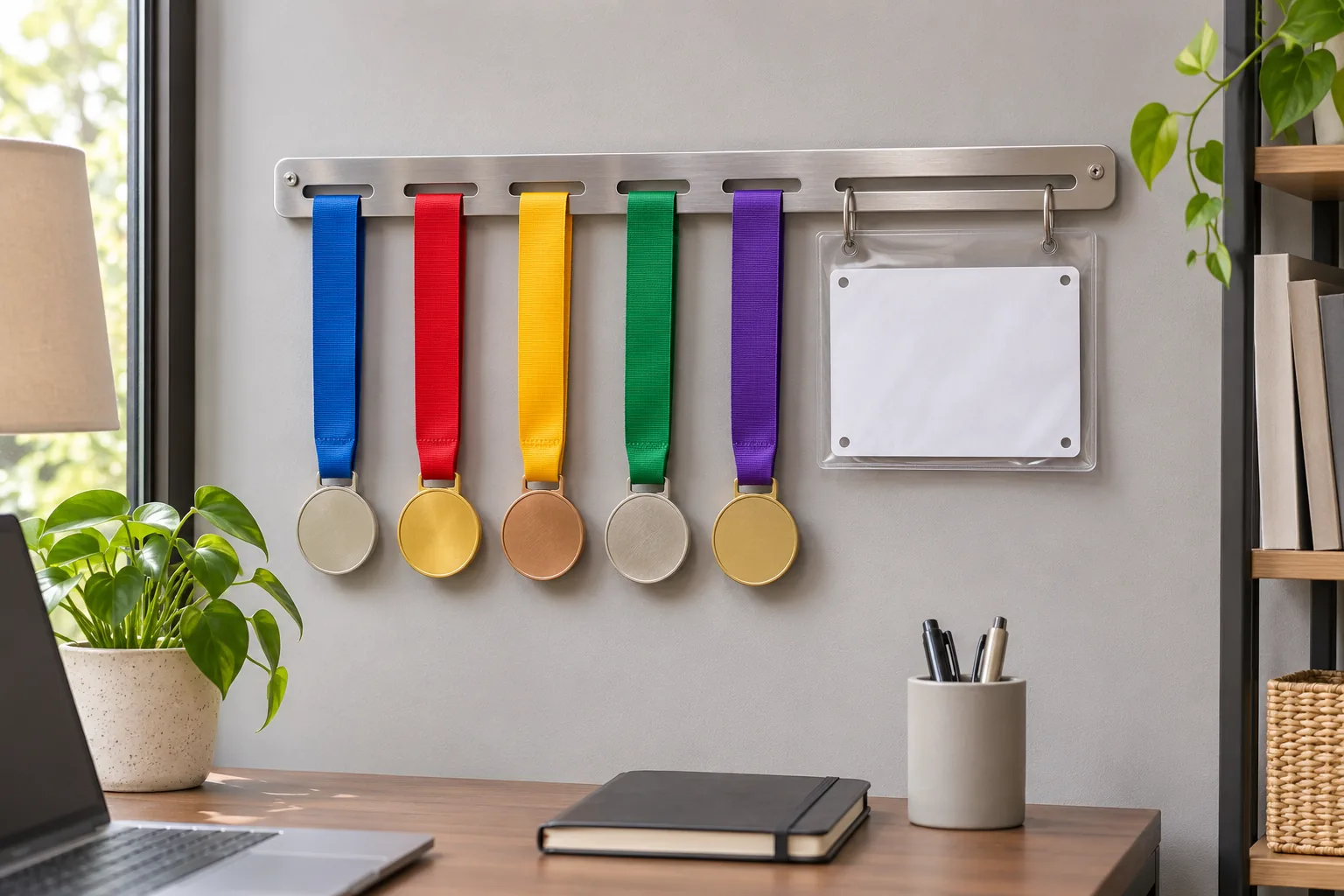
A metal medal and race bib display is a combined storage product with at least two different interfaces: a rail or hook that carries ribbons and medals, and a sleeve or holder that keeps paper race numbers visible and removable. Buyers should approve both interfaces with the actual medal ribbons, representative bibs and intended wall mounting parts. A stated medal count alone does not prove that a display will accept the buyer’s sleeve format, let a user turn a page, or leave enough clearance for a ribbon loop.
This guide is for importers and private-label buyers developing an adjacent home-organization product. The examples below explain buyer checks; they do not establish that Koitor currently makes medal displays. Before a supplier quotation, define the actual assortment, samples and ownership of any purchased sleeves or fasteners.
Start with the actual objects, not a capacity headline
For this decision, record the metal medal and race bib display requirements in the controlled specification and sample review so the approved scope remains clear to purchasing, quality and the supplier.
Collect representative medals, ribbons, bibs and any plastic sleeves before approving a design. A product page may describe a display by the number of medals or bibs it can hold, but a buyer still needs to know what collection and storage method that count assumes. Medal ribbons vary in width, fold, stitching and length. Medals vary in thickness, attached loops and hanging hardware. Race bibs may be carried loose, placed in individual protective sleeves, or turned through a sleeve arrangement that adds thickness and edge friction.
A combined display should be reviewed as one assembly, but the two storage jobs should be measured separately. A ribbon-support rail needs enough space for the ribbon to pass over its hook and hang without being trapped behind an adjacent medal. A sleeve interface needs a secure but serviceable edge: the page should be inserted and removed as intended, and a user should be able to see or turn the paper without catching it on the medal rail or wall.
Ask the product developer to state the intended bib format. Does the product hold one bib per sleeve, multiple pages back-to-back, or a single loose race number? Does the sleeve arrive with the display, or does the buyer source it separately? A product description that simply says “bib holder” can conceal a major packaging and compatibility difference. The Runner’s Wall, for example, describes a combined metal display with clear sleeves, medal tiers, spacers and mounting hardware. That is evidence of one architecture, not a universal configuration or capacity standard.
Separate the buyer’s target from the reference product. If a competitor listing shows an integrated rail, a particular sheet thickness or a claimed capacity, record it as a reference example only. Do not transfer its dimensions, load claim or proprietary geometry into an RFQ. A buyer’s own sample set and intended assortment define the acceptance reference.
Map the interfaces and clearances
A practical sample worksheet should identify each contact and movement path. Begin with the medal loop or ribbon fold and the rail’s opening. Record the clear opening that matters for insertion, the rail thickness or shape that touches the ribbon, the available spacing between adjacent positions, and the downward path the medal follows after it is hung. If a buyer expects to display medals of different sizes, use a representative group rather than selecting one unusually small sample.
For bib sleeves, identify the paper envelope, the sleeve’s outside dimensions, thickness when loaded, edge construction and the access method. A sleeve that fits when empty may bind after a paper bib is inserted. A sleeve may also need a margin around perforations or pins. If the display uses hooks, slots or a rail, specify whether the sleeve has a hole, loop or tab designed for that connection. The buyer should not assume a general-purpose sleeve will work with a purpose-built hook.
Wall spacing is a third interface. A standoff can separate the display from a wall, protect the wall finish, or create clearance behind a hanging ribbon; its function must be explicit. Check whether the deepest medal contacts the wall, whether a sleeve edge catches at the standoff, and whether an adjacent object obstructs page insertion. The mounting kit should be listed separately from the display body. Allied Medal Displays, for instance, shows that hardware packs can differ between ordinary medal hangers and bib-plus-medal configurations. That illustrates why the buyer should confirm kit completeness instead of assuming two related models share the same parts.
| Interface | What the buyer supplies | What the sample should demonstrate |
|---|---|---|
| Ribbon to rail | Narrow, wide and folded ribbon examples | Easy insertion, stable resting position and removal without snagging |
| Medal to adjacent position | A small and a broad medal sample | No unintended collision or overlap that blocks retrieval |
| Bib to sleeve | Actual bib size and selected sleeve | Fit with paper loaded, legibility and the intended page-change method |
| Sleeve to hanger | The actual sleeve edge or tab | Secure engagement with a controlled insertion and removal path |
| Display to wall | Intended wall mock-up and supplied spacer | Clearance for ribbons, medals and sleeves in the final mounting state |
| Kit to carton | Complete accessory set and instructions | Parts remain identifiable and protected through packing and receipt |
Choose an architecture that can be explained
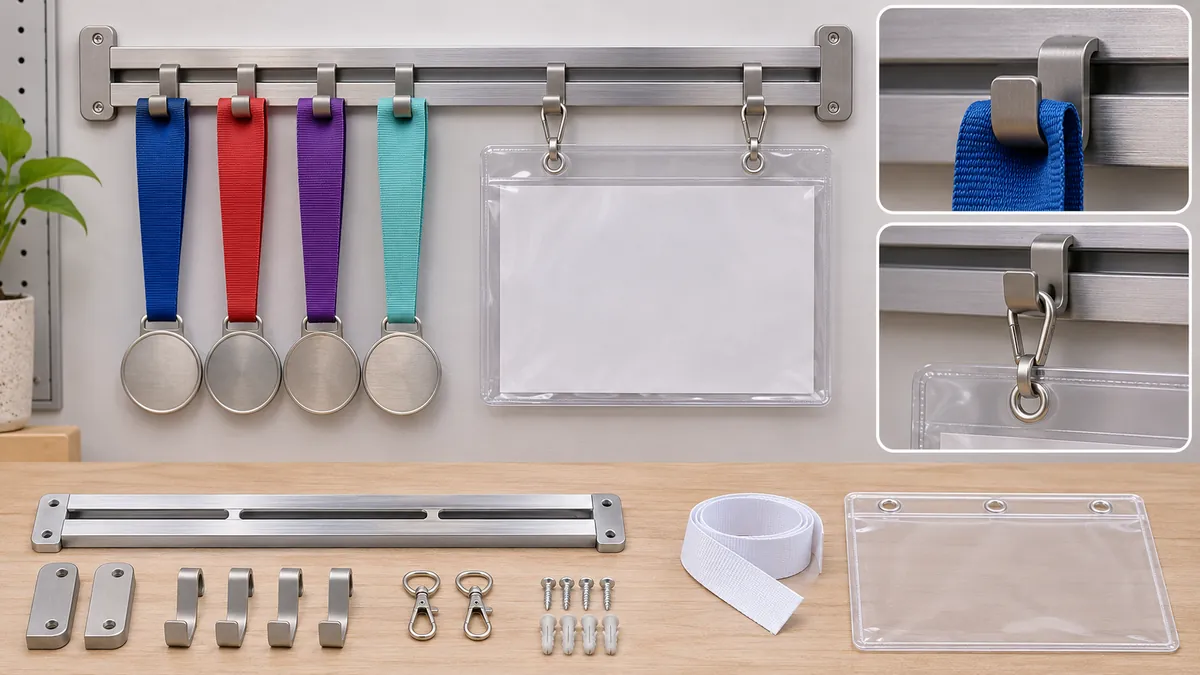
There are several ways to combine ribbon and bib storage: an integrated metal plate with separate zones, a rail with add-on sleeve hooks, a metal frame that supports replaceable sleeves, or a display that treats the sleeve as a separately sourced accessory. The buyer’s selection should follow a real merchandising and service decision, not a preference for the largest nominal count.
An integrated construction can make the assortment appear complete and may reduce the risk that customers overlook a needed component. It also ties the sleeve interface to the product design, so any change in sleeve material, edge or hole pattern can create a revision. A separate hook system may allow different configurations but adds parts to count, identify and package. A rail can create flexible spacing, but its usable positions and access path still need to be tested with mixed ribbons and medals.
Ask the supplier to identify which components are included in the quotation: metal body, sleeve or sleeve hooks, wall spacers, fasteners, installation instructions, protective packaging and any retail insert. If a part is purchased from another supplier, identify who approves its material and dimensions, who receives the specification change, and which party confirms the complete kit. A generic line such as “mounting accessories included” is not enough for a repeatable purchase order.
The drawing should show the product in its intended orientation and include the interfaces that affect use: rail profile, hook or slot positions, sleeve attachment, standoff depth and mounting hole locations. It should also show any cosmetic face and any area where a weld, bend or fastener must be hidden or controlled. A drawing is not a substitute for the physical sample; it is the reference that helps both sides discuss the same revision when the sample is reviewed.
For buyers sourcing a broader metal organization assortment, Koitor’s OEM home-storage hardware page describes the company’s general product and customization context. That page does not confirm medal-display capability. Any adjacent-product feasibility should be confirmed against the actual drawing and sample.
Approve the sample in a repeatable sequence
A useful sample approval separates fit, function, finish and package completeness. First, use the actual bib and sleeve: load the paper, install the sleeve in the designated position and confirm that its edge is not forced or distorted. Remove and replace it using the expected user motion. If it is meant to hold several pages, turn or swap them in the expected way. A sleeve that looks acceptable in a photograph can still be hard to service.
Next, test ribbon and medal access. Hang the representative ribbons, including the widest one and the one with the largest fold or loop. Add the intended mix of medals. Remove one from the middle position and observe whether neighboring items shift, block access or scrape the wall. This is a fit review, not a structural load or safety test. If a buyer needs a performance test, the requirement and method should be defined separately and supported by evidence appropriate to the intended use.
Then inspect appearance and handling. Look at front-facing edges, corners, deburring, coating or plating, visible welds, and points where fabric or plastic contacts the metal. A visual sample review can identify rough or sharp-feeling areas, but it cannot prove coating adhesion, corrosion life or long-term wear. Those questions need defined criteria and the relevant test evidence; do not infer them from a showroom sample.
Finally, count the complete shipment kit. Verify whether sleeves are included, whether wall spacers and fasteners match the drawing, whether the instruction sheet corresponds to the final revision, and whether packaging keeps metal edges from rubbing against clear sleeves. Check the carton and protective separators after unpacking. A display can pass the bench sample review and still arrive with scuffed components or mixed accessories if the packed kit was never approved.
Use the golden sample or a controlled pre-production sample as the named reference. Record the sample revision, date, supplied accessories, accepted exceptions and any changes required before bulk production. If the supplier changes the sleeve source, rail profile, finish or mounting kit, the buyer should determine whether that change affects the fit decisions already accepted.
Build a buyer specification and handoff record
A short specification can prevent repeated clarification. Include the target user’s collection pattern, the bib and sleeve references, representative ribbon and medal samples, the intended mounting system, the included accessories, the finish, the packaging concept and the drawing revision. Attach photographs with a ruler or measured outline where useful, but keep the actual sample available for approval when the interface is difficult to infer from an image.
The specification should also distinguish “must fit” items from “reference only” items. If a buyer wants to accommodate a specific existing sleeve, say whether that format is mandatory. If the display is designed around a supplied sleeve, identify that component as part of the bill of materials and revision control. If a retail assortment will include several colorways or display sizes, state whether the same hook and sleeve parts are shared across them or are separate SKUs.
Ask the supplier to list open assumptions before prototype approval. Examples include an unconfirmed sleeve source, an unspecified wall surface, a missing large-medal sample, or a mounting part not yet included. An assumption written down can be assigned to an owner; an assumption hidden in a message can be mistaken for an approved specification.
A practical buyer-ready handoff contains:
- Product purpose and intended assortment.
- A drawing with the metal body, rail or hook, sleeve interface, standoff and mounting holes.
- Actual ribbon, medal, bib and sleeve references.
- A complete accessories list and source for purchased parts.
- Finish and cosmetic-face requirements.
- The insertion, turning, removal and neighboring-item checks.
- Packaging protection for metal surfaces and clear sleeves.
- Sample revision, accepted exceptions and final approval owner.
This information is useful even if the buyer decides not to proceed. It reveals whether the product architecture fits the target assortment and whether the quotation includes the components needed to deliver that experience. It also helps a factory determine whether the concept can be evaluated through its documented metal forming, finishing, assembly and sample-development experience, without implying that the factory already manufactures this specific product.
For a project-specific review, send the product references, drawing and accessory list to Koitor. Provide the intended sleeve and mounting parts rather than asking a supplier to promise that a generic display fits every bib, ribbon or wall.

Foire aux questions
Does a published medal capacity prove that every medal will fit?
No. A capacity statement belongs to the specific product and conditions described by its supplier. Buyers should check their own medal envelope, ribbon fold and spacing requirements. A count does not show whether medals overlap, obscure one another or block removal.
Should buyers approve the sleeve separately from the metal display?
They should approve the complete interface. If the sleeve is supplied with the product, test it with the actual paper and hanger. If it is purchased separately, define its dimensions, edge or hole, material and revision in the product record and confirm that the complete combination has been sampled.
Can buyers use a competitor product as a specification?
A competitor product can help illustrate an architecture or a customer expectation, but it is not automatically the buyer’s requirement. Do not copy proprietary geometry or transfer a competitor’s material, capacity, fastener or performance claims. Use the buyer’s own target products and sample criteria.
What should be checked in packaging?
Confirm that the metal display cannot rub against a clear sleeve, that small hooks and fasteners remain counted, and that the instruction sheet matches the shipped revision. Inspect the unpacked sample for scratches, bent parts and missing accessories. Packaging checks do not substitute for a defined transit test if one is required.
Does Koitor currently make medal and race-bib displays?
The available company facts establish Koitor as a custom metal hardware factory focused on bathroom and home storage hardware. They do not establish a current medal-display SKU. Buyers should send a drawing and physical references for a feasibility discussion rather than treating an illustrative article image as a product offer.
Collaborez avec Koitor Hardware
A combined display should be specified around the actual ribbon, medal, bib sleeve and mounting kit the buyer intends to sell. Share those references with the drawing and packaging requirements. Koitor can clarify whether a proposed metal structure falls within the company’s documented manufacturing experience; adjacent product capability must be confirmed for the specific project.
Discuss a Relevant Metal Hardware Project
Share the product scope, drawings or samples, quantities and requirements relevant to this decision. Koitor can clarify whether a metal hardware project fits its confirmed production scope. The metal medal and race bib display specification should state the intended interface and review conditions.
Fabrication pour compte de tiers / Marque de distributeur
Transformez ce guide d'approvisionnement en cahier des charges
Indiquez-nous le produit souhaité, ses dimensions, sa finition, la quantité commandée et vos exigences en matière d'emballage. Votre équipe recevra une analyse pratique de la faisabilité de la fabrication avant l'établissement du devis.


 English
 Español
 Português
 Français
 Deutsch
 العربية