
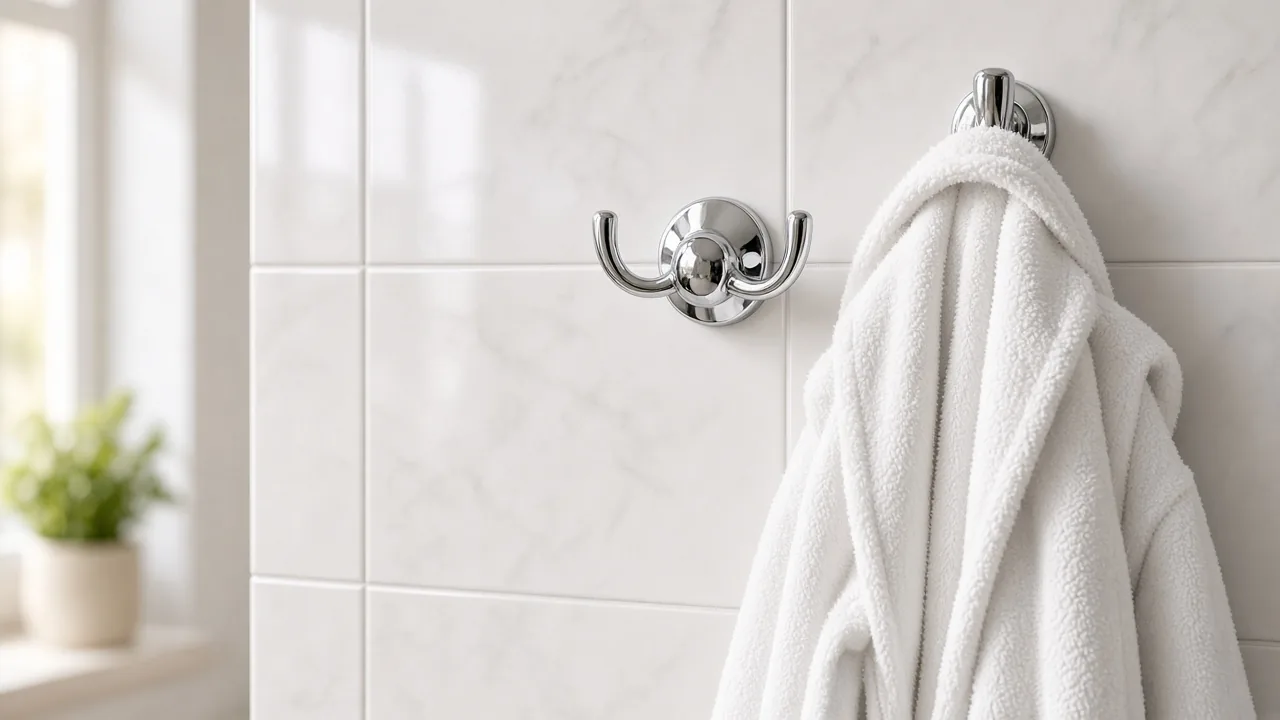
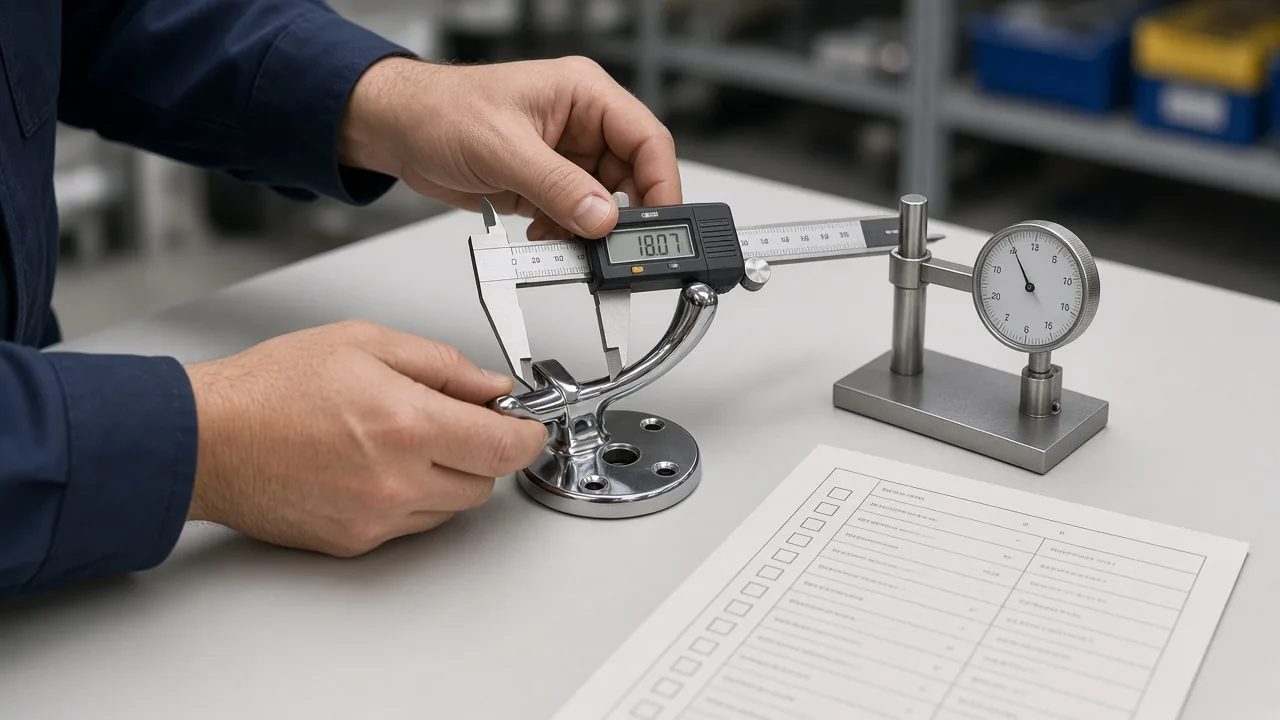
Importers who buy a metal robe hook from a catalog photo often inherit returns that sound like “hook bent,” “screws don’t match the wall,” “robe slips off,” “chrome scratched in the box,” or “sharp edge cut my hand.” Those complaints are not solved by a lower FOB quote. They are solved by RFQ and IQC language that freezes projection, load rating, baseplate and screw pattern, finish stack, edge safety, packing paint rub, single vs dual configuration, and backplate flatness before the mass PO is released.
This article is written for OEM buyers, hotel FF&E teams, private-label brands, and inbound QC. It covers wall-mounted bathroom and hospitality robe hooks—single or double—as acceptance language, not as a rewrite of hotel hanger-ring, toilet-partition coat-hook, or closet tie/scarf hanger pages. Those neighbors solve different interfaces. Here the product lives on a tiled or board wall with a hanging robe mass, so projection, anchorage, and finish protection become CTQs equal to chrome shine.
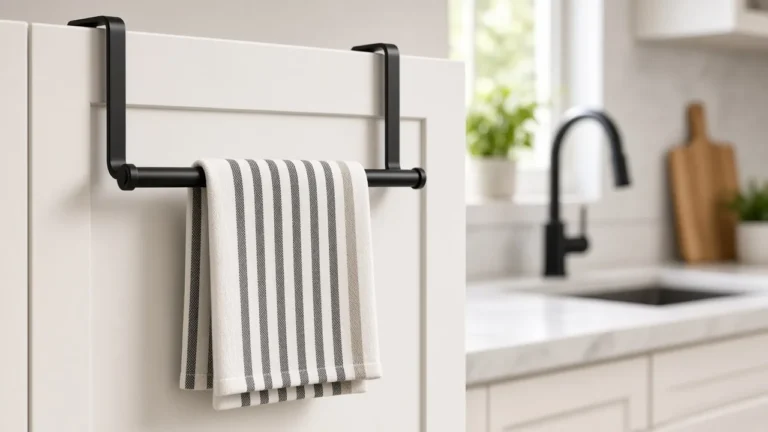
Photos in this guide are generic visual aids for RFQ and IQC discussion. They do not claim that every SKU ships from one plant. Koitor Hardware supports bathroom accessories and hotel hardware programs from Jiangmen, China, with practical specification wording for importers.
In this guide
- Why Wall-Mounted Metal Robe Hook Specs Beat Catalog Screenshots
- How to Freeze Metal Robe Hook CTQs for RFQ and IQC
- 10 RFQ Checks Before Mass PO for a Metal Robe Hook
- Accept, Rework, or Reject: IQC Disposition Rules
- RFQ Checklist Language for Projection, Load, Finish, and Pack
- FAQ: Metal Robe Hook RFQ and IQC
- Send Your Metal Robe Hook Spec for Review
Why Wall-Mounted Metal Robe Hook Specs Beat Catalog Screenshots
A polished product render hides the dimensions that decide field performance. Projection that looks “hotel like” in a photo can still collide with a swinging door or sit too short for a thick terry robe. A dual hook that photographs well can still fail when the two arms are not coplanar or when the shared baseplate rocks on an uneven tile. Catalog language such as “heavy duty” or “rust proof” is not a CTQ. Your RFQ must translate commercial stories into measurable checks.
Wall-mounted bathroom hooks also sit in a different risk family from closet organizers and partition hardware. Steam, splash, cleaner chemistry, and guest abuse cycles differ from dry closet use. Anchors into tile, drywall, or cement board differ from through-bolts on a toilet partition. If your team pastes a closet hanger RFQ into a bath robe-hook PO, you will over-specify wardrobe geometry and under-specify wet-area finish and edge safety.
Boundary with hanger rings, partition coat hooks, and closet hangers
Hotel hanger rings solve wardrobe and luggage-rack hanging interfaces—not wall robe hooks. Keep that program separate with the hotel hanger ring compatibility guide when you are freezing ring ID, wire diameter, and cart compatibility. Toilet-partition coat hooks and bumpers belong to stall hardware; use the toilet partition coat hook bumper buyer checks page for that family. Closet tie and scarf hangers are another SKU line. This page stays on wall-mounted metal robe hook RFQ language for bath and hotel guest rooms.
Commercial stories that start as “just a small hook”
Most robe-hook returns and punch-list items cluster into eight stories: projection too long for the door swing, projection too short so robes slip, load rating missing so guests hang wet coats and pull anchors, and screw patterns that do not match the frozen wall plate.
Other frequent stories include chrome or powder that rubs in the carton, sharp parting lines that catch skin or fabric, dual arms that look crooked after install, and baseplates that rock because they are not flat. Each story maps to one or more of the ten checks below. If claim codes only say “defective hardware,” you cannot trend factories or dual-source honestly.
Hospitality punch lists amplify silent exclusions. A metal robe hook that passed a dry static hang in the sample room can still fail when a wet bathrobe sits for hours on a soft drywall anchor. Your insert and RFQ must name the load method, the wall type assumptions, and the finish/pack rules. IQC must verify those rules on first article—not after the first container lands.
Why bath and hotel walls amplify finish and anchorage risk
Guest bathrooms see steam, splash, and aggressive cleaners. Chrome porosity, powder adhesion, and edge coverage matter more than they do in a dry closet. Anchors into tile require a frozen hole pattern so installers do not improvise. Soft substrates need different hardware kits than concrete. Spec language must therefore cover geometry, load, finish, packing, and kit contents—not only the silhouette of the hook arm.
Category context for bath accessories lives on the bathroom accessories product family page. Use that listing for assortment orientation. Do not treat a category page as your PO annex. The ten checks in this article are the annex language.
Importer cost of an unfrozen robe-hook stack
Unfrozen projection, screw maps, and pack rules on a metal robe hook program create silent margin leaks. Replacement shipments, guest-injury claims on sharp edges, hotel punch-list rework, and “scratched out of box” chargebacks all hit after the PO closed at the low quote. Freezing CHK IDs before award is cheaper than three CAPA rounds across two finish houses.
Buyers should also budget a simple wall coupon and load fixture for first article. A metal robe hook that never sees a wet-robe hang on the agreed substrate will still face that hang in the field. One controlled fixture costs less than a season of FF&E callbacks.
How to Freeze Metal Robe Hook CTQs for RFQ and IQC
Write every wall-hook requirement as a closed loop: check name, inspection location, measurement or photo method, severity class, and disposition. Ambiguous words such as “sturdy,” “hotel grade,” or “won’t scratch” fail under dispute. For a metal robe hook program, treat interface CTQs as equal to casting integrity and cosmetic finish.
Photo-spec labeling that survives email and WhatsApp
Golden-sample photos work only when each image carries a label block: SKU, finish lot, wall coupon type, hang mass, viewing distance, and check ID (for example, CHK-02 Projection). Mark accept / borderline / reject on the same frame or an annotated crop. Store the labeled set with first-article records so production IQC is not comparing against a faded chat screenshot.
Official references for coating adhesion, distribution packing, and storage-unit context
For coated or plated hooks where transit scuffs and cleaner exposure interact with adhesion risk, reference ASTM D3359 tape adhesion methods as a process gate on the metal finish itself. Adhesion on the hook does not replace a packing rub check; it prevents shipping a coating that already lifts under light tape pull.
For distribution hazards that rub finishes and crush corner protectors, buyers commonly reference ASTM D4169 performance testing of shipping containers and systems. Use it to agree a distribution cycle and open-inspect rule for finish scuffs and bent arms—not as a vague “export packing OK” line.
Furniture storage units have strength, durability, and stability methods in ISO 7170:2021. That standard is about furniture storage units, not a consumer robe-hook product mark. Cite it only as context when you explain why hanging accessories need explicit buyer-defined load and stability pass criteria—ISO 7170 itself does not hand you a wet-robe accept number for a wall-mounted metal robe hook.
CTQ table starters for robe-hook programs
Minimum CTQs for most metal robe hook RFQs include: overall projection from wall face to outermost tip; tip-to-wall clearance for robe thickness; single vs dual configuration and dual-arm coplanarity; rated static load and hold time on agreed wall type; and baseplate diameter or outline with flatness.
Also freeze screw hole count, diameter, and center-to-center pattern; finish system (chrome stack or powder) with adhesion gate; sharp-edge / burr standard; packing barrier and carton corner protection against finish rub; hardware kit contents; and instruction content that restates load and substrate assumptions. Add salt-spray or humidity only when your channel truly needs it.
Documentation that survives staff turnover
Buyer teams change; factories change inspectors. A metal robe hook program that lives only in chat threads will drift. Keep the check catalog, photo masters, and CTQ table in a controlled folder with revision dates. Require suppliers to echo the same CHK IDs on IQC sheets. When a new merchandiser asks why a lot was rejected, the photo-spec should answer in one page.
Also freeze the sample wall set. Record substrate (tile on board, drywall, cement board), anchor type, and cleaner chemistry if relevant. Without that, “passed load” means nothing when the next auditor hangs a wet robe on a lighter anchor.
10 RFQ Checks Before Mass PO for a Metal Robe Hook
Use the ten checks as numbered acceptance language in RFQ annexes, first-article reports, and inbound IQC. Severity classes below are starters—tune them to your channel risk. Critical usually means injury risk, structural pull-out, or finish breach that triggers chargebacks. Major means fit or function failure that drives returns. Minor means cosmetic issues that do not change hang performance.
1. Projection and tip clearance not frozen (CHK-01)
Definition: RFQ or drawing fails to state overall projection from finished wall face to outermost tip, or tip-to-wall clearance for a stated robe thickness. Causes include copying a competitor sample without measuring, mixing short residential hooks with deep hotel projections in one SKU story, or letting sales write “standard hotel size.” Spec tip: require projection min/max, measurement method with the baseplate seated flat, and a tip clearance that keeps thick terry from sliding off. Disposition: reject lots outside the frozen projection window on the golden fixture; do not “sort in the warehouse.”
2. Static load rating and hang method missing (CHK-02)
Definition: no rated mass, hold time, or wall-type assumption appears in the RFQ, insert, or IQC sheet. Causes include relying on “solid metal” marketing, testing only dry empty hangers, or ignoring wet bathrobe mass. Spec tip: freeze mass (for example, kg), hold time, load direction, and substrate/anchor kit. Record permanent set or tip deflection limits after unload. Disposition: fail lots that exceed deflection or pull anchors on the frozen wall coupon; treat undocumented “heavy duty” claims as incomplete RFQ inputs, not as passed CTQs.
3. Baseplate outline and screw pattern drift (CHK-03)
Definition: hole count, hole diameter, or center-to-center dimensions differ from the frozen drawing, or the plate outline changes so covers and templates no longer match. Causes include tooling wear, silent second-source castings, or mixing single- and dual-hook plates under one SKU. Spec tip: put a screw map on the drawing with tolerances; require a paper or plastic install template in the kit when your channel needs it. Disposition: Major when holes miss the template; Critical when field drilling into finished tile becomes the only recovery path.
4. Backplate flatness and rock on the wall (CHK-04)
Definition: the mounting face is not flat within the frozen gap limit, so the plate rocks on a true surface or leaves a visible gap on tile. Causes include casting warp, machining skip, or packing crush that bends thin plates. Spec tip: measure flatness on a surface plate or with feeler gauges at named points; photograph light-gap under agreed lighting. Disposition: Major when rock exceeds limit on the golden tile coupon; rework only if machining or selective fit is approved—do not force with over-torque that cracks tile.
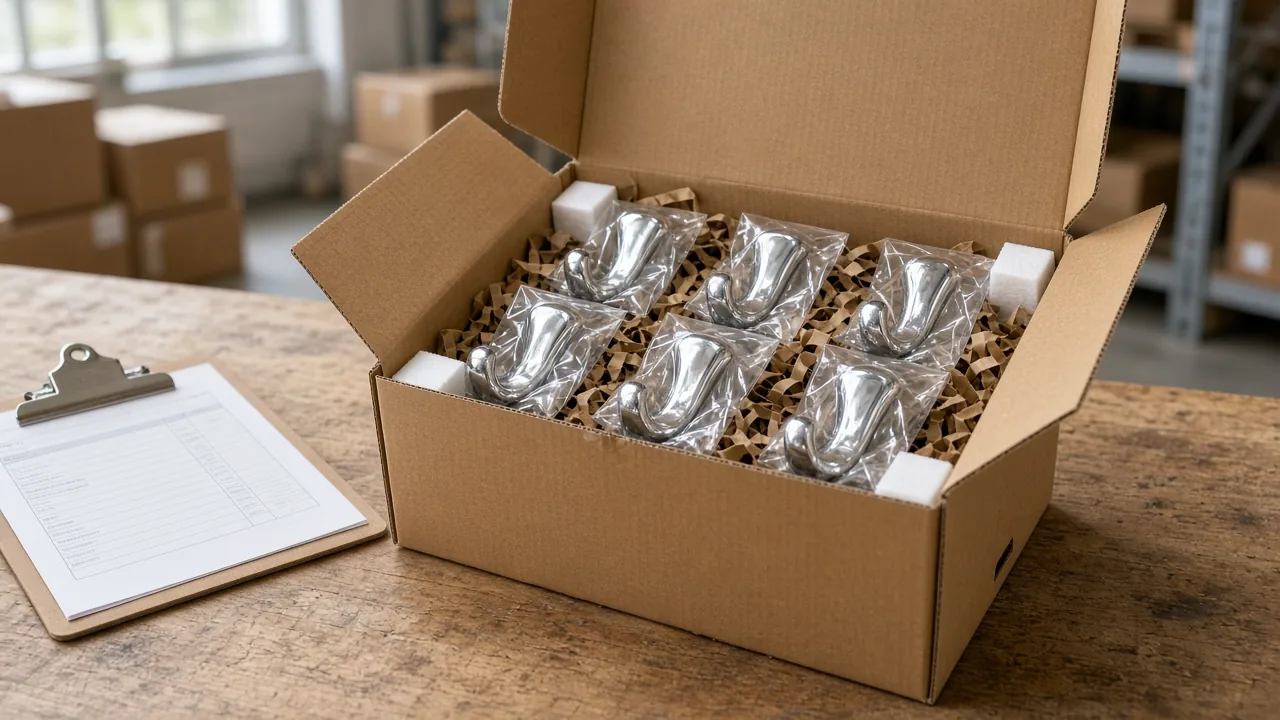
First-article package for robe hooks
A useful first-article set for a metal robe hook includes: dimensioned drawing with projection and screw map; flatness method note; finish master and adhesion record; edge photo masters; load-test photo on the frozen wall coupon; pack-out photos with barriers; kit laydown photo; label/insert revision proof; and signed CHK-01–10 checklist. Missing pieces become negotiations after the first hotel punch list—when leverage is gone.
What not to copy from capability pages
Do not paste “hotel quality robe hook” or “anti-scratch packing included” into a PO without projection, load, screw map, and pack barriers. Capability pages optimize trust. RFQs optimize dispute survival. Keep marketing soft claims aligned to the frozen annex, or force marketing to soften until evidence exists.
Channel differences: retail parcel vs hospitality master carton
Retail parcel packs for a single metal robe hook face corner drops and conveyor impacts. Hospitality master cartons face fork handling, container stack, and long humidity cycles. Do not reuse one drop height for both. Name the channel on the RFQ line and attach the matching protocol annex.
E-commerce returns often start with a “scratched chrome” photo from missing sleeves. Hotel punch lists often start with a screw map that does not match the template on site. Both are specification defects. Train merchandising and QA to open NCRs with CHK IDs so engineering does not chase plating baths for a kitting error.
How this catalog sits beside related hanger CTQs
Hanger-ring compatibility, partition coat-hook bumpers, and closet tie/scarf geometry remain valid programs—but they are not substitutes for wall robe-hook CTQs. A complete bath hardware flow freezes each interface on its own sheet. Mixing them in one vague “hooks” PO is how dual-source factories invent different projections under one price.
When CAPA starts, ask whether the failure is projection drift, flatness rock, finish rub in pack, sharp edge, wrong screw kit, or true plating under-spec. Wrong root-cause coding wastes months. CHK-01 through CHK-10 exist so the first nonconformance report already points at the right subsystem.
Sample gates that prove the hook before mass production
At concept sample, show projection and a proposed screw map even if the finish is temporary. At engineering sample, freeze load method and edge standard. At PPS, lock production finish, pack barriers, kits, labels, and the named transit sequence. Mass production without a PPS freeze is how “factory standard” quietly returns.
Photograph every gate with the same lighting and callouts. Compare PPS photos to the first three production lots. Drift in sleeve count or hole C/C is a specification change even when the silhouette looks the same. Treat that drift as change control, not as a packing-line preference.
Cost myths that create field defects
Myth one: thicker chrome fixes carton rub. It does not if hooks still grind each other for three weeks at sea. Myth two: any round plate is “universal mount.” Hole maps decide whether tile templates work. Myth three: dual hooks are just two singles on one plate. Coplanarity and shared flatness are extra CTQs.
Myth four: load rating is optional if the casting feels heavy. Guest wet robes and soft anchors disagree. Myth five: edges are “fine after plating.” Plating follows geometry; it does not erase flash. Good metal robe hook accounting includes punch-list labor, replacement freight, and injury exposure—not only FOB.
Inspector cues that do not need a full lab
On the dock, inspectors can still catch most CHK classes without a full ASTM suite. Measure projection. Overlay the screw template. Rock-test flatness. Wipe edges. Open the carton and check barriers. Count kit bags. Scan the barcode. Photograph anything borderline. Escalate to adhesion tape methods or a full distribution sequence when the finish or pack revision is new.
Keep a golden hook from PPS in the QC cage. When a production unit “looks the same,” compare side by side on the surface plate. Visual memory fails under schedule pressure. Side-by-side checks make hole drift and tip bend obvious in seconds.
Private-label and multi-factory programs
If two factories quote the same metal robe hook silhouette, they will not invent the same CTQs unless you freeze them. Dual source without a shared annex creates two projections, two screw maps, and two pack behaviors. Require both plants to ship against the same drawing, finish master, kit BOM, and protocol name. First-article each plant’s hook and pack, not only each plant’s shine coupon.
When a second plant proposes a cheaper thin plate, run the cost through rock risk and tile callbacks. Approve only after flatness and load validation match the frozen pass criteria. Price is not a mounting specification.
Writing the NCR so suppliers cannot redefine the defect
Lead with the CHK ID, the frozen CTQ clause, the photo of the dimension or rub node, the sample size, and the disposition. Avoid adjectives alone—“poor quality hook” invites a polite disagreement. “CHK-07: finish rub at tip node T1; PE sleeve missing in 6/8 cartons; Major; rework not allowed after ocean transit” ends the argument shape.
Attach the PPS photo that showed the barrier or screw map correct. Suppliers sometimes claim the buyer never required sleeves or templates. The annex and the photo close that loop. Keep the same ID language in Chinese and English work instructions so the line that bags the hook uses the same names as the team that writes the NCR.
FAQ: Metal Robe Hook RFQ and IQC
Is a metal robe hook really different from a partition coat hook?
Yes. Partition hooks often through-bolt on stall panels and may include bumper geometry. Wall robe hooks depend on baseplate flatness, wall anchors, and bath-area finish. Keep the CTQ sheets separate even if the silhouettes look related in a catalog.
How many times should we name metal robe hook CTQs in our internal SOP?
Enough that every form—RFQ, PPS, IQC, NCR—uses the same subsystem name. Teams that only write “hook” in one cell of a bath hardware checklist lose the CTQs that belong uniquely to a metal robe hook: projection, screw map, flatness, wet-load method, and pack rub barriers.
Do we need full ASTM D4169 certification for every SKU?
Not always. Many importers require a named protocol and a passing report on the golden pack, then control change. Certification vs. internal validation is a commercial choice. What you must not do is ship on undefined “export packing OK” emails.
Can projection change after PPS to save carton cube?
Only with change control, new install templates if the plate moves, and a fresh load and pack validation. Cube gains that recreate door collisions or slip-off returns are not savings.
Where do chrome and powder programs differ in IQC?
Chrome programs often prioritize haze, pit, and rack-mark rules. Powder programs prioritize coverage on edges, orange peel limits, and adhesion. Both still need the same geometry, load, flatness, and pack rub checks. Finish family changes severity defaults; it does not delete CHK-01 through CHK-10.
Who owns missing anchors in the kit?
Treat them as system defects on the finished carton under CHK-09. Root cause may be buyer BOM, factory kitting, or scan process—but disposition on the dock follows the kit clause so install teams do not guess.
Send Your Metal Robe Hook Spec for Review
If you are freezing a new wall-mounted metal robe hook for retail bath or hotel FF&E, bring the projection and screw map, load method, finish master, edge standard, pack barrier BOM, and kit list—not only a chrome photo. Clear CTQs shorten sample cycles and cut punch-list arguments before the first container sails.
Share drawings, pack-out photos, and labeled defect masters via our contact page or email simon@koitorhardware.com. We can help you turn the ten RFQ checks above into a supplier-ready acceptance sheet before the next production release.
Koitor Hardware — Jiangmen, China. Bathroom accessories and hotel hardware programs for importers and OEM buyers who want inspectable metal robe hook language, not vague “hotel grade” promises.
Fabrication pour compte de tiers / Marque de distributeur
Transformez ce guide d'approvisionnement en cahier des charges
Indiquez-nous le produit souhaité, ses dimensions, sa finition, la quantité commandée et vos exigences en matière d'emballage. Votre équipe recevra une analyse pratique de la faisabilité de la fabrication avant l'établissement du devis.
 English
 Español
 Português
 Français
 Deutsch
 العربية