

A metal mail organizer OEM brief should start with the mail sizes and quantity the buyer expects to store, then define the usable pocket opening, hook layout, mounting pattern and finished sample checks. A product that looks similar in a listing may use a different pocket depth, lip, hook projection or material combination. Buyers should approve the actual configuration against a drawing and representative sample, not rely on a category name or a photograph alone. No universal envelope size, hook spacing or load rating applies to every program.
What Should the RFQ Define for a Metal Mail Organizer OEM?
Describe the wall-mounted product as a particular mail-and-key configuration, not simply as an “entryway organizer.” A useful brief identifies what the unit stores, how many pockets or shelves it has, how many hooks are needed, and the intended wall-mount arrangement.
Start with the mail. List the envelope, folded document or card formats the product should accept and the quantity expected in each pocket. State whether the buyer needs the opening to accept one item at a time, a small stack, or a mix. If oversized envelopes or parcels are outside the use case, say so. This keeps suppliers from guessing a broader capacity or a deeper pocket that changes the product’s size and pack-out.
Then define the key set. Use the actual key rings, fobs or small bundles the buyer expects the hooks to hold. Record the number of hang points, the clear spacing between them, their projection from the panel and whether the hook points in a particular direction. A photo of a key ring can illustrate the reference, but the drawing should contain the controlling dimensions.
The brief should also state the product’s overall width and height, pocket count, shelf or tray features, finish, visible faces, wall-mount hole pattern and intended retail-pack configuration. If the proposed organizer combines materials—such as a wood front, metal mesh pocket and separate hooks—identify who supplies each component and who owns the final assembled inspection. One China private-label listing, for example, shows this type of mixed-material construction; it is an example of one supplier’s product, not a standard or a Koitor capability. A wholesale listing for a multi-layer metal organizer illustrates another configuration, but its listing fields do not set a universal specification.
For a metal mail organizer OEM quotation, send the same drawing and use-case brief to every supplier. Ask each one to list assumptions and exceptions rather than silently choosing hook count, fasteners, finish or materials. A useful quote should make the product scope comparable: organizer body, bought-in components, assembly, finish, individual pack, labels and any requested sample review. Listings reviewed for this article show that the category can vary: a CHIC Homeware example combines wood, metal mesh and separate hooks, while a Tradewheel marketplace listing illustrates a multi-tier metal configuration. These are supplier-specific examples, not a category standard or evidence of Koitor’s current product range.
How Can Buyers Check Mail-Pocket Fit?
The pocket should be judged by usable space and access, not only by its outside dimensions. Buyers should confirm that the intended mail enters, sits below the retaining edge and can be removed without catching on a seam or corner.
Measure the useful opening at the narrowest point. A folded return, side seam, lower bend or front lip can reduce the space available inside a pocket even when the overall width and depth look generous. On a multi-pocket organizer, specify whether each tier must accept the same envelope format or whether the layout has separate functions, such as incoming mail, outgoing documents or cards. Do not use a generic letter-size assumption when the actual assortment includes different markets or document sizes.
A sample check can use a small set of buyer-selected reference pieces: the largest envelope that must fit, the usual mail format, and any folded document or card that belongs in the use case. Identify each sample and the test direction. Insert and remove the pieces by hand using the normal access path. Record whether the front lip retains the contents as intended, whether a corner snags, and whether one pocket blocks access to another. This is a fit review, not a test of wall attachment or a load rating.
| Décision de l'acheteur | What to define | What to observe on the sample |
|---|---|---|
| Mail envelope | Actual maximum width, height and thickness to be stored | Entry, insertion, removal and contact at the corners |
| Pocket geometry | Number of tiers, usable opening, internal depth, side clearance and front-lip height | Whether mail sits at the intended level without being hidden or trapped |
| Mixed contents | Whether cards, folded documents or another named item is in scope | Access and separation between items in neighboring pockets |
| Visual presentation | Which surface or face is visible after mounting | Finish, edge appearance and any exposed joining detail |
Keep the sample reference with the drawing revision. If the organizer changes from a flat plate to mesh, gains a deeper lip, or adds another pocket, the usable space can change even when the outer size stays similar. A revised configuration needs a new fit review for the mail sizes that matter.
If the intended product is a desktop tray with drawers and multiple compartments, that is a different storage decision from a wall-mounted mail pocket. Koitor’s metal mesh desk organizer sample guide covers the desktop organizer configuration; this article remains focused on mail and keys on a wall-mounted unit.

Conceptual fit-review scene only; the envelope and key ring illustrate buyer-selected reference items.
How Should Key-Hook Layout Be Reviewed?
Review hooks with the key rings and fobs that buyers intend to store. Hook count alone does not show whether the layout leaves enough room for adjacent items or whether the hook projection suits the selected organizer depth.
Lay out the largest intended key ring, fob or key bundle beside the production-intent sample. Confirm that each item can be hung and removed without catching an adjacent hook, pocket edge or wall-mount feature. If a hook has a return, tip or rounded end, include that geometry in the drawing or mark it on the sample. Consider the space used by the hanging items, not just the distance between the metal hook centers.
Ask the supplier to identify the hook material and finish, whether the hook is formed from the body or attached as a separate part, and how it is retained. If the hook is welded, fastened or supplied as a bought-in component, that connection and responsibility should be clear in the specification. A buyer may decide to inspect visible attachment, spacing and finish at specific positions; the article does not prescribe a universal hook-load test.
Do not turn a convenience feature into a security claim. A wall mail organizer with key hooks is not automatically a lockable key cabinet, and a hook retaining one key ring during a fit review does not establish how it behaves under a defined load, impact or misuse. If the program requires a load value or a tamper-resistant feature, that is a separate design and test requirement that must be defined for the exact construction.
For an accurate sample comparison, use the same key ring or fob reference on each supplier sample and photograph the unit from the front and side. Record the panel revision, hook positions and the assembly method so that the buyer can distinguish a spacing issue from a hook-shape or component difference.
What Should the Mounting, Materials and Finish Brief Cover?
Specify the wall-mount interface as part of the product drawing, while leaving installation instructions and fastener selection with the responsible project party. Buyers should not assume that a mounting pattern or screw pack is interchangeable across walls or markets.
Show the hole or keyhole locations, pattern datum, intended orientation and any required clearance between the organizer and the wall. State whether the fasteners are supplied with the retail unit, sourced by the buyer, or separately confirmed after the target installation surfaces are known. If the design uses spacers or a rail, include their location and responsibility. The article does not provide wall-anchoring advice or guarantee that one fixing method suits every substrate.
Material and finish scope should match the product construction. A powder-coated steel pocket, a wood backboard and a separate metal hook each have different purchasing and inspection responsibilities. Identify the material reference for every component the buyer considers critical, the color or finish reference, the cosmetic faces and any edge that needs a stated condition. If a surface is hidden after assembly, mark it so suppliers can quote and inspect the same requirement.
Mixed-material sourcing can introduce handoff questions that a single-material drawing does not show. Confirm which supplier provides the pocket, backboard, screws, hooks and printed insert; who assembles the complete organizer; and where the final sample is checked. If material, finish, hook supplier or mounting components change after approval, treat that as a controlled change and decide whether the buyer needs a replacement sample.
For related products and confirmed manufacturing scope, see Koitor’s OEM home storage hardware page. It describes the company’s focus and does not confirm that wall mail organizers are a current Koitor product.
How Should Importers Approve a Representative Sample and Pack-Out?
Approve a sample that represents the agreed configuration, and record any differences between a prototype and the intended production route. The buyer’s approval should identify the exact mail and key references, mounting pattern, materials, finish and retail pack used during review.
A sample sheet can list each requirement, the evaluation method, the observed result and the disposition. Use separate rows for pocket fit, hook layout, overall dimensions, visible edges, finish, mounting-hole positions, included components and packaging. If a sample is hand-fitted or uses a different material or hook supplier, annotate the difference; a favorable result on that sample does not automatically approve an unchanged production process.
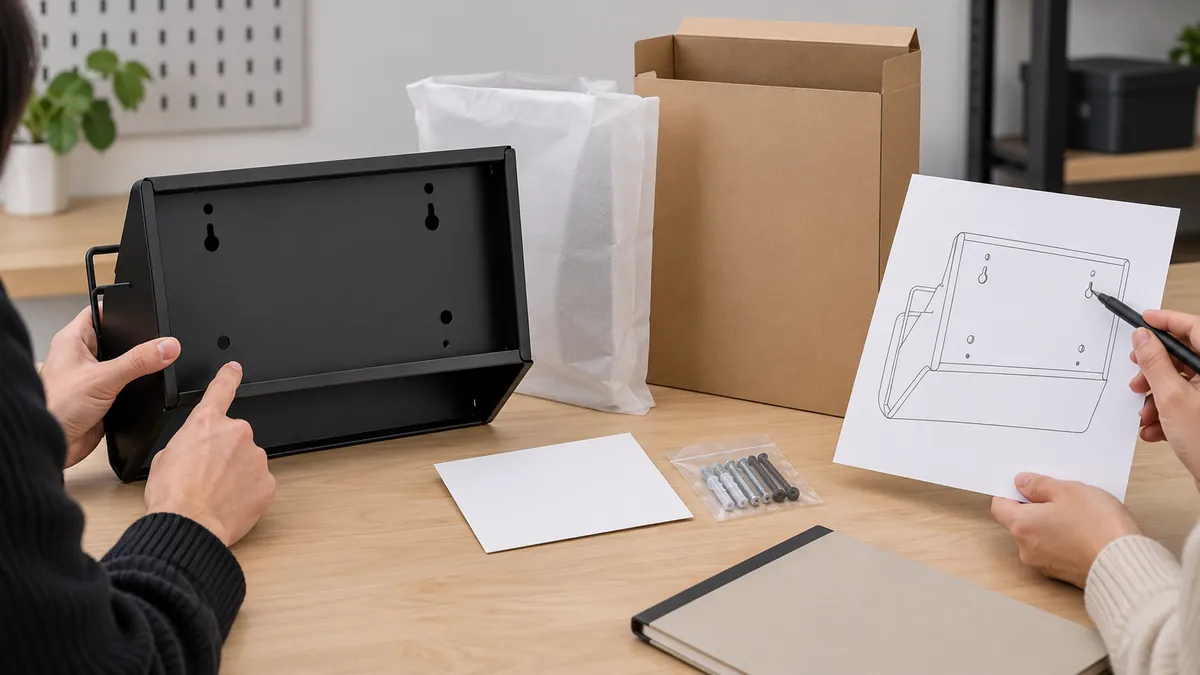
Conceptual sample and packaging review; this image does not show installation guidance or a tested product.
Pack-out deserves a sample check because the hooks and pocket edges can contact other surfaces in a carton. Review the organizer in its retail unit pack, not only on an inspection table. Confirm how the hook ends are separated from the pocket finish, whether the assembly is protected against movement, and whether any installation pieces remain with the correct SKU. If the item can be shipped assembled or flat-packed, state which format the quote and sample represent.
Product label, barcode and package contents should match the buyer’s approved item data. Treat the organizer model, color, hook count, included screws, instruction sheet and pack configuration as one revision. If the pack changes after the physical sample is approved, compare the new contents and protection arrangement before release.
Buyer release checklist
- Mail formats and maximum reference envelope approved for each pocket.
- Pocket count, usable opening, internal depth, lip and access path recorded.
- Key ring/fob reference, hook count, center spacing, projection and orientation agreed.
- Material and finish responsibilities assigned for every component.
- Wall-mount pattern, orientation, fastener supplier and instructions assigned.
- Sample ID and drawing revision recorded, including any prototype/production difference.
- Visible edge and finish acceptance criteria agreed on the actual sample.
- Individual pack, hook protection, included components, barcode and label reviewed.
- Changes requiring renewed buyer approval identified.
- Any requested load, security or installation requirement defined separately for the actual design.
A clear approval record helps a distributor or private-label buyer compare the delivered item with the right sample. It does not replace the buyer’s own inspection plan or turn an illustrative check into a performance certification.
Which Sourcing Mistakes Should Buyers Prevent Before Release?
Avoidable rework often begins with a missing reference, not a complicated manufacturing failure. The buyer can reduce ambiguity by checking that the drawing, quote, sample and pack all describe the same wall-mounted mail and key product.
Common gaps include:
- Asking for a “mail and key organizer” without stating which envelope sizes or how many items each pocket should hold.
- Measuring the outside envelope of the product while ignoring usable opening, front lip, side returns or access direction.
- Specifying the number of hooks without checking the key rings or fobs that must fit side by side.
- Leaving a mixed wood, mesh or metal configuration to supplier assumptions without assigning component and assembly responsibility.
- Reviewing only the bare organizer and not the retail pack that protects the hooks, finish and included components.
- Treating the supplied screw pack as suitable for every wall or market without identifying who owns installation instructions.
- Comparing samples with different hook quantities, finishes or pocket layouts as though they were the same SKU.
- Assuming a product listing’s dimensions, MOQ, sample availability or supplier claims apply to a different project or supplier.
- Approving a prototype without recording any different material, component, finish or production process.
- Inferring a load capacity, security level or installation result from a visual fit check.
A concise product brief prevents suppliers from solving different problems under the same product label. The buyer can keep the required checks focused on the few features that drive the assortment: mail fit, key access, wall interface, finish, item pack and accurate product data.
Frequently Asked Questions About Metal Mail Organizer OEM Projects
What mail sizes should an importer specify?
Use the actual envelopes, folded documents or cards that must fit. Identify the largest required format, quantity per pocket and any items outside the program. The usable opening and access path matter as well as the outer width and depth.
How many key hooks should a wall mail organizer have?
Set the count from the buyer’s intended use, then check the hook spacing and projection with representative rings or fobs. There is no universal hook count or spacing requirement for every organizer.
Does a sample check prove a hook’s load capacity?
No. A fit review shows whether the identified reference item can be hung and removed on that sample under the check performed. A load requirement needs its own design, method, criteria and evidence for the actual product.
Should the supplier provide wall screws with the product?
That depends on the product plan and market. The buyer should assign who selects and supplies fasteners and who prepares installation instructions after the intended mounting substrates and program requirements are known.
Collaborez avec Koitor Hardware
Koitor Hardware is a family-owned custom metal hardware manufacturer focused on bathroom and home storage hardware. The company supports drawing and sample discussions for confirmed product scope; it does not currently claim a metal mail organizer SKU or specific capacity for this adjacent category.
Share the product drawing or concept, mail and key references, finish, quantity and pack-out needs. Contact Koitor to confirm whether the project fits the production scope before treating the category as available.
Discuss a Home-Storage Product Brief
Send the intended mail formats, hook layout, mounting drawing, finish requirements, target quantity and retail-pack needs. Category-specific capability should be confirmed before sampling.
Fabrication pour compte de tiers / Marque de distributeur
Transformez ce guide d'approvisionnement en cahier des charges
Indiquez-nous le produit souhaité, ses dimensions, sa finition, la quantité commandée et vos exigences en matière d'emballage. Votre équipe recevra une analyse pratique de la faisabilité de la fabrication avant l'établissement du devis.
 English
 Español
 Português
 Français
 Deutsch
 العربية