
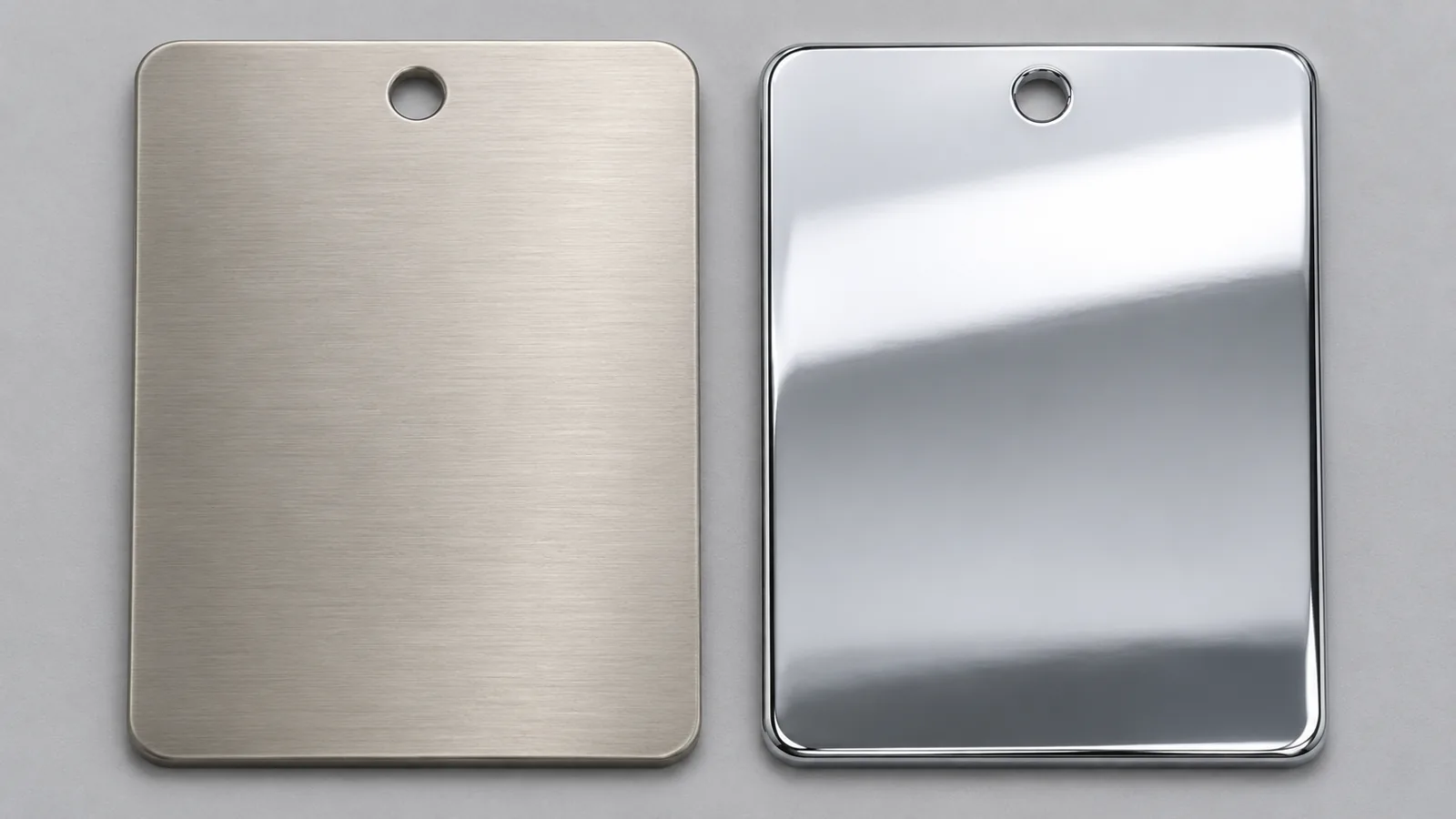
Nickel vs chrome is not just a choice between two colors. “Nickel” may identify a material layer or a named finish appearance, while “chrome” often refers to a chromium-containing finish layer or a commercial finish description; construction varies by product and supplier. For bathroom or home-storage hardware, specify the substrate, finish system, surface appearance, use conditions, and approved reference sample. A polished sample or a finish name alone does not prove the underlying material, corrosion performance, cleaning compatibility, or service life.
What problem does the nickel vs chrome comparison solve?
Buyers often compare product images and assume that polished nickel and polished chrome are fixed, universal finishes. In reality, catalog descriptions can refer to different finish constructions, substrates, intermediate layers, polishing sequences, or protective topcoats. A supplier may describe appearance in a way that helps a shopper recognize a style, but an OEM buyer needs a specification that can be quoted, sampled, inspected, and repeated.
The issue becomes important when a private-label brand combines products from different factories or when a buyer changes suppliers. Two items listed as “nickel” may not match in tone or reflectivity. A “chrome” look may refer to an actual plated system in one offer and a different surface treatment in another. If the finish is treated as a color word alone, the buyer can approve a sample that does not represent the eventual production route.
The buyer should separate three questions. First, what is the visible appearance? Second, what is the substrate and finish construction? Third, what performance, maintenance, or project evidence is required? Those questions are related but not interchangeable. Delta Faucet’s finish overview et a polished nickel versus polished chrome care comparison show why maker-specific names and care guidance matter; they do not create a universal standard for every hardware manufacturer.
This article does not claim that nickel is always warmer, chrome is always more durable, one finish never tarnishes, or either finish is suitable for every environment. Actual results depend on the specific finish system, supplier process, substrate, use, cleaning, and damage. The useful comparison is the exact pair of proposals for the same component and application.
When a buyer searches nickel vs chrome, the immediate decision may be visual, but the purchase decision reaches further. A product team may need several accessories to look coordinated across a retail assortment. A distributor may need replacement units to match an installed product. A project buyer may compare alternate quotations for an identical drawing. In all three cases, the finish name is only the starting point. Record the actual reference, supplier code, substrate, finish route where known, and the approval boundary so that the next person can identify what was purchased.
What do nickel and chrome mean in a finish specification?
Nickel can be a metal layer in a finish system, a reference to a named surface, or a commercial style description. Chrome typically refers to chromium in the finish construction or a chrome-like appearance, but procurement terminology can vary. The word in a catalog does not automatically tell the buyer how many layers are present, what lies beneath the outer surface, whether a clear topcoat exists, or what process sequence was used.
The base component may be steel, stainless steel, zinc alloy, brass, or another substrate. The finish can be applied to that base through a defined process, and the selected system may include one or more layers. Buyers should request the supplier’s description of the finish system and substrate for the actual product rather than infer either from a polished reflection. An outer appearance is not a material declaration.
| Quote description | What it may indicate | What it does not prove | Buyer clarification |
|---|---|---|---|
| Polished nickel | A named finish appearance or nickel-related construction | Exact layers, substrate, or universal tone | Ask for the supplier’s finish definition and sample |
| Chrome | A chromium-related finish or commercial appearance term | Layer sequence, substrate, or corrosion performance | Ask what system and base material are proposed |
| Nickel tone | A visual color direction | That nickel is present as a layer | Request written construction and reference |
| Chrome look | A reflective appearance | That the part uses a specific plating route | Confirm actual process and acceptance basis |
Some bathroom brands publish finish names and care notes specific to their own products. That is useful for understanding consumer expectations, but it should not be transferred as a guarantee to another supplier’s hardware. In an OEM project, the supplier’s declared process and the buyer’s approved specification control the offer. If a buyer needs a particular material or layer, state that requirement and ask what documents can support it.
How should buyers compare finish appearance?
Use an approved physical sample whenever appearance matters commercially. Compare the items under agreed lighting, orientation, and viewing distance. A camera, screen, room lighting, and surrounding colors can change perceived warmth, brightness, and reflectivity. If multiple finish samples are reviewed together, label them with supplier, part, finish code, date, and revision so that the evaluation remains traceable.
Specify which appearance characteristics matter. These may include general color family, gloss, reflectivity, texture, visible polishing direction, or allowable variation within a product set. Avoid subjective words such as “premium” without a reference. A color code can help only if both parties use the same system and understand its limitations on reflective surfaces. Do not assume a digital color swatch exactly reproduces a plated or polished part.

Review more than a flat coupon if the finished product has formed edges, welds, recesses, or multiple components. Polishing direction and reflections can vary across geometry. A sample should represent the component or assembly where the visible effect matters. If the sample is made through a different process or on a different substrate, document what it can demonstrate and what still needs production confirmation.
For a multi-SKU collection, establish whether the buyer expects every product to match exactly or only to remain within an agreed appearance family. Different suppliers or constructions may make exact visual matching impractical without a controlled program. State the priority order: finish appearance, process construction, substrate, or another requirement. The supplier can then explain constraints and propose a sample plan rather than guess which attribute matters most.
Look for differences at edges and transitions, not just on the broad flat face. A rail, hook, escutcheon, and bracket may reflect light differently because of shape, orientation, polishing direction, or assembly. Compare visible pairs from the same viewing angle and include a practical distance at which the consumer or installer will see the product. If the assortment has components made at different times, review them together before approving a new finish source. A collection can appear mismatched even when each item separately falls within its supplier’s internal color description.
When multiple suppliers are involved, one supplier’s “polished nickel” should not automatically become the master reference for another supplier’s finish. Ask whether the second supplier can work to the same physical sample or whether a separate approved standard is needed. If exact matching cannot be guaranteed, state the acceptable family or variation and decide how mixed items will be merchandised or packed. The objective is a transparent commercial decision, not an unsupported promise that two unrelated processes will produce identical reflections.
What product and sourcing information should an RFQ include?
Identify each product code, drawing revision, substrate, visible faces, assembly state, and finish reference. Mark the parts where a finish is cosmetic and the interfaces where it could affect fit, threads, adhesives, or assembly. If the item includes both visible and concealed components, specify whether they receive the same finish or a different treatment. List purchased fasteners and caps separately when they appear beside the main body.
Describe the application environment and cleaning expectations. “Bathroom use” is not a complete exposure category: the product might be in a dry powder room, a shower area, a coastal home, or a hotel facility with frequent cleaning. State what the buyer knows, including cleaning agents or care instructions that are required. Do not turn a broad room label into an unsupported lifetime claim.
Ask the supplier to identify the finish construction and process responsibility. Clarify whether the finish is applied by the supplier or a subcontractor, what sample will represent production, and how the supplier will handle a change in material or process. If the project demands test evidence, agree on the method, sample, acceptance criteria, and limitations in advance. A standard or test applied to one product does not automatically apply to another finish or substrate.
Clarify the naming convention in writing. Ask whether “nickel” refers to an actual nickel-containing layer, a finish color family, or a supplier-specific code; ask what “chrome” denotes in that supplier’s quote. These questions prevent both parties from assuming they mean the same thing. Request a technical description at the level the supplier can support and distinguish proprietary process details from the information needed to specify and control the product.
The buyer should also list any requirements that cannot be inferred from appearance: restrictions on a particular material, a documented finish construction, an agreed corrosion test, a cleaning compatibility requirement, or a project-specific regulatory criterion. For each, identify the evidence expected and who reviews it. If no performance test is required, say so and avoid implying that appearance approval is a performance qualification. A well-scoped RFQ gives the supplier a way to propose an alternative while preserving a clear approval gate.
| RFQ field | Example of useful detail | Buyer control |
|---|---|---|
| Substrate | Material and grade where specified | Tie it to part and drawing revision |
| Finish name | Supplier code plus buyer reference | Ask supplier to define what the code represents |
| Appearance | Physical sample, tone, gloss, texture, visible faces | Review under agreed conditions |
| Construction | Proposed layer or process description where relevant | Separate appearance from material claims |
| Application | Environment, cleaning and exposure context | Do not assume a finish name promises service life |
| Approval | Sample identity, date, revision and sign-off | Preserve one approved production reference |
What assumptions about finish performance should buyers avoid?
Assuming a finish name is a complete process specification. Two suppliers can use similar marketing words for different constructions. Ask what the name means in the quotation and connect it to the sample and product.
Assuming chrome or nickel never corrodes or tarnishes. No broad label guarantees immunity to corrosion, discoloration, or damage. Outcomes depend on the system, substrate, preparation, exposure, care, and process control. Use only claims backed for the specific item.
Treating a color as proof of material. Nickel tone and chrome look may describe appearance rather than composition. Require a written declaration if the actual layer or substrate matters.
Comparing samples under inconsistent light. Different lighting and surroundings can make finish samples appear unlike one another. Define review conditions and compare the same sample orientation and visible areas.
Assuming more polishing means better product quality. Appearance is one attribute. It does not by itself prove fit, substrate, finish adhesion, corrosion behavior, or manufacturing consistency.
Copying another brand’s care guidance. Manufacturer instructions are specific to their finish system and product. A buyer should confirm suitable care recommendations for the actual supplier and approved finish rather than applying another brand’s guidance as universal.
Ignoring concealed interfaces and adjacent parts. A visually acceptable finish may still affect assembly or create mismatch among components. Mark threads, edges, contact zones, and visible joins on the drawing.
Approving a prototype without recording its limits. The prototype may use a different substrate or process. State what it demonstrates and obtain a production-representative sample where needed.
How can finish approval be managed for OEM hardware?
Make the sample approval traceable. Record item, material, finish code, process description supplied by the manufacturer, sample date, drawing revision, and reviewer. Photographing the sample can supplement the physical reference, but photography alone is not a substitute for a retained sample when appearance is critical. Store the reference where the purchasing and quality teams can find it for reorder review.
If a collection is later expanded, use the retained sample to review the new component alongside existing pieces. A catalog image or old email attachment may not preserve viewing conditions or a reliable color reference. Document whether the new item is intended to match the master or merely coordinate with it, and record the decision in the product file.
Keep obsolete standards clearly marked so they are not reused accidentally.
Separate finish approval from product approval. A sample may pass a color review but still need dimensional, assembly, or functional review. Likewise, a finish may look right while the underlying substrate or process evidence remains unclear. Record each approval dimension and identify any unresolved condition before the purchase order is released.
Set a change-control rule. A supplier should notify the buyer before changing the substrate, finish source, process sequence, polishing route, or coating where that change could affect the agreed result. The buyer can then determine whether a new sample or review is needed. For repeat orders, compare the production lot with the approved reference and investigate meaningful appearance variation instead of silently accepting it as a new norm.
Packaging protects the appearance after finishing. Define individual separation, surface protection, and carton arrangement appropriate to the product. If there are several matching accessories in a collection, label finish codes so products are not mixed during picking. Confirm that the packaging material itself does not cause marks or leave residue under expected storage conditions.
Incoming inspection can compare production samples with the signed reference, but teams should agree on what can be judged visually and what requires a different method. Color, gloss, scratches, pits, or visible coverage may be reviewed under stated conditions. Hidden layer composition, adhesion, or corrosion behavior needs evidence appropriate to the claim and system. A polished, reflective face may make minor marks more visible than a matte face; inspection notes should distinguish a true defect from a lighting artifact and use consistent handling to avoid introducing scratches during review.
If a nonconformance occurs, retain the affected sample and identify the lot, SKU, supplier, finish code, and comparison standard. Describe the observed difference rather than jumping to a cause. The supplier and buyer can then determine whether it came from a process change, handling, substrate variation, cleaning, or another factor. Do not infer a coating failure from a single cosmetic observation without investigation, and do not treat a visually acceptable unit as proof of all hidden properties. The record helps decide disposition and prevent the same ambiguity on reorders.
In a multi-piece bathroom set, coordinate not only adjacent items but also fasteners and covers that are visible after installation. A mounting screw may be supplied separately and have a different supplier or finish code. If a visible screw head is expected to blend with the product, note it in the BOM and review it in the assembled sample. A generic instruction to “match chrome” may be insufficient when the main body and purchased hardware use different process families. Identify which component sets the visual master and what degree of variation is acceptable across the set.
For trial orders, decide which attributes must be stable from the first batch and which may be refined after market feedback. Appearance changes can affect stock already in distribution, so make finish revisions visible in SKU descriptions and packing identification. When a supplier proposes a substitute because a coating product is unavailable, pause and compare the new proposal against the approved reference. A different process may require a new sample, revised instructions, or customer communication. Never allow a temporary sourcing substitution to become an undocumented permanent standard.
For a custom project, use the Page consacrée à la fabrication sur mesure d'accessoires de salle de bains or the OEM home-storage hardware page to review the relevant product context. They are not finish certifications. Send a drawing, physical finish reference, environment, care expectations, and target quantity to the supplier; ask for the proposed construction, scope, and approval path in writing.
Buyer checklist for nickel or chrome finish selection

- Identify the exact product code, drawing revision, and substrate.
- Ask what “nickel,” “chrome,” or “tone” means in the supplier’s quotation.
- Separate the visible appearance from actual material and finish construction.
- Provide a physical reference sample or a controlled finish code.
- Mark visible faces, polishing direction, joints, and concealed surfaces.
- State the intended environment and cleaning expectations.
- Clarify whether finish layers or a protective topcoat are specified.
- Ask who applies the finish and who controls process changes.
- Review a representative product sample under consistent conditions.
- Record sample identity, date, revision, reviewer, and approval scope.
- Separate appearance sign-off from dimensional and performance acceptance.
- Define evidence or testing only when relevant and mutually agreed.
- Confirm packaging prevents abrasion and finish-to-finish contact.
- Require approval before changing substrate, finish source, or process.
Foire aux questions
Is polished nickel the same as chrome?
No. The terms refer to different finish descriptions or constructions, and suppliers may define them differently. Compare the actual proposed system and approved sample for the product.
Is nickel always warmer in color than chrome?
That may be a common visual expectation, but exact appearance varies by supplier, process, substrate, lighting, and sample. Use a reference sample rather than relying on the label alone.
Does chrome plating mean the product has a chrome substrate?
No. A finish layer and the base material are separate. Ask the supplier to declare the substrate and finish construction for the actual component.
Which finish is more durable for bathroom hardware?
There is no universal answer from the words nickel and chrome alone. The specific system, preparation, substrate, exposure, cleaning, and process matter. Request applicable evidence for the product and conditions.
Can I use another brand’s finish-care instructions?
Do not assume the instructions transfer. Care guidance is tied to a manufacturer’s finish system and product. Obtain recommendations for the actual supplier’s finish and communicate them in product documentation.
Clarify a Finish Before Approving Your Hardware Sample
Share the product drawing, substrate, finish reference, use conditions, and target quantity to discuss the information needed for an OEM quotation.
Fabrication pour compte de tiers / Marque de distributeur
Transformez ce guide d'approvisionnement en cahier des charges
Indiquez-nous le produit souhaité, ses dimensions, sa finition, la quantité commandée et vos exigences en matière d'emballage. Votre équipe recevra une analyse pratique de la faisabilité de la fabrication avant l'établissement du devis.



 English
 Español
 Português
 Français
 Deutsch
 العربية