

Buyers using the query “PPWR recyclability assessment hardware packaging” are trying to prepare a package record without pretending that an informal worksheet is an official grade. As of 23 October 2026, the PPWR already applies, and the Commission interprets Article 6(1)’s general recyclability requirement as applying from 12 August 2026. The detailed harmonised design-for-recycling criteria and performance-grade method follow a later timetable. For a hardware buyer, the practical step is to capture the current package construction, link it to the right SKU and revision, and re-check the file as the rules and delegated acts develop. This is procurement guidance, not legal advice or a product recyclability assessment.
The PPWR recyclability assessment hardware packaging question is best handled by keeping the supplier’s component facts separate from the buyer’s later regulatory conclusion.
Short answer: record the package now, but do not invent its grade
A supplier file can be useful before a final harmonised assessment method is available. Record what the package contains, how the components are combined, which version protects which product configuration, and which facts are confirmed by the packaging supplier. Mark open fields as unknown or pending; do not convert a planning worksheet into a claim that the package has a PPWR recyclability grade or a certificate.
There is an important regulatory distinction. Regulation (EU) 2025/40 began applying on 12 August 2026. The European Commission’s 2026 guidance states that Article 6(1), requiring packaging placed on the market to be recyclable, applies from that date. However, the specific design-for-recycling criteria and harmonised performance grades under Article 6(2)(a) are scheduled for a delegated act due by 1 January 2028, and Article 6(2)(a) applies from 1 January 2030 or 24 months after that act enters into force, whichever is later. These dates are not permission to ignore current obligations; they explain why a buyer should not claim that a self-made component spreadsheet is already the final official grade.
The guidance also explains the interim position before the harmonised criteria apply. This area has a legal interpretation component, so an importer should confirm the current official text and its own obligations with a qualified EU packaging-compliance professional. Do not rely on a supplier’s informal “recyclable” statement as a substitute for that review.

Separate current requirements from future grading criteria
A useful review starts by asking which question is being answered. “What materials and components are in this shipment’s package?” is a supplier-data question. “Does this package comply with the applicable legal recyclability rule?” is a regulatory assessment. “Which A, B or C grade applies under harmonised design-for-recycling criteria?” is a specific method-based question whose timeline depends on the delegated act. The three questions should not be collapsed into one checkbox.
| Buyer question | What can be recorded now | What it does not establish |
|---|---|---|
| What is included in the packaging? | Package level, component name, material description, known mass, source and revision | A recyclability grade or legal conclusion |
| How is each component assembled? | Attached, folded, taped, coated, laminated, nested or removable, if confirmed | How a final delegated method will score it |
| Which product does it protect? | Product SKU, finish, configuration, sample and pack revision | That a lighter or simpler pack is acceptable |
| Which rule applies at the current date? | Date-stamped review note and official source checked | A legal opinion for every country or operator |
| Is a recyclability grade available? | “Pending harmonised assessment criteria” where appropriate | A guessed grade or supplier-issued “PPWR certificate” |
This record is a buyer-created preparation tool, not a legal documentation template required by the PPWR. Requirements vary by the packaging type, role, market channel and current applicable provisions. The importer should ask its own adviser which statutory records are required and who must keep them.
A recyclability discussion must also stay distinct from nearby PPWR topics. Article 10 and Article 24 address packaging minimisation and empty-space ratios; Article 29 concerns reuse targets. Those are separate buyer decisions, not substitutes for Article 6 design-for-recycling. For the separate transport-carton calculation, see Koitor’s PPWR empty-space ratio guide.
Build a SKU-linked packaging component register
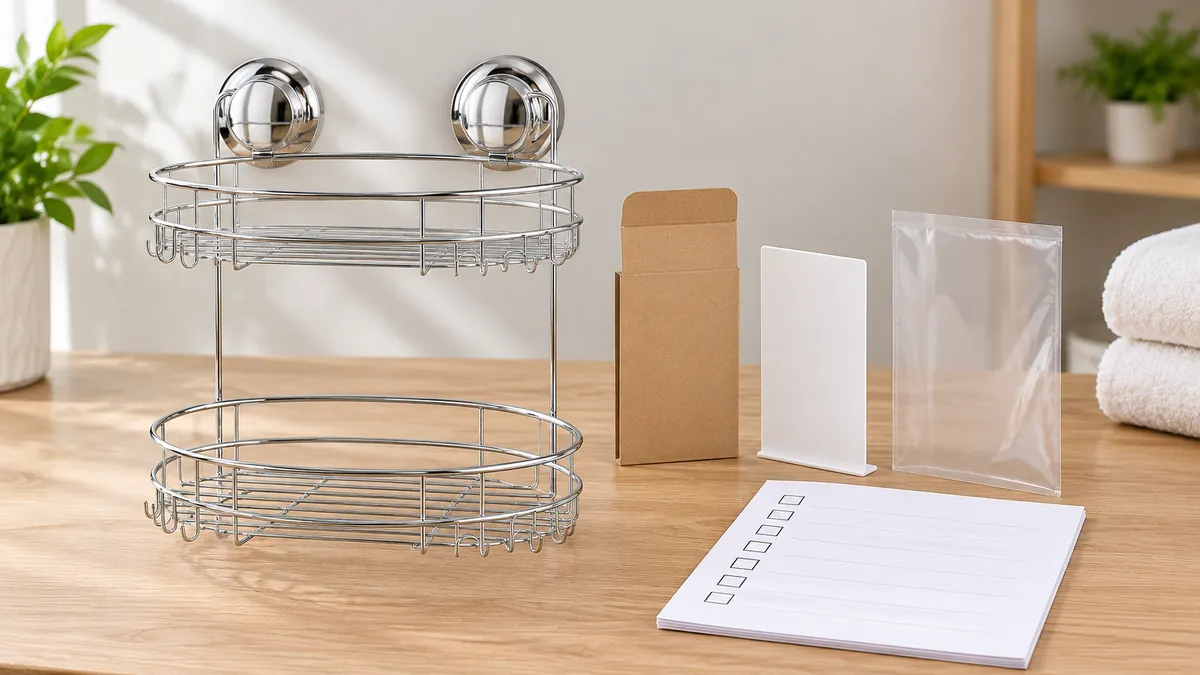
Metal bathroom and home-storage hardware is often shipped with more than one packaging layer. Depending on the approved configuration, a buyer may need to map a retail carton, inner box or sleeve, divider, protective bag or film, tape, label, printed insert and outer transport carton. This list is an inspection prompt—not a claim that every product includes these components or that all are regulated the same way.
The first field should be the product identity: SKU, drawing or sample revision, finish, included accessories, sales pack and date of approval. Then list each packaging component at the level that the buyer can identify. If the buyer does not know a component’s exact material, record the supplier’s stated description and mark the basis, rather than guessing from appearance. A “clear film” description should not silently become a specific polymer grade.
Useful buyer-managed fields include:
- Component name and package level: product-contact, retail, grouped or transport.
- Supplier’s material description, with a distinction between confirmed and provisional information.
- Mass or dimensions, if measured or supplied, and who provided the value.
- Construction: single material, combined materials, coating, adhesive, laminate, attached label or removable part, where known.
- Purpose: product separation, scratch protection, moisture protection, retail display, shipping stability or labeling.
- Product SKU, sample, pack artwork and packaging revision to which the information applies.
- Evidence reference: supplier declaration, specification, drawing, sample observation or other source, with date and scope.
- Unresolved questions, responsible contact, and next review trigger.
Use the register to find missing facts, not to create false precision. If the packaging supplier cannot confirm whether an insert is coated or whether tape is part of the supplied pack, mark the detail pending and route it to the responsible source. Do not infer a weight or material from a photograph. Do not ask a hardware factory to certify a component it does not make or control.
Request supplier evidence that states its scope
An RFQ or packaging-approval request should identify the exact product and proposed package revision. Ask the packaging supplier or other responsible source to identify the components covered, the material terms it can substantiate, the date or version of its information and any assumptions. Keep the original specification, declaration or test record intact; make a separate buyer note explaining how it relates to the package register.
Separate the evidence types. A supplier’s material declaration may report a stated composition. A packaging drawing may show dimensions and assembly. A buyer’s weighing sheet may show a measured mass for one sample. A laboratory report may answer a defined test question. None of those automatically assigns a PPWR recyclability grade unless it was produced under the applicable criteria and by an appropriate process.
Avoid a blanket request for a “PPWR certificate.” The Commission regulation and guidance are the primary sources for obligations; there is no reason to invent a generic certificate requirement. If a retailer or compliance provider requests a named document, ask what decision it supports, which package configuration it covers and who will evaluate it. Keep the request proportional to the open question instead of ordering a broad package test panel with no defined assessment scope.
Do not treat a supplier statement such as “paper,” “recyclable,” or “eco-friendly” as a complete record. Ask what component is meant, whether the claim applies to the material or the whole assembled package, and whether coatings, adhesives, labels or attached parts are included. Any environmental claim placed on packaging or a listing may also raise separate claim-substantiation questions; this guide does not evaluate those claims.
Keep product protection in the same design review
Design-for-recycling work should not be reduced to “remove as much packaging as possible.” A metal organizer can be scratched, bent, corroded or misshapen if a package change removes separation, surface protection or immobilization needed for the product and transport route. A packaging review should look at the intended product, finish, pack-out, shipping and handling conditions alongside material choices.
For each proposed change, compare the old and new package at the product and component level. Does a thinner divider allow metal parts to rub? Does removing a bag change protection for a polished or coated surface? Does combining materials make separation harder, or does it serve a genuine protection function? Does a smaller carton preserve the space needed for corner protection and stable packing? These are engineering and buyer questions, not blanket conclusions about which material is always better.
Ask for a sample pack-out and inspect the exact combination before approving a revision. Record the sample ID, product configuration, assembly sequence, pack dimensions, materials supplied, finish condition before and after handling, and the person who approved it. If a change reduces protection, return to the packaging supplier or product team for another design option rather than treating recyclability preparation as the only performance goal.
Koitor can discuss product structure, finish, drawing or sample details, and manufacturing-side packaging coordination for metal hardware projects. The factory does not provide a PPWR grade or certify a packaging design; the buyer should obtain regulatory assessment from the responsible operator and qualified professional.
Control revisions and schedule the next regulatory review
A supplier data file ages quickly if it is not tied to a version. A buyer can make the record useful by storing it with the product drawing, sample approval and pack-out revision. When product geometry, finish, accessories, carton, insert, coating, adhesive, artwork or packaging source changes, ask whether the old information still represents the shipped configuration. Do not assume every change requires a new legal assessment, and do not assume that an unchanged carton keeps its old evidence valid after its contents change.
Create a date-driven review point for official PPWR developments. The Commission guidance is a useful interpretation source, while Regulation (EU) 2025/40 is the binding text. The Commission’s PPWR FAQ, published 3 August 2026, is additional guidance and should be checked for updates. Revisit the delegated act and any relevant implementing acts when they are adopted, then ask the compliance reviewer which product and packaging categories are covered and when the applicable criteria take effect.
A practical buyer checklist is:
- Confirm that the SKU and package configuration match the record.
- Identify each supplied package component and responsible source.
- Mark the evidence basis and unresolved fields.
- Record current official rules and review date.
- Keep current legal requirements separate from future assessment method and grades.
- Validate that packaging changes do not compromise the approved product protection.
- Obtain a qualified assessment for the intended markets and business roles.
For an EU-bound assortment, buyers may also need separate reviews for substances, recycled content, reuse, labelling, minimisation, empty space, EPR and country-specific implementation. Keep those questions in their own evidence tracks; an Article 6 worksheet does not answer them.
Questions buyers should resolve before approval
Is the PPWR only a future concern until 2030?
No. The PPWR applies from 12 August 2026, and the European Commission interprets Article 6(1)’s general recyclability requirement as applying from that date. The harmonised design-for-recycling criteria and grades under Article 6(2)(a) have a later application timetable. Confirm the requirements relevant to the specific packaging and operator rather than treating 2030 as a universal start date.
Can an importer enter an A, B or C grade in its spreadsheet now?
Do not enter a grade as though it is official unless the applicable assessment method and criteria support it. A buyer-created worksheet may include a field such as “assessment status” or “pending applicable delegated criteria.” That records a state; it does not grade the packaging. For an importer evaluating PPWR recyclability assessment hardware packaging, this distinction prevents a readiness spreadsheet from being mistaken for a final assessment.
Does a supplier’s recyclability declaration settle the issue?
Not necessarily. Check which components, package levels, materials and revision it covers, and whether the statement is a material claim, a supplier opinion or a formal assessment under applicable criteria. Ask a qualified compliance reviewer whether it addresses the buyer’s legal obligation.
Should the importer switch to the lightest possible package?
Not automatically. Package design also needs to protect the product and support safe handling and distribution. A reduction that causes cosmetic damage, corrosion exposure or deformation could create another product-quality problem. Check the product with the approved pack-out, then document the trade-off and discuss any regulatory conclusion with the appropriate expert.
Is this register a legally mandated PPWR form?
No. It is a buyer-side preparation format suggested for organizing supplier information. The PPWR has its own scope, role and evidence requirements; use the official regulation and qualified counsel or compliance professionals to decide what records a particular operator must keep.
For current legal text and timing, consult Regulation (EU) 2025/40, the European Commission’s PPWR implementation guidance, and the Commission’s PPWR FAQ publication page. Guidance and legal requirements can change; check the current version and obtain market-specific advice before relying on the buyer worksheet.
Collaborez avec Koitor Hardware
Review Product and Packaging Changes Together
Share your product drawing or sample, current package layers and proposed revisions. Koitor can discuss manufacturing-side product fit and packaging coordination for metal hardware, while legal recyclability assessment remains with your qualified adviser.
Fabrication pour compte de tiers / Marque de distributeur
Transformez ce guide d'approvisionnement en cahier des charges
Indiquez-nous le produit souhaité, ses dimensions, sa finition, la quantité commandée et vos exigences en matière d'emballage. Votre équipe recevra une analyse pratique de la faisabilité de la fabrication avant l'établissement du devis.
 English
 Español
 Português
 Français
 Deutsch
 العربية