
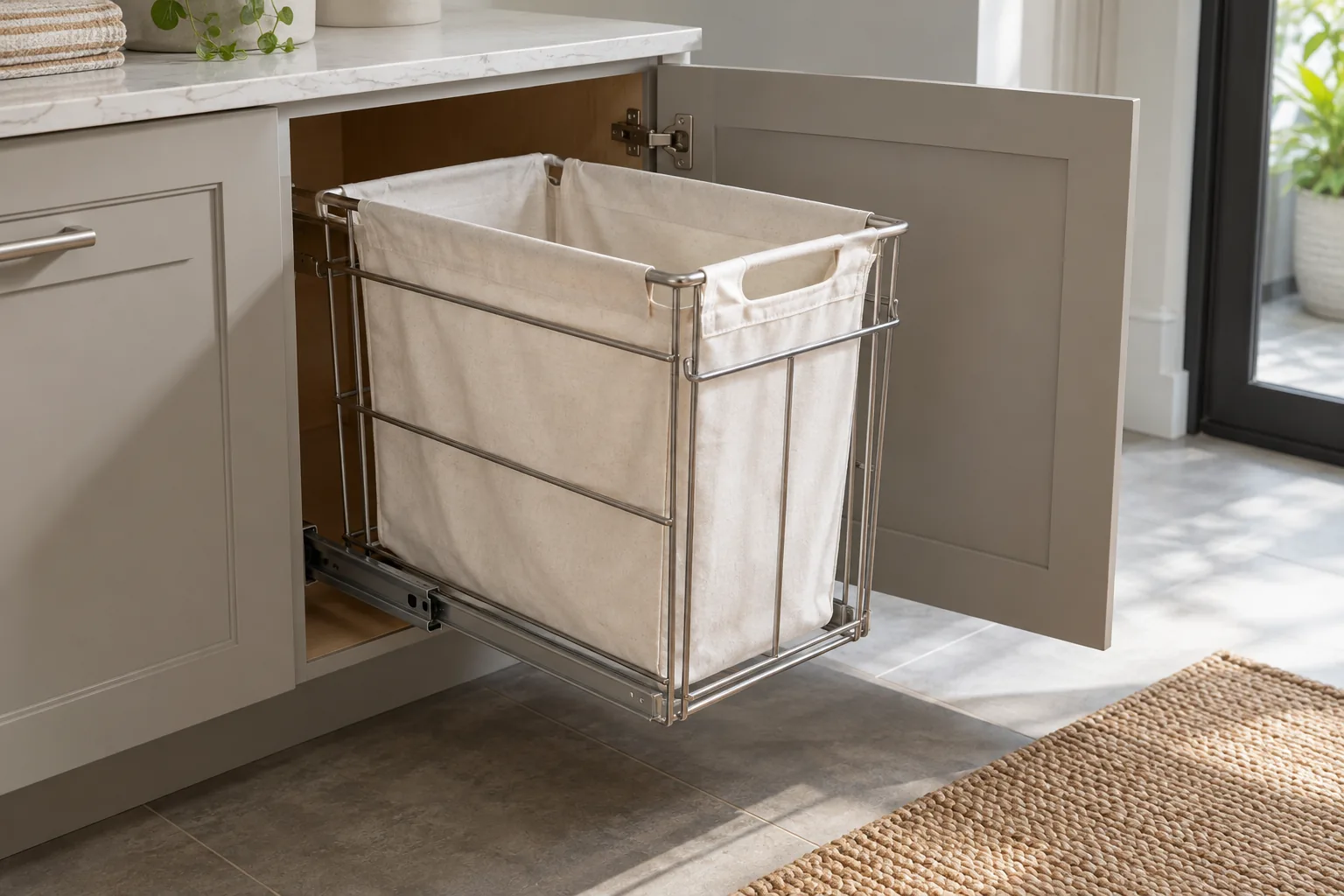
For a pull out laundry hamper bag removal decision, approve the complete bag-to-frame and frame-to-cabinet interaction—not just whether an empty liner can be lifted from a loose basket. The importer should verify capture, loaded removal, reinsertion, cabinet clearance and the replacement-liner definition on the actual purchased kit. A removable bag and adjustable door-mount brackets are documented features in the cited manufacturer example, but the dimensions and operating limits of that example are not transferable to another supplier's system.
What buyer decision does hamper bag removal create?
A removable liner is a service interface inside a larger moving assembly. The buyer is approving whether a user or retailer can take the bag out for carrying or laundering, then put it back without removing the cabinet, disturbing the pull-out frame or guessing how the top edge is retained. The relevant result depends on the specific basket, bag pattern, mounting brackets, slide system, door and cabinet opening. A product photograph may show that the bag is removable, but it does not establish loaded clearance, capture security or repeatable replacement fit.
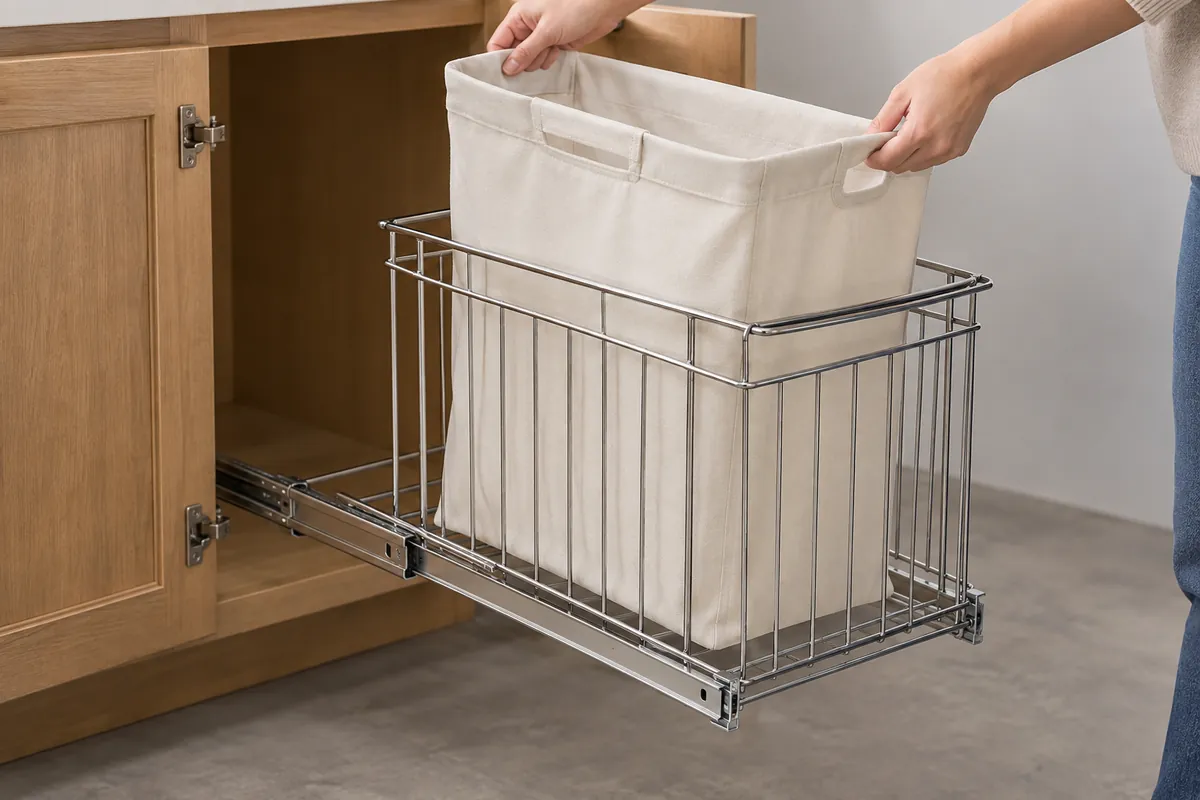
The sample question should therefore be framed as an observable task: with the hamper installed in the representative cabinet and its intended door position, can the liner be released, lifted clear, carried away and re-seated while the basket remains in its approved operating position? Buyers should agree whether removal happens with the basket extended, partially extended or another documented position. Do not infer that every hamper uses the same lift direction, clips, loops, fabric construction or slide arrangement; obtain the supplier's exact model and instructions.
A pull out laundry hamper bag removal review should name the position and sequence, because the same liner may be easy to lift when the basket is outside the cabinet but obstructed when the unit is installed. Record that distinction rather than describing the bag as simply removable.
This scope differs from tilt-out clearance and from runner-width tolerance. Those issues concern the motion envelope or frame-to-cabinet fit; this article owns the bag-removal and replacement task. Related issues still affect the result: an opening that blocks the liner, an edge that snags, or a frame that shifts during removal can make a nominally removable bag impractical. Keep these as interface checks rather than expanding the approval into a general cabinet-organizer review.
Which product and mating inputs must the RFQ identify?
Begin with an identity record: supplier, product family, model or revision, basket configuration, supplied bag identifier, bracket arrangement and any purchased runners or stays. If the supplier offers more than one bag size or attachment method, record the selected combination explicitly. A marketing name is not enough where a product family contains multiple widths, door-mount positions or bag variants. Ask for the installation drawing, assembly instructions and a parts list that connect the liner to the frame and the frame to the cabinet.
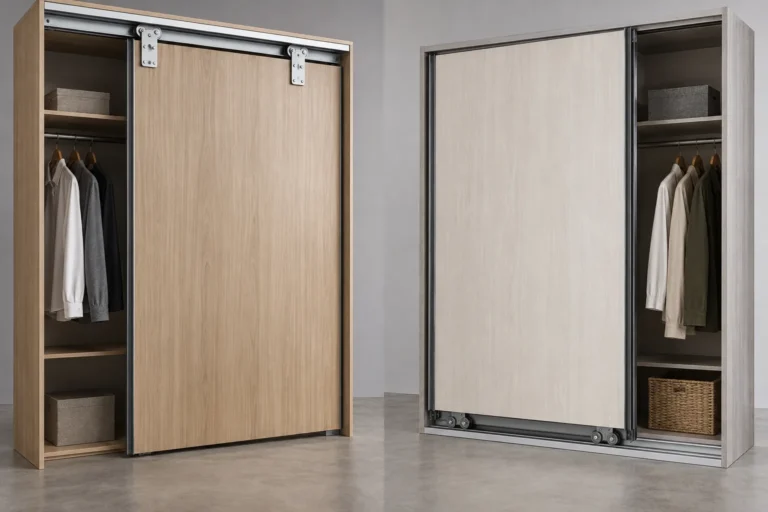
Define the cabinet conditions that influence removal: clear opening width and height, door thickness and position, hinge or door travel, adjacent shelf or drawer, internal obstructions, and the pull-out's parked and extended positions. These are project inputs, not universal dimensions. A supplier should not be asked to certify fit against an incomplete cabinet sketch. Use the intended production cabinet, a dimensionally controlled mock-up or an agreed representative fixture; label which one was used so a later reviewer can interpret the observation. For top hung vs bottom rolling cabinet doors, record the cabinet and panel setup just as carefully: the comparison is meaningful only when support conditions are stated.
Specify the bag task in ordinary language. State whether the liner is removed empty, with a normal representative contents condition, or both; who performs the task; whether the basket must stay installed; and which release direction is acceptable. Avoid assigning an unsupported load or cycle count. If the bag is expected to be washable, separately confirm care instructions from the textile supplier. The wire frame's metal construction does not establish fabric durability, laundering suitability or textile compliance.
Ask the supplier to distinguish included parts from optional or separately sourced items. A replacement bag may be a service part, a separately purchased accessory or unavailable as a standalone part; this affects assortment planning and after-sales promises. Do not advertise replacements until the exact spare part, availability and ordering route are confirmed. The buyer record should identify responsibility for bag pattern revisions, frame changes and compatibility after a product update.
How should buyers compare bag-retention arrangements?
Compare the actual capture method supplied, such as a folded top edge, loop, pocket, clip or another documented interface. The names here describe possible supplier configurations, not a claim that every system has them. For each proposal, ask what physically prevents the liner from slipping into the basket during ordinary use and what action releases it intentionally. A retention feature that is difficult to release may be secure but inconvenient; a simple lift-off can be convenient but needs a clear answer to how the liner stays positioned. Evaluate the two functions together.
The review should include fabric slack and basket contact. A liner that is too loose can bunch at corners or obscure usable space; a tight liner may be difficult to install after laundering or replacement. The correct fit is not determined by a generic percentage. Ask the supplier to provide the approved bag pattern or controlled sample, and compare seam placement, attachment loops and top-edge coverage against the frame. Check whether the product has exposed wire ends or joining details at the liner contact locations, and route any sharp-edge concern through the relevant product quality specification.
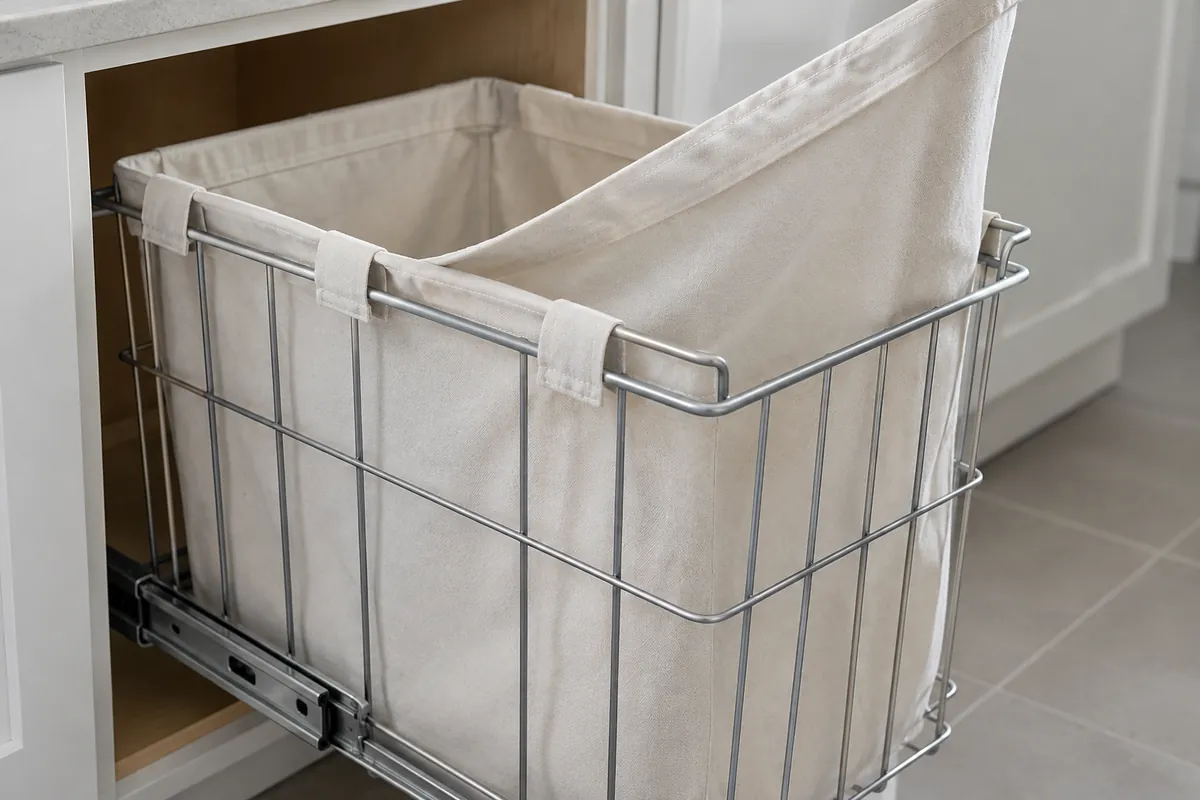
Use a comparison table in the quotation review, not an informal preference. Record what the supplier's sample demonstrates, what document supports the interface, what remains unknown and what change would reopen approval. If one proposal uses door-mounted brackets and another uses a different support, compare the complete loaded assembly and door movement rather than selecting by the bag attachment alone. Door position can alter reach and approach path, so test the selected access sequence in its installed context.
For a pull out laundry hamper bag removal approval, compare the same cabinet opening, liner identity and basket position across proposed systems. This keeps the decision centered on a repeatable buyer task instead of a broad impression of convenience.
The manufacturer reference in the research pack is useful for recognizing a real product-planning question: removable fabric bag and adjustable door-mount brackets are described for a particular series. It is not a universal specification, and no catalog limit should be copied into an unrelated project. Buyers should request the selected supplier's own drawing, instructions and sample. Where the component is bought from a specialist fitting supplier, that supplier remains responsible for its system-specific installation and compatibility data.
| Avis des acheteurs | Evidence to request | Approval question |
|---|---|---|
| Liner identity | Bag revision, pattern or controlled physical sample | Is the evaluated bag the quoted replacement and production version? |
| Capture method | Drawing/photo plus removal and re-seat observation | Does it stay retained in use and release intentionally? |
| Cabinet envelope | Opening, door position, obstructions and setup record | Can the specified bag move clear in the installed assembly? |
| Change ownership | Part list, revision record and approval contact | Which changes require another sample review? |
What should the representative sample review prove?
First confirm sample identity before handling it. Record the product model or drawing revision, basket, bag, brackets, runner or stay, and cabinet fixture. Confirm that the sample matches the proposed shipment and that no temporary fitting, hand adjustment or unapproved substitute is present. Photograph the installed orientation and note the cabinet conditions. A loose showroom sample may demonstrate that the bag can be removed, but it cannot demonstrate the same access in the buyer's cabinet envelope.
Perform a consistent sequence: install the specified assembly; close and open the cabinet door as intended; extend the hamper to the documented position; remove the bag using the agreed method; observe contact, snagging, interference or frame movement; replace the bag; and return the hamper to its normal position. Repeat the task enough to establish that the step is understandable and repeatable for the project's approval purpose, but do not label an informal observation as a certified endurance test. If the review includes representative contents, record them descriptively and use the same setup for every supplier comparison.
Check the bag after removal for unexpected tearing, displaced seams, distorted attachment loops or contact with an edge. Check the frame and door mount for looseness or movement created by the task. The observation is specific to the tested sample and conditions; it is not a lifetime statement. If a defect or concern appears, state exactly what happened, under which configuration, and whether the cause is confirmed. Do not assume the bag, wire frame, slide or cabinet alone caused an interaction failure before isolating the interface.
Close the review with a dated record that links photographs, sample identifiers, observed deviations and the approving role. Keep the approved liner and hardware identity together in the golden-sample or reference record where the buyer's quality system supports it. If the approval only covers an empty-bag removal demonstration, say so. A future change to fabric, loop position, frame geometry, brackets, runners, cabinet opening or instructions may alter the task and should trigger a question-specific recheck rather than automatic acceptance.
How should suppliers document changes and sourcing limits?
Put interface ownership into the RFQ: who controls the bag pattern, who supplies replacement liners, who confirms the frame attachment and who signs off on a cabinet fit deviation. Separate design inputs from observations. An installation drawing may define geometry; a sample review may show that the task works under one condition; a parts list may identify the bag revision. None of these documents automatically replaces the others. Ask for the evidence that closes the buyer's specific question, and record which version was accepted.
For a private-label program, request advance notice of changes to bag material, sewing pattern, supplier, frame wire route, attachment detail, bracket location, runner or packaging that could affect fit or removability. The commercial process should define whether the buyer approves a revised sample, receives a document-only notification or accepts an agreed change category. Do not write an unconditional guarantee that every change requires the same test; use a risk-based review connected to the affected interface.
Packaging should protect both the metal frame and textile bag from movement, abrasion, contamination and deformation during shipping. Ask the supplier to show how the bag is separated from sharp or projecting features and how parts are retained in the package. Validate the actual pack-out for the relevant sales unit. Do not claim that a generic carton or passed drop test guarantees no damage. If packaging changes orientation or compresses the liner, a bag fit issue could be mistaken for a sewing issue; preserve the as-received condition during inspection.
Koitor Hardware's verified experience is in custom metal bathroom and home-storage hardware, drawing and sample development, metal fabrication and practical buyer communication. That supports a structured conversation about the metal frame, assembly interfaces and documentation. It does not mean Koitor currently manufactures a specialist pull-out hamper, bag, slide, textile component or safety-rated mechanism. A qualified specialist supplier should confirm its own runner, bracket and textile details; buyers should keep those boundaries explicit when building an assortment.
Buyer checklist before quotation
- Identify the hamper, basket, bag, brackets and runner revisions
- Record the cabinet opening, door movement and adjacent obstructions
- Agree the removal position and representative contents condition
- Observe removal, carrying, reinsertion and frame stability
- Record snagging, liner damage, deviations and reviewer approval
- Confirm replacement-bag identity, ordering route and change notification
For a project-specific question, consult the manufacturer reference cited for this buyer issue. It describes the named planning point; it does not replace the selected supplier’s current documentation.
For related sourcing context, see Koitor OEM home-storage hardware information et private-label bathroom accessory sourcing.
Foire aux questions
Should the bag be removable while the hamper is still installed?
That is a buyer requirement to define, not a universal feature. If serviceability is important, test removal with the actual installed assembly and approved cabinet opening.
Does a removable sample prove every replacement bag will fit?
No. It proves only the evaluated bag and setup. Tie any replacement offer to a controlled part number or revision and recheck after pattern or frame changes.
Can a buyer reuse another supplier's cabinet dimensions?
Only when the cabinet, door, obstructions and purchased kit interfaces are demonstrably equivalent. Otherwise review a representative project cabinet or controlled fixture.
Does a smooth wire frame prove the fabric will not wear?
No. Inspect the actual contact points and bag after the agreed task. A visual check is not a durability-life claim.
Discuss a product-specific sourcing question
Koitor Hardware is a family-owned custom metal hardware factory. For bathroom and home-storage hardware projects, share the drawing or physical sample, the approved interfaces, target market, and the buyer decision that still needs evidence. Specialist purchased fittings should remain matched to their qualified system supplier.
Fabrication pour compte de tiers / Marque de distributeur
Transformez ce guide d'approvisionnement en cahier des charges
Indiquez-nous le produit souhaité, ses dimensions, sa finition, la quantité commandée et vos exigences en matière d'emballage. Votre équipe recevra une analyse pratique de la faisabilité de la fabrication avant l'établissement du devis.
 English
  Español
  Português
  Français
  Deutsch
  العربية