
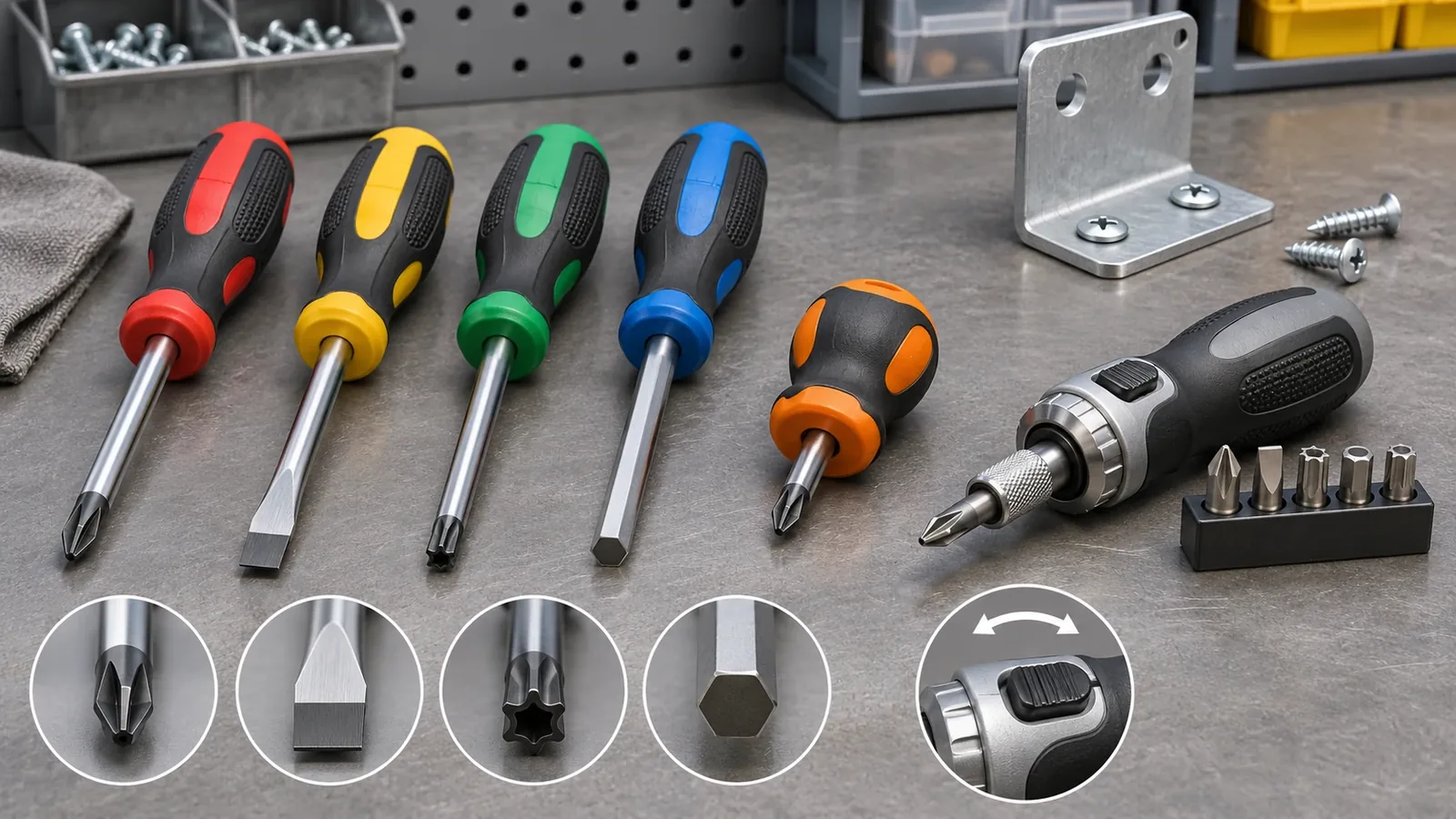
Types of screwdrivers are easier to compare when the buyer separates three axes: the drive profile that mates with the fastener, the tool form that reaches the work, and the mechanism that supplies or controls rotation. Slotted, Phillips, Pozidriv, Torx and hex describe drive interfaces. Manual, electric, ratcheting, fixed-shaft, interchangeable-bit, stubby and precision describe other aspects of the tool. These categories can overlap: a ratcheting screwdriver may accept interchangeable bits, and a compact tool may use a particular drive tip. One label cannot replace a complete tool-and-fastener specification.
This distinction helps importers and product teams review assembly requirements without assuming that a driver name proves torque control, fit across all sizes, safe electrical work, or a particular productivity result. For a metal bathroom or home-storage product, document the actual fastener, access clearance, assembly requirement and relevant process evidence. The tool taxonomy is a starting point for a focused question, not a substitute for an approved work instruction.
What does a screwdriver type describe?
A screwdriver is a hand or powered tool that transfers rotation to a fastener through a tip or bit. Product names may describe the tip shape, how the tool is held, whether it contains a mechanism, or how power is supplied. Buyers often see these descriptors mixed together in catalogs, which makes simple lists of “screwdriver types” confusing.
The first useful axis is the drive profile. A slotted driver has a flat blade intended to fit a corresponding slot. Phillips and Pozidriv are distinct cross-shaped profiles; they should not be treated as interchangeable because they look broadly similar. Torx uses a star-shaped profile, and hex drivers engage an internal hexagonal socket. These are examples, not an exhaustive taxonomy. The exact fastener profile and size should be taken from the drawing, parts list, sample, or supplier specification.
The second axis is tool architecture. A fixed-shaft screwdriver has a dedicated tip and shaft arrangement. An interchangeable-bit driver accepts separate bits within a compatible holder system. A multi-bit handle may store several bits, but compatibility and retention details still depend on the product design. The tool architecture affects what the buyer should procure and how replacement components are identified; it does not alter the drive profile that must match the fastener.
The third axis is operating mechanism. A manual screwdriver relies on hand-applied rotation. A ratcheting model includes a mechanism that allows turning through repeated strokes without removing the tip from the fastener at every return movement. An electric screwdriver uses a powered drive. Those labels do not establish a particular torque limit, calibration status or suitability for a defined joint. The maker’s product data and the buyer’s approved process remain necessary when those properties matter.
| Classification axis | Examples | What the buyer should confirm |
|---|---|---|
| Drive interface | Slotted, Phillips, Pozidriv, Torx, hex | Exact profile and size of the mating fastener |
| Tool construction | Fixed shaft, interchangeable bit, multi-bit | Holder compatibility, intended bit and replacement identity |
| Mechanism or power | Manual, ratcheting, electric | Operating requirements relevant to the assembly task |
| Access form | Standard length, stubby, precision | Available clearance and the fastener’s location |
| Control requirement | Ordinary driver or a separately specified controlled tool | Whether the process requires verification or calibration evidence |
Identify the fastener before selecting a tip
The fastener is the mating component, so start with the actual fastener head or socket. A product description that merely says “cross head” may not distinguish the drive system. If the distinction matters to fit or assembly, identify the exact profile and size using an approved drawing, part specification, physical sample or supplier data. A visual resemblance is not enough to conclude that two standards or sizes are equivalent.
A head-shape guide can help clarify the terminology; see screw head types and their profiles. That page addresses fastener head forms. This guide covers driver architectures and mechanisms, so the two subjects should not be collapsed into a single classification. The screw determines the interface; the driver must match that interface and size.
A mixed product or assortment may include several fasteners. In that case, record each fastener separately in the bill of materials or assembly specification. “One screwdriver for the product” may be an oversimplification if different components use different drives. Conversely, specifying a large collection of tools when one approved driver covers the required fasteners adds inventory detail without necessarily improving the process.
The buyer should also distinguish a driver that physically engages a fastener from a tool that has been approved for a production operation. Physical engagement alone does not prove the correct seating, torque, clamp load, joint integrity or final product performance. Those are separate requirements with their own owners and evidence.
Tool form: fixed, interchangeable, stubby and precision
A fixed-shaft tool dedicates a handle and shaft to a particular tip or profile. It may be convenient where a known fastener is repeatedly used, but the decision depends on the buyer’s procurement needs, tool storage and task. The name does not guarantee a certain quality or expected service life.
Interchangeable-bit tools use a holder and removable bit. They can consolidate several drive profiles or sizes into a shared handle, but the buyer should verify the holder interface and the bits required for the assembly. A bit assortment that appears complete in a catalog may not contain the exact size, profile or reach needed for the product. The tool list should identify the actual bit set or model where interchangeability is part of the process.
Stubby describes a compact form, usually selected where available space around the fastener is constrained. Compact length can help with access in some layouts, while other locations require a longer reach. The term by itself does not tell the buyer whether the handle clears adjacent walls, whether the shaft reaches the fastener, or whether there is room to rotate the tool through the required arc. Review the product geometry and approach direction.
Precision drivers are intended for smaller interfaces and fine work contexts, according to tool makers’ product categories. A buyer should identify the actual screw dimensions and assembly purpose rather than infer the appropriate driver from the word “precision.” This guide does not set a torque, tip tolerance, electronics procedure or allowable damage limit. Use the drawing and the responsible process owner’s instruction.

Mechanism and power are not drive profiles
Manual, ratcheting and electric describe how a tool is operated, not what fastener interface it fits. A ratcheting handle can be paired with a slotted, cross, star or hex bit when the holder supports that bit. An electric driver also needs the correct tip. The drive profile remains a fastener-matching decision regardless of the mechanism.
Ratcheting may change how the operator turns a fastener through repeated strokes. It does not automatically prove faster assembly, consistent torque, reduced defect rates or suitability for a controlled joint. Those outcomes depend on the tool, fastener, operator, joint, work access, process design and measurement requirements. Treat productivity and quality claims as claims requiring evidence, not as automatic properties of the mechanism name.
Electric tools vary in design and controls. A buyer should consult the exact model’s operating and technical documents. Do not infer torque range, shutoff behavior, calibration, suitability for a particular fastener, or electrical safety from the general term “electric screwdriver.” If a production process requires torque management, identify the requirement separately and connect it to an approved method and record.
Torque screwdrivers and controlled assembly tools are a related but separate topic. A catalog description or the word “torque” should be checked against the actual tool, calibration or verification process, joint requirement and applicable records. For that distinct question see torque screwdriver calibration and assembly evidence for OEM buyers. The present article does not repeat the calibration procedure or claim that ordinary drivers control torque.
Match access and assembly context
Before specifying a tool form, look at how the fastener is reached. A bracket behind a rail may require a different approach than a screw on an open face. A nearby wall, flange, decorative cover or neighboring component can restrict the handle’s turning arc. The physical product or controlled drawing should be reviewed for access, preferably in the actual assembly orientation.
For a hypothetical towel rail bracket, a screw might be positioned near a folded edge. The team should confirm whether a standard driver handle fits, whether a bit holder is compatible with the required extension, and whether the assembly instruction specifies any control. This is an illustrative decision example, not a claim about Koitor’s production process or any particular product design. The correct choice depends on the real geometry and the authorized work method.
A compact form is not automatically better in restricted spaces. A short handle may fit but provide inadequate reach or a difficult grip; a long tool may reach but lack turning clearance. A flexible or angled tool may have a role in some contexts, but its suitability must be confirmed against the product and process. Avoid broad rules such as “longer always gives more leverage” or “stubby always fits tight spaces.”
| Access condition | Information to capture | Question to resolve |
|---|---|---|
| Recessed or obstructed fastener | Fastener location, adjacent geometry, approach direction | Which tool form reaches and turns without interference? |
| Multiple drive profiles | Part numbers and exact drive sizes | Which dedicated or interchangeable tips are required? |
| Finished or visible face | Surface condition and permitted contact points | How is cosmetic contact prevented or evaluated? |
| Controlled assembly joint | Requirement owner and defined evidence | Is a specific controlled tool and verification record required? |
Build a clear tool and fastener specification
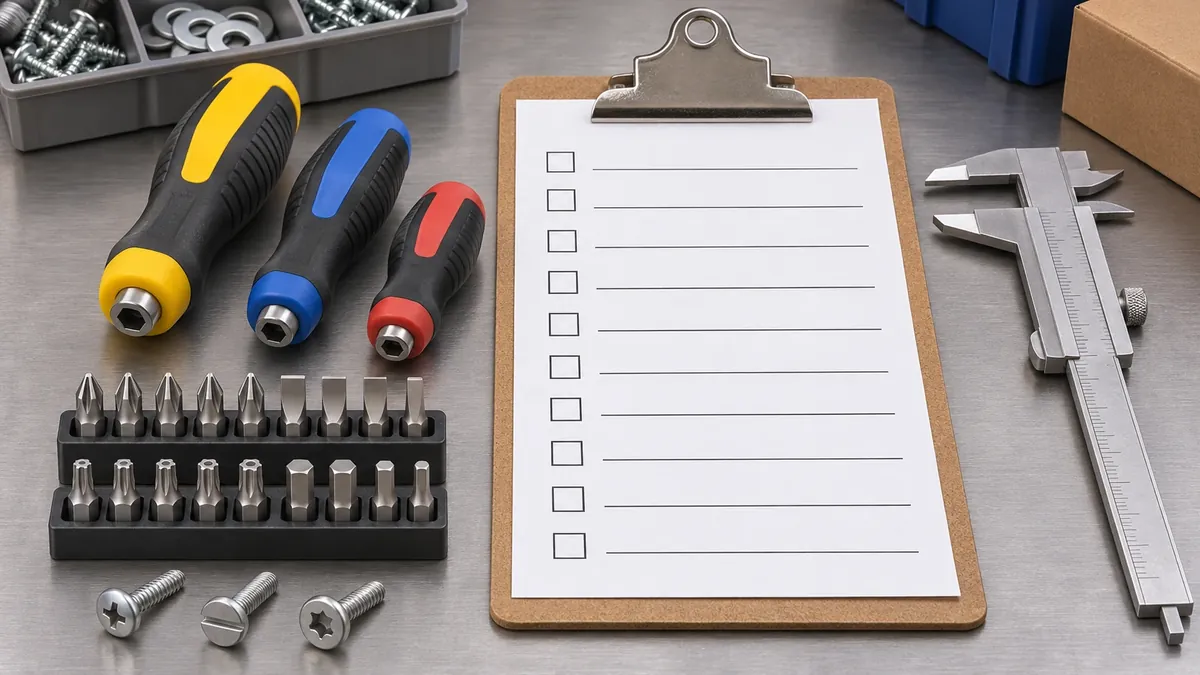
A concise specification can capture the actual decision without turning a buyer guide into an unnecessary catalog. Include the fastener identity, profile, size, tool architecture, access constraints and the process requirement when those items matter. State whether an exact model is mandatory or a defined equivalent is acceptable. If it is acceptable to substitute, list the characteristics that must remain compatible.
A practical tool record may include:
- Product or assembly revision.
- Fastener part number and drive profile.
- Fastener size from an approved source.
- Tool type or exact model, if specified.
- Fixed-shaft or interchangeable-bit configuration.
- Reach and clearance requirement.
- Operating mechanism where relevant.
- Separate torque or process-control requirement, if one exists.
- Responsible approver and revision date.
This record should distinguish facts from pending questions. “Pozidriv size specified in drawing revision C” is a traceable statement if the drawing confirms it. “Phillips equivalent” should remain an open question until the responsible design or process authority confirms compatibility. “Electric tool used” does not establish calibration or torque control. A good specification avoids implying more than its evidence supports.
When comparing suppliers, ask them to identify the exact drive and tool configuration they plan to use where the buyer’s requirement calls for it. Confirm substitutions through the agreed change process. Do not interpret a supplier’s tool list as an independent certification of its production quality. A tool is one element of an assembly method; the final buyer decision depends on the product specification and relevant inspection evidence.
Common selection and documentation errors
One frequent error is to use “Phillips” as a generic label for every cross-shaped recess. The buyer should verify the specified drive rather than assume that similar outlines are interchangeable. A fastener profile reference can clarify the distinction; use the exact approved specification when ordering drivers or bits.
Another error is to list a mechanism as though it were the tip. “Ratcheting” does not identify the drive interface. A ratcheting driver still needs a compatible tip or bit and the correct size. Similarly, “electric” describes power delivery, not the shape that mates with a screw.
A third error is assuming an interchangeable-bit holder includes every needed bit. Confirm the holder interface and the required bit set. If replacement or replenishment is important, specify how the part number is identified and what counts as an acceptable substitute. Avoid relying on a product photo to determine exact interface dimensions.
A fourth error is assuming precision or compactness implies a particular control level. Precision is a product category label whose meaning depends on the maker and intended context. Stubby indicates a form, not a guaranteed access result. Use dimensions and the actual geometry for fit questions.
A fifth error is treating driver fit as proof of assembly quality. A tip that engages a fastener does not show that the fastener is correctly installed, that the joint meets a torque target, or that the assembly will perform as required. Those statements require their own controlled process and evidence. If a joint has a defined torque requirement, follow the approved calibration and process route instead of inferring it from tool type.
Finally, avoid turning general buyer guidance into instructions for electrical work, powered-tool operation, or operator safety. Tool maker instructions and the organization’s authorized safety and process controls govern such work. This article helps distinguish names and specification fields; it is not an operating manual.
Review substitutions and tool availability
A production plan may identify a driver that later becomes unavailable, or a buyer may ask whether an equivalent model can be used. Treat this as a controlled question. Compare the exact drive profile and size, holder or shaft arrangement, access dimensions, intended operation, and any separate process requirement. A substitute that engages the same fastener may still differ in reach, handle clearance, bit retention or controls relevant to the task. The responsible design or process owner should decide which attributes are critical and document the approved replacement.
Do not assume that an interchangeable bit is acceptable solely because it fits the holder. Confirm the profile, size, condition and any model or supplier requirement stated in the applicable instruction. If a bit is a wear item, identify the replenishment route and how the correct type is recognized. These details matter most when the assembly specification explicitly relies on a particular tip, access arrangement or control. Where no such requirement exists, avoid adding arbitrary restrictions that create procurement friction without protecting a buyer decision.
If a fastener supplier changes a part number or makes a design revision, verify whether the mating drive profile and size remain the same. A part-number change may be administrative or may accompany a meaningful geometry change; do not infer either outcome from the number alone. Obtain an updated drawing or written specification and reconcile it with the bill of materials and assembly documentation. This check is especially useful where products use several fastener types or where a small fastener sits behind a bracket or cover.
Separate fit questions from joint-performance questions
The driver interface and final joint performance are related but distinct subjects. A correctly matched tip helps the tool engage the intended drive, but a buyer cannot infer from that engagement that the fastener is seated to a defined depth, that a specified torque was achieved, or that the assembly meets a load or service requirement. Those conclusions require the applicable product design, process controls and verification records. Keep the interface check, process instruction and product acceptance criteria in separate fields.
For example, a buyer may verify that the fastener drive shown in an approved drawing corresponds to the tool bit named in a work instruction. That comparison can reveal a mismatch in nomenclature or an outdated instruction. It does not establish how much rotation or force should be applied, whether a powered tool is appropriate, or what torque is correct. The responsible engineering authority must define those requirements from the actual joint and product design.
A review also needs to account for the state of the part. A tool may be used before finishing, after finishing, during a subassembly, or only for maintenance. The same contact method may not be acceptable across all stages. If appearance or coating protection is part of acceptance, identify the allowed contact points and inspection method rather than assume a tip shape or handle form protects the product. Document the workpiece revision and process stage so the review is traceable.
For a sourcing team, this separation supports a concise supplier question: identify the fastener, matching drive, tool form and access; then provide separate evidence for any controlled-joint or product-performance requirement. This avoids asking a catalog to answer an engineering question and reduces the chance that a tool category is misrepresented as proof of quality.
When comparing types of screwdrivers across suppliers, preserve the same distinction. One supplier may use a general “cross-head” term while another lists a specific drive. Ask both to map their words to the approved fastener specification. A mismatch is a clarification item, not by itself evidence of poor workmanship. Record the answer and responsible approver before accepting a change to the production tool or component.
FAQ: screwdriver names and buyer decisions
Is Phillips the same thing as a cross-head screwdriver?
“Cross-head” can be used informally, but it may not identify the precise fastener profile. Confirm the drawing, fastener specification or sample and use the name and size defined by the responsible source.
Can a ratcheting screwdriver use different types of bits?
Some ratcheting handles use interchangeable bits, but that depends on the specific product design. Check the holder interface and the exact bit set needed for the assembly.
Does an electric screwdriver control torque?
Not necessarily. The general label “electric” does not prove a torque range, shutoff behavior, calibration or suitability for a particular joint. Check the exact tool and approved process evidence.
Is a precision screwdriver only for electronics?
The term appears across product categories, but it does not by itself define the intended use. Identify the fastener, tool dimensions and application, and follow the maker’s instructions.
Should the buyer specify an exact screwdriver model?
Specify an exact model when identity affects the requirement or the process. If equivalents are acceptable, define the relevant compatibility and control attributes and name who approves a substitute.
Can one driver fit every screw on a product?
Not necessarily. A product may contain different fastener profiles and sizes. Review the bill of materials or approved drawing and identify the required drivers by fastener.
Specify the mating drive, then the tool form
The most useful comparison of types of screwdrivers begins with the fastener profile and size, then addresses tool construction, access form and operating mechanism. Slotted, Phillips, Pozidriv, Torx and hex describe interfaces; manual, ratcheting, electric, fixed-shaft, interchangeable-bit, stubby and precision describe different features. Several descriptors can apply to one tool, and no generic name guarantees process control or a finished-product outcome.
For a custom metal bathroom or home-storage product, share the controlled drawing or sample, exact fastener information, access constraints and any defined assembly requirement with the relevant technical owner. Koitor’s role is limited to confirmed OEM manufacturing scope; the OEM hardware page explains that context, and buyers can contacter Koitor with a specific project question.
Discuss Your Metal Hardware Specification
Send the controlled drawing or sample and actual fastener and access requirements so relevant product-development questions can be scoped for your project.
Fabrication pour compte de tiers / Marque de distributeur
Transformez ce guide d'approvisionnement en cahier des charges
Indiquez-nous le produit souhaité, ses dimensions, sa finition, la quantité commandée et vos exigences en matière d'emballage. Votre équipe recevra une analyse pratique de la faisabilité de la fabrication avant l'établissement du devis.


 English
 Español
 Português
 Français
 Deutsch
 العربية