

Shim vs washer describes a difference in primary function, not a guaranteed difference in shape. A shim is primarily used to adjust a gap, position or spacing; an ordinary washer is commonly placed in a fastener stack to provide a bearing or contact surface. A washer can sometimes act as a spacer, and a shim can be ring-shaped, so the part’s intended use must be stated explicitly. For a metal hardware assembly, specify the gap or contact requirement, the relevant dimensions and the approved part rather than assuming a thin ring can substitute for another component.
The terms are easy to confuse because both parts can be thin, flat and made from metal. But choosing by appearance alone can leave an assembly requirement unclear. A sourcing drawing should tell the supplier whether the part is intended to position components, fill a controlled gap, support a fastener interface or perform another defined function. The proper selection depends on the specific design and evidence, not on the word alone.
What is the main difference between a shim and a washer?
A shim primarily adjusts spacing or position by filling a gap. A washer is commonly used in a threaded-fastener stack to create a bearing or contact surface beneath a bolt, screw or nut. Phoenix Specialty’s comparison describes shims as spacers and washers as parts often used to distribute load from a threaded fastener. The same source notes that some uses overlap, which is why the intended function should be made clear.
The part’s geometry does not settle the question. A washer may be circular with a central hole, but a shim can also be a ring or a flat strip. A washer may sometimes serve as a spacer in a particular assembly. That does not make every washer appropriate as a gap-control component or every shim suitable beneath a fastener head.
| Question | Shim role | Washer role |
|---|---|---|
| Primary purpose | Adjust spacing, gap or position | Provide a fastener bearing/contact interface |
| Shape | Can vary with the assembly | Often ring-shaped, but types vary |
| Thickness concern | May be selected to fill a defined gap | May be controlled for fit or fastener stack, depending on design |
| Common placement | Between parts or beneath a component to position it | In a screw, bolt or nut stack when specified |
| What the name does not prove | Precision class or material suitability | Locking behavior, load capacity or interchangeability |
This is an introductory comparison, not an engineering specification. The drawing and responsible design owner determine the actual component requirement.
When does an assembly need a shim?
A shim may be used when a design requires a defined spacing or positional adjustment between components. The required thickness and form depend on the gap and the assembly’s function. A buyer should identify the surfaces or components being spaced, where the shim sits, and how the accepted position is established.
In a hypothetical metal storage rack, a thin spacer might be proposed to align a bracket with another component. That example does not imply that every rack needs shims or that adding one is an approved correction. If the fit is not correct, the responsible engineer or product designer should determine whether the gap reflects a drawing requirement, a manufacturing variation, an assembly issue or an unapproved part substitution.
Shims can be manufactured from different materials and in different shapes. Phoenix Specialty’s article gives metal, wood, plastic and stone examples, but the suitability of any material depends on the design and service conditions. This article does not prescribe a material, thickness, tolerance or stack-up. The buyer should specify those fields only when the design owner has defined them.
A shim is not automatically a precision part simply because it adjusts a gap. One application may use an approximate spacer, while another may require a tightly controlled thickness or surface. The term does not identify tolerance, flatness, hardness, corrosion protection or inspection method. If the assembly depends on a controlled position, the drawing should state the needed dimension and acceptance method.
When does a washer belong in a fastener stack?
A washer is often used beneath a screw, bolt or nut to create a bearing/contact surface or to perform another function specified by the design. There are many washer types, and their intended roles differ. A plain washer, spring washer, sealing washer and locking washer should not be treated as interchangeable based on a similar outer shape.
Phoenix Specialty describes a washer as commonly distributing a fastener load, while also recognizing other uses such as spacing or wear contact. That is a useful general distinction, not a promise that any washer prevents fastener failure or loosening. The actual washer type, material, dimensions and installation must follow the relevant design and supplier information.
For an importer reviewing a bathroom accessory BOM, a washer in a wall-mounting kit may be part of a defined fastener stack. The buyer should confirm which fastener it pairs with, what surfaces it contacts and whether the drawing identifies its role. A washer label alone does not prove that a chosen fastener will meet a particular load or installation requirement.
Can a washer be used as a shim?
Sometimes a washer may serve as a spacer in a specific assembly, but that does not make it a universal substitute for a shim. The design must account for the washer’s dimensions, contact area, quantity, material and effect on the fastener stack. If a washer is being used to correct a gap, document that purpose and obtain approval from the responsible design owner.
The reverse is also true: a shim may have a washer-like shape, but that does not establish that it is suitable as a fastener bearing part. The part may not have the required dimensions, surface, material or condition. Do not replace a washer or shim in a production BOM based only on a similar appearance or the fact that both parts fit over a screw.
For sourcing, record the approved part number and revision. If a supplier proposes an alternative, compare the required function and interface before approving it. A substitution can affect more than thickness: it can alter the fastener stack, contact location, assembly sequence or alignment. The supplier can provide the proposed part data, but the design owner must approve changes that affect product intent.

What should a drawing specify for a shim or washer?
A drawing should describe the component’s required function and the properties necessary to control that function. The amount of detail should match the design risk. If thickness controls alignment, state the relevant thickness and tolerance. If a washer is part of a fastener stack, identify the fastener interface and required component form. Do not use “shim” or “washer” as a substitute for missing dimensions when those dimensions are critical.
Useful fields to review include:
- Component role: gap adjustment, position, bearing surface, spacing or another defined use.
- Part location and orientation in the assembly.
- Material and finish when required by the product environment or specification.
- Relevant dimensions and tolerance from the design owner.
- Contact surfaces and any required clearance.
- Associated fastener, nut or mating component.
- Approved part number, revision and supplier substitution rule.
- Inspection method when a controlled feature must be verified.
Not every project needs every field. A simple spacer may not require the same controls as a component that establishes an assembly datum. The buyer should not add an unsupported precision class or universal tolerance to a drawing merely because a component is called a shim. Clarify the design intent with the responsible engineer or product owner.
How should a buyer inspect a gap-adjustment part?
Inspection should follow the drawing and approved method. A buyer can confirm the part identity, revision and visible condition, then measure the defined dimension if that measurement is part of the acceptance requirement. Do not substitute visual comparison for a controlled measurement when the gap or thickness matters to assembly.
If a fit concern appears during sampling, record the actual location and sample revision. Identify the two surfaces forming the gap and the assembly condition in which it was observed. A photo can document the location, but it does not replace the required measurement or tolerance. Ask the supplier whether the observation is within the drawing and route a proposed corrective shim through the authorized design-change process.
Do not stack arbitrary washers or shims to force a fit without approval. A stack changes the assembly condition and may affect contact, alignment or fastener engagement. The acceptable solution depends on the design and must be confirmed by the responsible technical party. This article does not provide a method for adjusting a particular product.
How do buyers avoid confusing spacer, washer and shim terminology?
Define the required function in the purchase specification and BOM, then name the part. A material or component vendor may use “washer,” “shim” and “spacer” in ways that overlap. The buyer should connect the term to the drawing, dimensions and assembly role so the supplier can quote the intended item.
When reviewing quotations, compare the exact part description, drawing reference, material, dimensions and tolerances. If one supplier quotes a washer and another quotes a shim for the same line item, ask whether they understand the same function. Do not assume the difference is only vocabulary. Obtain a drawing or sample where it resolves the ambiguity, and make changes traceable through the approved revision system.
| Quotation field | Buyer should confirm |
|---|---|
| Part name | Is it a washer, shim, spacer or a project-defined item? |
| Function | What does it do in the assembly? |
| Drawing reference | Which revision controls? |
| Dimensions | Which features and tolerances are required? |
| Material/finish | Are they specified for the intended environment? |
| Substitution | Who approves a proposed equivalent? |
The table helps organize supplier responses; it does not prescribe a universal part standard.
What mistakes should importers avoid?
The most avoidable mistake is selecting a component by outline alone. Thin metal parts can look alike but serve different roles. A washer used to distribute a fastener contact area is not automatically a gap-control shim, and a shim that establishes position is not automatically a qualified washer.
Avoid these assumptions:
- “They are both flat rings, so they are interchangeable.” Confirm function and dimensions.
- “A shim is always precision-made.” Precision depends on the drawing and use.
- “A washer prevents loosening.” Only a specified type and design can support a particular function; do not infer it from the generic name.
- “Adding another washer will correct the sample.” A changed stack requires technical approval.
- “The component material is obvious from its appearance.” Obtain the specified material evidence when required.
- “A supplier’s similarly named part is equivalent.” Compare the part number, drawing and acceptance criteria.
- “A gap can be corrected without updating the record.” Document accepted changes through the design revision process.
These points are not a claim that every hardware assembly needs special shims. They are reminders to keep component function and buyer acceptance aligned.
How does the comparison apply to bathroom and home-storage hardware?
Thin components may appear in mounting kits, adjustable interfaces or assemblies for bathroom and home-storage products. Whether a particular product uses a washer, shim or spacer depends on its design. This article does not claim that Koitor uses a particular component in every product or that every assembly requires a shim.
For an OEM project, a buyer can send the drawing, sample and BOM to the product manufacturer and ask which interface each thin component controls. If the project has a fit concern, identify the measured gap and approved revision rather than proposing an unreviewed substitution. Koitor Hardware can discuss custom metal hardware drawings or physical samples within its bathroom and home-storage scope. Its role does not replace the designer’s approval of a changed fastener or spacer arrangement.
Related product context appears on Koitor’s OEM home-storage hardware page et custom bathroom hardware page. Use the project drawing and approved BOM to confirm the actual parts.
How should a buyer manage a shim or washer substitution?
Treat a proposed substitution as a design question, not a catalog cleanup. First compare the approved part number and drawing with the supplier’s proposed alternative. Determine whether the part is used to locate components, fill a gap, distribute fastener contact or perform another specified function. Then compare the dimensions and interfaces relevant to that function and ask the design owner to approve any change that affects fit or performance.
A supplier may suggest a standard washer in place of a custom shim because the parts look similar or are easier to source. That suggestion can be useful, but it should be reviewed against the actual assembly. The replacement may change the stack height, contact location, fastener engagement or visible gap. Those effects depend on the product design and should not be guessed from the part’s outline.
If a substitution is accepted, update the BOM, drawing or purchase specification as appropriate. Include the approved supplier part reference and revision so that a later reorder does not revert to the earlier component. If the alternative is approved only for one order, record that limitation explicitly. A temporary deviation and a permanent design change are different records.
How can teams investigate a fit problem without using an unapproved stack?
When a sample has a gap or misalignment, document the location and the assembly condition before proposing a shim. Identify the two surfaces, the drawing revision, the part numbers and whether the issue is consistent across samples. A photo can show where the gap appears, while a defined measurement method can characterize it if the design owner requires a measured result.
Do not add washers or shims to force a sample into position and then treat the adjusted assembly as the baseline. The added component may conceal a dimension problem or create a different fastener condition. Instead, ask the supplier to explain whether the sample matches the drawing and request the responsible designer’s disposition. The accepted correction might involve a part revision, a tolerance review, an approved spacer or another solution, but this article does not select one.
Keep the original and adjusted samples identifiable if a technical review requires both. Record who authorized the change, the part revision, the applicable order and the evidence used to approve it. This protects the production record from becoming ambiguous when the same assembly is built again.
When does thickness need to be controlled?
Thickness matters when it controls an assembly position, a designed gap, a fastener stack or another specified interface. It may be a critical characteristic in one design and a general nominal dimension in another. The component name does not determine the tolerance; the drawing and product requirement do.
For a shim, the buyer should specify thickness only to the level supported by the design. For a washer, the required thickness and geometry may relate to a fastener or contact interface. If the part is being purchased to a recognized standard, identify the standard and edition only when that is truly part of the requirement. Do not invent a tolerance or assume that every supplier interprets a standard part name identically.
If several shims are used as a stack, the design owner should determine whether the total assembled thickness and contact arrangement are acceptable. A buyer should not assume that individually acceptable pieces automatically create an acceptable stack. The assembly requirement and inspection method must address the actual configuration.
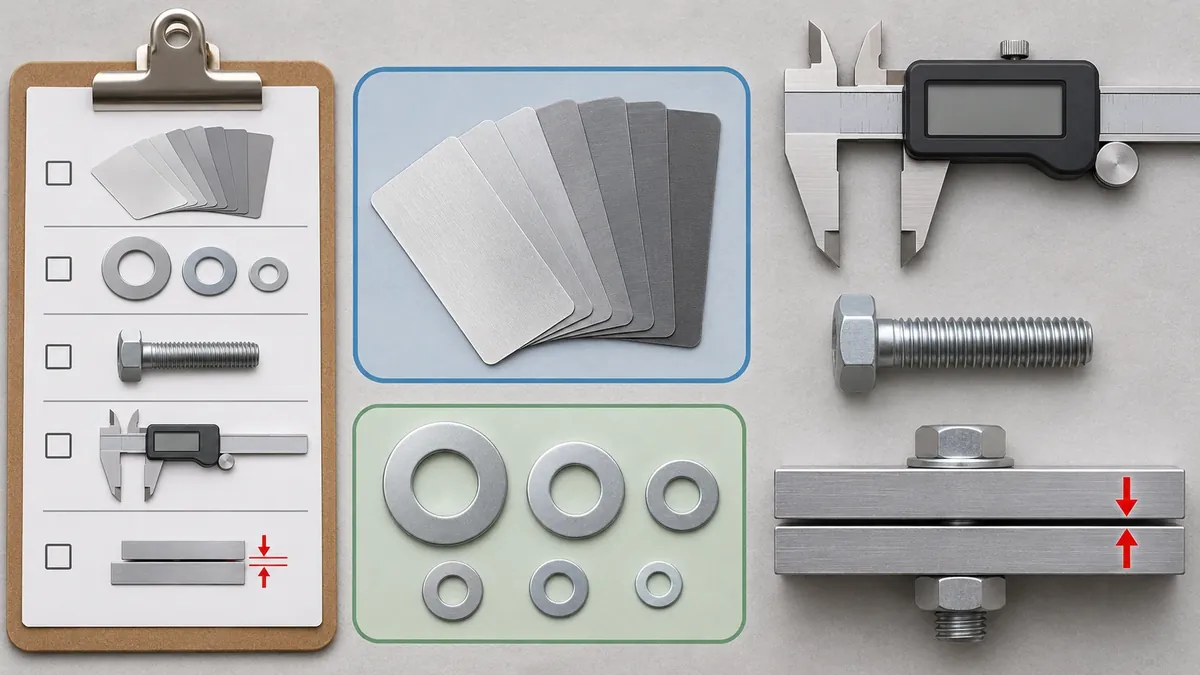
For a buyer asking “shim vs washer?”, this checklist should be applied to the named sample, assembly or supplier record.
Buyer checklist before approving a washer or shim
- State the component’s intended function.
- Identify the exact location and mating parts.
- Confirm the drawing revision and part number.
- Specify thickness and other dimensions where required by design.
- Confirm material and finish only where they are part of the approved requirement.
- Keep washer bearing contact separate from gap adjustment.
- Review any proposed substitution with the design owner.
- Avoid unapproved stacks used to force sample fit.
- Use the agreed inspection method for controlled gaps or dimensions.
- Update the BOM and drawing when a change is accepted.
Foire aux questions
A useful “shim vs washer?” answer states the comparison boundary and points to the product-specific evidence.
What is the main difference between a shim and a washer?
A shim primarily adjusts spacing or position. A washer is commonly used as a bearing/contact component in a fastener stack. Some applications overlap, so the assembly’s intended function should control.
Can a washer work as a spacer?
It can in a specific design, but the buyer should confirm dimensions, material, contact and fastener stack with the responsible design owner. A generic washer is not automatically an approved shim.
Is a shim always a thin metal ring?
No. Shims can have different materials and shapes. The selected part must match the design and environment.
Does every washer distribute fastener load?
Do not infer the function of every washer from the generic name. Review the specified washer type and its intended use in the design.
Should I stack washers to correct a gap?
Do not make an unapproved assembly change. Record the gap and ask the design owner or supplier to approve a suitable correction.
Does “shim” tell me the required tolerance?
No. The drawing or specification must define any controlled dimension and tolerance that matters to the assembly.
Record a Fit Correction Without Hiding the Original Gap
When an assembly does not sit as intended, document the observed condition before choosing a replacement part. Record where the gap appears, which parts touch, the fastener stack, the measured dimensions that are relevant to the drawing, and whether the issue occurs on one unit or across a sample set. Photographs with a scale can help describe the location, but they do not replace a controlled dimension or an approved tolerance. This evidence gives the designer or supplier a chance to identify whether the cause is part variation, assembly order, a missing component, or a design condition.
If a shim is proposed, define what dimension it is intended to change and where it belongs in the stack. If a washer is proposed, define its specified type and contact position. A washer may occupy space, and a shim may have a hole or ring shape, but similar geometry does not establish equal function. The responsible design owner should review contact area, fastener engagement, material, finish, corrosion environment, and any movement or service requirements that apply to that assembly.
Avoid solving repeated fit issues by adding loose washers or stacking unapproved shims on the production line. Such a workaround may change the assembly stack or obscure the source of the mismatch. Instead, link the proposed correction to a drawing revision, bill-of-material change, or documented deviation approval. State whether the change applies to a trial unit, a defined lot, or future orders, and identify who is allowed to release it. If the review finds no approved correction, keep the item on hold and escalate it to the design owner.
For purchasing, ask suppliers to quote the named component and any approved alternatives separately. The request should identify dimensions, material or finish when specified, quantity, and any inspection evidence needed for the interface. Do not ask a supplier to infer a tolerance or select a substitute from a photograph alone. This approach turns the shim-versus-washer distinction into a traceable fit decision while avoiding claims that either part will universally prevent loosening, distribute load, or correct a design error.
Source note
The general terminology distinction is informed by Phoenix Specialty’s washer and shim overview. The source notes that their functions can overlap; the actual design and approved part specification control each application.
Collaborez avec Koitor Hardware
Review a Custom Metal Hardware Drawing
Send Koitor your product drawing, sample, BOM and fit question for a discussion about the metal hardware scope. Any changed shim, washer or fastener arrangement should be approved by the responsible product designer.
Fabrication pour compte de tiers / Marque de distributeur
Transformez ce guide d'approvisionnement en cahier des charges
Indiquez-nous le produit souhaité, ses dimensions, sa finition, la quantité commandée et vos exigences en matière d'emballage. Votre équipe recevra une analyse pratique de la faisabilité de la fabrication avant l'établissement du devis.


 English
 Español
 Português
 Français
 Deutsch
 العربية