
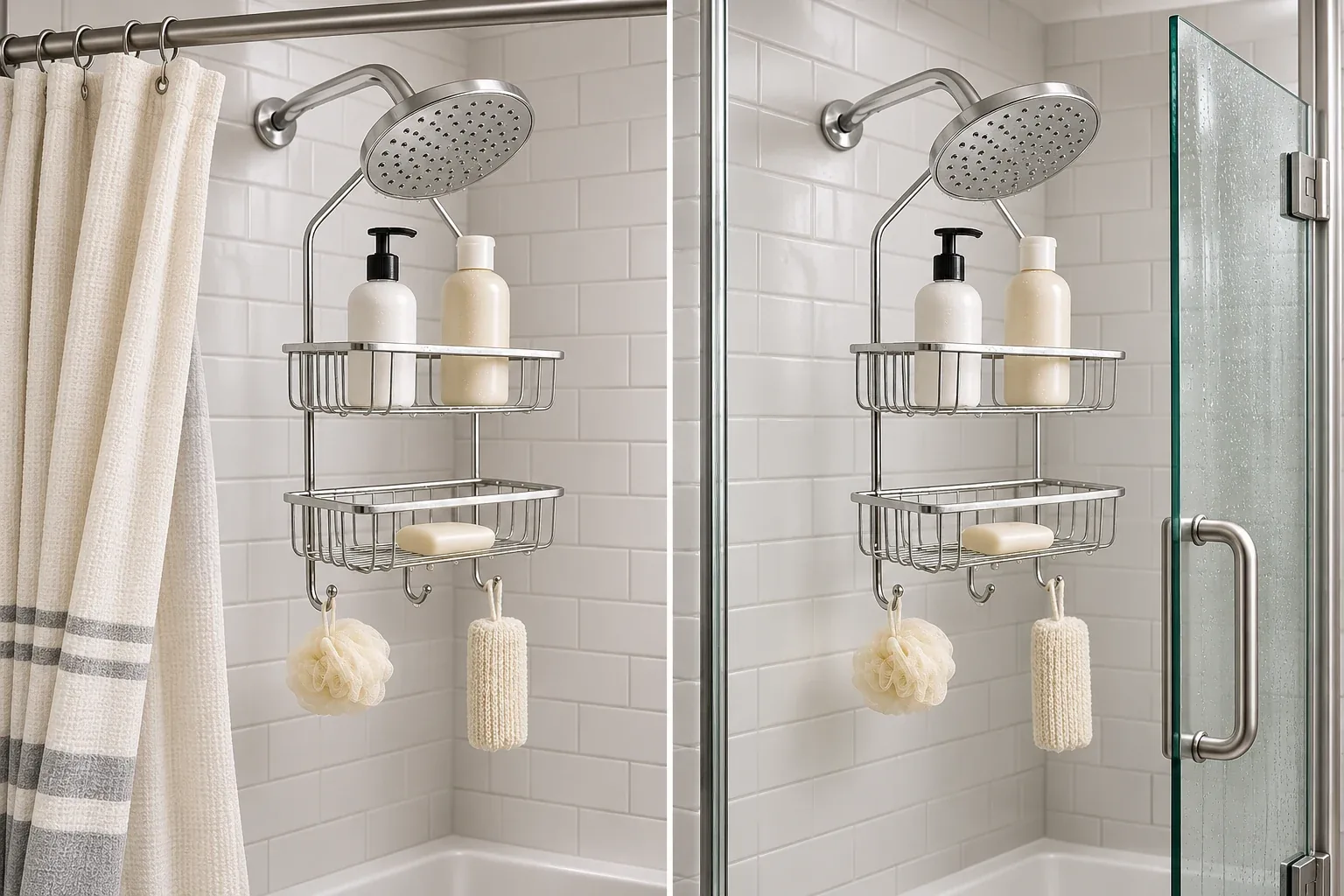
When comparing a shower curtain vs glass door, start with the room layout and how the barrier moves. A curtain gathers along a rod or track, while a glass door uses rigid panels and its own support and movement hardware; a swinging door needs a clear arc, whereas a sliding arrangement has a different movement envelope. Neither choice guarantees better water containment, privacy or cleanliness. Compare the exact configuration, maker instructions, replacement parts and installed scope before deciding.
What decision does this comparison answer?
The phrase “curtain versus door” can describe very different installations. A curtain may hang from a rod or track and move aside by gathering. A glass configuration can have a hinged or sliding panel, fixed panel, enclosure frame, rollers, guides, seals or other hardware. A buyer who compares only the material—fabric against glass—may overlook the space used by the opening, the support method, the parts that need maintenance and the responsibilities included in installation.
For a household, this comparison helps organize a product choice around available room and everyday use. For a distributor, retailer or bathroom assortment planner, it helps define which items belong together in a product set and what compatibility information a customer needs. For a hardware buyer, it can clarify which brackets, rods, rails, supports or accessories are relevant. It is not a claim that Koitor manufactures a complete glass enclosure or curtain system; the appropriate product scope must be verified with the relevant supplier.
The direct answer is conditional. A curtain configuration may suit a layout where a flexible barrier that gathers is preferred and where the installed rod or track can be supported as specified. A glass system may suit a layout where rigid panels and a particular opening arrangement are desired, provided the configuration fits the room and is installed according to its instructions. A swinging panel uses space differently from a sliding panel; neither automatically solves access or cleaning concerns. Draw the movement path before selecting the system.
How does each configuration occupy space?
A curtain typically moves along the line of its rod or track and gathers to one side. The gathered fabric still occupies space, and the rod position, liner, rings or gliders and nearby fixtures influence how it feels to enter and clean the area. A curved rod changes the available interior shape but does not automatically create a particular amount of usable clearance. Existing guidance on Curtain rod finial compatibility and replacement checks et Tension versus bracket-mounted shower curtain rods addresses those separate layout and support questions.
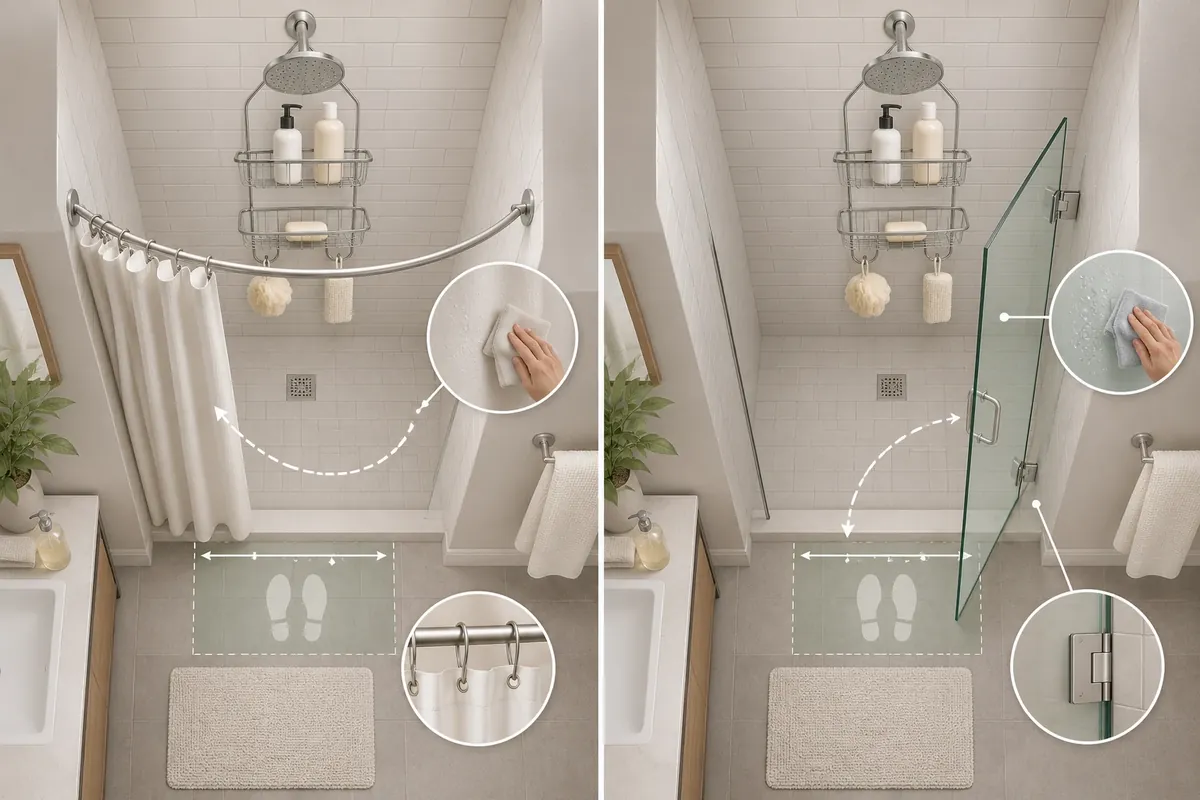
A hinged or swinging glass door needs room for its panel to travel through an arc. Nearby basins, toilets, towel bars, storage baskets, walls or other doors may intersect that path. The hinge side and panel width determine the movement envelope, so the actual plan view matters more than a generic statement that “a shower door opens outward” or inward. A sliding glass door moves along a track, which may use less swing clearance but introduces a different rail, overlap and access arrangement. Fixed panels may shape the entrance differently again.
Plan the usable opening, not only the nominal enclosure width. Check where a person stands, where a handle or frame projects, how the barrier is moved and what path the panel or curtain takes. A shower storage caddy, grab point or towel bar can affect the configuration if placed near a moving panel. This does not mean accessories must be installed in one location; it means buyers should compare the actual room drawing and installed product combination.
| Layout question | Curtain configuration | Glass configuration | What to confirm |
|---|---|---|---|
| How does the barrier move? | Gathers along a rod or track | Swings, slides or combines fixed and moving panels | Exact mechanism and travel path |
| What projects into the room? | Rod, rings or carriers and gathered textile | Panel edge, frame, handle, guide or track | Nearby fixture and circulation clearances |
| What supports it? | Rod or track and its wall, ceiling or other approved supports | Panels, hinges, frame, rollers and their mounting points | Supplier instructions and building conditions |
| What is replaced? | Textile or liner, rings or carriers, and potentially rod hardware | Panel, seal, guide, roller or other system-specific part | Part identification and compatibility |
| What instructions govern care? | Textile and hardware maker instructions | Glass, coating, seals and hardware maker instructions | Approved cleaners and maintenance steps |
What are the practical care differences?
Care should follow the instructions for the specific textile, liner, glass surface, coating, seal and hardware. A general comparison cannot prescribe one cleaning solution or interval for every product. A curtain may be removable or washable only if its maker says so. The curtain material, liner construction, rings and track can have different care requirements. The buyer should check whether the textile is replaceable separately, how it is attached and whether the instruction permits a particular cleaning method.
Glass care also depends on the actual surface and product system. The enclosure maker should specify which products are compatible with the glass, coating, seals and hardware. Do not assume a treatment is present because the glass looks smooth, or that a marketing term guarantees easier maintenance. Avoid abrasive or chemical recommendations unless supported by the system maker’s instructions. The selected door hardware may have its own care requirements as well.
From a product assortment perspective, care information is a usability feature. A seller can compare whether instructions are easy to find, whether replacement components are identifiable and whether a buyer can obtain the parts that the product owner actually supports. Clear instructions reduce confusion, but do not guarantee that a surface will remain free from marks, buildup or damage. The care burden depends on the household’s conditions and how the product is used.
How should opening and support hardware be evaluated?
For a curtain system, identify the rod or track, the support points and the mounting surface. Confirm whether the product requires wall brackets, a ceiling support or a particular arrangement. A curved rod’s support span and geometry are not interchangeable with every straight rod. If the buyer is selecting a rod accessory, confirm dimensions and support requirements from its actual drawing or instructions. A curtain and liner can contact nearby hardware, so check the fully gathered and fully extended positions.
For a glass door, identify the manufacturer, model, panel arrangement and hardware series. Hinges, pivot points, rollers, guides and seals are often configuration-specific. A replacement component that looks similar may have different fixing dimensions or load responsibilities. Do not select replacement hardware based on a photograph alone. Read the enclosure maker’s documentation, confirm the model and installation direction and ask the responsible installer or supplier to verify compatibility.
The buyer should distinguish product selection from installation engineering. Wall substrate, anchoring, waterproofing, glass dimensions and structural support require the system’s instructions and qualified installation review. This article does not provide drilling patterns, load limits, code requirements or a safety-glazing determination. If a product has a safety or building-code requirement, use the current applicable official guidance and the responsible professional rather than inferring compliance from the product category.
How do replacement and ownership costs differ?
Separate the purchase price from the total scope. A curtain set may include a textile, liner, rings or carriers, rod or track and mounting hardware; another offering may include only some of those items. A glass system may include panels, frame or track, hinges, seals, handle and installation components, with scope varying by supplier. A low headline price is not comparable if one quote includes a support system or installation and the other does not. Make the included items visible before evaluating cost.
Replacement tasks also differ. A curtain or liner may be replaceable as a textile if the product and dimensions are compatible. A glass panel is a rigid component tied to the enclosure system, while smaller parts such as guides or seals may have their own identification requirements. Availability and replacement timing depend on the supplier and model; do not promise that a part can be replaced independently unless the product documentation confirms it.
For a retail or project buyer, record who handles end-user support and how replacement parts are identified. A product page can show the configuration, a clear parts list and an installation scope without promising indefinite availability. If a hotel or project installation is involved, the owner may need a repeatable specification for replacements across rooms. That decision should include model control, finish, mounting details and approved alternatives—not just a photograph of the selected system.
What should distributors and project buyers specify?
For an assortment, first decide whether the offer is a complete system, a component set or a compatible accessory. A listing titled “shower curtain kit” may include a rod and rings but not the curtain or liner. A glass-door package may include panels and hardware but exclude site measurement, installation and wall preparation. The purchase unit should state what is in the carton, what must be sourced separately and which instructions are included. This helps sales and customer service avoid implying that one SKU solves every installation.
Project buyers should also distinguish the room schedule from the product specification. A schedule may show opening width, barrier type and hardware finish, while the selected manufacturer’s technical drawing controls the actual panel or rod dimensions. If there are multiple room types, create a model-to-room mapping and record approved substitutions. A substitution from hinged to sliding, or from one rod-support arrangement to another, changes the movement or support configuration and should not be treated as a cosmetic revision.
When planning replenishment, preserve identifiers for the system and its service parts. Record model or revision, finish, supplier, part numbers and the documentation source. If the original manufacturer changes a component, compare the interface and instructions rather than assuming older stock remains compatible. For private-label programs, align the consumer-facing description with the actual supplied contents and include only claims supported by the maker’s documents.
The commercial value of this comparison is operational clarity: a buyer can decide what to stock, what to quote and what to verify at the installation. It is not an endorsement of one barrier type. The correct configuration depends on the site and intended use, while the hardware supplier can answer only for the products within its verified scope. Keep the decision record tied to the actual room plan and product documentation so that a future reorder does not rely on a generic category name.
A practical comparison example
Imagine a buyer comparing two bathroom layouts with the same shower storage basket. In Layout A, a curtain moves along a rod and gathers near one wall. The buyer checks the rod supports, gathered fabric position and whether the basket or nearby towel bar obstructs movement. In Layout B, a glass door opens on a hinge. The buyer checks the panel arc, handle projection and nearby fixtures, then confirms the enclosure maker’s support and installation requirements. Holding the basket constant helps reveal the barrier’s effect on access without claiming that the accessory itself proves the enclosure is compatible.
The comparison sheet can record the open width, movement path, support points, accessories included, care instructions, replacement route and installation responsibility. If the glass option is sliding, the buyer substitutes track travel and panel overlap for the swing-arc review. If the curtain option uses a track rather than a rod, the buyer records that system’s approved carrier and mounting details. This is a decision framework, not a dimensional standard; each product’s documentation controls the actual values.
For an online assortment, provide a simple diagram that shows the opening type and included components, with a note that site measurements and installation must follow the system documentation. A clear image can help a shopper understand the difference, but it does not replace a dimensioned drawing or professional review. Avoid statements such as “fits every bathroom,” “leakproof,” or “maintenance-free” unless the product owner has current evidence and approved wording for the exact model.
Where replacement support matters, include a contact path and enough identifying information for the buyer to request the correct part. Keep the model label, finish and revision consistent across the carton, instruction sheet and digital listing; discrepancies can make a valid part difficult to identify later.
When reviewing a real site, compare the complete path in both positions: barrier open and closed. This exposes a collision or access issue that a product photograph taken from one angle may not show.
Also check whether the selected caddy, towel bar or handle sits in the movement envelope. Treat the position as a site-specific interface and confirm it against the actual product and installation drawing.
Before the purchase order, ask each supplier to confirm the configuration being quoted and identify exclusions. Ask the installer or project professional to review site-specific questions. If one bidder cannot confirm a dimension or accessory, mark it as unresolved and obtain a drawing or clarification rather than filling the gap with an assumption. A clean comparison can prevent a low price from appearing equivalent when the package contents or responsibilities differ.
Common mistakes when choosing a curtain or door
One common mistake is deciding from a styled image. A photo may hide nearby fixtures, the panel’s swing arc, the gathered width of a curtain or the position of a handle. Use a plan view and dimensions to check the specific configuration. If the room differs between images and the project site, the image is illustrative rather than evidence of fit.
Another mistake is assuming one option always contains water better. Water behavior depends on configuration, overlap, installation, use and the products involved. This research does not support a universal leak-proof claim for either curtains or doors. If containment is a requirement, define the actual boundary, system, installation and evaluation conditions with the supplier or professional responsible for the enclosure.
A third mistake is assuming glass always requires less care or that curtains are always easier to clean. Product surfaces and maker instructions differ. A fourth mistake is comparing only initial price and omitting installation, support hardware, replacement parts and documentation. A fifth is selecting a replacement hinge, roller or guide by appearance without confirming the specific system. These issues are manageable when buyers document configuration, model, dimensions and responsibilities before ordering.
Make the configuration comparable at review
Before selecting a system, build a comparison using the same room assumptions. Record the wall-to-wall or opening dimensions that the supplier requests, nearby obstructions, the desired entry path, accessory locations and who will measure the site. Then compare each proposed configuration with those same inputs. A quotation based on a measured drawing should not be compared directly with a generic catalog size if the installation scope differs.
Ask each supplier to state what its offer includes. A curtain proposal could include the rod, brackets and carriers but exclude the curtain or liner. A glass proposal could include the panels and hinges but exclude installation or site preparation. The description should identify included and excluded items, relevant model numbers, finish options and instructions. If the quote mentions a seal or guide, ask which product component it refers to and whether it is included in the kit.
For a project or rental portfolio, define a repeatable configuration by room type. Keep an approved drawing or product schedule, the installed model, replacement-part identifiers and the source of care instructions. If one room has different wall geometry, record it as a separate condition rather than relying on installer memory. That record helps a maintenance team order the right part and reduces confusion when a brand or model changes.
This comparison can also be revisited after installation feedback. A repeated access issue, replacement difficulty or unexpected interference may indicate that the original room assumptions were incomplete. Capture the observation and review the specific configuration with the product supplier. Do not generalize one installation into a claim that every curtain or door has the same limitation; use evidence from the actual site and product.
Buyer checklist before selecting a configuration
- Draw the room and mark fixtures, access paths and the barrier opening envelope.
- Identify whether the curtain gathers, the glass swings, slides or combines fixed panels.
- Confirm the actual system dimensions, included accessories and installation scope.
- Verify mounting requirements against the product maker’s instructions.
- Ask which components are replaceable and how compatibility is identified.
- Read care instructions for the actual textile, glass, coating, seals and hardware.
- Separate visual appearance goals from access, support and maintenance requirements.
- Confirm the configuration with the responsible supplier or installer for the real site.
- Do not treat an illustrative image as proof of fit, safety or water performance.
- For assortment buying, define unit contents, spare parts, instructions and support ownership.
Foire aux questions
Is a shower curtain or glass door better for a small bathroom?
There is no universal answer. Compare the curtain’s gathered position and the actual movement path of the door. A swinging panel needs a clear arc, while a sliding configuration has a different track and overlap arrangement. Check the room plan.
Is a glass door always easier to clean?
No universal conclusion follows from the material alone. Follow the specific enclosure maker’s cleaning instructions and consider the glass surface, coating, seals and hardware.
Can I use curtain-rod dimensions to choose a glass enclosure?
No. A rod layout and an enclosure system have different support, opening and component dimensions. Use the relevant manufacturer’s drawings and installation requirements for each configuration.
Can I replace one shower-door part with a similar-looking part?
Confirm the enclosure model, dimensions, mounting interface and manufacturer guidance. Similar appearance is not enough to establish compatibility.
Work with Koitor Hardware
If your assortment includes metal storage accessories around a shower configuration, share the product drawing or sample, installation interface, target dimensions and intended sales channel. Koitor Hardware is a family-owned custom metal bathroom and home-storage hardware factory; project discussions can cover drawing or sample customization, component fit, finish coordination, assembly and packaging preparation. This does not include complete glass enclosure or curtain manufacture. Contact the team through the OEM home storage hardware page with the actual hardware scope.
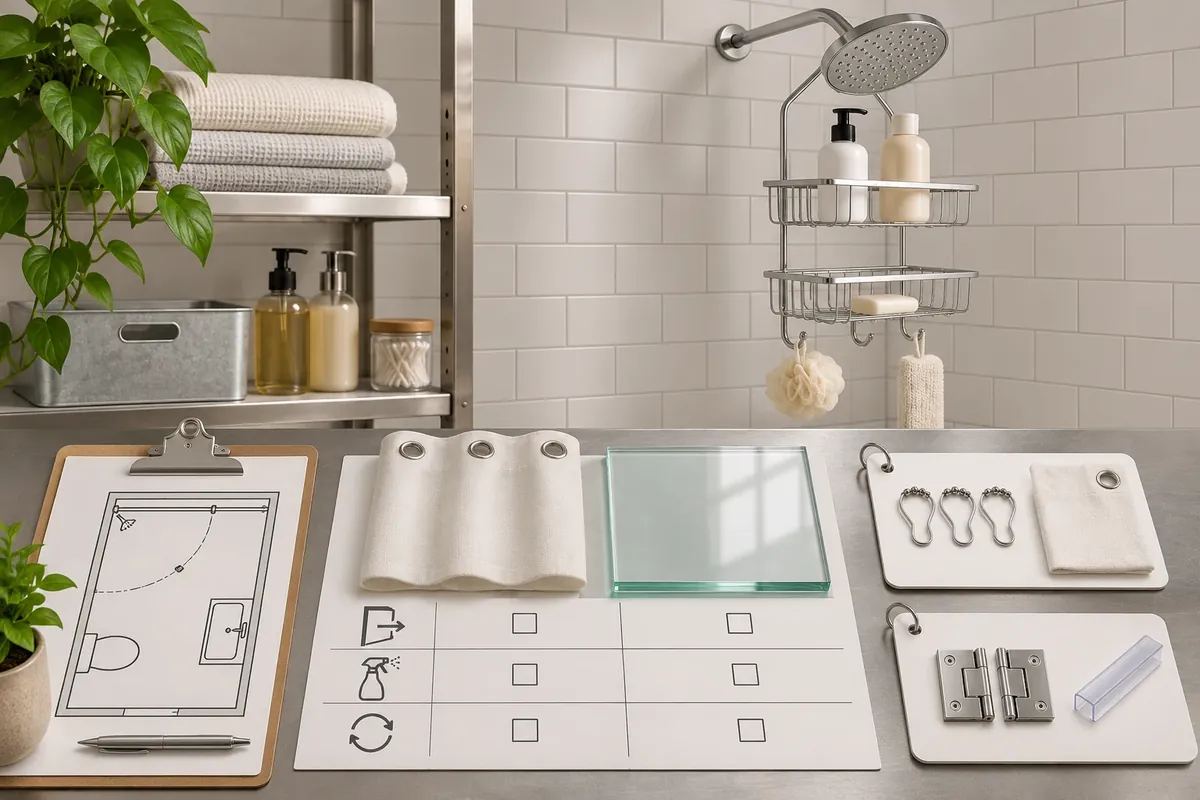
In practical sourcing, shower curtain vs glass door should frame a defined comparison; the purchase specification still needs the exact material or process, acceptance criteria, and evidence required for the actual part.
Sources
- Lee & Cates Glass: Shower enclosures vs. curtains
- Curtain rod finial compatibility and replacement checks
- Tension versus bracket-mounted shower curtain rods
Discuss Your shower curtain vs glass door Requirements
Share the controlled drawing or sample, intended use and the specific question you are resolving. Koitor can discuss relevant metal hardware manufacturing scope and identify details that need confirmation for your project.
Fabrication pour compte de tiers / Marque de distributeur
Transformez ce guide d'approvisionnement en cahier des charges
Indiquez-nous le produit souhaité, ses dimensions, sa finition, la quantité commandée et vos exigences en matière d'emballage. Votre équipe recevra une analyse pratique de la faisabilité de la fabrication avant l'établissement du devis.



 English
 Español
 Português
 Français
 Deutsch
 العربية