
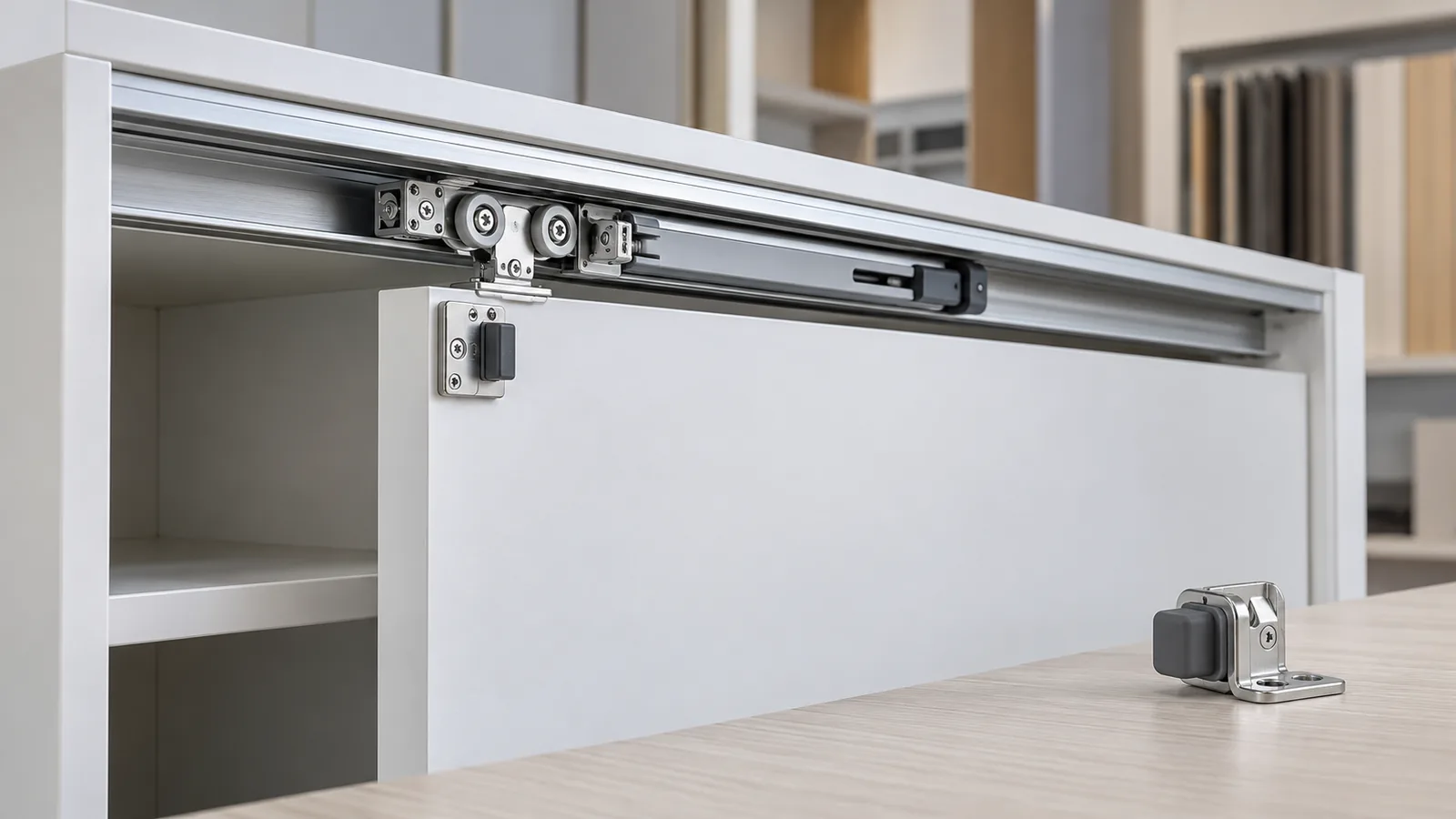
A sliding cabinet door soft close weight range is a compatibility limit for a specific fitting, not a universal setting for every wardrobe. A door can fall within the track system’s maximum load and still sit outside the damper’s intended operating range. Before approving a kit, buyers should record the finished door’s mass and geometry, confirm the exact soft-close variant and installation arrangement, and test the assembled sample using the production-intent panel. Use the hardware maker’s model-specific limits; a generic “soft close” description does not establish fit.
Why is the soft-close weight range different from the system capacity?
A sliding-door system combines several functions: tracks, running gear, guides, activators, stops and—when specified—a damper. The system’s maximum supported door weight describes a limit for the selected hardware arrangement. A soft-close mechanism also needs to engage and control a door within the operating conditions defined for that particular model. Those two values are related, but they are not interchangeable.
Manufacturers publish model-specific examples. Häfele’s Slido F-Line18 50A product page states a soft-closing range of 10–50 kg and recommends sets with a stopper for lighter doors up to 10 kg. Titus’s Slidix product guide publishes different operating ranges for different products, including models described for lighter doors and others for heavier applications. These figures are examples for the named fittings only. They are not design standards, and buyers should not transfer them to another brand, track profile or cabinet configuration.
The phrase “sliding cabinet door soft close weight range” therefore needs a model number beside it. A supplier quote should identify the damper, matching activator, track, number of doors, closing direction and any stopper alternative. If the component combination changes, the applicable range may change too.
Which door details should buyers weigh and record?
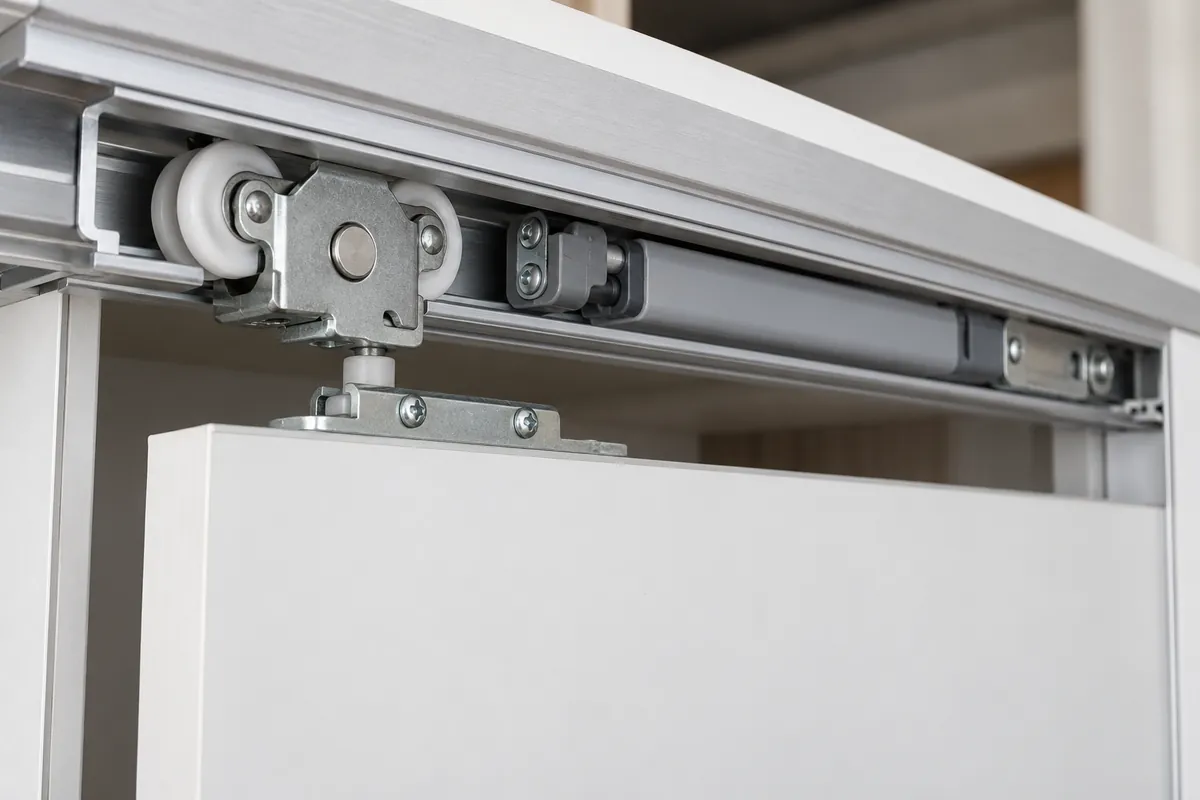
Start with the complete finished door leaf that will be installed—not an unfinished board estimate. Record its measured mass after adding the production-intent frame, edge treatment, glass or mirror insert, handle, trim and other attached parts. If the door will be customized for several markets, calculate or measure each materially different configuration.
Mass alone is not the whole fit record. Include panel height, width, thickness, material construction and the running arrangement. Door width and height affect the geometry and leverage of the moving panel; track and roller makers may specify separate limits or configuration conditions. Record whether the cabinet uses one or multiple leaves, whether the soft-close acts in one or both directions, and which panel receives each kit.
For products sold in multiple sizes, create a separate row for each door construction instead of applying one sample result to the whole range. A narrow lightweight door and a wider panel with a heavier insert may use the same cabinet family name but present different operating conditions. Record the finished mass in the unit used by the fitting supplier, note the weighing method, and retain the panel or sample identifier. If the approved range includes a tolerance, confirm whether the maker evaluates nominal mass, maximum finished mass or another defined value. Do not add an assumed safety factor to a manufacturer rating unless the manufacturer or project specification calls for it.
A useful RFQ attachment is a door schedule listing the leaf identifier, dimensions, construction, estimated or measured finished mass, track system and requested closing direction. Mark estimates as estimates. Before final approval, replace them with measured production-intent samples or a documented final build. This makes the phrase “sliding cabinet door soft close weight range” actionable: it is tied to a known door and named hardware set rather than left as a generic search term.
A supplier’s “up to” weight figure is not proof that the damper works correctly at every lower mass. Conversely, a low-mass door should not automatically be labeled incompatible. Some product families offer a stopper or alternate component for lighter panels. Confirm the exact selection with the component maker’s instructions and the assembled sample.
What should the buyer compare in the fitting specification?
Use a comparison sheet that separates the door, carrier system and soft-close function. Ask the supplier to name each component and state the approved combination rather than quoting only a generic maximum load.
| Approval item | What the buyer should record | Pourquoi est-ce important ? |
|---|---|---|
| Finished door leaf | Measured mass and final construction | Establishes which actual configuration is being evaluated |
| Door geometry | Height, width, thickness and material build-up | Helps identify model-specific size or installation limits |
| Track and running gear | Exact system and carrier model | System capacity belongs to the selected combination |
| Soft-close device | Model, number per door and closing direction | Identifies the mechanism whose operating range applies |
| Activator / catch | Matching part number and mounting location | The damper must engage the intended activator correctly |
| Light-door option | Stopper or alternative specified by the maker | Avoids assuming every panel needs the same damping kit |
| Installation variant | Surface/recess mounting, track position and clearances | Different installation variants may have different conditions |
| Sample evidence | Door revision, kit revision and observed closing result | Makes approval repeatable after a design or supplier change |
If a supplier provides only one “maximum door weight,” ask whether it is the track-system rating, the fitting kit limit, or the soft-close mechanism’s operating range. Request the maker’s installation drawing and instructions for the exact variant. Do not derive an operating range from a catalog image or from a different product in the same family.
Ask for the component list and the document revision used to select it. A manufacturer may publish a system capacity for a complete set while describing the damper’s compatible range elsewhere in a product guide or installation document. Preserve the source page or PDF and the date checked in the approval file. If the supplier proposes an equivalent component, request its own model-specific range and confirmation that the activator, mounting position and track profile remain compatible. “Equivalent” should be verified against the actual application, not assumed from appearance or a shared nominal load.
Where a catalog uses overlapping boundary values or words such as “up to,” ask the fitting maker to explain how the threshold is applied to the exact kit. Do not resolve a boundary by rounding the measured door weight or by choosing a component without written confirmation. A buyer can record the maker’s selection and then verify the received sample against the approved BOM. These small controls prevent a quote, sample and production order from referring to different configurations.
How should suppliers demonstrate the selected option on a sample?
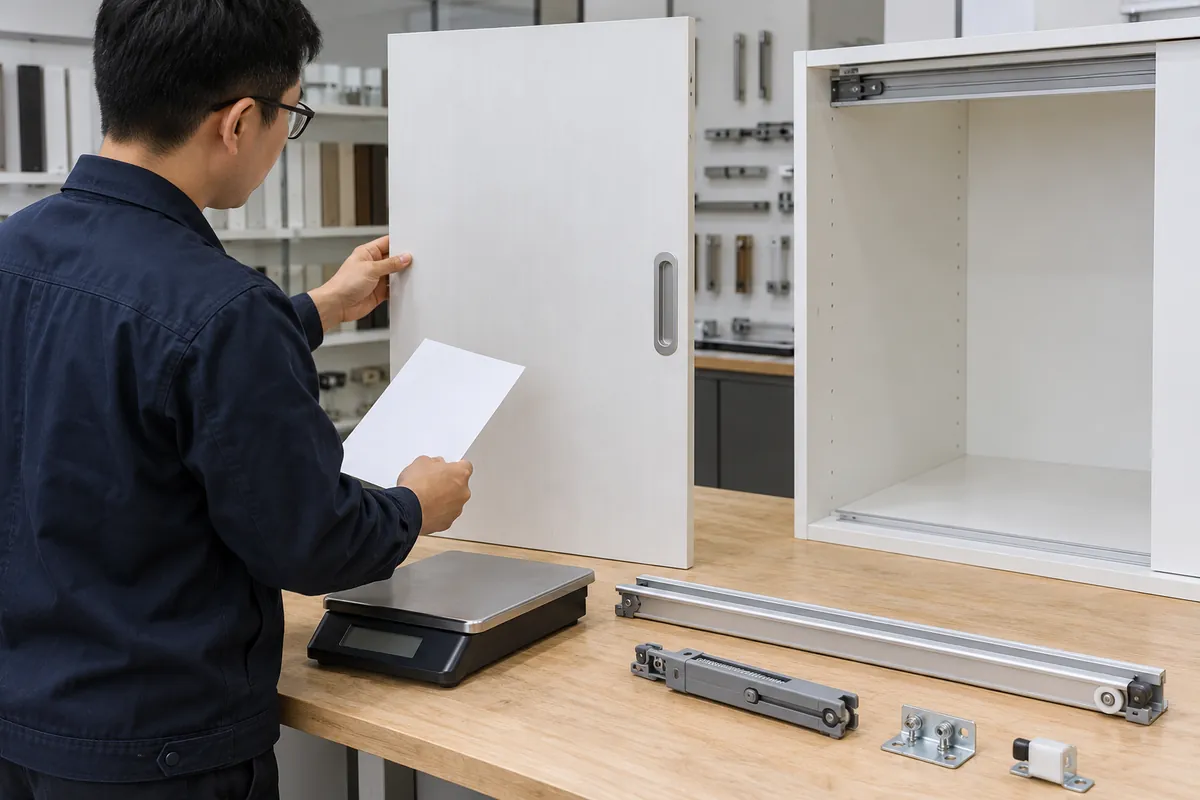
Test the final panel with the selected hardware installed in the intended track and cabinet geometry. Use the actual door configuration or a controlled equivalent whose mass and dimensions are recorded. Check the full closing path from several starting positions, and observe whether the activator engages, the panel is captured, and the movement completes without an unexpected stop or rebound. Agree the acceptance criteria before testing; the observation is a project sample check, not a lifetime or cycle-life claim.
Review both directions when the purchased arrangement is specified to soft-close on both sides. For multi-leaf cabinets, test each relevant panel and the order in which doors overlap or pass one another. A component may be suitable for one leaf yet interfere with an adjacent panel or require a different activator position in the actual layout.
Use a repeatable sequence: first move the panel through the track without forcing it; then test the soft-close engagement from the intended approach direction; repeat from the opposite side if that function is included; and check the open and closed end positions for collision or incomplete travel. Conduct the checks on a level, fully assembled cabinet with guides and stops installed. Record the number of observations, the panel identity and any adjustment made. If the maker specifies a test procedure, follow that procedure and keep the observed result separate from a formal endurance or load test.
Do not compare an empty frame or a temporary board with a final door that adds glass, mirror, edge profiles or a handle. If a controlled substitute panel is used, document its dimensions, mass and how it represents the production version. The approval should state whether the sample proves fit for one configuration only or for a defined family of doors. That distinction limits later product claims to the evidence actually collected.
If the lighter-door option is a stopper rather than a damper, identify that part clearly in the sample record and product bill of materials. Do not describe a stopper as a soft-close unit in the buyer-facing listing. Keep the approved door mass and the exact installed components together so a repeat order cannot silently substitute a different variant.
What symptoms should trigger a fit review rather than a quick diagnosis?
A door that fails to slow, stops short, feels difficult to move or does not consistently engage the catch deserves a system-level review. Door mass can be one input, but it is not the only possible cause. Track alignment, floor or cabinet level, roller adjustment, friction, debris, activator position, installation clearances and component damage may also affect operation. A single symptom does not prove that the door is too light or too heavy.
For diagnosis, separate the observation from the suspected cause. Note the point in travel where the issue appears, whether it happens on every closing cycle, whether the panel moves freely before the damper engages, and whether the condition changes after a permitted installation adjustment. Photograph the catch and damper position before changing it. Share those observations with the hardware maker rather than asking a supplier to guess from a brief statement such as “soft-close does not work.” The maker can then compare the installed setup with its model instructions.
Check the installed geometry and compare the actual hardware against the approved drawing. Confirm that the damper and activator are the specified pair, the trigger position matches the instructions, and the panel moves freely before it reaches the soft-close zone. If a kit was switched to a lighter-door stopper, confirm that the packaging, BOM and installed sample all agree. Ask the fitting manufacturer to assess any behavior that falls outside its instructions.
How can buyers control changes after sample approval?
Freeze the door construction, component model, mounting details and test arrangement in the approved sample record. Identify the door mass and dimensions, track system, damper/stopper variant, activator location, number of doors and closing direction. Attach the revision-controlled drawing and photographs of the installed interface.
Reopen approval when a change could affect moving mass or engagement: a thicker panel, added glass or mirror, a new handle, a different frame, a revised track, an alternate roller or a shifted catch. The buyer and supplier can then decide which model-specific documents and sample checks need to be repeated. Do not assume that a component change is immaterial because the door still appears to fit the cabinet opening.
Häfele and Titus product data illustrate why the model number belongs on the buyer’s specification: different named soft-close products publish different conditions and operating ranges. The fitting manufacturer’s current instructions control the final selection. Koitor can discuss related metal home-storage hardware fabrication and buyer-side component integration, but production of sliding-door soft-close mechanisms is not confirmed; the mechanism maker should validate its own operating limits.
Buyer checklist before requesting a quotation
- State finished door mass for each panel configuration, including attached hardware and inserts.
- Provide door height, width, thickness and material construction.
- Name the track, running gear, damper, activator and stopper option separately.
- Ask for the exact model-specific operating range and maximum system capacity as distinct values.
- Confirm door count, overlap arrangement and whether damping is needed in one or both directions.
- Request the relevant manufacturer installation drawing and instructions.
- Review an assembled sample using the production-intent door and approved hardware variant.
- Record the sample, drawing, BOM revision and agreed closing check.
- Repeat the review after a mass, geometry, track, activator or fitting-model change.
The practical rule is simple: approve the complete door-and-fitting combination, not a “soft-close” label or a single maximum-load number. A documented weight range, exact component pairing and sample record make the supplier decision easier to verify and repeat.
Foire aux questions
Does maximum door weight tell me the soft-close range?
Not necessarily. Maximum system capacity and damper operating range describe different limits. Ask the fitting maker to identify both for the exact selected kit and installation.
What if the door is lighter than the damper’s stated range?
Do not assume the system is unusable or substitute a part without approval. Some product families specify a stopper or another variant for lighter doors. Confirm the exact option and test it in the intended assembly.
Can two kits with the same maximum load have different soft-close ranges?
Yes. Published limits are product-specific. Compare exact model numbers, door configuration and installation conditions rather than relying on a shared maximum figure or product-family name.
If the door closes badly, is its weight the cause?
It is one possibility, not a diagnosis. Check alignment, rollers, friction, activator position, clearances and component pairing against the manufacturer’s instructions before attributing the issue to door mass.
Reference documents: see Häfele’s Slido F-Line18 50A fitting page and Titus’s Slidix damping systems guide. Their values and selection conditions apply to the named models, not to all sliding cabinet hardware. For related metal storage sourcing context, see Koitor’s home-storage hardware manufacturing page.
Discuss a Custom Home Storage Hardware Project
Share the cabinet drawing, door construction, target finished mass, fitting-maker model and sample requirements. Koitor can review confirmed metal-storage hardware scope and manufacturability; the soft-close component manufacturer should confirm the mechanism’s compatibility and operating limits.
Fabrication pour compte de tiers / Marque de distributeur
Transformez ce guide d'approvisionnement en cahier des charges
Indiquez-nous le produit souhaité, ses dimensions, sa finition, la quantité commandée et vos exigences en matière d'emballage. Votre équipe recevra une analyse pratique de la faisabilité de la fabrication avant l'établissement du devis.
 English
 Español
 Português
 Français
 Deutsch
 العربية