
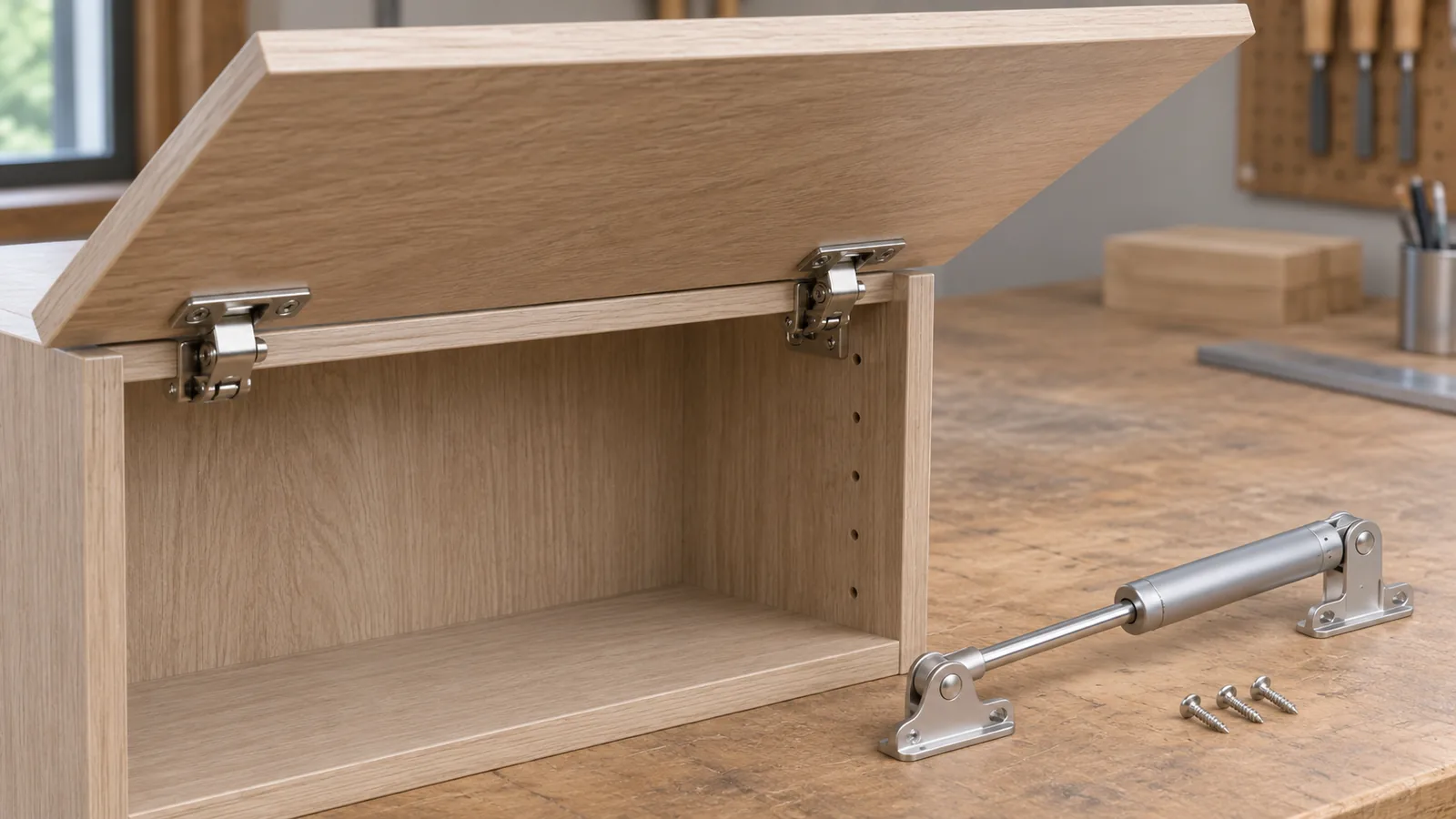
A cabinet lid stay should be selected by the movement the buyer wants and the actual moving assembly, not by appearance or a label that mentions a maximum load. “Soft down,” “stay,” “support,” “lift assist” and “free stop” can describe different functions. A cabinet door may need controlled downward closing without being held at any intermediate position; another design may require holding or upward assistance. The buyer must state the intended behavior before comparing components.
A good selection brief names the door and hinge arrangement, gives the responsible supplier the real assembly inputs, identifies left/right or pair configurations, and records the complete mounting envelope. Then the buyer reviews the selected stay in a representative assembly. This is a sourcing and approval framework. It does not calculate a stay force, define a universal speed, or establish a safety rating for a cabinet lid.
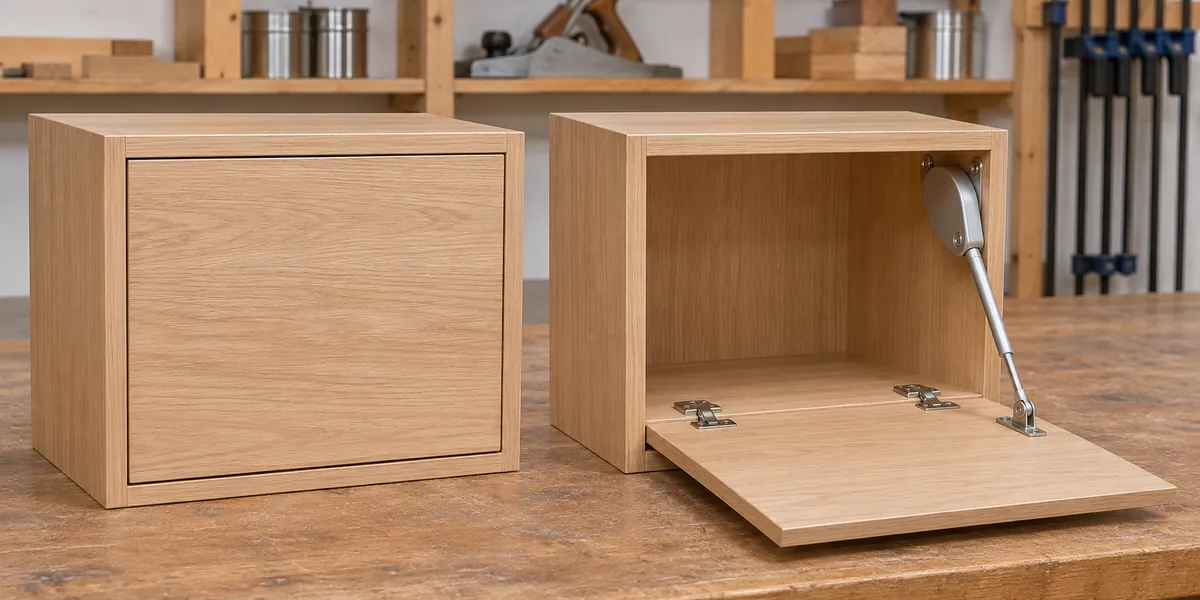
Separate cabinet lid stay damping, holding and assistance
Start by writing what the door should do. A damping stay can resist or control movement in a defined direction. A friction stay may hold a door at an intermediate position. A lift-assist mechanism can help move a door upward. Similar arms and brackets do not prove that the mechanisms are interchangeable.
Sugatsune’s maker selection resources distinguish opening configurations and describe that door size and weight matter when selecting a damper stay. The selection guide also emphasizes verifying the chosen model on the actual equipment. These sources help frame the buyer’s questions, but their illustrative forces, torque ranges and installation coordinates must not be reused as general limits. See the Sugatsune damper-stay selection tips et selection guide.
Another arm-style fitting can use friction to hold a position rather than damp a closing motion. Sugatsune’s S-TAR catalog drawing shows a contrasting friction free-stop stay with different opening and handed variants. It is useful evidence that visually related linkages can have distinct behavior; it does not show that the S-TAR is a soft-down damper or can be selected using the same method.
Write the required function in a simple decision statement:
- Required: controlled movement in a named direction.
- Required: position holding at a specified range, if the design genuinely needs it.
- Required: opening assistance, if needed and supported by the selected mechanism.
- Not requested: any function that should not be inferred from the term “soft down.”
- Open: any behavior the cabinet designer has not yet decided.
This language helps prevent a supplier from quoting a component that controls closing when the buyer actually expects the lid to hold open. Do not use a marketing label as the acceptance criterion. Describe the movement and ask the mechanism supplier to identify the product family that matches it.
Define the opening direction and cabinet configuration
A stay selected for a top-opening lid may not serve a downward-opening flap. A left-side configuration may not mirror into a right-side one. Some product families offer variants by orientation or installation side; other mechanisms have different mounting instructions. Confirm the exact variant from the current manufacturer drawing.
Provide an opening sketch with the cabinet front, hinge axis, fixed side panel, stay location and direction of movement. Mark the viewed side and orientation so “left” and “right” cannot be interpreted from opposite viewpoints. Identify whether the stay is installed on one side, both sides or another arrangement specified by the manufacturer. Do not assume a pair is automatically required, or that two units share load evenly.
The selection record should include:
| Saisie | Buyer should provide | Supplier response |
|---|---|---|
| Opening class | Top-up, downward flap or another defined motion | Compatible product family |
| Handing | Left/right view reference and mounting side | Exact variant or part numbers |
| Hinge | Model, axis location and revision | Compatibility or required change |
| Door | Width, height and construction | Remaining required inputs |
| Moving assembly | Complete attached components and source of mass data | Selection basis, if supplier offers it |
| Mounting envelope | Panel construction and available space | Drawing and fixing arrangement |
| Required behavior | Damping, holding, assistance or explicit exclusions | Confirmed function and limitations |
The table is a request for information, not an engineering calculator. The supplier should say what additional data its selection method needs. The buyer should not assume that a single dimension or weight label is enough.
Supply the complete moving assembly inputs
The moving door is not just a bare panel. Handles, applied fronts, mirrors, attached bins or other hardware can change the moving assembly. The buyer should provide the full configuration and identify the source of the dimensions and mass. If the product is not yet finalized, label assumptions and ask the mechanism supplier to say which inputs are provisional.
Centre of gravity can matter to mechanism selection, but buyers should not invent it by assuming that it lies at half the door height. Provide a drawing or the supplier’s requested input, and let the responsible design party or mechanism supplier determine how to establish the value. Avoid converting a marketing weight limit into a compatibility statement for an assembly with different geometry.
A practical data packet may contain:
- Cabinet and door model or controlled drawing revision.
- Door width and height with measurement references.
- Panel construction and thickness.
- Hinges, handle and all attached parts included in the moving assembly.
- Complete mass data and how it was obtained.
- Hinge axis and mounting positions from the drawing.
- Available side-panel area and interior obstructions.
- Opening angle or intended operating range, where specified by design.
- A sample cabinet or prototype for verification.
- Any data the stay supplier specifically requests to complete its selection.
Do not treat this list as a universal requirement for every product. The exact supplier may require additional or different inputs. Its selection aid belongs to that manufacturer and should be used with its current instructions. If a figure is missing, write “supplier to advise required data” instead of filling in a plausible number.
Distinguish the stay from the hinge and the panel
A stay is part of an assembly that also includes hinges, panels, fasteners and cabinet structure. A component may fit the available side space but conflict with the hinge movement, door edge, frame or interior. The product supplier’s drawing should identify mounting points and clearance for the exact model. The cabinet designer must determine whether the panel and cabinet structure are suitable for those loads and fixings.
The buyer should ask who is responsible for each interface:
- The cabinet designer controls door and case construction.
- The hinge supplier defines the hinge model and mounting arrangement.
- The stay supplier identifies its model, orientation and installation details.
- The buyer coordinates the approved BOM and intended movement.
- The qualified product or safety owner assesses any broader safety claim.
This division avoids asking the stay vendor to approve a cabinet structure it has not seen, or assuming that a hardware sample proves the panel’s fixing strength. A generic screw list is not confirmation that those fasteners suit every board or cabinet design.
If the stay is a replacement, identify the original mechanism by maker, model and revision where possible. A photo can help locate the part, but it cannot establish hidden dimensions or force characteristics. Ask the replacement supplier to confirm the mapping, mounting pattern, handedness and required companion parts. If any of those are unknown, call the match provisional until a physical and functional review is complete.
Check mounting envelope, handedness and pack scope
A buyer should compare the complete installation drawing with the cabinet layout. Note the body length, arm sweep, mounting plate, pivot positions and required screw access only where the manufacturer specifies them. Check that the mechanism will not collide with a shelf, wiring channel or stored item throughout the movement. Do not take coordinates from a rendered illustration or another model’s drawing.
Ask for the component list and clarify whether the quoted unit is one stay, a left/right pair, a stay plus bracket, or a kit that also includes screws. Confirm whether both sides use the same part number or different handed versions. These details matter for project quantities, replacement stock and pack labels.
For an importer assembling multiple cabinet sizes, create a SKU matrix that records each door model, stay model, handing, unit count and approved drawing. If a single mechanism is proposed for several doors, retain the supplier’s written compatibility response for each configuration. The fact that two cabinet doors look similar does not establish equal movement inputs.
Packaging and labels should distinguish the part number and hand. If components look alike but are not interchangeable, use separate labels and pack identifiers. A receiving inspection can then compare the contents with the purchase order without relying on a visual guess.
Select through a qualified component supplier
The buyer can give the mechanism supplier complete inputs and request a model recommendation, but should preserve the boundary between a supplier’s catalog selection and approval of the finished cabinet. A selection tool may narrow the model family; the prototype review still needs to confirm the actual combination of door, hinge, stay and mounting arrangement.
Ask the supplier to provide:
- The exact model and current drawing.
- Which opening and handedness variants are valid.
- The inputs used and any assumptions.
- The intended function and functions not provided.
- Mounting parts and exclusions.
- Installation instructions for the selected model.
- Any model-specific performance document available.
- A list of unresolved questions requiring cabinet-engineering review.
Do not copy force thresholds or torque figures from another product’s selection page. Do not multiply a per-piece value by an arbitrary number of stays to infer a suitable door weight. A pair’s behavior depends on the actual product and system arrangement; the component supplier should state the basis it supports.
Approve a prototype by observing the stated motion
A production-intent sample should use the representative door, hinges, stay model, handedness, mounting hardware and enclosure. Record the model numbers and drawings, the complete door configuration, the settings or assembly conditions, and who conducted the review. The review should compare behavior with the buyer’s written function requirement.
The observations may include whether movement is controlled in the intended direction, whether the door reaches the expected positions, whether it interferes with adjacent parts, and whether the supplied instructions match the installed configuration. These are prompts for a product-specific review, not a generic pass/fail speed test.
Do not label every door that stops midway as “soft close” or “free stop.” Those descriptions mean different things. If the door stops in a position the buyer did not request, record that behavior and ask the supplier to interpret it for the selected model. Do not alter the mechanism, reposition mounting points or substitute a stronger unit without review.
Record limitations clearly. A prototype can demonstrate the observed behavior of that assembly under the conditions tested. It does not by itself establish performance across every door size, future production variant, lifetime cycle count or misuse condition.
Handle changes and reorders through revision control
Changes in door width, height, panel construction, hardware, mass or hinge position can change the inputs provided to the stay supplier. A replacement order should reopen the selection question when those inputs differ materially from the approved record. Do not assume that a prior model remains suitable after a cabinet redesign.
Keep the following together for reorders:
- Cabinet and door revision.
- Full moving assembly configuration.
- Stay supplier, part number and drawing revision.
- Handing and quantity per cabinet.
- Mounting components and fasteners.
- Approved sample identification.
- Intended motion and excluded functions.
- Any supplier selection assumptions.
- Changes since the last order and the approval owner.
If the supplier proposes a new model, compare its function, orientation, mounting envelope and documentation. A visually similar arm can be a different mechanism. Ask the supplier to confirm whether the change affects the expected motion or installation, then update the BOM and sample record.
Replacing an existing stay without guessing from appearance
Replacement sourcing needs a positive model match. Photograph the installed component and record visible codes, but treat those observations as identification clues rather than a complete specification. A label may be hidden, a code may refer only to a product family, or the current part may have been changed during a previous repair. Keep the cabinet manufacturer, door revision and hinge model in the search record so the replacement supplier can evaluate the complete arrangement.
Ask the cabinet or mechanism supplier to confirm whether the original part is still available, whether a successor model exists, and which companion parts must also change. Compare the pivot locations, body envelope, handedness, mounting plate and intended motion in current drawings. If the replacement uses different holes, do not drill a new pattern or adapt the old bracket without authorization from the responsible cabinet designer. A dimensional match at the screw positions does not by itself establish equivalent damping behavior.
When original documentation cannot be recovered, describe what is known and what is uncertain. Measure the cabinet geometry with a consistent reference, identify the hinge axis and provide a complete moving assembly sample or drawing. The supplier can state which additional inputs it needs. Do not infer a force value by comparing arm length or hand resistance. Hand operation is not a calibrated test, and a replacement that feels firmer or looser may still have a different intended function.
For a distributor, preserve replacement mapping by cabinet model and revision. Avoid a broad compatibility claim based only on shared appearance. If one replacement is offered for several cabinet versions, request written confirmation for each configuration and retain the evidence in the SKU file. If the cabinet version is unknown, label the fit as unconfirmed and direct the buyer to verify the model before purchase. This protects the product description from implying that a stay is universal.
Finally, plan how the original and replacement sample will be compared. Record the old part’s orientation, complete part count, mounting location and behavior before removal when that can be done safely by the responsible technician. The new sample should then be reviewed on the identified cabinet configuration, and the approval should state what was observed. This comparison can help manage sourcing continuity, but it does not establish safety or long-term reliability beyond the evidence available.
Make product claims match the evidence
Product listings should avoid unqualified phrases such as “safe lid support,” “prevents slamming,” “holds any door” or “works on all cabinets” unless the seller has evidence appropriate to the exact claim and configuration. A description can identify the documented motion, the intended compatible model or the included parts. It should not suggest that a stay substitutes for a separate safety support or protects against every fall or pinch condition.
A damper is not automatically a certified lid support. This guide does not establish child safety, toy safety, assistive-device suitability or a protective restraint. The responsible product owner should determine which current requirements apply to the product and target market, obtain competent assessment and ensure packaging language reflects that evidence.
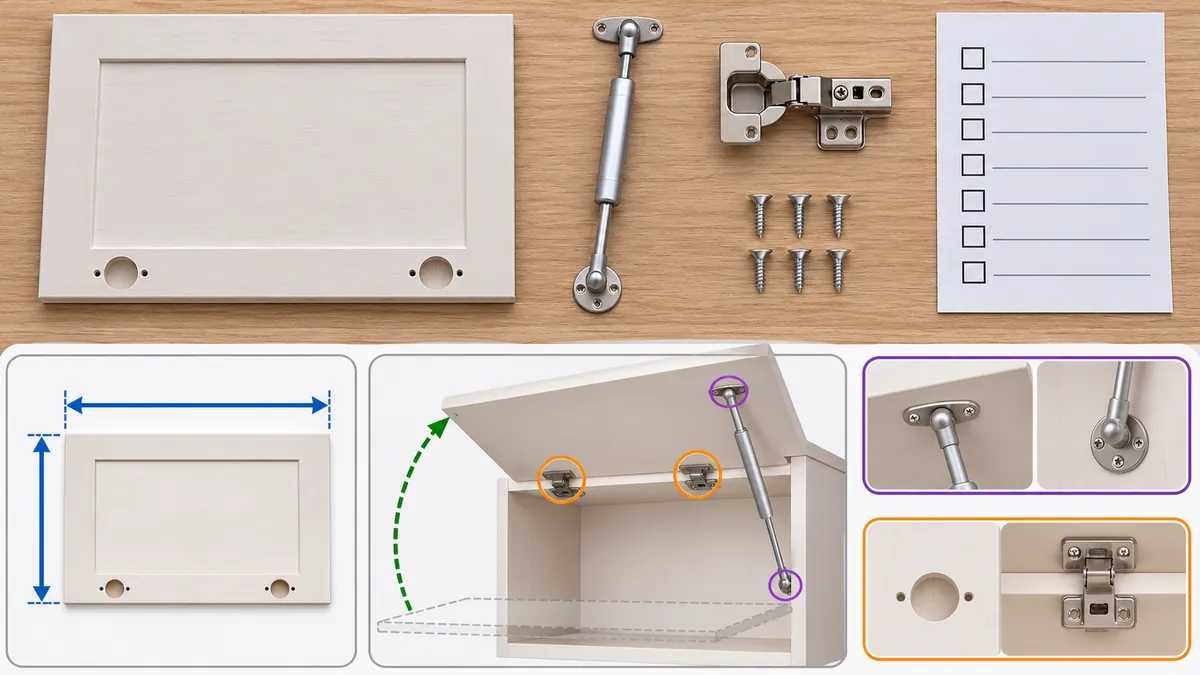
Buyer RFQ and sample checklist
Before sending an RFQ, state the opening direction, intended function, door and hinge references, full moving-assembly inputs, mounting envelope and handedness. Ask the supplier to identify the exact model and its required information. List the parts and quantities included in the quote.
Before approving the sample, check the actual cabinet configuration, supplied fasteners and motion requirement. Record the behavior observed and the conditions used. Keep unverified claims out of product copy. Before reorder, compare the BOM, door revision and supplier drawing with the approved sample.
Record the decision so that the factory and buyer share the same reference
Keep the buyer’s requested behavior, supplier’s selected part and sample observations in one version-controlled approval record. If the supplier’s selection depends on an assumed door mass or mounting position, list that assumption near the part number instead of burying it in an email. A later reviewer should be able to see whether the assumption was confirmed before the production order. Where an input remains provisional, identify who will confirm it and whether the sample decision can proceed without it.
The record should also distinguish a supplier recommendation from the buyer’s approval. A quotation that lists a part number may confirm commercial scope but not prove that the product owner has accepted its movement. Conversely, a sample that appears to move as expected does not automatically approve a substituted part in the next order. Link the quote, drawing, component list, sample record and final purchase order by revision and date so a change can be traced.
For teams that manage multiple cabinet families, use one line per cabinet and door configuration rather than a single broad “compatible” entry. Include the hinge reference, handedness, stay quantity and the source of the door inputs. If two doors use different dimensions or attached hardware, note whether the supplier evaluated both separately. This makes it easier to spot when a previously approved mechanism has been copied to a new cabinet without review.
If a discrepancy appears during incoming inspection, capture the label, part code, mounting features and relevant drawing revision before deciding on disposition. Route a missing part, wrong hand or unapproved model substitution to the change owner. Do not ask the receiving team to judge mechanism performance from hand feel alone. The qualified product owner and component supplier should determine whether the item matches the approved configuration and what further review is needed.
Keep the exact cabinet lid stay description consistent across the RFQ, approved sample, carton label and reorder record.
Foire aux questions
Does “soft-down” mean the lid will stay open at any position?
No. Damping, position holding and opening assistance are distinct functions. Ask what the exact selected mechanism is designed to do.
Can I choose a stay only from the door’s weight?
Not reliably from a weight label alone. The supplier may require geometry, hinge position and other configuration inputs. Provide the complete assembly information requested.
Can a gas spring or friction stay replace a damper stay?
Do not assume that mechanisms with similar arms provide the same function. Use the intended motion and supplier documentation to select the product family.
Does left/right orientation matter?
It can. Record the viewed side and exact mounting position, then confirm the model-specific hand with the supplier.
Is one sample enough to approve every cabinet size?
No. It covers the configuration actually reviewed. Different door geometry, hardware or mounting arrangements need a separate decision.
What if the cabinet was redesigned after approval?
Recheck the moving assembly inputs and mounting envelope with the component supplier. Update the drawing and sample review as the project requires.
Does a damper make the lid safe?
This guide cannot establish a safety claim. The responsible product owner must evaluate the complete product and any applicable requirements.
Koitor scope boundary
This is a buyer guide for selecting a purchased component. It does not claim Koitor manufactures dampers, gas springs or cabinet-stay mechanisms, and it does not provide a force calculation or certified lid support. Koitor Hardware is a family-owned custom metal hardware factory focused on bathroom and home-storage hardware. Buyers evaluating a metal cabinet concept can share the drawing and component scope for a feasibility discussion through the contact page or review the OEM home-storage hardware scope.
Sources
- Sugatsune, damper-stay selection tips — manufacturer guidance on opening configuration and door inputs; no universal values transferred.
- Sugatsune, damper-stay selection guide — manufacturer selection resource; exact model and current documentation should control.
- Sugatsune, S-TAR catalog drawing — contrasting friction free-stop architecture, not evidence of a soft-down mechanism.
- Reddit, cabinet stay replacement discussion et soft-close/lift-assist question — indexed discovery leads only; not technical proof or customer-frequency evidence.
Discuss a Custom Metal Hardware Project
Share your drawing, reference sample, finish target, component scope and order quantity. Koitor can review whether an adjacent metal concept fits its confirmed production scope before quotation.
Fabrication pour compte de tiers / Marque de distributeur
Transformez ce guide d'approvisionnement en cahier des charges
Indiquez-nous le produit souhaité, ses dimensions, sa finition, la quantité commandée et vos exigences en matière d'emballage. Votre équipe recevra une analyse pratique de la faisabilité de la fabrication avant l'établissement du devis.


 English
 Español
 Português
 Français
 Deutsch
 العربية