
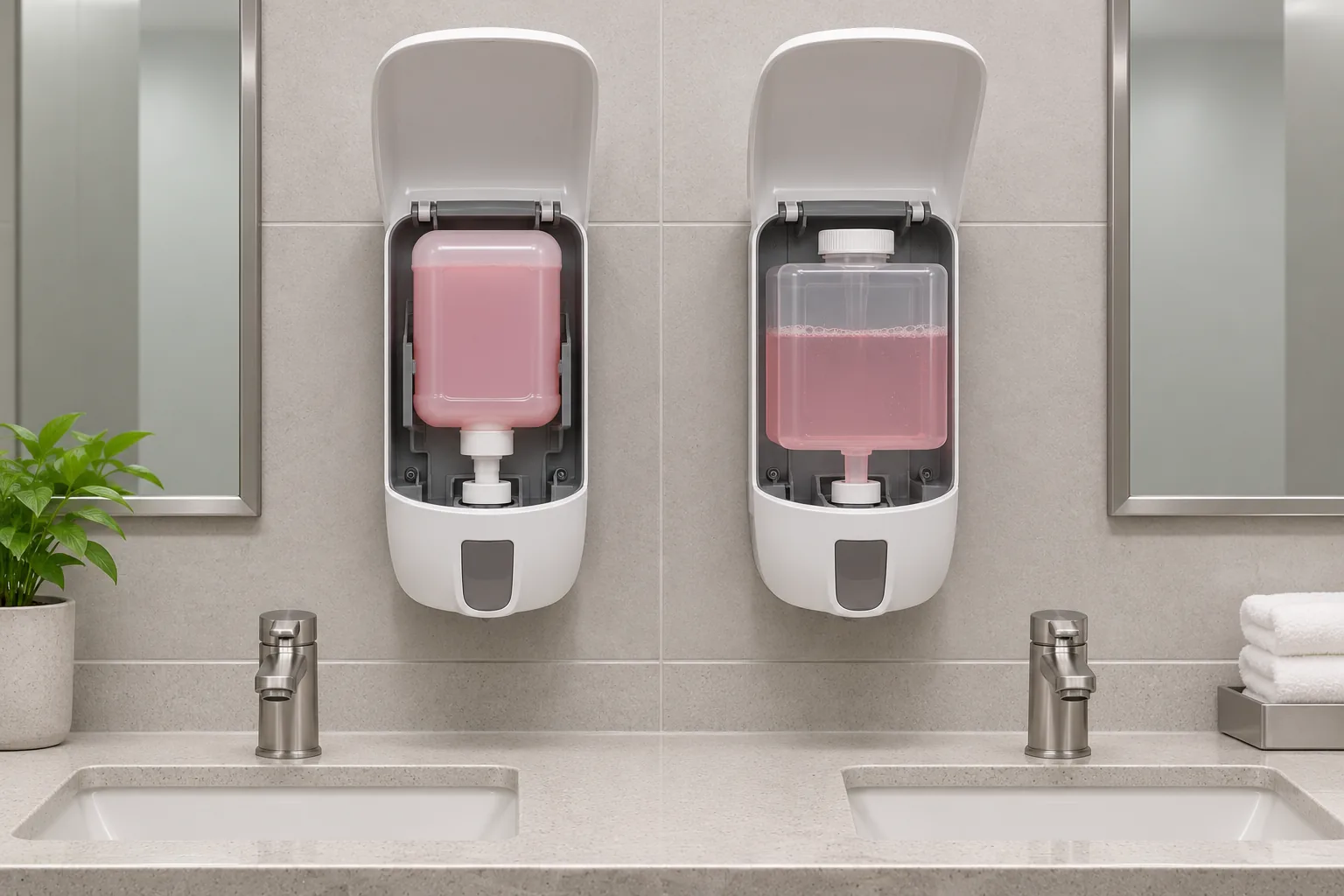
Universal vs proprietary soap dispensers should be compared over one defined period; the label alone does not tell a buyer which system costs less to operate. A commercial washroom purchaser should compare the dispenser, approved soap format, refill availability, service routine, labor assumptions, waste handling and compatibility. Manufacturer calculators can help structure the comparison, but their default traffic, dose, labor and price assumptions are not a neutral forecast for every site.
This guide is for washroom distributors, hotel and project procurement teams, facility buyers and importers specifying dispensers or refill programs. It focuses on purchase and lifecycle inputs, not hygiene claims, chemical suitability or promised savings. Koitor’s soap dispensing mechanism and refill chemistry capabilities are not confirmed; this article is a neutral buyer framework.
Universal vs proprietary soap dispensers: define the offer
A bulk-fill or broadly compatible dispenser may accept a buyer-selected container or soap format, subject to the maker’s written limitations. A proprietary cartridge system may use a defined cartridge, pump, valve or refill pack intended for a named dispenser family. These are not simple opposites: a dispenser can have a proprietary pump but allow more than one soap product, or a refill can be widely available while still requiring a specific closure. Ask the manufacturer to define the compatibility boundary.
Do not use “universal” to mean “any soap will work.” Verify whether the dispenser maker permits bulk liquid, bag-in-box, pouch, bottle, cartridge, foam, liquid or another specified format. Confirm if viscosity, container neck, nozzle, pump, vent, adapter or priming routine matters. A reseller’s phrase “universal refill” may describe only packaging or a subset of models. Request current documentation for each dispenser and refill combination.
Likewise, proprietary does not automatically mean poor value. A dedicated cartridge may simplify SKU identification or service handling for a particular program, but the buyer must confirm supply, price, storage, change frequency and any contract terms. Do not assume exclusive purchasing, refill lock-in, warranty consequences or a distribution restriction unless the supplier’s current documents state it.
For procurement, identify the system at three levels: dispenser model, refill SKU or format, and replacement parts such as pump, valve or key. A dispenser without an available compatible refill may be an incomplete offer. A refill that appears to fit may not be approved for a particular pump or soap formulation. Keep those connections in a compatibility matrix rather than relying on generic category labels.
The comparison also needs a fixed use case. Specify site type, number of locations, estimated user traffic, operating days, dispenser count, refill approach and comparison period. If traffic is unknown, set a range and treat the result as a scenario, not a forecast. The point is to make offers comparable, not to claim that one architecture is universally more economical.
A well-scoped request asks each supplier to list the dispenser model, included mounting or service components, initial refill, approved refill codes, unit size, dose information if documented, service procedure, recommended replacement parts and current commercial terms. If the supplier cannot confirm a field, leave it marked “not provided” rather than filling it with an assumed value.
Build a like-for-like cost horizon
Choose one horizon before comparing systems—for example, a project term, annual budget period or contract review period. Use the same number of sites, dispensers, estimated uses and service assumptions for each option. If one offer includes initial units and another includes only refills, normalize the scope before calculating. Keep equipment acquisition separate from recurring consumable and service costs.
A simple total-cost model can include:
- Dispenser acquisition, mounting parts and any required installation service.
- Initial soap and the cost of refills consumed during the comparison period.
- Replacement pumps, valves, adapters, keys or other documented parts.
- Staff time for inspection, refill, cleaning or order administration.
- Storage, freight, minimum-order quantity and replenishment handling.
- Waste or packaging handling when the buyer has a defined cost or procedure.
- Training, transition or removal costs when changing an installed system.
Only include inputs that the buyer can support. If the supplier provides a unit price, record its date, currency, volume and pack size. If internal labor is estimated, state the wage assumption and task time source. If traffic or dose per use is uncertain, model low, middle and high scenarios. Do not treat a manufacturer calculator’s preset values as a buyer’s measured consumption.
Bobrick’s cost-savings calculator and technical bulletin illustrate how a manufacturer frames acquisition and operating inputs under stated assumptions. They can help a buyer identify variables to request. Their example prices, traffic or savings outputs are not independent benchmarks and should not be transplanted into another project. Use the current source and document its assumptions, then replace them with verified project data where available.
A refill system may shift cost between categories. One option might have a lower dispenser price and higher recurring consumables; another may have a higher initial hardware cost but different refill prices or service needs. The buyer should compare all stated line items over the same horizon. Do not describe one as cheaper without showing which costs are included and what inputs drive the result.
Consider sensitivity. If a result changes materially when traffic varies by a small amount, the conclusion is fragile. Show which inputs dominate: refill price, consumption, dispenser count, labor, freight, or scheduled replacement. The decision record can say “Option A has lower modeled cost under the stated low-traffic scenario” rather than “Option A saves money.” That wording preserves the conditions and avoids claiming a guaranteed outcome.
A useful comparison should also distinguish cash cost from operational preference. A maintenance team may value a standardized service routine, common keying or a smaller set of approved refill SKUs. Those factors can matter, but describe them as buyer preferences or operational requirements unless measured. Do not convert convenience into an invented monetary saving.
Verify compatibility at dispenser, refill and pump level
Start with the dispenser’s model number and generation. Ask whether its manufacturer lists the specific refill or cartridge, and whether the pump is part of the refill or a separate reusable component. Some systems change parts over time. A refill labeled for a brand may still have model or version limits. Confirm the current product documentation before ordering.
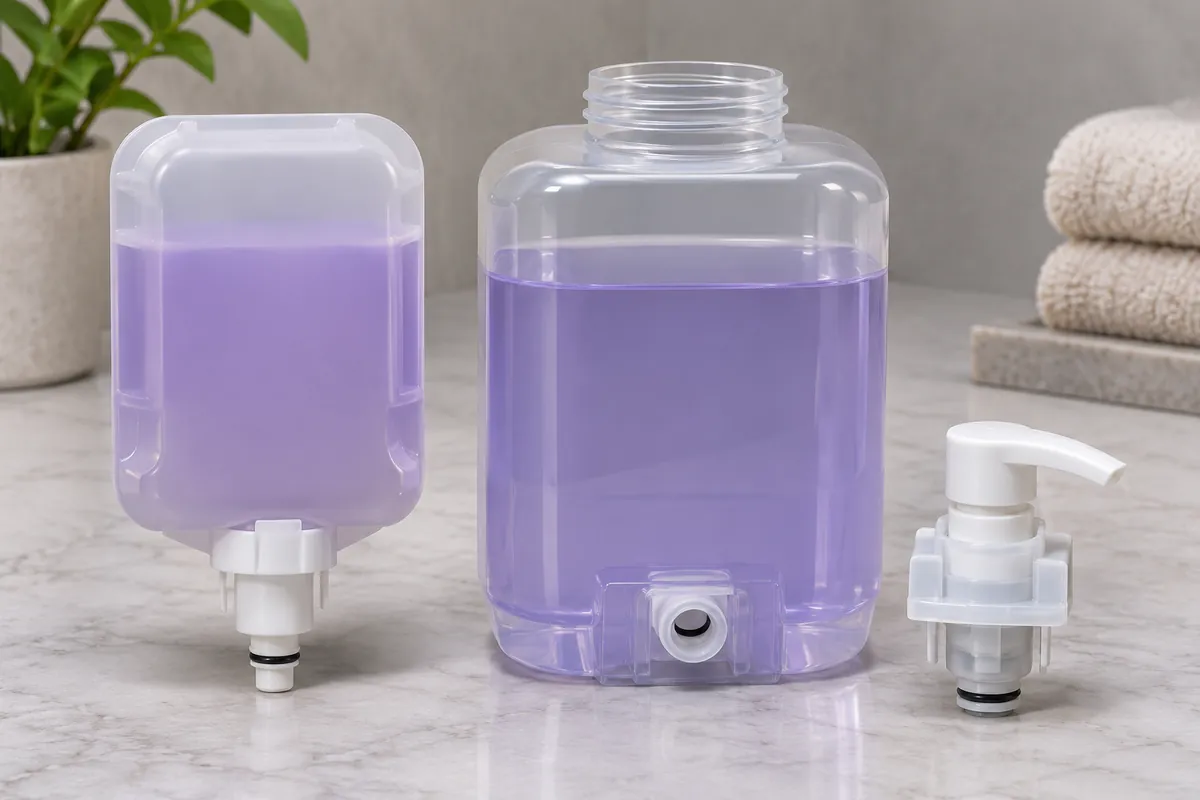
Record refill form and interface details where relevant: package dimensions, neck or connection, valve, bag outlet, pump attachment, keying or lock feature. Do not assume a container will work because it physically fits inside the enclosure. Fit, dispensing and manufacturer approval are separate questions. Request an official compatibility list or written confirmation that names the model and refill code.
Document soap type and specification separately from the dispenser. Liquid and foam products can use different mechanisms or dosage settings. The system maker may limit suitable product properties or formats. Ask the chemical supplier and dispenser maker to confirm the specific combination. Do not imply that a refill is compatible based on color, brand family or a product listing that omits the model.
A proprietary cartridge program can reduce ambiguity if the supplier provides a clear model-to-refill mapping. That does not mean it will fit all installed units or be available from every distributor. Ask about current codes, regional supply, pack size, lead time, substitutions and what happens if a SKU is discontinued. If the buyer operates multiple regions, verify availability in each destination market.
For a broadly compatible or bulk-fill system, the buyer should request the maker’s allowed formats and limitations in writing. Check whether the refill container is part of the dispenser, a separate bottle or a buyer-provided package. Clarify who selects and validates the soap, who maintains the dispenser and what parts are replaced during service. “Open refill” is not a complete compatibility specification.
If a dispenser uses a reusable pump or valve, determine whether it is cleaned, replaced or included with the refill according to the maker’s instructions. Do not infer sanitation or contamination outcomes from the system type. These matters depend on the product instructions, facility procedure and responsible hygiene guidance. The buyer should not write an unverified hygiene advantage into the procurement document.
Keep the compatibility record versioned. For each approved combination, store dispenser SKU, refill SKU, pump or valve reference, source document, revision and confirmation date. If the supplier changes a cartridge or dispenser generation, review the record before reordering. This helps avoid a seemingly small packaging revision becoming an unplanned equipment mismatch.
Compare service routines and replenishment needs
The operational comparison should describe what staff actually do. Ask how the unit is opened, which refill is loaded, whether a pump is retained or replaced, what visual indicator shows refill status and what tools or keys are required. Use the maker’s service instructions. Avoid making a claim about refill speed until the buyer has measured it under the relevant routine.
For each system, map a service task from start to finish: identify the location, check inventory, retrieve the correct refill, access the unit, replace or reload the consumable, close and inspect it, record completion and dispose of packaging according to local procedure. Compare the number of SKUs and steps only when the supplier’s materials or facility workflow support the comparison. A shorter list may be easier to manage, but it does not by itself prove lower labor cost.
Replenishment reliability is a buyer concern. Record supplier, lead time, case quantity, order minimum, shelf-life information if provided, regional availability and substitution policy. A low unit price can be offset by high minimum quantities, urgent freight or slow replenishment, but quantify these only with the buyer’s actual terms. Do not infer stable supply from a supplier’s marketing statement.
For a multi-site rollout, define who owns the approved refill list and who checks substitutions. A local operator may choose an apparently similar refill when stock is short, while the central team expects a model-specific supply. The procurement record should show which role can approve a substitute, what documentation is required, and how the updated choice is communicated to each site. If an emergency purchase is allowed, state whether it is temporary and how the dispenser/refill combination will be reviewed afterward. This is a governance question rather than a product-performance claim, but it can materially affect the buyer’s assortment and service planning.
Storage is part of the operational picture. Compare case dimensions, refill units per carton, pallet configuration where available and the facility’s storage constraints. If exact case dimensions or shipping data are missing, request them. Do not estimate logistics costs from product photographs. For a multi-site buyer, note who holds inventory and how refill codes are distributed to each location.
Replacement parts affect service continuity. Ask whether the supplier sells separate pumps, valves, keys, mounts or covers; whether they are included in a refill kit; and whether repair is allowed under the product documentation. Keep the replacement-part list distinct from consumables. A dispenser may be inexpensive to buy but difficult to maintain if critical parts have no documented supply path; confirm this rather than assume.
If the buyer switches systems, account for transition tasks: removing or retaining current dispensers, matching wall fixings, staff training, initial stock, site labeling, and disposition of incompatible refill inventory. These may be material for a large project. Include only the tasks that apply and assign responsibility. A “conversion cost” should not be fabricated as a blanket percentage.
Evaluate repeat-order friction. A central purchasing team may value one refill across multiple dispenser models, but that is only useful if the compatibility is verified and each location can receive the correct pack. Conversely, model-specific cartridges may require more SKUs but make matching explicit. Compare the buyer’s actual assortment and distribution method instead of presenting either arrangement as always simpler.
Model refill consumption without false precision
A cost comparison may use dosage and traffic to estimate volume, but the calculation depends on the source and actual use. Record whether dose per actuation comes from the manufacturer, an adjustable setting, a site measurement or an assumption. Confirm whether the refill package’s stated volume is usable volume or nominal capacity where documentation distinguishes them. Do not derive dose by dividing a guessed container size by an assumed number of users.
If no site consumption data exists, show ranges. For example, create low, expected and high-use cases based on the facility’s own estimates or a clearly labeled scenario. Explain that the values are planning inputs, not observed performance. When a site can measure consumption, define the period, dispenser count, refill deliveries and way to handle partial containers. That evidence can improve future procurement without pretending to be a universal benchmark.
Different sites can behave differently. A hotel, office, transport hub and sports venue may have different traffic patterns, service intervals and stock arrangements. The buyer should not use one location’s experience as a market-wide result. If the project includes multiple facility types, calculate them separately and consolidate only after recording each assumption.
Manufacturer calculators often allow the buyer to enter variables such as number of users, price, usage and labor. That is a helpful structure. The default output remains dependent on the values entered and the manufacturer’s chosen method. Save the inputs and date with the result. If the output is used in a business case, have the buyer’s finance or operations team confirm the assumptions.
Report the outcome as a scenario. A table can show the total modeled cost, cost categories and key unknowns for each option. Label estimates clearly and avoid a single precise total when major inputs are uncertain. Sensitivity analysis can show whether the choice changes at different refill prices or consumption levels. If all scenarios favor one route, the conclusion may be more robust, but it still applies only to the modelled case.
The buyer should also consider refill discontinuation risk. Ask whether the supplier has a transition notice process, replacement model or documented compatible format. Do not assume that a “universal” format will remain available forever or that a proprietary refill will be discontinued. Treat both as supply-chain questions and review the current supplier terms.
Use a normalized procurement comparison
A decision sheet should contain enough data for another buyer to reproduce the comparison. Keep the unit, currency, pack size, period, dispenser count, refill consumption assumption and service scope visible. List what is supplied once versus recurring. Distinguish maker-stated facts from buyer estimates and analyst calculations.
| Saisie | Universal/bulk-fill offer | Proprietary cartridge offer | Evidence to retain |
|---|---|---|---|
| Dispenser acquisition | Unit price, included parts and mounting scope | Unit price, included parts and mounting scope | Current quote and model sheet |
| Refill format | Permitted containers and soap limitations | Exact cartridge/refill SKUs and model mapping | Maker compatibility documentation |
| Refill price | Pack volume, case count, currency and date | Cartridge count, volume and date | Dated supplier quotation |
| Consumption | Buyer scenario and source | Buyer scenario and source | Site data or labeled assumption |
| Service | Staff steps, reusable parts and tools | Staff steps, cartridge/pump replacement | Current service instructions |
| Availability | Lead time, minimum, regional supply | Lead time, minimum, regional supply | Supplier confirmation |
| Replacement parts | Pump, valve, key, mount and availability | Pump, valve, key, mount and availability | Parts list or maker response |
| Transition | Existing unit disposition and stock | Existing unit disposition and stock | Project plan and inventory record |
Request each supplier to state exclusions, superseded codes, substitutions and order minimums. If a quote omits the refill or labor assumption, mark it unknown rather than comparing it as zero cost. If one offer uses a different comparison period, normalize the model or show the difference explicitly.
Use a clear selection rationale. It might prioritize verified compatibility with the installed base, availability in every project region, service routine, number of refill SKUs, commercial terms or buyer preference. Do not write that one system is universally “best” or “cheapest.” State what the buyer values and which evidence supports the choice.
For a private-label program, the buyer may need to specify the metal housing, bracket or enclosure separately from the pump and refill mechanism. Identify which party is responsible for dispenser mechanism, cartridge interface, soap chemistry, testing, documentation, packaging and service parts. Koitor’s confirmed metal-hardware scope does not establish a dispenser or pump capability. Keep that capability boundary explicit in supplier communication.
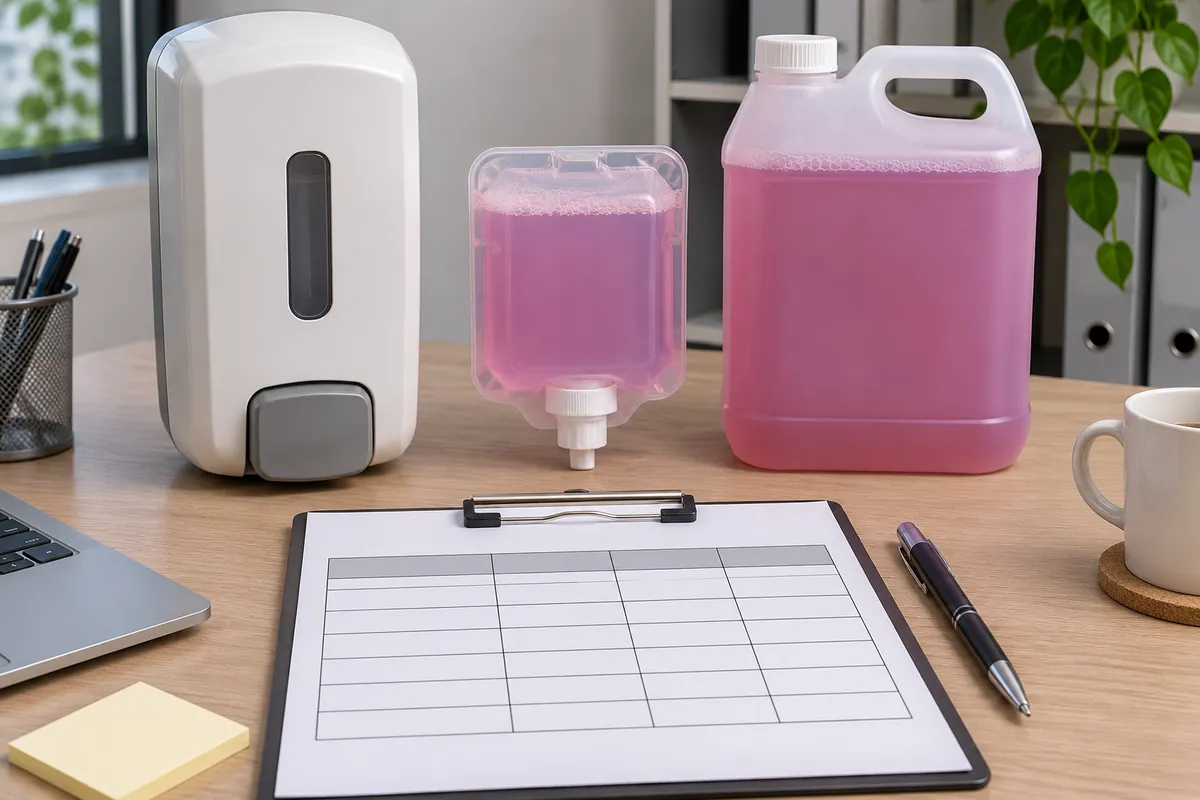
When comparing offers, the procurement team should also separate the dispenser purchase from the refill contract. A bundle may look inexpensive because the initial unit is discounted, while the ongoing refill price or minimum order is listed elsewhere. Another supplier may quote the equipment and consumables separately. Put both into the same cost horizon and show which items are optional, required or conditional. Ask the supplier to confirm whether a quoted refill code is current for the exact dispenser model, and record a substitution rule if the original item is unavailable. This avoids treating an incomplete bundle as a lower-cost system and gives the buyer a clear basis for renewal review.
Foire aux questions
Is universal soap always less expensive?
No. The total depends on dispenser price, compatible refill price, usage assumptions, labor, shipping, service parts and contract terms. Compare the same scope over a stated period.
Does proprietary mean the buyer must purchase from one supplier?
Do not assume that. Check the current product documentation and commercial terms for the exact model and market.
Can a bulk-fill dispenser accept any soap?
No. Confirm the dispenser maker’s permitted refill format and the chemical supplier’s specifications for the proposed combination.
Are manufacturer cost calculators reliable?
They can help structure inputs, but the result depends on their assumptions and the buyer’s entries. Save the assumptions and replace defaults with project data when available.
Should the refill pump be included in the comparison?
Yes, if the system uses a separate or reusable pump. Confirm whether it is included, replaced, retained or sold as a service part.
Technical references
- Bobrick B-823 cost-savings calculator — manufacturer tool with acquisition and operating inputs.
- Bobrick technical bulletin TB-102 — manufacturer comparison under stated assumptions; not a neutral buyer forecast.
- Koitor OEM manufacturing information — verified metal-hardware scope; soap dispensing capability is not implied.
For a documented metal-hardware project, see Koitor’s OEM manufacturing information. Buyers should obtain current dispenser, refill and service documentation from the relevant system supplier before selecting universal vs proprietary soap dispensers.
Discuss a Metal Hardware Specification
Share a controlled drawing, finish reference and sample requirements for a project review. Dispenser mechanisms, refill compatibility and operating-cost assumptions should be confirmed by their respective suppliers.
Fabrication pour compte de tiers / Marque de distributeur
Transformez ce guide d'approvisionnement en cahier des charges
Indiquez-nous le produit souhaité, ses dimensions, sa finition, la quantité commandée et vos exigences en matière d'emballage. Votre équipe recevra une analyse pratique de la faisabilité de la fabrication avant l'établissement du devis.


 English
 Español
 Português
 Français
 Deutsch
 العربية