
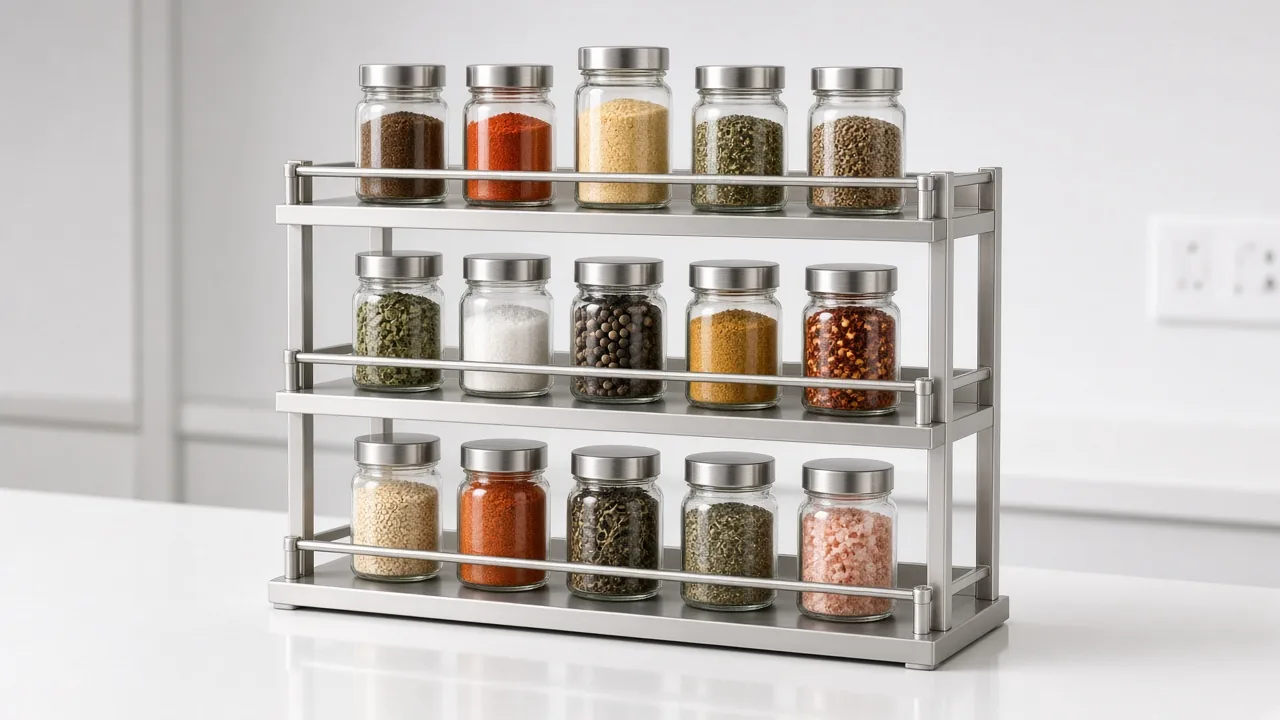
A front rail can keep a jar from sliding and still leave the lid hitting the shelf above. Spice rack shelf spacing should be frozen as finished pitch versus a named jar height, including the lid, before a door-mount or standing rack is listed as fitting a spice collection.
Measure the clear opening the jar actually uses, including tilt and rail intrusion, and check that the jar can be removed, not only that it sits in a photo. If that file is missing, keep “fits most spices” off the artwork.
This guide is for importers and private-label teams buying door-mount or standing kitchen spice racks. It does not set front-rail height, over-door hook and door-swing fit, pull-down cabinet motion, or freestanding tip-over. Koitor Hardware, a family-owned China OEM manufacturer of kitchen storage hardware, can review a pitch brief with a drawing or a sample; the buyer still has to name the jars and the claim.
Why a retention rail does not settle shelf pitch
A rail answers whether a jar stays on a shelf, especially a tilted shelf, when the door closes or someone brushes the rack. Pitch answers whether that same jar, with its lid on, fits between shelves and can come out again. You can pass a rail height and still fail a tall lid. Those checks belong in separate files so one does not hide the other.
Kitchen spice rack jar clearance design is a useful neighbor when the question is the jar envelope and retrieval clearance in a broader fit sense. This page stays on vertical shelf-to-shelf pitch versus named height including the lid. Do not treat the two as interchangeable, and do not use either one to rewrite a rail-height page.
Pull-down spice rack loaded-motion checks is out of scope here. A pull-down unit is a moving cabinet mechanism. Do not borrow that file to prove a static standing or door-mount pitch.
Worked example: a standing three-tier rack is photographed with short jars. The listing says “fits most spices.” Shoppers buy mixed jars with taller lids, and the top of the lid hits the shelf above. The rail never failed. The pitch was never checked against the lid.
Worked example: a door-mount rack has enough pitch on a flat drawing, but the shelves tilt and the rail eats the opening. The jar sits, yet it cannot be removed without unscrewing the lid. The claim was about storage, not about use.
Custom kitchen storage rack manufacturing can quote a spice rack, but a request that only says “standard spacing” is not a pitch file. Name the jars, including lids, and the method.
How should finished pitch be measured on a tilted or straight shelf?
Write whether pitch is a clear opening or a center-to-center distance, and then measure the opening the jar actually uses on the finished rack. On a straight shelf, clear opening between the shelf above and the shelf deck, minus any rail or hook that intrudes, is usually the useful number.
On a tilted shelf, the useful height changes along the depth of the shelf. Measure at the position the named jar will sit, and also check the removal path as the jar is lifted out.
Measure the finished coated or plated rack, not only a bare wire fixture. Coating and a later rail can shrink the opening. If shelves are adjustable, freeze the positions you will sell and photograph, and measure those positions, not an unused empty slot in the upright.
Keep the measurement method out of any sampling-plan sentence. If you later agree how many racks in a lot are measured, that plan can follow ISO 2859-1 or another agreed scheme. The scheme does not define pitch.
Do not invent a Koitor default pitch. If a project needs a numeric opening, agree it on the sample as a project figure with a simple tolerance, and write the datum beside it. A catalog phrase such as “generous spacing” is not a datum.
If the rack mixes a straight top shelf and tilted lower shelves, write each row. A single number that only describes the top row will fail on the tilted row, where lids often hit first.
Door-mount racks should be measured as hung on a named door or a door-thickness stand-in only for the pitch of the shelves, not as a substitute for the hook and swing file. The hook, the door thickness, and the swing stay on that other file. Here you only need the shelves in the attitude they will have when hung, because a hanging rack can change its shelf angle slightly compared with a bench.
Which named jars, including lids, belong in the sample file?
Name at least one conservative jar by body height, lid height or overall height including the lid, and diameter if diameter changes how far the jar sits under a tilted shelf. If the brand has a house spice jar, retain it. If the brand does not, pick a stated commercial jar or a project gauge and say so. “Typical spice jar” will drift between offices.
Include the lid in every height. Shoppers store jars closed. A file that measures only the glass body will approve a pitch that fails as soon as the lid is on. If a lid is unusually tall, either include it in the matrix or exclude that lid type on the artwork.
Build a short matrix when the assortment is mixed: a short jar, a medium jar, and the tallest lid you are willing to claim. Fill the shelves as the photo will show, then also try the tallest jar on each row you will allow. If a row is only for short jars, say so on the instruction or the listing.
Removal is part of the check. A jar that sits under the shelf above but cannot be lifted out without tilting into the rail is not a pass for a “easy access” line. Write whether a slight tilt during removal is acceptable, and try it with the lid on.
Label visibility is a trade-off, not a reason to copy a rail page. Tilted shelves can help labels face the shopper and can also reduce useful height. Record the trade-off in one sentence if it affects the pitch claim, and leave rail height itself on the rail file.
Do not use a pantry-organization essay as the method. DIY blogs teach people how to group jars. This file teaches a factory and a buyer how to freeze an opening against a named lid.
| Claim element | What to freeze | What a sample should show | What to keep off artwork until then |
|---|---|---|---|
| Finished pitch | Clear opening or center-to-center, with a datum on the finished rack, including tilt and rail intrusion | Each sold row is measured in the hanging or standing attitude | A drawing pitch taken from a bare, untilted fixture |
| Named jar | Body and lid, or overall height including the lid, plus a retained jar or gauge | The named jar sits and can be removed on each claimed row | “Fits most spices” or “fits all jars” |
| Fill and photo | Which jars appear on which row, matching the instruction | The lifestyle photo does not use only short jars to sell a tall-lid claim | A short-jar hero used as proof of mixed-jar fit |
| Removal path | Whether a tilt during removal is allowed, with the lid on | The jar comes out without unscrewing the lid, unless that step is written | An “easy access” line with no removal check |
| Neighbor files | Rail height, door-hook swing, pull-down motion, and tip-over stay on their own pages | This file only answers vertical pitch versus lid height | A rail pass or a door-clearance pass used as a pitch proof |
| Adjustable rows | The positions that will actually be sold and photographed | Those positions are the ones measured | An unused hole in the upright treated as if it were the selling pitch |
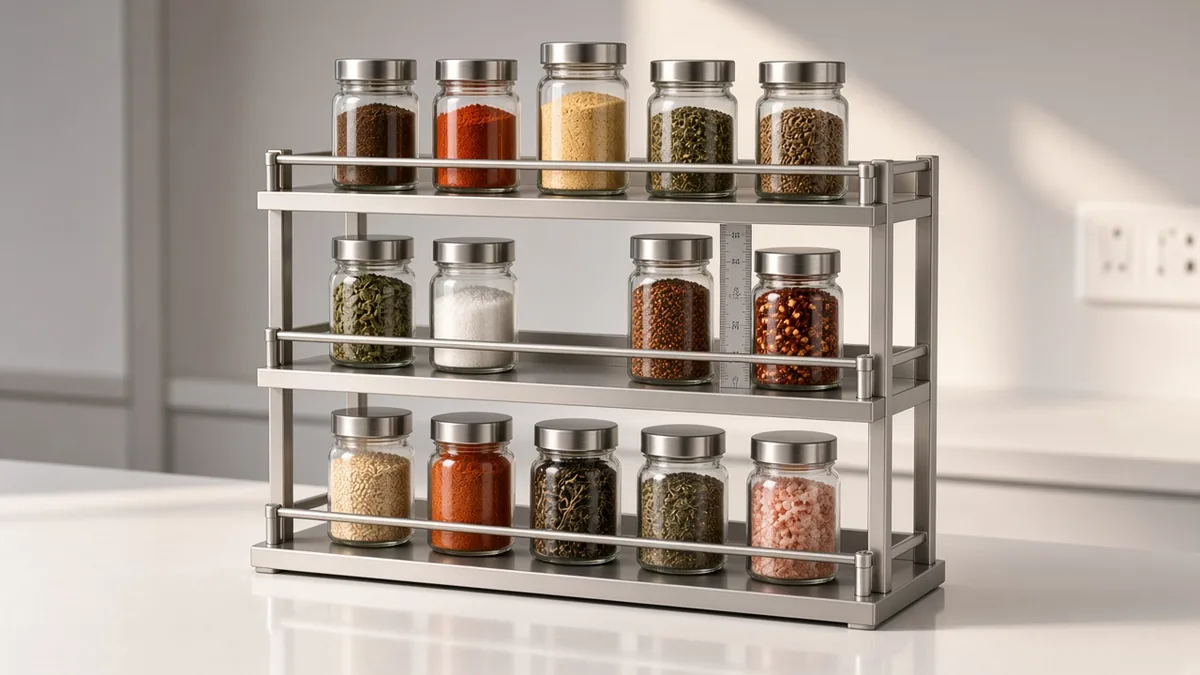
What “fits most spices” language should stay off artwork?
Keep “fits all spice jars,” “fits most spices,” and similar lines off the listing until the named-jar matrix exists and the removal check has been run. The U.S. FTC Policy Statement Regarding Advertising Substantiation is a useful reminder that those sentences are claims. If you only checked short jars, say that, or stay quiet.
Photography should include at least one tall-lid jar if the claim includes mixed jars. A row of matching short jars is a styling choice, not evidence. Carton diagrams should show overall height including the lid when they give a “fits jars up to” line, and that line should match the project figure.
Translations should keep the lid in the sentence. A translation that drops “including the lid” changes the claim. Compare language versions against the matrix, not only against a word count.
If a marketplace title needs a number, use the project figure from the matrix, not a rounded hope. A number that is larger than the smallest useful opening on the rack will fail on the tightest row.
Buyer checklist for spice rack shelf spacing
Use this list before a door-mount or standing spice rack is approved for a mixed-jar or “fits most spices” line.
- Separate pitch versus lid height from rail height, door-hook swing, pull-down motion, and tip-over; a pass on those files is not a pitch pass.
- Write whether pitch is clear opening or center-to-center, and measure the useful opening on the finished rack, including tilt and rail intrusion.
- Measure in the standing or hanging attitude the SKU will actually use, and keep the method out of any sampling-plan clause.
- Name jars by height including the lid, and retain a house jar or a gauge; do not rely on a verbal typical jar.
- Fill a short matrix for mixed jars, and try the tallest claimed jar on each row you will allow.
- Check removal with the lid on, and write whether a tilt during removal is acceptable.
- If shelves are adjustable, freeze and measure the positions that will be sold and photographed.
- Keep fits-all or fits-most language off artwork until the matrix and the removal check exist.
- Do not let a short-jar hero photo, or a drawing of a bare fixture, stand in for the finished opening.
- Remeasure when a rail, a tilt, a coating, or a new jar SKU is added to the program.
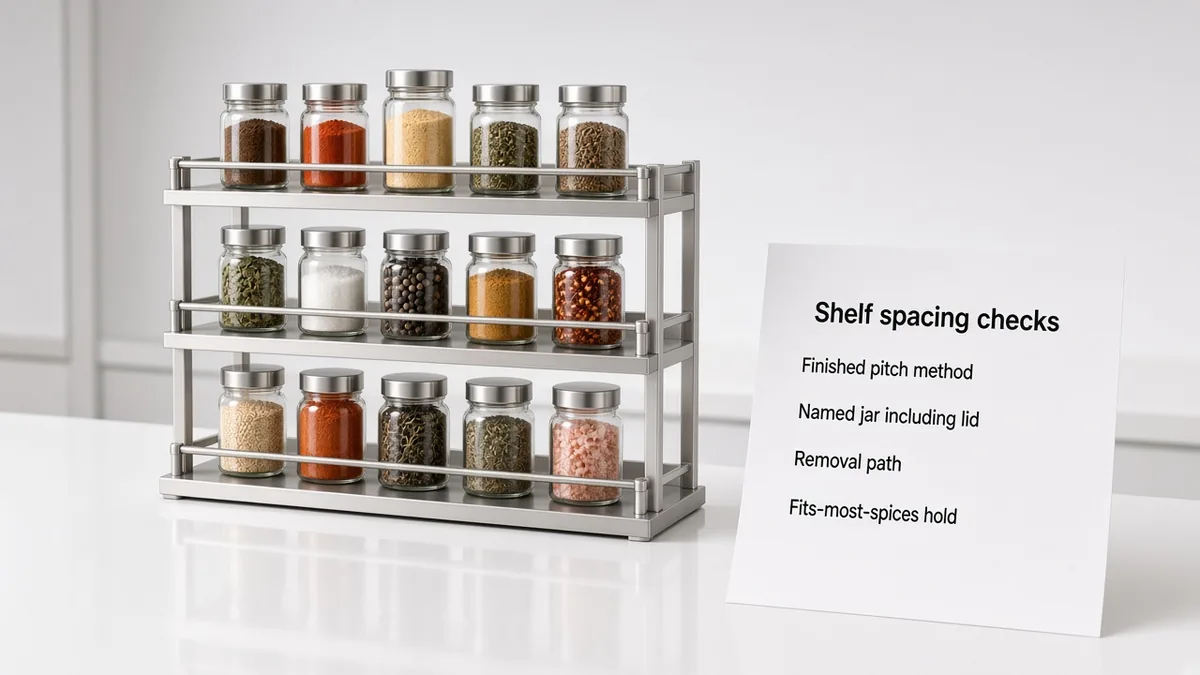
Koitor can review a pitch brief as part of fabrication de rayonnages de rangement sur mesure pour cuisines. Send the drawing or the sample, the intended fit sentence, and the jars, including lids, you want in the matrix.
Small-batch customization is possible depending on the product. MOQ can start from 100 pcs depending on the product, samples usually take 5–7 working days after details are confirmed, and bulk production usually takes 4–6 weeks depending on the project. A new shelf pitch or a new rail can change that discussion under careful approved wording.
A family-owned factory can hold a shelf fixture and a retained rack, but it cannot honestly promise that every jar in a shopper’s cupboard will clear an unwritten opening. The buyer still owns the matrix and the artwork.
Incoming lots should include a pitch or gauge check on the finished shelves, not only a count of racks. A later bend, a later rail lot, or a later coating shop can reopen spice rack shelf spacing even when the upright looks unchanged. Tick the tightest row against the retained jar or gauge.
If a distributor asks for a slimmer door-mount version with the same “fits most spices” line, treat it as a new pitch file. Slimmer usually means less tilt room, a different rail, or a shorter opening.
Retail sets that include a starter set of jars should use those jars in the matrix. A gift set that ships taller lids than the photo is a claim failure waiting at unboxing.
Instruction cards should show the tallest intended jar, including the lid, and the removal motion if a tilt is required. A card that only shows short jars will not teach the shopper why a taller lid does not fit.
Warehouse flattening of tilted shelves in a tight carton can reduce useful height. Inspect a rack after unpacking, not only on the line, when shelves are meant to sit at an angle.
When the finished pitch, the named jars including lids, the removal check, and the photo map are written, a fit sentence can be considered. If the file only says “standard spacing,” spice rack shelf spacing is still an open claim.
A second plant should not inherit the pitch by a short-jar photo. Remeasure the useful opening with the retained jar and lid on the actual rack and finish.
Do not use a field “jars don’t fit” story as a reason to raise the rail. Ask whether the lid hits the shelf above or whether the jar slides. The first is a pitch problem. The second is a rail or tilt problem. Split them before a tool is changed.
Freestanding tip-over remains a different file. A taller pitch that raises the center of gravity can affect stability, but you should not rewrite a tip-over method here. If a pitch change is large, note that the stability file may need a new look, then go to that file.
Over-door hook fit remains a different file. Do not use a successful door hang as proof that the shelves clear the lids. Hang is necessary for a door-mount check of pitch attitude, not sufficient for the lid claim.
Adjustable racks sold with loose shelves should ship with a recommended hole map that matches the matrix. A shopper who sets the tightest holes will not see the opening you photographed. Either lock the positions or teach the map.
If a catalog includes both a standing rack and a door-mount rack under one collection name, give each architecture its own pitch file. They do not share a shelf angle just because they share a finish.
Label-forward merchandising is fine, but a forced tilt that was never measured will show up as lid hits. Record the tilt, measure the useful height, then talk about labels. The order matters.
When a new house jar is introduced mid-season, drop it into the matrix before the carton typography is updated. A new lid height is a pitch event, not only a packaging event.
Club-pack racks that ship already filled should be checked as packed, not only as a bare rack. Pack compression can tip a shelf or press a lid into the shelf above, and that is a pitch-and-packing issue rather than a rail issue.
If a retailer wants a lower overall height for a counter display, treat the shortened rack as a new matrix. Cutting a bottom row, or flattening a tilt, changes useful openings even when the remaining shelves look familiar.
Wire shelves can sag under a full row of glass. If the program fills every slot, include a full-row condition so mid-span lids are checked, not only the end jars next to the uprights.
Plastic lids and metal lids of the same nominal size can differ in overall height. If both are in the assortment, include both, or limit the claim to the lids that were actually checked.
A dark lifestyle photo that hides the lid line is not evidence. The sample photo for the file should show the lid-to-shelf gap clearly enough that a later reviewer can see whether the jar clears.
When all of that is written, spice rack shelf spacing can support a careful fit sentence. Until then, sell the rack as a rack, and leave the mixed-jar promise off the box.
Keep the retained jar, the last pitch measurement, and the hole map in the same request so a new finish or a new rail lot can be compared without rebuilding the method from memory. A family-owned factory can hold that set, but the buyer still has to say which lids the claim covers.
If a later catalog adds grinders or oil bottles to the same rack photo, treat those shapes as new heights and diameters, not as spices by courtesy. A grinder lid is often taller than a spice cap, and it will fail a matrix that never included it.
Foire aux questions
Does a retention rail prove that jars will fit?
No. A rail keeps jars from sliding. Pitch versus lid height decides whether the jar, including the lid, fits and can be removed.
Should I measure the glass only, without the lid?
No. Shoppers store jars closed. Include the lid in the height, or you will approve an opening that fails in use.
Is jar-envelope clearance the same as shelf pitch?
They are related but not the same. Envelope and retrieval clearance can include diameter and path. This file freezes vertical pitch against named height including the lid.
What about pull-down cabinet spice racks?
Those are a loaded-motion decision and are out of scope here. Do not use a pull-down file to prove static shelf pitch on a standing or door-mount rack.
Can I say the rack fits most spices?
Only after a named-jar matrix and a removal check exist, and even then you should be careful. If you only checked short jars, do not use a mixed-jar sentence.
What should a first sample include?
The finished rack in its selling attitude, the named jars with lids, a pitch method note, and a fill photo that matches the claim. A short-jar beauty shot is not a pitch sample.
Collaborez avec Koitor Hardware
Need a spice-rack pitch brief reviewed?
Send Koitor the drawing or sample, the intended fit sentence, and the jars, including lids, you want in the matrix. Our team can review shelf pitch, the removal path, and small-batch OEM options before quotation.
Fabrication pour compte de tiers / Marque de distributeur
Transformez ce guide d'approvisionnement en cahier des charges
Indiquez-nous le produit souhaité, ses dimensions, sa finition, la quantité commandée et vos exigences en matière d'emballage. Votre équipe recevra une analyse pratique de la faisabilité de la fabrication avant l'établissement du devis.
 English
 Español
 Português
 Français
 Deutsch
 العربية