

A stainless steel bag clip specification should identify the clip’s body and spring, the jaw contact, the folded bag reference and the intended closure claim. The outside width alone does not describe how the jaws meet the actual bag. Nor does a clip staying on a folded bag prove that the package is airtight, preserves food for a stated period or has a verified food-contact status. Importers should define the exact clip and bag pairing, inspect representative samples under an agreed method, and keep customer-facing claims within the evidence available. A practical stainless steel bag clip specification also records which details come from the supplier and which are only sample observations.
This is a product-selection and sample-approval question for kitchenware importers and private-label teams. A reusable clip can combine multiple components and materials, so a general “stainless steel” product name may not describe every part. The jaw can contact the bag differently depending on fold placement and material. The spring’s identity and construction may matter to the complete assembly, but the supplier must provide the applicable specifications. Buyers should not infer an alloy, temper, spring force or closure performance from a product photograph.
Maker pages illustrate why a component-level view is useful. DULTON’s RN-0426S/3 product page lists different stainless materials for the body and spring and includes care cautions about wet storage, moving parts and excessive force. This is a product-specific material declaration and set of instructions; it does not establish an optimal grade, food-contact suitability or airtight results. OXO describes a different plastic-bodied clip with a non-slip mouth and hanging hole. That example demonstrates another jaw/contact architecture, not proof that plastic outperforms metal or that either design preserves contents for a quantified duration.
What belongs in a bag clip specification?
Start with the exact product identity: maker, model or SKU, revision where available, body and spring references, finish or surface description, and the configuration intended for sale. If the clip is supplied as a preassembled part, record the source product documentation and approved sample. If the supplier lists more than one version, maintain separate entries until its documentation confirms which features are shared.
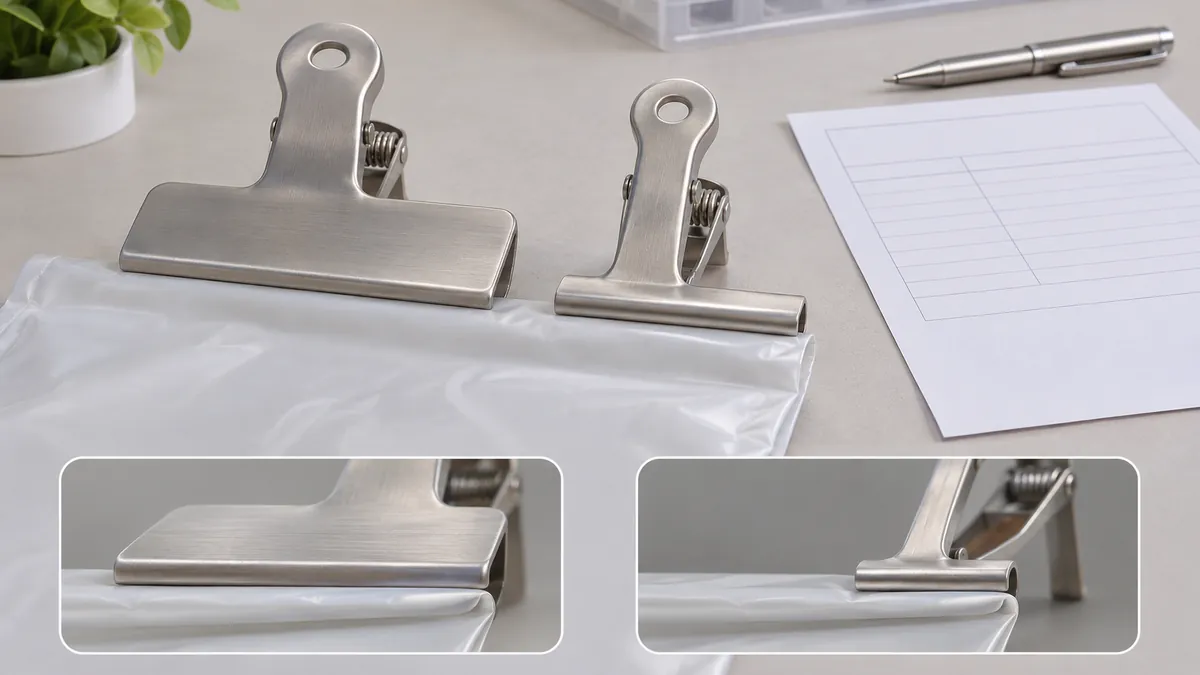
Then describe the interface with the bag. Record the useful jaw contact span, the intended mouth or fold arrangement, and the reference bag supplied for review. These terms should correspond to actual supplier information and sample observation. Do not use a nominal outer clip width as a substitute for usable contact. A wide body may have a smaller contact surface; a narrower jaw may meet a folded film differently. There is no universal jaw width that guarantees suitability for all bag types.
Identify component materials by source. DULTON’s product information distinguishes the material of its body and spring; that declaration applies to its specific item. If another supplier merely calls its product “stainless,” request clarification about which components that term covers. Do not assume that a spring shares the body alloy, that a finish identifies the substrate, or that a catalog description proves a food-contact declaration.
An RFQ can request:
| Specification area | Buyer should identify |
|---|---|
| Clip identity | Model, revision and supplier |
| Body and spring | Supplier-declared component materials and source |
| Jaw contact | Usable contact geometry from drawing or sample |
| Bag reference | Exact bag SKU or supplier sample |
| Fold | Number and placement of folds used for review |
| Intended use | Reusable storage closure, display clip or another stated use |
| Claims | Exact proposed customer-facing wording |
| Approval | Reviewer, sample date, evidence and unresolved items |
The table is a decision aid, not a universal standard. If a field is unknown, flag it for supplier confirmation. Do not fill a missing material or performance fact with a common industry assumption.
Why does folded-bag fit matter more than the outside width?
A clip contacts the bag at the jaw, while the bag’s mouth may be folded, rolled or doubled over. That changes the thickness and shape at the point of contact. Different bag materials can also have different stiffness, surface texture and construction, as declared by their suppliers. The bag’s nominal width alone does not say how it will sit between the clip jaws.
The importer should use actual references from the intended assortment. Record the bag’s maker and product code, any supplier-declared material or thickness information, and the precise fold arrangement used during review. Do not infer a universal film thickness or use a different bag simply because it appears similar. If the clip will be sold as suitable for a range of bags, select representative references based on that promised range and obtain supporting supplier guidance. This is why a stainless steel bag clip specification should describe the bag interface alongside the clip dimensions.
Observe the actual contact points. Does the clip close over the intended fold without the bag being forced into the jaw? Does the product remain attached during the buyer-defined handling review? Are visible marks or damage observed? Does the bag slip under the conditions evaluated? Record observations in neutral terms. A short sample check does not establish a general grip rating or repeated-use life.
Avoid turning a difference in apparent jaw width into a better/worse conclusion. OXO’s plastic-bodied example describes a non-slip mouth for its own item; DULTON’s metal clip has a different component structure. These product pages do not supply a controlled head-to-head test using the same bags, folds, humidity, loads or cycle method. The buyer can compare actual samples for its assortment, but should not attribute superiority from unrelated maker descriptions.
If the sample review uses a bag folded several times, record the fold count and placement. If a customer will use a clip with a rolled mouth, test that arrangement separately. The approval is only as useful as its description of the configuration. If the product is packaged or photographed with an illustrative bag, make clear internally whether that bag is included or is only a reference.
How should a buyer review the body, spring and jaw assembly?
Treat the clip as an assembly, even when the product appears to contain only a body and spring. Identify which parts the supplier declares and whether replacements or service parts are part of the offer. The buyer should confirm the material and finish information needed for its product record, rather than treating the word “stainless” as a complete bill of materials.
Inspect the assembly’s visible condition under a consistent sample review. Note whether the jaws meet as intended, whether the hinge moves as described, and whether any burr, edge, looseness or surface issue is observed. Do not infer an exact spring rate or force from a hand squeeze. The sources do not provide a common force protocol or an allowable range. If those properties matter to a program, request supplier data or agree on a test method with the responsible supplier.
A component-level record can distinguish what is known:
| Part | Evidence source | Question to resolve |
|---|---|---|
| Clip body | Drawing, material declaration or sample | What material and finish are declared? |
| Spring | Part list or supplier documentation | Is the spring material distinct from the body? |
| Jaw surface | Drawing or physical sample | What surface contacts the folded bag? |
| Hinge or pivot | Product documentation and observation | What movement and maintenance are stated? |
| Complete assembly | Approved sample and revision | Does this exact unit match the order reference? |
DULTON lists different stainless materials for its body and spring. That is an example of why one headline material name may not answer every component question. It does not establish what material another supplier uses, or which combination is optimal. Keep every material statement tied to the source that supports it.
What does a sample review prove—and what does it not prove?
A sample review can document that the identified clip was used with the identified folded bag under the stated conditions and that the buyer observed a particular result. It cannot, without a defined and suitable test, establish a universal grip rating, airtightness, leakage resistance, food preservation, freshness duration or number of reusable cycles. Do not convert “remained closed during this brief handling check” into “airtight.”
Define the review before it happens. Name the clip and revision, bag reference, fold arrangement, operator action, handling condition and observation criteria. If the buyer plans to compare models, keep the same bag and fold method across those samples when appropriate, and record any condition that differs. A written method helps avoid comparing one clip on a single fold against another on a thicker rolled mouth and then attributing the outcome only to the clip.
The observation should separate engagement from claim substantiation. The clip may stay attached while air can still move through the package opening. Mechanical closure is not the same as a verified seal. The clip may be used to hold a bag closed for storage, but that alone does not establish how long contents remain fresh or whether the package prevents moisture or gas transfer.
K493 in Koitor’s existing content map covers industrial heat-seal testing for packaging. That subject involves a different closure technology and evidence question. Do not transfer its methods or conclusions to a reusable kitchen clip without applicability review by a qualified party. This guide’s focus is the clip-to-folded-bag interface and the language the importer can support.

How should closure and product claims be bounded?
A product listing should say what the clip is and what the buyer has evidence to support. “Reusable metal bag clip” is a form and use description if it accurately reflects the offered product. A statement such as “airtight,” “keeps food fresh,” “prevents freezer burn,” “food safe” or “leakproof” makes a broader performance or compliance claim. The sources reviewed for this article do not substantiate those claims for a generic clip.
If a brand wants to make a food-contact, dishwasher, freezer, corrosion or freshness claim, ask the responsible supplier for relevant current evidence for the exact model and intended market. Do not infer compliance from stainless material naming, retail positioning or a successful closure observation. If no suitable documentation exists, narrow the claim or leave it out.
The evidence record should preserve the wording reviewed. A product manager may approve “closes the folded opening in our sample review” while declining “airtight.” That distinction allows the marketing and customer-service teams to use accurate descriptions. Keep the photo, product page, package copy and marketplace listing aligned with what was approved.
| Proposed statement | Evidence question |
|---|---|
| “Stainless steel clip” | Which components are declared stainless, and by which supplier document? |
| “Fits this bag” | Which exact bag reference and fold were reviewed? |
| “Reusable” | What reuse conditions or instructions does the maker state? |
| “Non-slip” | What test and bag conditions substantiate the statement for this model? |
| “Airtight” | What appropriate closure test supports that claim? |
| “Keeps food fresh” | What evidence supports a stated duration and conditions? |
Do not copy a maker’s claim from one model to another simply because the products look similar. OXO’s page describes its own product features; DULTON’s page lists its own material and care information. Neither makes a claim for a third-party private-label design.
What should change control cover?
Changes to the clip body, spring, jaw contact, finish, supplier, assembly or packaging may warrant a review. A new bag supplier, different film construction or changed fold arrangement can also affect the evaluated interface. The buyer should agree which changes require notification and who decides whether a new sample is needed. A change is not automatically a defect; the point is to reassess whether the previous approval still describes the item being offered.
Retain a dated reference sample or controlled drawing according to the buyer’s document process. Link it to the item code and actual supplier. If the supplier substitutes a spring or material, ask what evidence confirms the approved assembly still applies. Do not assume that a visual match means the new part is functionally equivalent.
If a listing expands to additional bag types or new claims, treat that as a scope change even when the clip itself is unchanged. Compatibility evidence and marketing wording have separate owners. The buyer should check that the new claim does not exceed what the sample review or supplier documentation can support.
How can buyers compare clip and bag samples consistently?
Use a comparison worksheet that follows the product through the decision, rather than recording only a pass/fail mark. Begin with one row per clip SKU and revision. Add the supplier identity, the source for the body and spring descriptions, and the specific reference bag. Record the bag code and any construction details the bag supplier actually provides. If thickness, laminate or surface information is not available, mark it unknown instead of estimating from appearance.
For each pairing, write down how the opening was folded and where the jaws engaged. A useful record distinguishes the clip’s external envelope from the portion that actually contacts the folded material. Note the operation performed and what was observed: for example, whether the jaws met, whether the clip remained attached during the agreed handling step, and whether the bag showed visible marks. These are observations for the reviewed configuration, not ratings that can be applied to every bag.
| Comparison field | Why it belongs in the record |
|---|---|
| Clip SKU and revision | Connects the result to the actual item evaluated |
| Bag SKU and supplier | Prevents a generic bag description from hiding material differences |
| Fold arrangement | Shows the geometry presented to the jaws |
| Contact span and location | Separates useful jaw engagement from overall product width |
| Operation reviewed | Makes samples comparable under the same buyer-defined action |
| Observed slip, marks or damage | Captures what was seen without inventing a performance score |
| Authorized wording | Keeps the listing within the evidence reviewed |
| Open questions and owner | Assigns follow-up to the clip or bag supplier responsible |
When comparing two clips, use the same bag and fold where that is appropriate to the intended assortment. If each clip is designed for a different bag configuration, document the difference and avoid claiming a direct winner from unlike conditions. Keep photographs tied to the sample identifiers and revision. A photo can help a reviewer recognize the setup, but it does not independently verify material grade, spring force or seal performance.
The worksheet is not a laboratory protocol. It does not prescribe a universal handling force, retention time, cycle count or acceptable mark limit. If the commercial decision depends on one of those properties, the importer and responsible supplier should define an appropriate method and acceptance criteria for the specific product. Keep that requirement separate from the simple visual and operational observations used during assortment screening.
Which substitutions should be reviewed before a reorder?
Substitution control should follow the interfaces and claims that mattered in the original approval. A different spring, body material, jaw shape, surface, assembly source or finish may change what the buyer needs to confirm. A replacement bag source can also change the folded interface even when the clip stays the same. The buyer should request notice of relevant changes and assess the evidence before extending the old approval to the new configuration.
Create a short decision record for each proposed change: what changed; who supplied the information; which previously approved references are affected; whether the exact pairing was sampled again; what was observed; which claims remain supported; and who accepted the result. If the change appears unrelated to the approved function, record why a new sample was unnecessary. This creates a traceable rationale without assuming every small change is risky or every visually identical part is equivalent.
Artwork and catalog changes deserve their own check. A new image may show a rolled bag while the earlier review covered a flat fold; a revised product name may imply broader compatibility; and a marketplace bullet may add words such as “airtight” or “keeps fresh.” Compare the released copy with the approved evidence whenever the pictured setup, named bag range or claim language expands. Route food-contact or preservation claims to the relevant compliance and testing owner, rather than asking a general mechanical sample review to answer them.
For repeat orders, preserve the approved sample reference and link it to the purchase specification, product copy and supplier communication. If the supplier cannot confirm whether the delivered assembly matches that reference, pause the affected claim review and resolve the configuration first. This is a document-control checkpoint, not evidence of a defect. It helps the category manager distinguish an actual product change from an incomplete record and avoids quietly broadening a claim during a routine reorder.
Questions kitchenware importers should resolve before release
Does a wider clip fit more bags? Not necessarily. Outer width does not define jaw contact or the folded material interface. Review the actual bag reference.
Does a stainless body mean the spring is stainless too? Not automatically. DULTON’s own listing illustrates separate material declarations for body and spring. Ask for component-level information for the exact supplier model.
Does a clip staying closed prove it is airtight? No. Mechanical closure observation is not a suitable leak or barrier test.
Can one bag sample establish universal compatibility? No. Approval is tied to the sample, fold, clip revision and conditions reviewed.
Can the buyer use “food safe” because the body is metal? No. Obtain applicable evidence from the responsible supplier for the specific product and market.
Should the clip be tested on K493’s industrial heat-seal method? Do not assume that method applies. K493 addresses a different sealing technology; any transfer requires a qualified applicability decision.
A useful buying record names the clip, its body and spring evidence, the folded bag reference, the sample observations and the exact claim authorized for release. It keeps a dimensional match separate from mechanical performance, and mechanical closure separate from airtightness or food-preservation evidence. That gives category teams a consistent way to compare reusable clips without inventing a universal jaw width, force or shelf-life result.
Koitor’s approved knowledge includes metal hardware manufacturing and general coordination of metal components, but current bag-clip production, spring manufacture and specialist food or airtight testing are unconfirmed. For a lawful metal-component drawing review within confirmed scope, send the product reference and intended requirements through the contact page. The scope should be assessed before describing any complete-product capability.
Collaborez avec Koitor Hardware
Discuss a Metal Homeware Component
Share a lawful drawing, component references and intended product claims for a scope review. Koitor’s current bag-clip production and specialist food or airtight testing are unconfirmed.
Fabrication pour compte de tiers / Marque de distributeur
Transformez ce guide d'approvisionnement en cahier des charges
Indiquez-nous le produit souhaité, ses dimensions, sa finition, la quantité commandée et vos exigences en matière d'emballage. Votre équipe recevra une analyse pratique de la faisabilité de la fabrication avant l'établissement du devis.


 English
 Español
 Português
 Français
 Deutsch
 العربية