
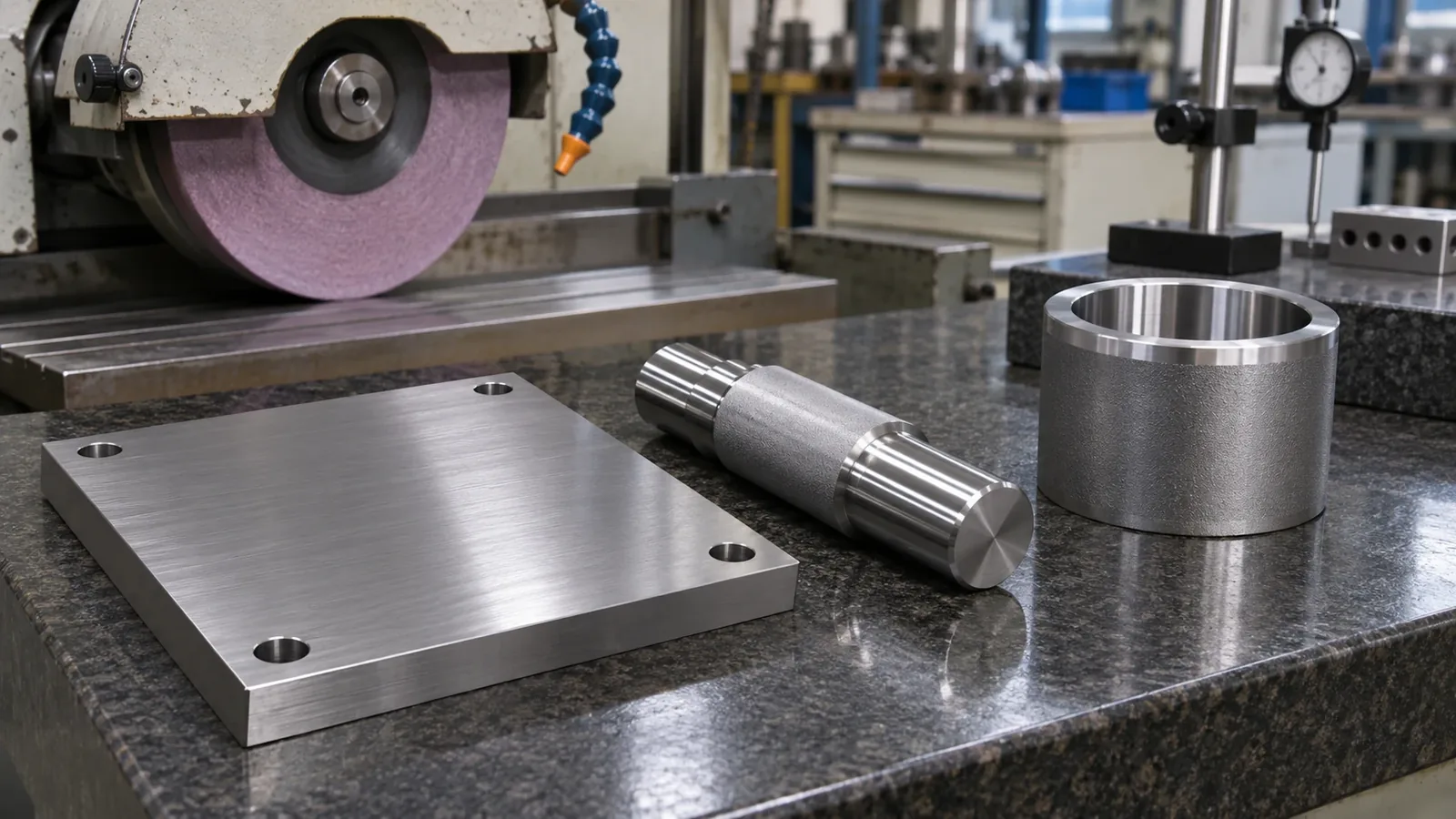
Types of grinding can be classified by the feature being processed, the way the workpiece is supported or the abrasive medium used. Surface grinding concerns a flat or defined surface; external cylindrical grinding concerns an outside cylindrical feature; internal grinding concerns an inside feature. Centerless describes a support arrangement for cylindrical work rather than the opposite of cylindrical grinding, while belt grinding names an abrasive medium that can serve different surfaces. These labels do not guarantee a tolerance, roughness or finished-part result. When reviewing a process proposal, identify the surface, support, operation and acceptance requirement separately.
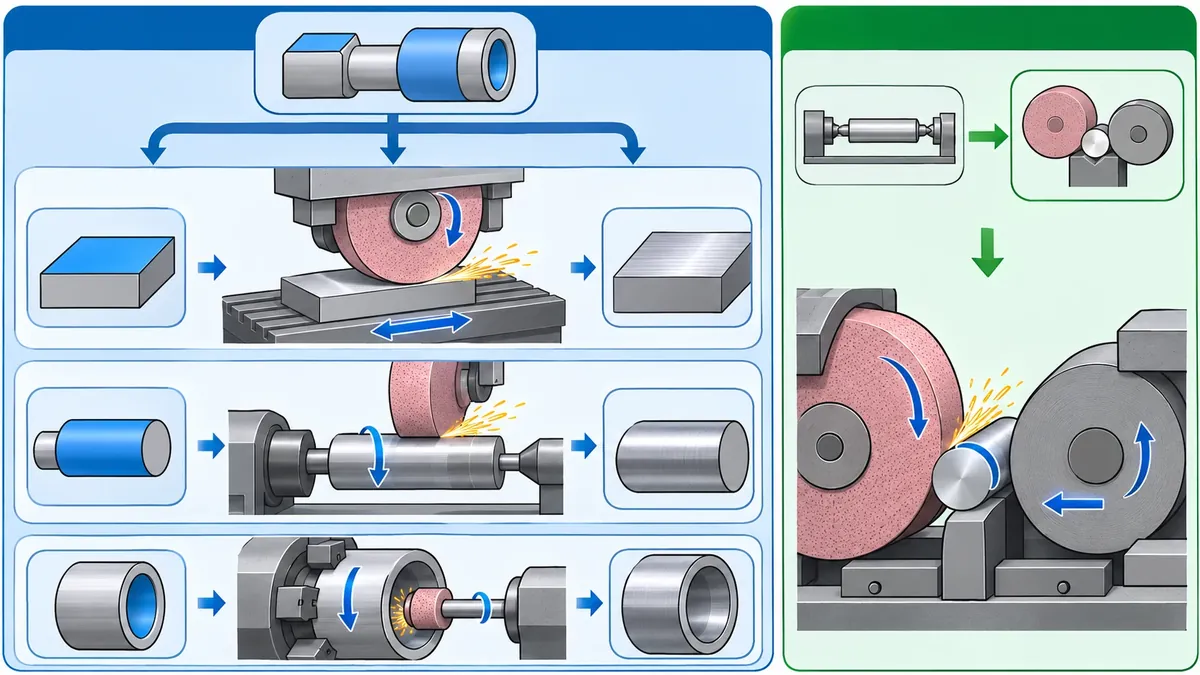
Types of grinding by the workpiece feature
Grinding names often describe what part of the workpiece is processed. Surface grinding generally refers to producing or correcting a flat or defined surface. External cylindrical grinding works on an outside cylindrical surface. Internal grinding addresses an inside cylindrical surface or bore. These terms describe broad process categories, not complete instructions or guaranteed outcomes.
Machine-maker classifications such as the ANTs Machine grinder overview group surface, cylindrical, internal and centerless grinders by application and workpiece geometry. A separate precision-component maker’s process overview also uses flat, inside, outside and centerless categories. These sources support a terminology map only. They do not establish that every machine in a category provides a particular tolerance, finish or capability.
| Process label | Feature or operation emphasis | Questions for a buyer |
|---|---|---|
| Surface grinding | A flat or defined surface | Which face is processed, how is it located, and what drawing requirement applies? |
| External cylindrical grinding | An outside cylindrical feature | What diameter or surface is controlled, and how is the part supported? |
| Internal grinding | An inside cylindrical feature or bore | What internal surface is accessible, and what method verifies it? |
| Centerless grinding | Workpiece support arrangement often used for cylindrical work | How is the workpiece located and controlled without centers? |
| Belt grinding | Abrasive medium or tooling format | Which part surface is contacted and for what purpose? |
| Tool, profile or gear grinding | Application or feature family | What exact feature and supplier process are intended? |
The categories are not a single mutually exclusive list. A cylindrical workpiece may be processed using a centerless arrangement. Belt grinding can be used on different geometries. A process name that describes the abrasive medium does not necessarily identify the surface geometry. When a supplier says “grinding,” ask for a short explanation of the actual feature and operation.
A part can also receive grinding for different reasons. A supplier may remove stock from a precision feature, improve a mating surface, blend a weld, remove a burr or prepare an appearance surface. Those objectives are not interchangeable. “Ground” alone does not say which dimensions or appearance are controlled.
Is centerless the opposite of cylindrical grinding?
No. Cylindrical describes the workpiece feature or process family; centerless describes how the cylindrical workpiece is supported and controlled. These labels can refer to different classification axes and may occur together.
Centerless describes support, not a finished-shape category
In centerless grinding, the part is supported and controlled by elements such as a grinding wheel, regulating wheel and work-rest blade rather than being held between centers in the conventional arrangement. The exact machine setup and suitable workpiece depend on the processor and application. The important buyer distinction is conceptual: “centerless” is about a workpiece-support arrangement, not a separate shape class that excludes cylindrical grinding.
A buyer should not infer a specific result from the word centerless. It does not automatically guarantee concentricity, roundness, diameter tolerance, surface finish or production rate. Those depend on the component geometry, material, process setup, machine capability, control plan and measurement method. No universal numeric result can be stated from the process name alone.
For a purchased pin or sleeve, a supplier may propose a centerless route for an outside cylindrical surface. The buyer still needs to identify the actual dimension or surface that matters, the part drawing, required acceptance criteria and the evidence returned with the order. If a part has a functional mating diameter, specify the controlling feature and inspection basis. Do not assume that a process label replaces a dimensional requirement.
Support and locating also matter for product geometry. A thin, short, flexible, interrupted or otherwise unusual workpiece may require a different method or specialist review. This is not a universal limitation or capability claim; it is a reason to ask the processor how the actual component will be held and controlled. The supplier should review the drawing and state whether the proposed operation is feasible for the part as specified.
Why does support matter in a process quotation?
The support arrangement affects how a workpiece is located during the operation. A buyer should understand the proposed arrangement when it relates to the target feature or acceptance plan, but should leave machine setup and process parameters to the qualified processor.
Belt grinding identifies the abrasive medium
Belt grinding refers to the use of an abrasive belt. It can be used across different surfaces and part shapes, depending on the tool, contact arrangement and process. The term therefore identifies the abrasive medium more than a single finished geometry.
This classification differs from surface, external cylindrical and internal grinding, which emphasize the workpiece feature. The terms can overlap in practical descriptions: a supplier might use a belt on a surface, while another operation uses a wheel on a cylindrical or internal feature. The buyer should ask which surface is processed and which abrasive medium or machine route is proposed only to the level needed to compare the offer and control the result.
Abrasive choice, grit sequence, wheel or belt specification, speed, pressure, dressing and safety procedures are process-specific topics. They require the responsible processor’s current instructions, equipment data and material context. This article does not prescribe a grinding recipe or abrasive selection rule.
A process note should also distinguish cosmetic finishing from dimension control. A belt operation may remove visible marks, blend an edge or prepare a surface. It should not be treated automatically as a precision dimensioning operation. If a feature’s size, flatness or geometry is critical, state the requirement on the controlled drawing and define how it will be checked. The processor can then confirm whether the proposed method and equipment are suitable.
| Description in a quote | What it identifies | What remains open |
|---|---|---|
| Surface grinding | A surface-oriented process category | Exact face, support, stock allowance and acceptance criterion |
| Cylindrical grinding | Work on an outside cylindrical feature | Location method, target dimension and verification basis |
| Internal grinding | Work on an inside surface | Access, feature definition and inspection method |
| Centerless | A support and locating arrangement | Whether the part and required feature are appropriate for the route |
| Belt grinding | Abrasive medium | Contact geometry, objective, finish reference and dimensional effect |
| Weld blending | A finishing objective or operation description | Allowed stock removal, remaining wall and visual acceptance |
This table is a language map, not a process specification. If a quote uses several terms at once, ask the supplier to map them to the specific drawing features.
Separate cosmetic blending from precision requirements
A ground or blended weld may be part of a cosmetic finish plan. That goal differs from grinding a precision diameter, flat surface or internal feature. A cosmetic operation may focus on a visible transition; a dimensional operation controls a defined geometry. The word “grinding” does not communicate which of these applies.
For a visible metal hardware joint, the buyer should identify the cosmetic face, approved appearance reference, allowable visible transition and any design limits on stock removal. A supplier can explain the proposed manufacturing route, but a drawing or sample must define the buyer’s acceptance target. If removing material could affect wall thickness, fit or strength, the design authority should review the operation.
For a functional cylindrical feature, identify the datum, dimension, location and acceptance requirement. For a flat mounting face, state which face and relationship matter. If the intent is only to remove a sharp burr, say so without implying a precision surface. Clear wording helps prevent a decorative finishing operation from being mistaken for a controlled geometric process.
Surface finish terminology also needs context. A ground appearance is not a universal roughness value or a complete appearance description. If the final surface must match a standard or sample, name that reference. If a measured surface parameter matters, specify the method and acceptance basis with the technical owner. Do not copy a value from a machine-maker article and treat it as a product requirement.
Does a ground weld prove flatness or diameter acceptance?
No. Grinding a weld or surface does not, by itself, demonstrate a finished dimension or tolerance. The drawing and inspection method define what must be accepted and how it is verified.
How to read a grinding process proposal
When a quote or supplier discussion mentions grinding, ask for the operation to be described in terms a buyer can compare:
- Which part feature or surface will be processed?
- Is the objective cosmetic blending, material removal, surface preparation or a controlled dimension?
- How is the workpiece supported and located?
- Which supplier or sub-supplier performs the operation?
- What drawing revision and sample describe the expected product?
- Which dimensions or appearances are acceptance requirements?
- What method and record verify those requirements?
- Which process details are assumptions rather than confirmed commitments?
- Does the proposed operation affect fit, wall thickness, assembly or a visible face?
- Who can approve a process change or deviation?
The buyer does not need to specify every machine parameter. A useful RFQ names the result and feature that matter, then asks the supplier to confirm a feasible route. The processor should own the production method and any necessary setup detail. The buyer’s technical authority should approve changes that affect product design, fit or acceptance.
If two quotations use different process names, compare the actual scope rather than ranking the labels. One supplier may call an operation belt grinding and another may describe it as a finishing step. Ask whether both address the same feature and buyer requirement. If one quote includes cosmetic blending while another includes a controlled diameter operation, they are not quoting the same scope even if each uses the word grinding.
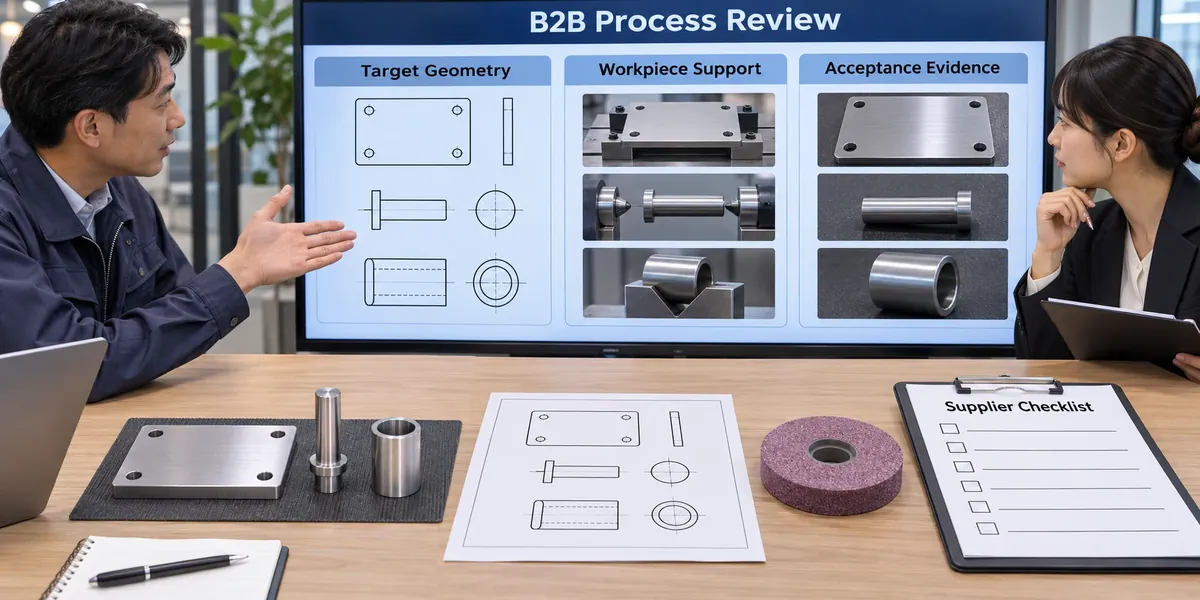
Ask the processor to mark the target feature on a drawing or sample photograph when the terminology is not clear. A simple visual reference can show whether the quote addresses an external surface, an internal feature, a flat face or a cosmetic joint. The record should still refer to the controlled drawing and revision so the illustration does not become a separate, uncontrolled specification.
For repeat orders, record the approved drawing, supplier process description, sample stage and inspection evidence. If the supplier changes the abrasive process or support method, determine whether the change affects the product’s fit, finish or acceptance. A change in production method does not automatically require redesign, but it should be reviewed against the requirement that the process serves.
Common misunderstandings about grinding types
Treating centerless as the opposite of cylindrical. Centerless describes support, while cylindrical describes the surface or feature family. They can overlap.
Treating belt grinding as a surface geometry. Belt identifies the abrasive medium. The part surface and operation objective remain separate.
Assuming one process name guarantees a tolerance. A name does not specify the numeric acceptance requirement or verification method.
Using cosmetic weld grinding as evidence of precision machining. Weld blending and dimensional grinding serve different purposes. State the actual acceptance target.
Assuming every listed grinder type belongs to one mutually exclusive taxonomy. Some labels describe surface geometry; others describe support, abrasive medium or application.
Assuming a supplier’s machine list proves a particular job capability. A capability statement must be tied to the actual part, route and required evidence. Do not transfer another manufacturer’s equipment claims to Koitor.
Writing “grind smooth” without a reference. Smooth can be subjective. Identify the appearance or measured feature and the approved sample or specification.
Copying a process parameter from a general article. Parameters depend on the processor, material, equipment and job. Use the qualified supplier’s instructions and approved plan.
Map a component feature to the supplier’s process description
An importer can make a proposal easier to review by mapping each process label to the feature it addresses. A flat mounting face, a round pin, an internal sleeve and a visible weld are not the same inspection problem. The table below shows questions to ask; it does not prescribe which process a supplier must use.
| Part feature in a metal-hardware assembly | Process term a supplier might mention | Buyer clarification |
|---|---|---|
| Flat mounting face | Surface grinding or another surface-finishing operation | Is flatness, appearance or another requirement being controlled? Which face and datum apply? |
| Outside diameter on a pin | External cylindrical grinding, possibly a centerless support route | Which diameter and length are relevant, and what acceptance evidence is required? |
| Inside surface of a sleeve | Internal grinding or another internal finishing route | How is the feature accessed and how will it be inspected? |
| Visible welded joint | Grinding or blending for appearance | What appearance sample and material-removal limits have been approved? |
| Long surface finished with an abrasive belt | Belt grinding | Which geometry is contacted and is the target cosmetic or dimensional? |
The supplier should explain whether the named operation is planned for the actual part, a subcomponent or only a sample. If the quote describes a process but does not state which feature it addresses, ask for a clarification drawing or written scope note. That keeps a process list from being mistaken for an acceptance plan.
Compare the proposal against the drawing and sample. If the intended result is cosmetic, establish the relevant visible face and reference. If it is dimensional, identify the feature, datum, tolerance from the controlled design and inspection record. If the buyer’s requirement has not been selected, leave the issue open and ask the responsible designer to resolve it before production. Do not infer an acceptance value from a grinding process name or from a generic machine overview.
Buyer checklist for a grinding-related quote
Before approving a grinding operation or process note, confirm:
- The exact drawing feature and revision.
- Whether the target is a flat, outside cylindrical, inside or another surface.
- Whether the term describes the workpiece support, abrasive medium or process objective.
- Whether the purpose is cosmetic, dimensional, deburring or surface preparation.
- The supplier responsible for the operation.
- Any interface or thickness that could be affected.
- The approved appearance reference or dimension.
- The inspection method and acceptance record required.
- Whether a sample represents the production process.
- How the supplier will notify the buyer of process changes.
- Who can approve deviations or revised process assumptions.
- Which details remain process-owner responsibility rather than buyer instructions.
This checklist does not prescribe machinery, abrasive selection, wheel or belt parameters, safety procedures or tolerances. It is designed to make a quote understandable and expose the difference between the surface being made, the support arrangement and the abrasive medium.
Keep the approved process description with the drawing revision, sample stage and inspection record. If a processor later changes the operation, support arrangement, sub-supplier or finishing objective, compare the change with the same controlled feature and acceptance requirement. The change may be harmless for one cosmetic surface and important for another functional interface; the buyer should ask the technical owner to assess the actual part. Updating the record helps the next order reproduce the approved scope without implying that the process name alone guarantees a result.
What Koitor can review in a hardware project
Koitor is a family-owned custom metal bathroom and home-storage hardware factory supporting customization from buyer drawings or physical samples and relevant forming, joining, finishing, assembly and packaging work. These approved facts do not establish ownership of precision surface, cylindrical, internal or centerless grinding equipment, gear production or a specialist grinding service.
If a custom metal hardware design includes a ground surface or bought-in ground component, Koitor can review the drawing and manufacturing scope within its verified capabilities and identify questions for the responsible processor. Provide the feature, intended purpose, controlled drawing and any approved sample or acceptance requirement. The qualified grinding supplier must confirm its actual process and evidence; the buyer’s technical authority must approve the product requirement.
A useful discussion also separates external supplier scope from the final assembly. If a ground component comes from a sub-supplier, identify who controls its dimensions, how it is inspected and how it is tied to the assembly revision. That clarification helps avoid assuming that a general process label is a material or performance guarantee.
Foire aux questions
What are common types of grinding?
Commonly used process labels include surface, external cylindrical, internal and centerless grinding. Belt grinding describes an abrasive medium, and tool or profile grinding can describe particular applications. The labels address different axes.
Is centerless grinding a type of cylindrical grinding?
It can be used for cylindrical work. “Centerless” describes the support arrangement, while “cylindrical” describes the workpiece surface or process family.
Does belt grinding identify the finished shape?
No. It identifies an abrasive medium. The workpiece geometry and surface being processed must be described separately.
Does grinding always improve dimensional accuracy?
No. A process label alone does not prove a dimensional result. The required feature, process capability, measurement method and acceptance criteria need to be specified and verified.
Is grinding a weld the same as cylindrical grinding?
No. Weld blending is a finishing objective for a joint or visible surface; cylindrical grinding concerns an outside cylindrical feature. The target geometry and acceptance requirement differ.
Collaborez avec Koitor Hardware
If a bathroom or home-storage hardware drawing includes a ground surface or supplier process note, share the current drawing or sample and the feature that must be controlled. Koitor can review the metal hardware scope within its stated capabilities. Confirm specialist grinding equipment, process conditions and acceptance evidence with the responsible processor and technical authority.
Clarify a Metal Hardware Process Requirement
Send the controlled drawing or sample, the surface or feature in question and the acceptance requirement. Koitor can review the manufacturing scope and identify questions for the process supplier.
Fabrication pour compte de tiers / Marque de distributeur
Transformez ce guide d'approvisionnement en cahier des charges
Indiquez-nous le produit souhaité, ses dimensions, sa finition, la quantité commandée et vos exigences en matière d'emballage. Votre équipe recevra une analyse pratique de la faisabilité de la fabrication avant l'établissement du devis.

 English
 Español
 Português
 Français
 Deutsch
 العربية