

The types of handles are best compared by what the user grips, whether the handle moves, how it mounts, and whether it operates a mechanism. A fixed pull or bridge handle stays in place; a folding handle changes position; a recessed or flush pull sits within a panel profile; and a lever or crank can operate a latch or other mechanism. These forms are not interchangeable just because each is called a handle. Buyers should match the form to the product’s movement, panel, hand clearance, attachment, and intended use.
For importers sourcing bathroom or home-storage hardware, a handle may be a product feature, an access point, a cabinet component, or a part of an assembly. The name is only a starting point. The drawing and approved sample should show the grip, mounting interface, movement, clearance, and any connected mechanism. Do not infer a load rating, security level, accessibility outcome, or carrying function from the handle type alone.
Types of handles: form, movement, and function
Product catalogs may use names inconsistently. One supplier may call a part a pull, another a handle, and a third a grip. A more reliable comparison identifies what physically happens:
| Attribute | Questions to ask | Examples of possible answers |
|---|---|---|
| Gripping form | What does the hand contact? | Knob, bar, loop, bridge, recessed pocket, lever |
| Movement | Does the handle move relative to the panel? | Fixed, folding, retracting, rotating, spring-returning |
| Mounting | How does it attach? | Through-fastened, surface-fixed, recessed, integrated, concealed |
| Function | What does it operate or allow? | Pulling a drawer, opening a lid, turning a mechanism, gripping a component |
| Interface | What must the surrounding panel or assembly provide? | Hole pattern, recess, thickness, clearance, reinforcement, mating linkage |
These are separate dimensions. A recessed pull can be fixed or incorporate moving parts. A lever can be surface-mounted or built into a larger mechanism. A bridge handle can attach through two points but is not automatically suitable for carrying the whole product. The buyer should identify the exact configuration rather than treating a catalog name as a full specification.
Fixed pulls and bridge handles
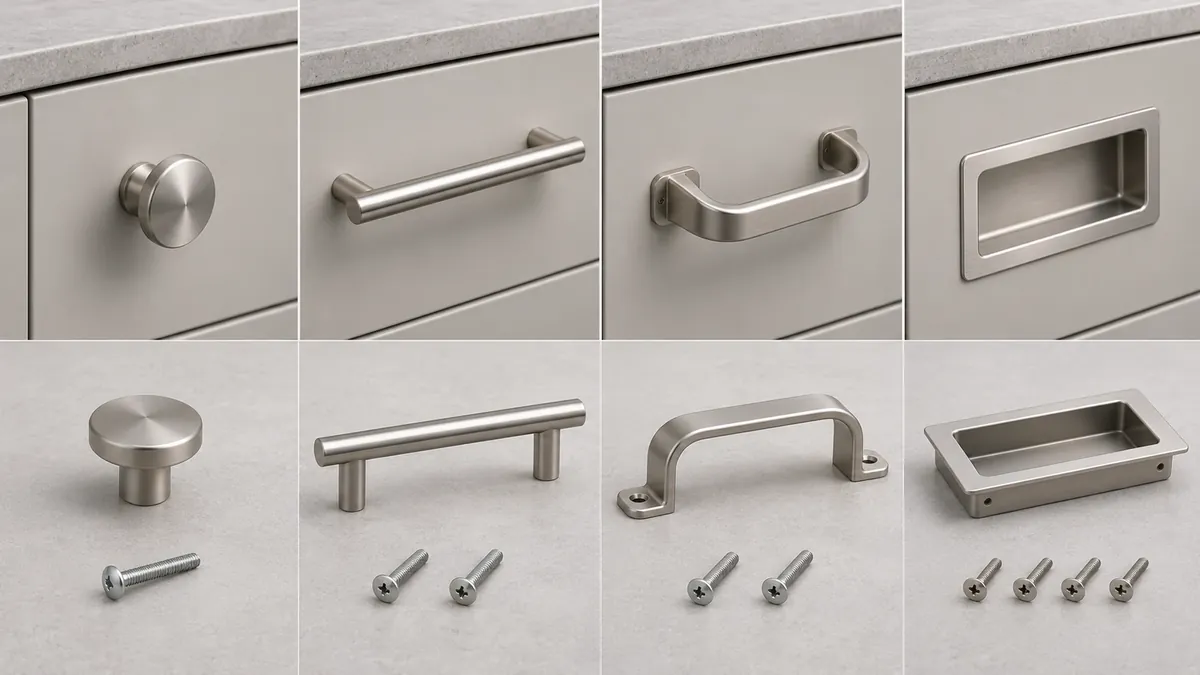
A fixed pull provides a stationary gripping point attached to a panel, door, drawer, basket, or other component. Bridge or bar forms commonly project from the mounting surface and leave space for fingers behind the grip. A loop may provide a different grasp geometry. These names describe broad shapes and do not specify dimensions, attachment strength, clearance, or safe working load.
For a custom metal storage product, the buyer should show the handle’s location, projection, orientation, and fixing pattern. Confirm whether fasteners are included, which side is accessible during assembly, and whether there is enough tool access. If the handle is attached to wire or thin sheet, the connection and local reinforcement may need review. A larger grip does not automatically make the attachment stronger, and more screws do not guarantee better performance.
The user’s hand clearance should be assessed on the actual assembly. A bar may look accessible in a rendered image but be blocked by an adjacent wall, rail, door, or stored item. A prototype or sample can reveal interference. Define the intended operation and the reference dimensions to check rather than writing a vague requirement such as “easy to use.”
Folding and movable handles
A folding handle changes position when it is not being used. The movement can reduce projection or allow a component to sit closer to another surface, but the actual benefits depend on the design. Buyers should review the pivot, stop position, clearance, retention feature, fasteners, and operating sequence on the exact product.
Do not assume that a folding grip is intended to carry a loaded product. It could be designed only to open a panel or operate a lid. Carrying capability must come from the product maker’s instructions and any evidence applicable to the exact configuration. A handle’s presence, apparent thickness, or smooth movement is not a load test.
If the handle can fold toward a panel, check for pinch points, interference with adjacent parts, and whether the movement is controlled. These are questions for the product’s design and safety owner; this guide does not certify safe clearances. If the intended users or setting create accessibility or safety requirements, use the relevant professional and applicable requirements for the specific product.
For production, state the required movement and its acceptance criteria. A buyer might specify the range of motion, resting orientation, or an agreed sample feel, but the criteria need to be appropriate to the product. If retention or life-cycle performance matters, define the required verification method with a qualified engineer. Do not invent a universal cycle count or torque value.
Recessed and flush pulls
A recessed or flush pull places the gripping area within a panel or its surface profile. This may reduce projection, but it introduces a cut-out, pocket, or formed feature that must be coordinated with the panel thickness, edge distance, surrounding parts, finish, and assembly access.
The drawing should identify the recess dimensions, depth, edge radii, mounting method, panel material and thickness, and visible face. A sample can confirm that the grip is accessible and that the part sits as intended. A flush appearance does not prove that a component is snag-free, accessible to every user, weatherproof, or suitable for a given load.
Recessed designs can also complicate manufacturing and finishing. The part may require a cut-out, formed pocket, separate purchased component, or additional assembly step. Whether a coating or finish reaches a recess consistently depends on the process and geometry. Buyers should ask the supplier to review the exact design and identify any inaccessible regions or production constraints before approving the sample.
Knobs, levers, and operating handles
A knob gives a localized grip, while a lever can provide a longer point of contact and may operate a latch or mechanism. A crank or operating handle can be designed to turn or move another component. These terms describe shapes or actions, not a universal level of force, ease, or safety.
For an operating handle, specify what it moves, the direction and travel, the mechanism it connects to, the permitted clearance, and the relevant user interaction. A supplier should not be expected to infer a mechanism’s load or torque from a photo. The product engineer should define the interface and performance requirement, and the buyer should identify what evidence is required.
If the handle is decorative and non-operating, make that clear. If it is used to open a door, drawer, lid, or panel, show the mating hardware and the assembled condition. A handle’s nominal type does not explain whether it includes a latch, spindle, lock, linkage, or reinforcement. These components should be listed separately in the BOM and quotation.
Match handle choice to panel and assembly
Check the mounting surface
Identify the substrate, thickness, curvature, visible face, and edge condition where the handle attaches. A mounting method suitable for a thick wood panel may not apply to thin sheet, a tube, a glass panel, or a wire assembly. If a part is mounted through glass or another specialized substrate, use the component manufacturer’s exact installation guidance and do not generalize from a standard metal panel.
Confirm hole pattern and access
Provide center-to-center spacing, hole diameter, orientation, tolerances, and fastener information on the drawing. Confirm that tools can reach the fixing points during assembly and service. A handle may fit its own holes but still conflict with a frame, rail, or internal component.
Review projection and clearance
Show the handle with nearby doors, shelves, walls, or stored items. Consider the product’s intended installation orientation and expected user approach. A product photograph that shows an isolated handle may hide the important clearance problem.
Define finish and cosmetic faces
Identify the visible surfaces and finish expectations. For plated, coated, polished, or brushed appearance, use the approved sample or relevant project criteria. A handle name does not define surface quality, corrosion resistance, or color consistency. Treat those as separate requirements with suitable evidence.
Agree what the sample proves
Use sample approval to confirm fit, hand clearance, movement, appearance, and assembly sequence as relevant. Record which points were actually checked. Sample approval does not automatically establish structural performance, safety, long-term durability, or suitability for every installation.
Compare alternatives using the same product brief
When a product team is choosing between a fixed pull and a recessed pull, compare them against the same panel and use conditions. A fixed pull may project from the surface and require two mounting points; a recessed pull may require a pocket or cut-out and can change tooling or assembly. One is not automatically the lower-cost or better-performing solution. The result depends on the actual design, material, finish, quantity, and packaging.
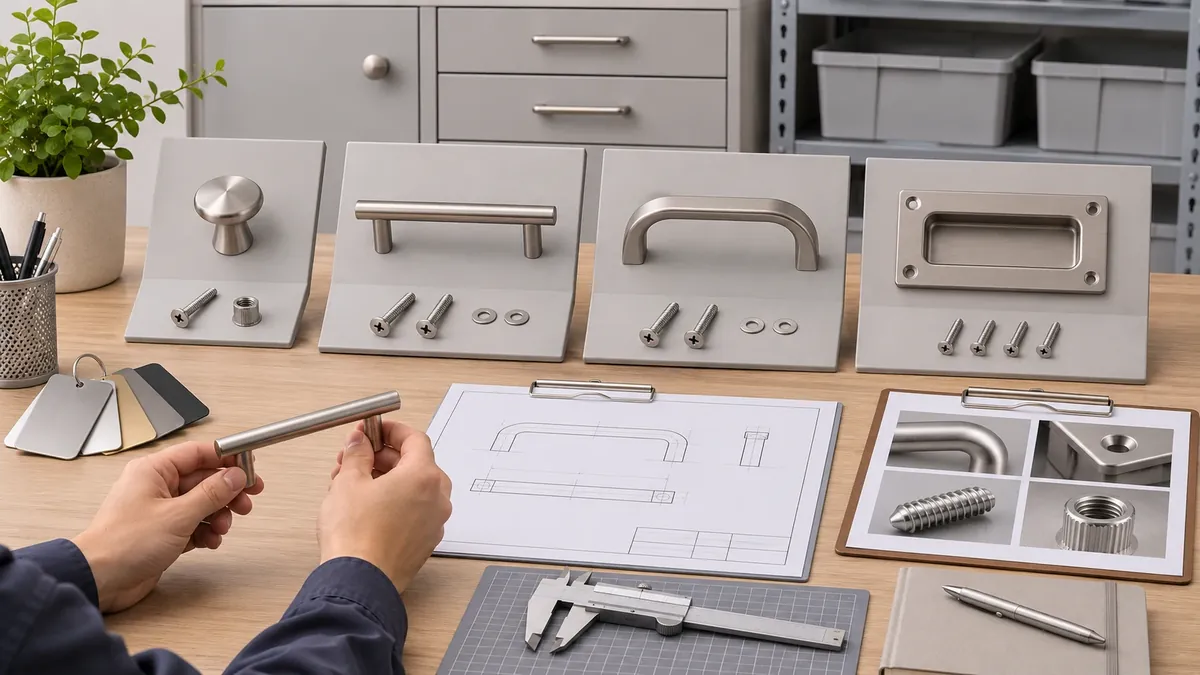
A useful comparison sheet should record the handle outline, projection, grip opening, mounting pattern, fastener access, panel thickness, adjacent clearances, visible faces, and assembly steps. Add the proposed material and finish as separate fields. If one option includes a different mechanism or purchased component, identify it rather than comparing only the exterior appearance.
For a folding alternative, add movement limits, pivot location, rest position, interference zones, and any retention feature. Ask the supplier to identify what is included in the quotation and what must be supplied by the buyer. For a lever or crank, include the mating mechanism and expected movement so the supplier is not asked to estimate an unknown operating load from a standalone component.
If a prototype is used for a review, plan the physical checks in advance. A sample may demonstrate whether a hand can reach the grip, whether the part clashes with a nearby surface, and whether the assembly sequence is workable. It will not necessarily confirm durability or performance. Those require defined criteria and a suitable method selected by the responsible technical owner.
The product team should also consider service and replacement. Can the handle be removed without damaging the visible face? Are replacement fasteners available? Does a moving handle require inspection or maintenance under the product instructions? These questions can affect the total product experience, but they must be answered from the actual design and supplier documentation rather than from a generic category name.
Consider packaging and transport context
Projecting handles can influence how products nest, stack, or fit into a carton. Recessed or folding forms may change pack density or the need for protective inserts. These are possible design considerations, not universal outcomes. Review the actual package configuration, including how a handle might contact another product during transit. A sample packed as intended can reveal interference or cosmetic contact points before bulk release.
If the handle is shipped separately for final assembly, identify the included hardware, bagging, labeling, and instructions. Make sure the buyer’s installation document describes the actual supplied parts. If the handle is preassembled, confirm that packaging protects both the grip and the product’s cosmetic faces. The packaging owner should approve the final pack-out and any required testing; handle type alone does not establish transit protection.
Keep the approved reference clear
Once a design is selected, archive the controlled drawing, sample photographs, BOM line, finish reference, and approved fastener details. State whether the approved sample is a visual reference, fit reference, movement reference, or all of those within a defined scope. This matters when several products share a catalog name but use different center spacing or panel thickness.
For a repeat order, compare the supplier’s proposed component to the approved revision before production. A change in a handle’s projection, fixing, material, finish, or pivot may affect fit and pack-out. Route it to the product owner for approval instead of treating it as a cosmetic adjustment. The change record should state why it was proposed and what the buyer checked.
Organize handle information in the RFQ
A useful RFQ does not need to solve every engineering decision before it is sent. It should show what is known and identify what is still open. Provide the overall product drawing, the detail or reference photo of the handle, its location, the mounting surface, intended movement, product quantity, finish, and packaging plan. Mark dimensions as confirmed, target, or for supplier review so that a preliminary sketch is not mistaken for an approved production drawing.
If the buyer is open to several handle types, ask the supplier to quote clearly separated options. Each option should identify the part, material or finish assumption, mounting hardware, and any design change required. Avoid combining a fixed-pull price and a folding-handle price in one line without explaining the different scope. A fair comparison needs the same quantity and packaging assumptions, plus an explicit note of which option still needs engineering approval.
The supplier’s manufacturability feedback can identify questions such as tooling access, weld or fastener location, finish coverage, and assembly sequence. Treat those comments as inputs to design review, not as automatic acceptance of the handle’s user performance. The buyer’s product owner remains responsible for intended use, installation, and any safety or accessibility criteria. Once the decision is made, update the drawing and purchase specification before requesting a production quotation.
If the handle is supplied by a separate vendor, include that vendor’s part number and drawing revision in the product record rather than using only a generic name. This makes future substitutions and service questions easier to trace.
This keeps quotation, sampling, and production aligned to one approved interface.
Common handle selection mistakes
Choosing by catalog name alone
The same term may cover different shapes or mounting details. Request a drawing and identify the actual interface.
Assuming a folding handle is a carrying handle
Folding describes movement, not intended load or use. Confirm the manufacturer’s documented function for the exact product.
Treating recessed as automatically safer or more accessible
Reduced projection alone does not establish safety, accessibility, or ease of operation. Those outcomes depend on the full product, location, user, and applicable requirements.
Ignoring the panel and surrounding assembly
A handle may be suitable by itself yet conflict with panel thickness, internal structure, adjacent components, or tools. Review it in context.
Treating appearance as proof of construction
A polished or plated finish does not reveal the underlying material or attachment method. Specify the substrate and visible finish separately.
Omitting intended movement
If a handle pivots, folds, rotates, or operates a mechanism, document that behavior. A still image cannot specify the movement or limits.
Treating a sample review as a performance certificate
A buyer may approve a sample because its dimensions, finish, interface, and movement match the drawing. That approval is meaningful only within its recorded scope. It does not automatically establish load capacity, life-cycle performance, corrosion resistance, accessibility, or installation suitability. If one of those outcomes is required, define the relevant evidence with the responsible technical owner and keep it separate from visual sample acceptance.
Forgetting the packaging presentation
The handle can be correct while the retail kit remains confusing. Check whether the package displays the handle and the included hardware accurately, whether small parts are secured, and whether the assembly instructions correspond to the supplied model. If the handle can move or project, review how it is protected from contact during transport. These are package checks, not proof of a handle’s in-use rating.
Losing the approved reference on a repeat order
For a repeat order, preserve the approved model, supplier part number, finish sample, fixing pattern, and product revision. Compare a new quotation with that baseline before accepting a substitute. If the vendor has discontinued the part, require the new part drawing and route the change through design approval. A similar catalog name does not establish dimensional or functional equivalence.
Buyer checklist for a handle specification
- What does the handle grip, open, move, or operate?
- Is it fixed, folding, recessed, rotating, or another configuration?
- What panel or product structure does it attach to?
- What are the mounting pattern, fasteners, access, and assembly sequence?
- What hand clearance and surrounding envelope are required?
- Which faces are visible and what finish is approved?
- Is the handle decorative, operational, or intended for another documented use?
- Does any load, safety, accessibility, or cycle-life requirement need specialist definition?
- Which sample or drawing revision represents the approved configuration?
- What evidence will verify fit, movement, appearance, and any defined performance requirement?
This checklist helps an importer prepare an RFQ and evaluate a sample. It does not establish a handle’s rated load or certify its suitability. Have the responsible designer or product safety specialist define and verify any performance-critical requirement.
Foire aux questions
What are the main types of handles?
Common forms include knobs, fixed pulls or bridge handles, loops, folding handles, recessed pulls, levers, and operating handles. Compare them by grip, movement, mounting, function, and interface.
Are a pull and a handle the same thing?
Usage varies across catalogs. A pull commonly describes a part used to pull a door or drawer, while handle can be a broader term. Drawings and intended function are more precise than the name alone.
Is a folding handle designed to carry a product?
Not necessarily. Folding describes how the handle moves. Use only the documented function and evidence for the exact product.
Does a recessed handle need different design information?
Often the panel cut-out, depth, thickness, edge clearance, mounting method, finish, and assembly access must be reviewed. The exact drawing controls.
Can the handle supplier confirm accessibility?
The supplier may provide product dimensions and instructions, but accessibility depends on the product, installation, users, and applicable requirements. The responsible project specialist must assess it.
Sources and scope
- Essentra Components: Ultimate Guide to Access Hardware — used for bounded handle-form and mounting terminology; no universal ergonomic, load, or impact claims are adopted.
- Southco: The Complete Guide to Handle Types — used only for terminology visible in the returned search content; direct full-page access was unavailable, so no detailed specifications are attributed to it.
This guide is a product taxonomy and RFQ aid, not an ergonomic or accessibility assessment, load rating, security certification, or handle design approval.
Collaborez avec Koitor Hardware
Share the handle interface with the full product brief
For a custom bathroom or home-storage product, provide the handle drawing or sample, intended function, mounting panel, hole pattern, movement, finish, quantity, and packaging requirements. Koitor Hardware is a family-owned custom metal hardware factory focused on bathroom and home-storage products. The handle’s actual performance and any bought-in component requirements should be confirmed for the specific project.
Review a Custom Product Interface
Send Koitor the product drawing or sample, handle location, mounting details, finish, target quantity, and packaging brief. The team can review confirmed manufacturability and sample-development details for a practical OEM discussion; any rated performance or accessibility decision requires the appropriate project evidence.
Fabrication pour compte de tiers / Marque de distributeur
Transformez ce guide d'approvisionnement en cahier des charges
Indiquez-nous le produit souhaité, ses dimensions, sa finition, la quantité commandée et vos exigences en matière d'emballage. Votre équipe recevra une analyse pratique de la faisabilité de la fabrication avant l'établissement du devis.


 English
 Español
 Português
 Français
 Deutsch
 العربية