
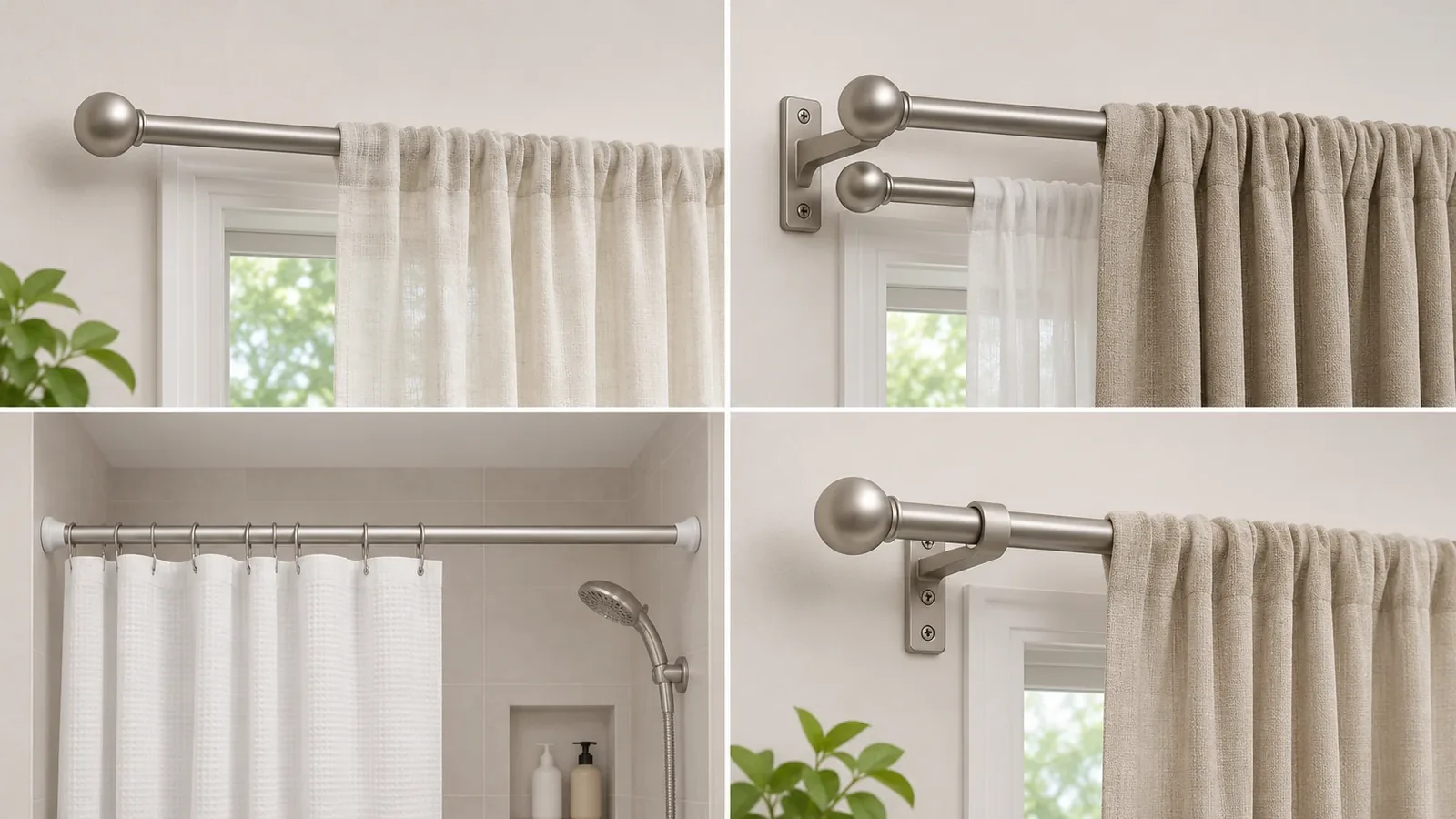
The types of curtain rods are easiest to compare by separating two questions: how many curtain layers the system supports and how the rod is supported. A single rod provides one hanging line; a double arrangement provides two lines for separate layers. A tension rod is named for its support mechanism, while bracket-supported rods use separate mounting hardware. These terms describe different attributes, so they are not one mutually exclusive list.
For a buyer sourcing a retail kit, verify the rod, brackets, rings, finials, mounting hardware, supported span, and instructions for the exact model. A lifestyle photo may show items that are not included. Suitability for a particular wall, window, curtain weight, or installation is model-specific and must follow the maker’s documentation. This guide is an adjacent home-hardware purchasing aid, not a claim that Koitor manufactures curtain rods or curtains.
Types of curtain rods: layering and support
Retail listings often use short labels such as single rod, double rod, or tension rod. These words can answer different questions. Single and double generally refer to the number of rod lines or curtain layers. Tension describes a way the rod is held in place. Brackets describe components used to support or mount a rod. A specific model may combine a layering arrangement with a particular support system.
| Term | What it mainly describes | Buyer verification |
|---|---|---|
| Single rod | One rod line for a curtain layer | Rod length, included supports, compatible header and curtain |
| Double rod | Two rod lines for separate layers | Which rod is for which layer and whether all supports are included |
| Tension rod | Support by a tension-based mechanism in a defined opening | Maker’s model-specific surfaces, span, fitting instructions, and use limits |
| Bracket-supported rod | Rod held by one or more mounting brackets | Bracket type, fasteners, installation substrate, and placement instructions |
This is a classification aid rather than a complete catalog of window-treatment systems. Tracks, specialty traverse systems, swing-arm products, door-mounted systems, and other designs may follow separate conventions. The exact manufacturer’s product documentation controls what a particular kit includes and how it is used.
Single curtain rods
A single rod provides one line from which a curtain can hang. The rod may use brackets, a tension mechanism, or another support design, depending on the product. The term “single” does not tell a buyer the support method, maximum span, material, finish, or whether mounting hardware comes in the package.
For an importer or retailer, the product listing should describe the actual rod length or adjustment range, included components, and the curtain connection the product supports. Curtains may use rings, tabs, grommets, pockets, or another header style. Confirm compatibility with the rod diameter and supplied accessories using the manufacturer’s product data rather than assuming all curtains fit all rods.
A single rod may be selected where the buyer intends one visible layer, but that choice depends on the product use and room design. Do not make broad claims that a single system is always simpler, lower cost, or suitable for every window. The kit configuration, opening dimensions, desired operation, and buyer’s product specification determine the comparison.
Double curtain rods
A double arrangement provides two rod lines so a buyer can hang separate curtain layers. A common configuration may use a decorative front layer and a different rear layer, but the exact intended combination is chosen by the buyer and product maker. The front and rear rods may differ in diameter, projection, support, or supplied hardware.
When reviewing a double kit, ask which rod is intended for each layer, how the brackets separate the lines, whether both rods are included, and whether rings or other connectors are supplied for each. The package should identify all components and the assembly sequence. A product photo that shows two curtains does not prove the kit contains every part visible in the image.
Double systems may create additional clearance questions. The buyer should review the window, trim, adjacent walls, blinds, handles, and the desired curtain movement against the product’s dimensions. Do not assume that a second rod automatically clears every window feature. The model’s projection and support geometry determine the actual arrangement.
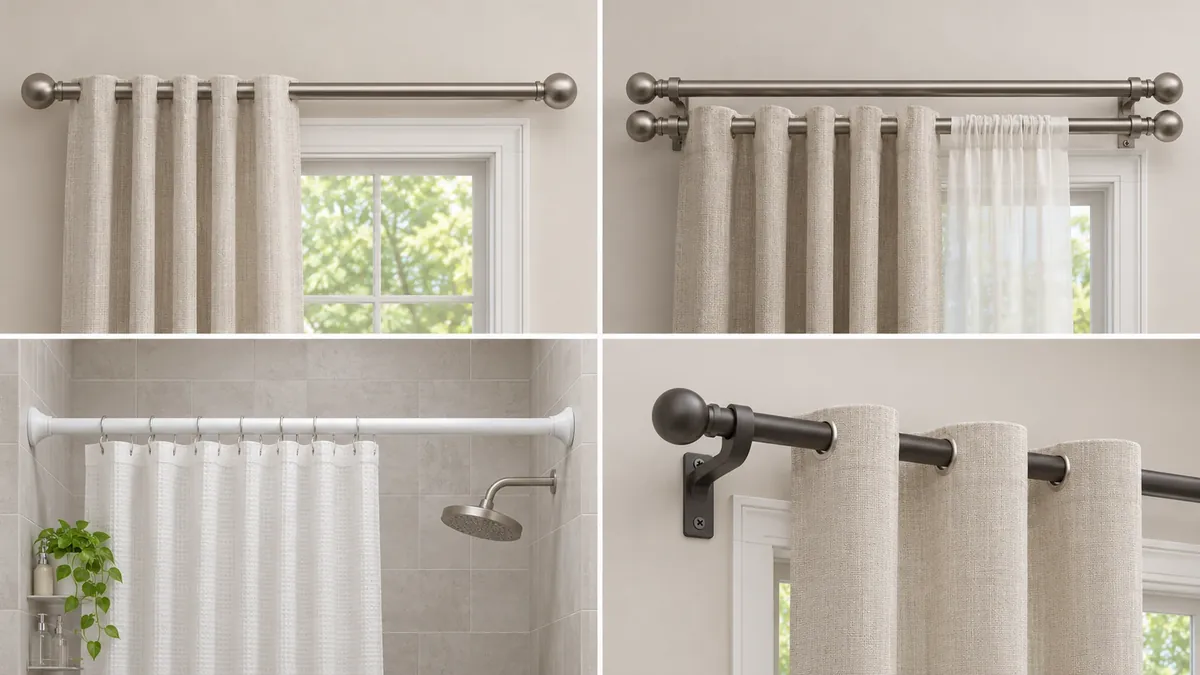
Tension rods
A tension rod is described by how it is supported, rather than by the number of curtain layers. The mechanism holds the rod in a suitable opening according to the manufacturer’s design and instructions. A listing may call a tension product a single rod because it has one hanging line; those descriptions are not contradictory.
Tension products are not universally “no damage,” “no drill,” or suitable for every surface. Performance and installation depend on the model, opening dimensions, contact surfaces, curtain, and instructions. Do not infer a supported load or long-term holding result from the name. A buyer should check the exact product documentation and avoid applying it outside the maker’s stated conditions.
For private-label sourcing, the buyer should request the relevant fit range, assembly information, included pads or end parts, and any stated use limits for the exact SKU. If a customer asks whether a tension rod will work on a specific tile, painted wall, or narrow opening, answer only from the manufacturer’s instructions or a verified evaluation of the actual conditions. Avoid generalizing from another model or a supplier’s lifestyle photograph.
Bracket-supported rods
Bracket-supported systems use brackets or other mounting components to carry the rod. The bracket type, number, location, and attachment method vary by product. A buyer should confirm which fasteners are included and what mounting surface or substrate the maker’s instructions address.
The buyer or installer must verify the actual wall or frame conditions. A product’s retail description does not prove that the supplied fasteners are suitable for every substrate. Surface type, concealed structure, installation environment, and local requirements can affect the choice. Do not recommend drilling into tile, glass, masonry, or another substrate based on a generic rod category.
If a kit offers extension or multiple span options, confirm how the rod sections connect and where supports should be placed according to the maker’s instructions. A joint between rod sections may influence appearance or operation, but the exact product design controls. The buyer should inspect the sample and packaging contents, and the installer should follow the published model instructions.
Rod, brackets, rings, and curtain connection
A complete curtain setup can include several distinct items: rod, brackets, finials or end caps, rings, clips, fasteners, and the curtain itself. Some retail kits include only selected components. A supplier photograph or a generic bundle title may not define the commercial scope.
For quotation and product data, list the parts separately. State rod material and finish where specified; bracket quantity and style; whether finials are included; connector type; fastener pack; instructions; and retail package. If the buyer supplies the curtain, describe the header style and the interface it needs. This prevents a product being advertised as a complete set when the curtain or installation hardware is not included.
Packaging should protect the rod’s finish and any projecting brackets. Review how long pieces are restrained, whether hardware bags are separated, and whether sharp edges or small pieces can contact the rod during transport. These are pack-out questions, not assumptions that one support type is safer or more durable than another.
How buyers can compare options fairly
Define the intended curtain layers
Decide whether the assortment needs one hanging line or two. State which curtain layers are in scope and whether they are sold with the rod or separately. This establishes whether single or double configuration is relevant.
Define the opening and mounting context
Provide the intended width, mounting location, adjacent trim, and known substrate information. If the buyer does not know the installation conditions, mark them as requiring site verification. The supplier should not be asked to guarantee fit based on an incomplete description.
Compare the same included package
For each candidate, list the rod, brackets, finials, rings, fasteners, instructions, and curtain included or excluded. Compare total cost only after the package scope is aligned. A less expensive item may omit parts that another quote includes.
Review operation and access
Confirm how the curtain is attached and moved. Check the maker’s stated design and any limitations. If the buyer needs frequent opening, layered operation, or a specialized movement path, make that a distinct evaluation criterion and test the actual sample.
Verify the specification and evidence
Ask for the current product drawing, item dimensions, material and finish information, assembly instructions, and stated support limits if relevant. Evidence must apply to the exact model and configuration. A general category label cannot confirm a performance property.
Use a product matrix for assortment planning
An importer considering several curtain rod SKUs can prevent naming confusion by tracking support method and layer count in separate fields. A simple matrix might list the model name, number of rod lines, support type, length range, included bracket count, connector type, compatible curtain header, finish, package contents, and current instruction revision. Keep each value tied to the maker’s documentation rather than copying a competitor’s listing.
For example, two products might both be described as single rods, but one uses wall-mounted brackets and the other uses a tension mechanism. They are not the same installation product. Conversely, a double rod may use brackets but still be classified by its two hanging lines. A catalog that stores only one “rod type” field may lose this distinction. Separate fields make product filters and customer-service answers more accurate.
Identify the buyer and installation owner
Retail product teams, distributors, and installers may need different information. A retail buyer wants to know what is in the pack and which curtain connection it supports. A store associate needs a clear description of size and installation requirements. An installer needs the exact model instructions and verified site conditions. The product listing should not imply that the manufacturer has assessed every possible wall or window.
If the buyer sells to multiple markets, confirm whether labels, instructions, or included fasteners vary by market or SKU. Do not assume one package or one instruction sheet applies everywhere. Changes should be reviewed by the brand owner and the product supplier before packaging artwork is released.
Compare total kit scope, not just rod price
Two offers may have different included components. One may include brackets and fasteners; another may sell them separately. One may provide decorative end pieces or rings while the other does not. Compare the complete pack-out, material and finish descriptions, instructions, carton protection, and quantity assumptions before evaluating the unit price.
If the rod is adjustable or assembled from multiple sections, clarify the parts and connection arrangement. Ask how the product’s stated size relates to the assembled dimension and which parts are required for the maximum or minimum configuration. Do not calculate compatibility from a photo or a rough headline claim. Use the manufacturer’s product data.
Align image, title, and package claims
The image, product title, description, packaging, and included-parts list should describe the same configuration. If photography shows a curtain, rings, or extra brackets not supplied, clearly identify them as illustrative or remove the ambiguity. If a pack contains two rods but not two curtains, the title and package contents should say so. This is a practical way to reduce returns and customer misunderstanding without promising universal fit.
Before approving final retail artwork, check that the SKU code, variant, color, rod count, support type, and included parts match the production sample. If a supplier changes a bracket, finial, or protective insert, assess whether the package content or product image must be updated. A visually similar component may still affect fit or customer expectations.
Sample and pack-out review
For a first product order, review a physical sample with the actual supplied components. Confirm the rod sections, connectors, brackets, end pieces, rings, fasteners, and instructions against the BOM. Assemble the kit according to the maker’s steps or have the intended product specialist review it. Record which parts were present and which functions were observed.
Then review the packaged sample. Check that long components are restrained, small fittings are separated, and the finish is protected from rubbing against other parts. Verify the pack count and item label. These are package and presentation checks; they do not establish the rod’s load performance or suitability for a customer’s specific wall.
If a packaging or product change occurs after approval, identify the affected requirements and repeat only the necessary checks. A new carton may affect protection and weight; a bracket change may affect installation; a different rod finish may affect appearance. Update the product file and customer-facing material where needed. Do not use a previous sample approval to cover a materially different configuration.
When photographing an assortment, match each image to the exact package contents. Show one product configuration at a time or label the alternatives clearly. If a photograph includes a curtain, decorative ends, or wall fasteners that are illustrative rather than supplied, say so. This prevents a customer from assuming that the product includes additional items or supports a different installation method.
On receipt of a sample shipment, check the model identifier against the request before evaluating appearance. Record missing parts separately from visible defects, and compare the instructions to the actual components. If a part is absent, ask the supplier whether it was excluded from the quotation or lost in packing. The distinction affects whether the product specification or the shipment needs correction.
For retail cartons, confirm that labels distinguish single and double configurations and any size variants. A shared package design can be economical, but the actual variant must remain clear to the buyer and warehouse. Review any barcode, language, and warning text under the relevant market and channel requirements; this article does not establish those obligations.
Keep special systems in their own category
Some window treatments use tracks, traverse mechanisms, swing-arm supports, or door-coupled products. These systems have different operation and mounting questions from a basic rod. A broad “curtain rod types” article should not reproduce their detailed architecture or installation decisions. If a buyer is evaluating one, use the exact system maker’s documentation and treat it as a separate project.
The buyer should also distinguish the curtain itself from the support hardware. A rod can be compatible with one header style and not another. The curtain’s weight, lining, width, and operation may matter to the model’s stated limitations, but the category term alone cannot settle that fit. Ask the supplier for the required measurements and verify the exact curtain and hardware combination before promising compatibility.

Common curtain rod selection mistakes
Treating “single,” “double,” and “tension” as competing types
Single and double generally describe rod lines or layers; tension describes support. A product can use more than one descriptor.
Assuming a tension rod works on every surface
Surface suitability and fit are model-specific. Check the instructions for the exact product and conditions.
Assuming every photographed component is included
The retail pack may not include a curtain, rings, fasteners, or decorative ends shown in marketing images. Read the BOM and package list.
Ignoring bracket projection and opening clearance
A rod can fit a width but still conflict with trim, blinds, handles, or an adjacent wall. Review the actual geometry and installation instructions.
Comparing rod material by appearance alone
Finish does not identify the substrate or coating system. Request the documented material and finish information for the exact SKU if it matters to the buyer.
Making universal load or damage-free claims
The system name alone does not establish load, safe use, or surface impact. Use only model-specific documentation and the buyer’s actual installation conditions.
Buyer checklist for a curtain rod kit
- Is the requirement one curtain layer or two?
- Does the product describe layering, support method, or both?
- What exact model and current instructions apply?
- What rod length or adjustment range is required?
- Which brackets, end parts, rings, fasteners, and instructions are included?
- What curtain header or connector must fit the rod?
- What opening, trim, substrate, and clearance conditions are known?
- Does the manufacturer state a limit relevant to the intended use?
- Has the physical sample and full pack-out been checked?
- Are product-page, package, and customer-service claims supported by the model documentation?
The checklist is for sourcing and assortment review. It is not an installation procedure, load test, or guarantee of compatibility. The actual manufacturer’s instructions and the conditions at the site govern.
For a product listing, keep the short title consistent with the detailed contents and instructions. If a model is sold without rings or curtains, say so plainly. Clear scope helps buyers compare offers and helps retailers answer questions without implying components or installation support that the package does not include.
Foire aux questions
What are the main types of curtain rods?
Common retail labels include single rods, double rods, tension rods, and bracket-supported rods. The labels mix layer count and support method, so compare those attributes separately.
Is a tension rod the same as a single rod?
Not exactly. Tension describes a support mechanism, while single describes one rod line or layer. A tension rod can also be a single-line system.
Does a double rod include two curtains?
Not necessarily. The package may include only the rod system or selected hardware. Confirm the exact contents in the product listing and BOM.
Can a tension rod be installed on any wall?
Do not assume so. Follow the model-specific instructions and verify the actual opening and contact surfaces.
Are all curtain rods compatible with every curtain?
No. Compatibility depends on rod dimensions, curtain header, rings or connectors, and the product configuration. Verify the actual item information.
Source and scope
- Umbra: Curtain Rod Basics and Types — used for bounded distinctions among single/double arrangements, tension support, and separate hardware components. Product-specific fit, load, and damage claims are excluded.
This article is a buyer-oriented classification guide, not a window-treatment design or installation recommendation, load rating, or claim that Koitor manufactures curtain rods or curtains.
Collaborez avec Koitor Hardware
Discuss confirmed product and packaging scope
If your assortment includes bathroom or home-storage metal accessories alongside curtain hardware, share the drawings or samples, product mix, finish, quantity, and packaging brief. Koitor Hardware is a family-owned custom metal hardware factory focused on bathroom and home-storage hardware. Curtain rods, curtains, and window-treatment fit should be confirmed with the relevant product manufacturer; no manufacturing capability for those items is implied here.
Review a Home Hardware Assortment Brief
Send Koitor the confirmed bathroom or home-storage hardware drawings or samples, finish requirements, target quantity, and packaging details. Our team can discuss verified OEM product scope; curtain rod compatibility and installation should be checked against the product maker’s instructions.
Fabrication pour compte de tiers / Marque de distributeur
Transformez ce guide d'approvisionnement en cahier des charges
Indiquez-nous le produit souhaité, ses dimensions, sa finition, la quantité commandée et vos exigences en matière d'emballage. Votre équipe recevra une analyse pratique de la faisabilité de la fabrication avant l'établissement du devis.


 English
 Español
 Português
 Français
 Deutsch
 العربية