

Undermount drawer rear notch hook dimensions must be taken from the drawing for the exact runner family and approved drawer construction. The buyer should record the mating parts, datum, left and right orientation, engagement direction and sample evidence together. A generic notch size cannot establish compatibility: the runner hook, drawer back, bottom, locking parts and cabinet position form one system. Treat this as an interface approval task for the purchased fitting supplier and basket or drawer maker.
This short video shows the product or manufacturing context discussed in this guide.
Why does the rear notch and hook interface need its own approval?
The rear connection often sits out of sight after a drawer or basket is installed, so a front view can look correct while the rear engagement is incomplete. A hook may need to pass through a prepared notch, enter a receiving feature or sit at a defined relation to the drawer back. The actual arrangement depends on the selected runner system. Buyers should ask the component supplier to identify the function of the rear feature and show how the drawer is retained during normal travel.
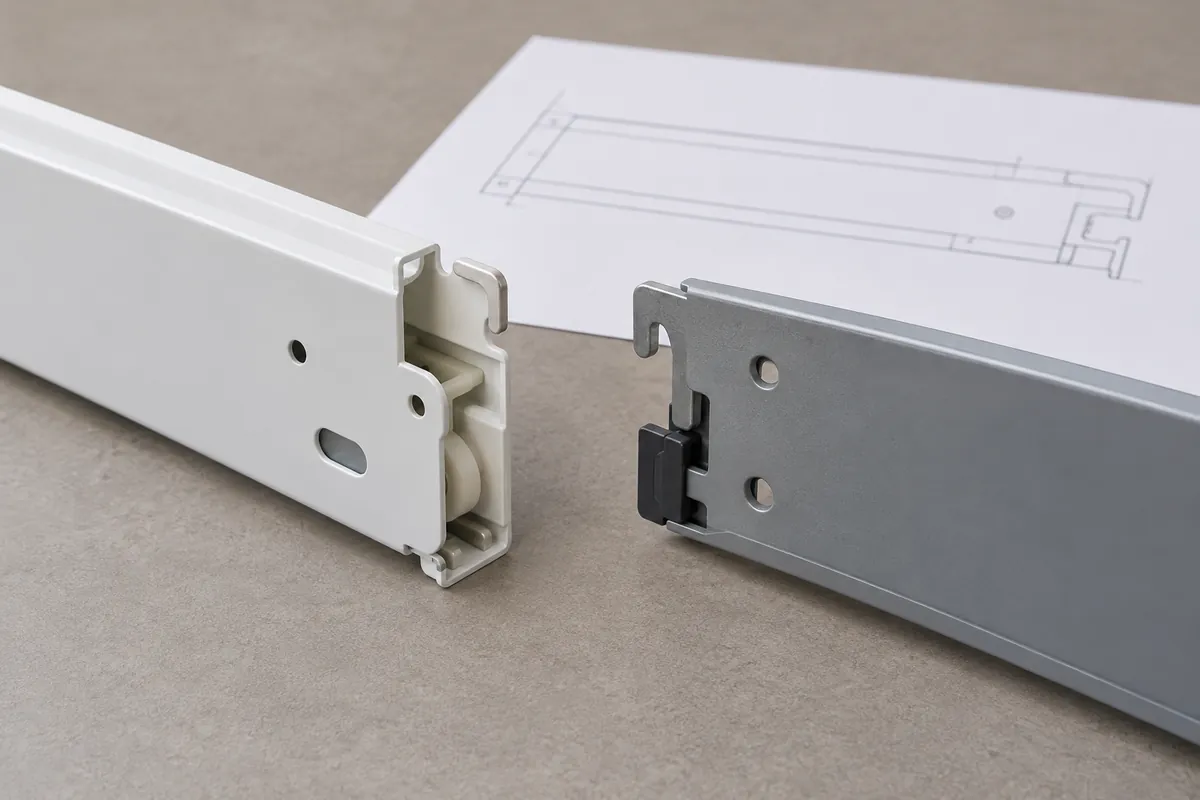
The manufacturer preparation material cited here treats rear notching, hook preparation and locking-device installation as separate planning details. That matters because a rear cutout does not automatically include every other required hole, attachment or clip. Use the drawing and current installation sheet for the exact model. The reference confirms that the interface is a buyer planning concern; it does not supply a universal size for other brands or prove the fit of a custom metal basket.
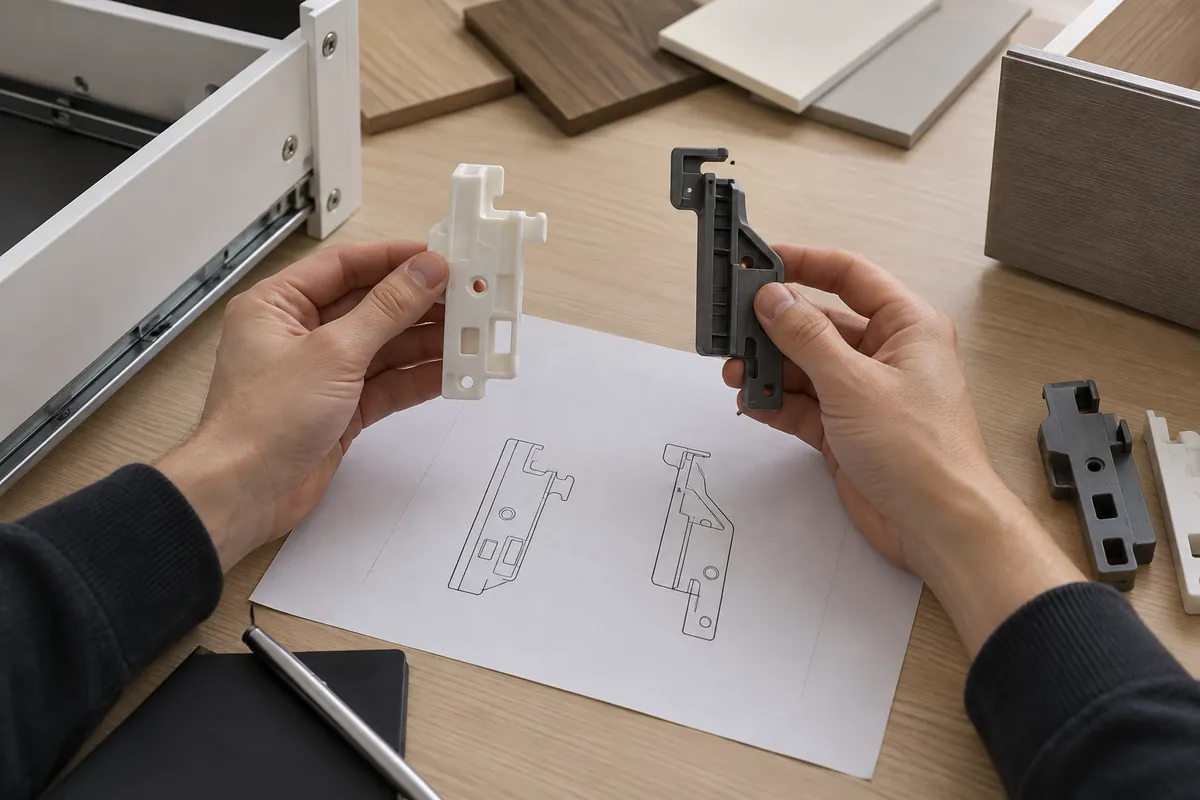
For a private-label organizer, responsibility may cross several suppliers. The metal basket maker may control its rear panel, while a specialist runner supplier controls the hook profile and engagement path. The importer needs one approved drawing that connects those responsibilities. If the basket is adapted from a drawer system, identify who owns the combined geometry and who signs off on a changed notch, rear panel or purchased runner revision.
Keep this approval separate from front locking clips. A front clip can appear seated even when a rear hook is misaligned, and the reverse can also occur. The full assembly has multiple points of interaction. A useful acceptance record names the visible and hidden engagement points, the installed orientation and the intended movement sequence, rather than recording only that the drawer opens and closes once.
What should the RFQ drawing and dimension record contain?
Start with the supplier's current runner drawing and revision, then identify the drawer or basket revision that is intended to mate with it. Ask the runner supplier to mark the rear hook datum, required notch shape, engagement direction, allowed clearance and any keep-out zone. Do not ask a fabricator to infer these from a photograph. A side or underside view may be needed because a top view can hide the hook height and the relationship to the bottom panel.
Record every dimension from a named datum. That may include the drawer back edge, bottom surface or runner mounting plane, as selected by the component maker. A number without a datum is ambiguous: two suppliers can measure the same offset from different surfaces and both report a value that looks plausible. The controlled drawing should also state units, tolerance source and whether the feature is mirrored, handed or shared between left and right sides.
The notch is only one element in a stack. Include back-panel material and thickness, bottom position, any folded edge or reinforcement, screw access and the location of front locking devices. If an adapter is used, show its thickness and attachment. Ask the runner supplier which dimensions are critical to engagement and which are reference dimensions. This helps prevent an unrelated basket detail from being given an invented tolerance that the fitting maker never specified.
For quotation comparison, require each supplier to identify included parts and exclusions: runner pair, hooks, clips, fasteners, adapters and any template or installation instruction. If the metal module is sold without runners, state that boundary plainly. A quote that assumes a different fitting or drawer back cannot be compared on price alone. Preserve part numbers, drawing revisions and who approved the interface in the same file as the sample photographs.
How should buyers compare alternative hook and notch arrangements?
Compare only alternatives that a qualified runner supplier confirms for the specific assembly. A captured hook may be fixed at the rear of the runner, while another system may use a different peg, pin or drawer-preparation arrangement. These are examples of possible system designs, not interchangeable options. Request a section view or supplier explanation showing how the feature enters, seats and remains engaged through the intended travel.
Look at the installation sequence as well as the final position. Does the drawer need to be tilted, lowered, slid rearward or aligned before front locking devices engage? The buyer should follow the selected supplier's instructions and observe whether the metal basket permits the required approach. If a rear crossbar or wire blocks access, the sample may need a revised layout. Do not remove a basket member or enlarge a notch as a field fix without controlled engineering approval.
For each proposal, compare the rear panel geometry, hook engagement, front retention, left-right matching, adjustment method and service removal. The system may use the same nominal runner length yet require a different rear interface. Record what the supplier document establishes, what the physical sample demonstrates and what remains unverified. This lets a distributor compare systems without pretending that a visually similar hook proves equal retention or interchangeability.
Changes to the drawer back or basket wire can move a datum or obstruct the hook even when the external product dimensions remain constant. Treat revisions to material thickness, bend location, weld position, adapter, runner family or installation direction as potential interface changes. Ask the responsible supplier which checks must be repeated. The point is not that every change invalidates the entire product; it is that affected mating features need evidence before the revision is released.
What does the sample review need to demonstrate?
Build the review around a representative cabinet, the quoted runner pair and the production-intent drawer or basket. First verify part labels and revisions. Confirm that the sample has no temporary spacers, hand-cut notches or unrecorded substitutions. Photograph the underside and rear before installation so reviewers can see the hook and notch relationship. Record the cabinet side construction and runner mounting position, since those conditions affect the assembly sequence.
Follow the supplied installation steps and observe the rear engagement directly where possible. Check that the hook reaches its intended seat without forcing, that the drawer reaches its normal front position and that both sides behave consistently with the supplier's design. Open and remove the assembly only using the documented release method. A visual check of one sample describes that sample and setup; it does not prove service life, load performance or a universal safety outcome.
Inspect for contact marks, deformation, interference with the bottom panel, movement of a rear adapter or a hook that misses its receiving feature. If a concern appears, record what happened, at which side and at what stage. Avoid diagnosing the cause from a single symptom. A runner alignment issue, basket width, cabinet geometry or an incorrectly prepared notch may create similar symptoms. Have the relevant suppliers review the same evidence and assign corrective action ownership.
Once the fit is acceptable, sign an approval record that includes the sample ID, product drawing, runner family, left and right parts, image evidence, installation instruction revision, observed deviations and approver. If the sample passes only after an adjustment, capture that adjustment on the released drawing. A verbal statement that the hook seemed fine will not help a factory reproduce the approved system or help a buyer distinguish the next shipment from an unapproved revision.
How should buyers control production changes and supplier handoffs?
Assign the drawer interface owner before mass production. One party should maintain the controlled drawer or basket drawing; the runner supplier should confirm its own system requirements; and the importer should approve the complete combination. If the parts are sourced separately, ask one supplier to provide a compatibility confirmation rather than assuming that each vendor reviewed the other's geometry. The purchase order should name the approved runner and drawer revisions, not only a broad product description.
A substitute runner, hook or locking device is a controlled change even if it comes from the same general product category. Require notice before substitution and decide whether drawing review, dimensional inspection or a new assembled sample is appropriate. The supplier should identify which features changed and why. Recheck affected interfaces rather than automatically repeating unrelated finish or packaging tests; the review scope should match the change and the buyer's quality plan.
For repeat orders, use a sample or digital record that clearly shows both rear engagement and front retention. Keep the drawing, parts list, assembly instructions and product photographs linked to one revision. If the installation kit is packed separately, identify how the correct hooks and runners will be paired. Clear identification reduces the risk that an approved basket ships with a different fitting merely because two components share a similar appearance.
Koitor's verified capability supports custom metal hardware development, sample communication and discussion of formed or welded metal interfaces. It does not establish that Koitor manufactures or qualifies undermount runners. For a basket or organizer project, buyers can share the metal assembly drawing and ask the fitting supplier to confirm the rear connection. That keeps the manufacturing discussion useful while leaving specialist runner limits and compatibility with the responsible supplier.
How should dimensional deviations be handled?
A buyer should agree how the runner supplier defines the allowed interface before a factory reports a notch as acceptable. The measurement method needs a datum, tool or drawing reference, sampling plan and revision. If the notch is too close to a bend or weld, the result may depend on how the back panel is fixtured. Ask the supplier which surface and point control the engagement, and keep the reported measurement separate from a visual fit impression.
When a measured feature falls outside the released drawing, do not enlarge it immediately. Check that the correct left or right part was measured, that the drawer back is oriented as shown and that the runner family matches the drawing. A change to a notch can reduce material around the rear wall or affect a nearby weld. Route any proposed correction through the responsible product and fitting suppliers, then record the revised geometry and the reason for the change.
If a component supplier uses a gauge or installation template, identify that tool and its revision in the approval record. A gauge can support repeatable inspection when it is designed for the named part, but it does not replace a controlled drawing or confirm every assembly function. Make sure the production team can tell the intended hook opening from a similar cutout on another basket model.
Include dimensional evidence in the sample file alongside photographs. A close-up image helps reviewers see the location, while a measurement record shows how the value was obtained. If the feature is difficult to access after assembly, measure it before final installation or request an inspection method from the supplier. This is especially useful for a drawer module shipped with the runner already attached.
What should the buyer record after approving the interface?
The approval should state the undermount drawer rear notch hook dimensions source, not simply repeat a number. Point to the drawing, model and revision that define the relationship. Include the sample identifier and note whether the supplier confirmed left-right symmetry or uses distinct parts. The record should also name the person or organization responsible for approving any change to the runner or drawer preparation.
For each production lot, preserve enough identification to connect the basket to the fitting it was reviewed with. That may be a part label, kit number, packing list or controlled supplier code. A broad description such as metal drawer basket cannot distinguish different rear geometries. Coordinate labelling with the importer so warehouse staff can match replacement parts without opening every package and relying on visual guesses.
When a new component version arrives, compare its documentation with the approved configuration. Ask the runner supplier to summarize the change and identify any affected dimensions or assembly steps. If the difference does not touch the rear engagement, the supplier may justify a limited review; if it changes the hook or drawer preparation, perform the appropriate updated sample check before shipment. Keep that reasoning in the product file.
A concise technical handoff makes responsibilities clear: the metal supplier controls its released back-panel geometry, the runner maker controls its hook interface and system limits, and the importer approves their combined use. This keeps the project from assigning an unsupported compatibility claim to a party that did not design the purchased component.
How should the approved interface be communicated to production?
The release package should put undermount drawer rear notch hook dimensions beside the runner model and drawer revision they were checked against. Include a marked drawing, installation sequence and photographs of the seated rear connection. If the interface was approved only for a specific basket or drawer construction, say so in the parts list and purchase order. This gives production and incoming inspection a controlled reference instead of an isolated number detached from its mating system.
Buyer comparison table
| Drawing input | Evidence to request | Approval question |
|---|---|---|
| Runner identity | Supplier, model, revision and handed parts | Does the drawing match the quoted fitting? |
| Rear feature | Datum, notch profile and engagement direction | Can the supplier explain the mating path? |
| Drawer stack | Back, bottom, adapter and front clips | Are all interfaces represented on one assembly? |
| Sample record | Installed photos and deviations | Can the released configuration be repeated? |
Liste de contrôle pour l'acheteur
- Freeze the exact runner family and revisions
- Mark notch dimensions from the runner supplier's named datum
- Show back, bottom, adapters and front clips together
- Review installation and removal on a representative cabinet
- Record left-right observations and deviations
- Approve the drawing and sample as a matched configuration
For a project-specific detail, consult the manufacturer or technical reference. Its information applies to the stated system and conditions.
See related OEM sourcing information or contacter Koitor for a metal-product drawing discussion.
Foire aux questions
Can one rear notch dimension fit every undermount runner?
No. Hook geometry and drawer preparation are system-specific. Use the selected supplier's current drawing and compatibility confirmation.
Does the cited manufacturer sheet give a universal notch size?
No. It identifies rear preparation as a planning detail. Buyers must use the selected runner's own drawing for actual dimensions.
Is front locking-clip engagement enough to approve the drawer?
No. Review the rear hook, drawer back, front retention and installation sequence as one assembly.
Can a metal basket supplier decide the hook dimensions alone?
The basket supplier can document its geometry, but the runner supplier must confirm the mating interface and system limits.
Discuss a project-specific sourcing question
Koitor Hardware is a family-owned custom metal hardware factory focused on bathroom and home storage products. Share the product drawing or physical sample, the purchased fitting identity, the intended application and the buyer decision that still needs evidence. Specialist drawer runners, closet shelf fittings and coating systems must be confirmed by their responsible suppliers.
Fabrication pour compte de tiers / Marque de distributeur
Transformez ce guide d'approvisionnement en cahier des charges
Indiquez-nous le produit souhaité, ses dimensions, sa finition, la quantité commandée et vos exigences en matière d'emballage. Votre équipe recevra une analyse pratique de la faisabilité de la fabrication avant l'établissement du devis.

 English
 Español
 Português
 Français
 Deutsch
 العربية