
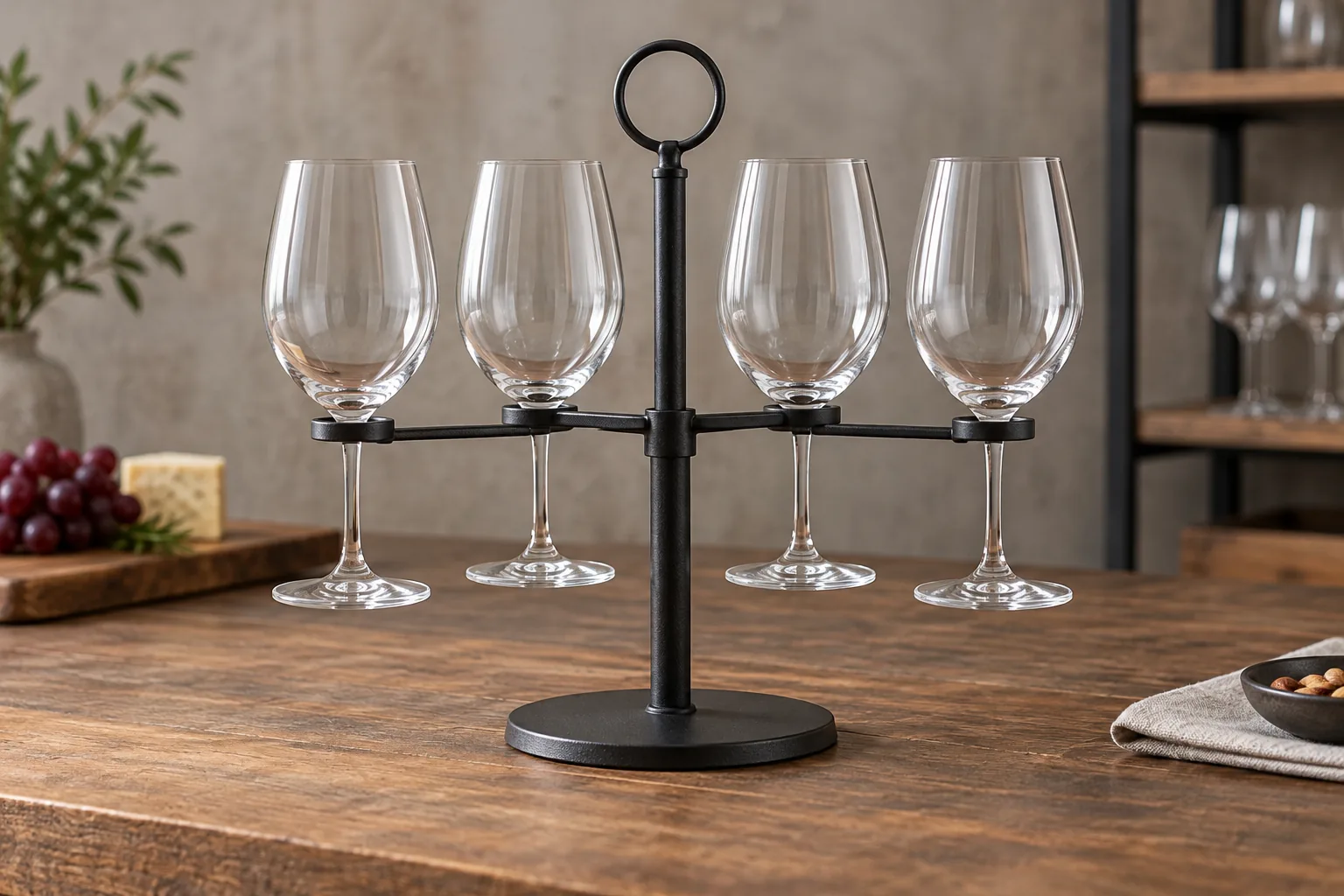
Wine tasting stand glass fit should be approved with the actual glass models and intended service sequence, not inferred from a product name or a photograph. The buyer needs to establish where each glass contacts the support, whether stems and bowls remain clear in the upright position, and how staff load and remove them during service. The fit decision is specific to the selected stand architecture and glass references; a similar glass category does not guarantee interchangeability.
What fit decision should the buyer make first?
The first decision is whether the stand is sold as a holder for identified glassware, as a stand-only item with buyer-supplied glass references, or as a coordinated set. Those are different commercial offers. The quotation, product page, packing list and sample approval should use the same language. If glasses are not included, the buyer should not rely on a styled photograph that shows them in place.
Record the service arrangement before asking a supplier to finalize the frame. Is the unit carried between tasting stations, placed at a fixed counter, used for a seated tasting, or kept on a serving trolley? Does the user load several glasses before moving the stand, or place one glass at a time? Is the stand expected to remain on the table while glasses are removed? These questions affect spacing, grip access and the path a hand follows around neighboring glassware.
A multi-glass layout also has a footprint. The buyer should mark the intended glass positions on a top view and compare the occupied envelope against table width, tray edges or nearby serving items. A stand may hold the individual glasses but still be awkward to approach if the outer rim of one glass crowds another. The goal is a reviewable arrangement, not an unsupported claim that a design is universally stable or suitable for every hospitality venue.
Define the product boundary in the RFQ:
- Stand only, or a coordinated stand-and-glass set.
- Upright serving position and intended number of displayed places.
- Glass brand, model, revision and physical sample source.
- Counter, tray or trolley envelope in which the unit will be used.
- Required assembly, detachable parts and packed condition.
- Whether a buyer-approved glass may change during the order.
This boundary prevents a later dispute over whether a glass mismatch is a stand defect, an unapproved substitution or simply a different reference item.
How should the glass reference be specified?
Use a named model and a controlled sample whenever possible. Record a supplier, model number, revision or purchase reference; add a drawing or measured profile if the glass itself is custom. Product names such as tasting glass, flute or stemmed glass do not provide enough geometry to approve a support opening. Two vessels in the same broad category can have different foot diameters, stem lengths, bowl transitions and widest points.
For an upright stand, identify the actual support zone. A ring that bears under a bowl has a different contact requirement from a ring intended to capture the stem or support a foot. Show the contact section on a drawing and make clear which surface carries the glass in the displayed orientation. If the glass passes through a ring, state which part is expected to stop it from moving down. If the ring is only a lateral guide, do not represent it as a load-bearing seat.
Measure the reference glass at the features that interact with the stand. Useful control points commonly include foot width, stem diameter at the proposed contact, bowl width near the support, total height and any local taper. The project engineer should choose dimensions and tolerances based on the actual geometry and sample. This guide cannot assign a universal opening size because different stand designs intentionally contact different parts of a glass.
An official TableCraft Cascade Wine Tasting Flight product page describes one model-specific vertical steel presentation architecture and identifies glass-related arrangements for that product. It is useful evidence that the reference belongs to a defined model and offer. It does not establish fit for another stand, say that every displayed glass is included in every package, or substitute for checking the exact current SKU and packing contents.
The buyer should also state whether glassware is fixed for the life of the product or may be revised. A later glass change can alter contact, overall height, spacing and the reach needed for removal. If the glass is still being selected, mark the product as a development sample and keep the sample decision open rather than approving production geometry against an assumption.
What does upright service clearance mean?
Upright service clearance is the space needed to place, use and remove the glass in the exact stand arrangement. It includes more than the visible gap between rings. A user’s fingers need an approach path; a stem or foot needs to pass any retaining feature; neighboring bowls must not collide when one glass is lifted; and the stand’s handle or frame must not block a pour or tasting action if those actions occur while glasses remain in place.
Create a simple sequence for the sample review. First load each glass in the intended order. Then inspect whether a glass seats without twisting or forcing. Next reach for every position with a normal grip, lift one glass while the others remain, and return it to the same position. If the product is intended to travel while loaded, review that separate handling arrangement with the buyer’s own defined conditions. Do not convert a brief handling check into a transport-safety or load-performance claim.
A side view helps reveal height conflicts. Check whether the bowl clears crossbars, whether a stem reaches the contact point, and whether the base sits above the serving surface as intended. A top view helps compare spacing and access; an end view can expose an asymmetric arrangement or a handle intrusion. Where the design is adjustable or assembled from several sections, record each approved configuration rather than assuming all positions behave identically.

Use this process image as a prompt for the inspection conversation, not as a dimensioned production reference. The actual drawing and glass sample govern the design. For hospitality use, the buyer may want the sample checklist to include the surface on which the stand sits, the route a server’s hand takes, and the neighboring items that share the work area. These observations make service access concrete without implying that one measurement proves suitability for every table.
Which features belong in the drawing and sample record?
The drawing should separate product dimensions from interface dimensions. Overall height and width describe the envelope; opening or ring measurements describe the contact. Mark the material and finish as project requirements, then identify which faces are visible and which contact the glass. If the stand has welds, bent wire, formed sheet or a removable base, show the construction and revision so the approved sample can be compared with the production drawing.
A controlled review record can include the following:
| Buyer requirement | What to record | Pourquoi est-ce important ? |
|---|---|---|
| Glass identity | Brand/model, revision and physical reference | The name category alone does not define the profile |
| Support contact | Contact zone and measured interface | It shows what feature actually locates or holds the glass |
| Position layout | Number and spacing of places, plus orientation | One glass can fit while adjacent positions remain inaccessible |
| Service envelope | Hand approach, lift and return path | It captures use access beyond a static photograph |
| Stand construction | Material, joints, finish and visible faces | It supports drawing-to-sample comparison |
| Offer contents | Stand-only or named glass set | It prevents image styling from being mistaken for package contents |
| Revision control | Drawing, sample and glass revision | It prevents an unapproved reference change from being treated as equivalent |
Dimension the critical interfaces from stable datums. For example, use the stand centerline or a defined edge to locate each support rather than relying on a chain of rounded measurements. Where the design depends on a glass taper, identify the height at which the contact diameter was measured. The buyer and supplier should agree how the measurement is taken and how much variation is acceptable; do not insert generic tolerance values that have not been engineered for the design.
The sample should carry a visible identification label or a linked inspection record. Include the stand revision, date, glass references and any deviations approved for the sample. If the sample has a different finish, temporary fastener or hand-adjusted feature, list it as a deviation. A sample can demonstrate fit for its own components but cannot establish that an unapproved substitute glass will behave the same way.
How should the sample prove fit without overstating performance?
A useful sample review answers a defined question. It can confirm that the named glass reaches its intended seat, that the upright position is visually correct, and that staff can access each place in the described sequence. It can show that a detachable part is installed as instructed and that the package contents match the offer. It does not, by itself, establish long-term service life, a load rating, resistance to impact, sanitation compliance or suitability for every venue.
Use a pass/hold/deviation record. For each feature, state the expected condition, observed condition, evidence and decision owner. “Pass” should refer to a specific criterion, such as the approved glass reference seating without interference in the reviewed configuration. “Hold” should identify an unresolved item, such as one glass model not yet supplied. A deviation should describe exactly which dimension, finish, component or package item differs and who approved that difference.
After approval, freeze the reference set. Store the drawing and sample images with an identifier, and include the approved glass supplier/model in the order documentation. If the buyer later changes the glass, reopen the relevant fit review. If a supplier proposes a change to the support geometry, review the effect on every glass position, removal path, appearance and packing arrangement before accepting it.
Packaging deserves its own sample check. Glassware, when included, has different protection needs from a metal frame. If the order is stand-only, confirm that the frame cannot rub against its own finished contact surfaces or protruding elements during shipment. If separate accessories are included, define their compartments, labels and assembly instructions. Avoid claiming that a carton or insert guarantees no transit damage; confirm the actual pack arrangement and inspect it against the buyer’s distribution plan.
For a broader view of Koitor’s documented metal storage scope, the company’s home page describes its current business context. That scope does not confirm a wine-tasting stand SKU, glassware supply, food-contact certification or tested performance. A buyer can send drawings and reference parts through the Koitor contact page to ask whether the metal-support portion is a feasible project; any product-specific capability must be confirmed before a quotation is treated as an offer.
For a repeatable wine tasting stand glass fit review, link the named glass list to the support measurements and the position-by-position access record.
What sourcing mistakes create avoidable changes?
One common mistake is specifying only the opening diameter. That may omit the glass’s contact height, taper or foot, so a ring can appear correct on a drawing while meeting the wrong part of the glass. Show the cross-section and identify the intended bearing or guide surface.
A second mistake is approving a photograph rather than the exact set. A promotional image may show a vessel, condiment cup or accessory that is not included in the order. Copy the commercial contents into the RFQ and verify the current model’s instructions and package list. The buyer owns the decision about what is sold together; do not let a styling image silently expand the package.
A third mistake is testing only the first glass position. The nearest slot may be easy to reach while a back or center position is blocked by a frame member or an adjacent bowl. Walk through loading, lifting and returning each glass. If users may reach from more than one side, inspect the intended orientation from those sides.
A fourth mistake is accepting an untracked substitution. A similar glass from another supplier may differ at the contact zone, even when the overall shape seems close. Require written approval for replacement models, and repeat the relevant fit review when the change affects an interface.
A fifth mistake is treating the prototype as proof of all manufacturing characteristics. A single sample can be useful for geometry and assembly review, yet it does not prove that every future piece has the same dimensions or finish. Buyers should agree a production-intent reference, drawing revision and inspection plan appropriate to the order. Claims about process control or defect acceptance should be tied to the actual supplier agreement, not assumed from the sample alone.
A final wine tasting stand glass fit decision should identify the sample, set contents, exceptions and drawing revision rather than only say approved.
What should the buyer checklist cover?
Before requesting a quotation, prepare the glass reference, stand-only or set boundary, intended number of positions, use orientation, service area, material/finish preference, target quantities, label and packaging requirements. Attach drawings where they exist and identify dimensions that are critical to the interface. If the buyer has only a physical sample, photograph it with a scale and ask the supplier to confirm which dimensions it will control before production.
Before sample approval, review all glass positions, the contact zones, upright seating, hand access, lift-and-return sequence, visible surfaces, fasteners, assembly instructions and package contents. Record deviations and name the approver. If dimensions remain under discussion, do not mark the sample as a final production standard.
Before shipment, compare the order reference, approved drawing, approved sample, label and packing list. Verify carton arrangement and any included glassware against the offer. Make the recipient’s inspection criteria explicit so a later question can be tied to an agreed reference. The practical result is fewer avoidable disputes about whether the stand, glass, pack or image description was the source of a mismatch.
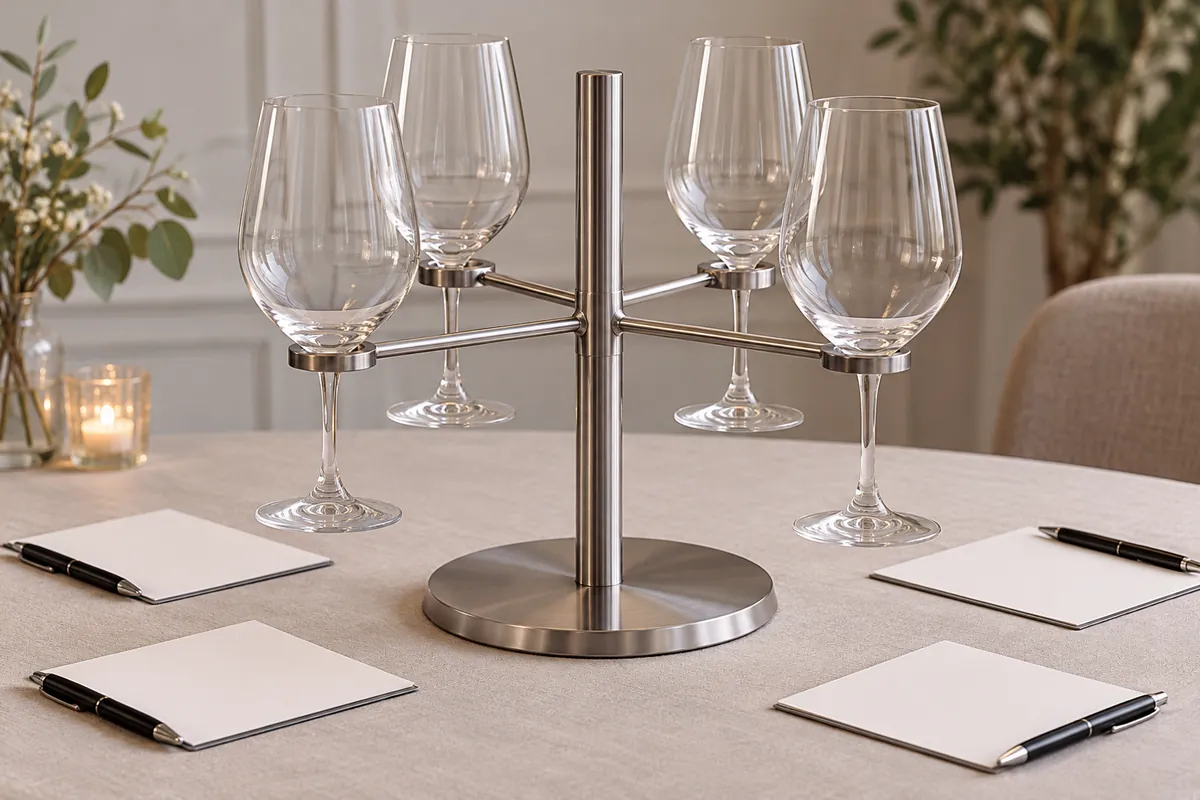
Use this final checklist view to record the actual glass references, approved position layout and hand-access review; it is an illustration, not a dimensioned drawing.
Does a glass-count statement confirm that every glass fits?
No. A count is a model-level description. Buyers still need the exact glass identity, contact zone, spacing and removal path for the arrangement they plan to sell.
Should a buyer specify glass dimensions if supplying a physical sample?
Yes. The supplier should record which surfaces control the interface and identify the sample revision. Measurements make the approval repeatable if the physical item is misplaced or later changed.
Is a sample fit check a load or stability test?
No. It answers only the criteria actually reviewed. Any performance test requires a defined setup, method, acceptance level and responsible party.
What if the glass model changes after approval?
Reopen the affected fit review. Compare the new model at the support, neighboring-glass spacing and service path, then update the drawing and sample record before production.
Reference examples: TableCraft Cascade Wine Tasting Flight is cited for one identified model architecture; verify current SKU details directly before using them in a commercial offer.
Review a metal-support concept with Koitor Hardware
Send the drawing, glass references and expected package contents. Koitor will confirm whether the metalwork falls within its documented capabilities before any project scope is assumed.
Fabrication pour compte de tiers / Marque de distributeur
Transformez ce guide d'approvisionnement en cahier des charges
Indiquez-nous le produit souhaité, ses dimensions, sa finition, la quantité commandée et vos exigences en matière d'emballage. Votre équipe recevra une analyse pratique de la faisabilité de la fabrication avant l'établissement du devis.


 English
 Español
 Português
 Français
 Deutsch
 العربية