
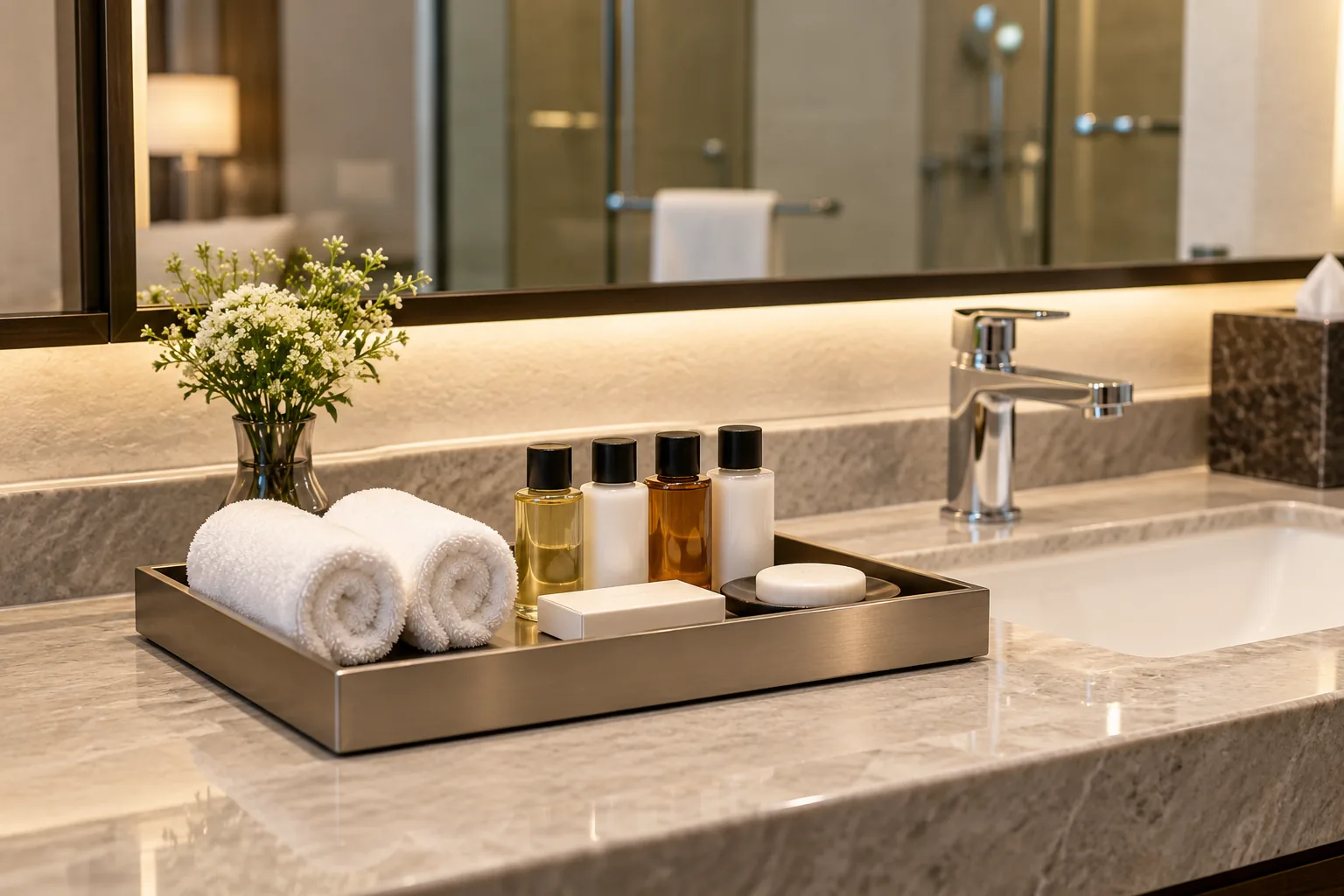
A hotel bathroom amenity tray should be specified around the actual room-tier item set, the usable vanity footprint and the housekeeping reset—not selected from a decorative photo. Buyers should list which amenity pieces belong in a standard room, suite or other room type; measure the tray’s inner usable area and outside footprint; and check access for cleaning, restocking and replacement. Product catalogs show different tray shapes and accessory combinations, but do not establish a universal hotel setup. Use the property’s own requirements and validate the exact tray with representative items.
Why Should Room Tier Drive the Tray Specification?
A hotel may offer different amenity sets across room types or service tiers. A tray sized for a single soap and tissue item may not work for a larger collection of packaged toiletries or dispensers. If the buyer chooses the tray first and adds items later, the vanity can become crowded or the selected articles may overhang the usable area.
Start by listing the items the property actually intends to place on the vanity. Identify each item’s dimensions, packaging, orientation and replenishment status. Separate durable accessories from consumable products. A bottle, soap carton, tissue box or welcome item may have different replacement and cleaning needs. The buyer should confirm which pieces are provided by the hotel, a hospitality supplier or another vendor.
For a hotel bathroom amenity tray project, create one row for each room type and item set. If standard and suite rooms differ, record those distinctions rather than averaging them into one tray. A property may also have a phased renovation or local room variation; treat those as separate configurations until the owner confirms they can share a SKU. Catalogs demonstrate product variety, not what any specific hotel should stock.
How Can Buyers Map Items to the Tray Footprint?
Measure the inner usable area and the external footprint. The interior dimension determines whether the items fit together; the outside dimension determines how much vanity space the tray occupies. A raised rim, divider or insert can reduce usable area even when the overall length and width appear sufficient. Record height and side access if items need to be lifted out or labels must remain visible.
Arrange representative samples on the tray. Include packaging, not just the container, because a wrapped soap or carton can occupy a larger area than its contents. Check whether frequently used items are reachable without moving the full set. Make room for the guest to put personal items if that is part of the room design, and have the property team confirm the required clear counter space.
| Room tier | Amenity item set | Tray inner area | External footprint | Service note |
|---|---|---|---|---|
| Standard | Owner-selected core items | Measure with real samples | Compare with vanity plan | Record default replenishment |
| Suite | Owner-selected expanded set | Include cartons and dispensers | Check available counter zone | Note added or upgraded items |
| Accessible/special room | Project-specific owner set | Verify in approved layout | Keep design team review | Do not infer requirements |
| Renovation phase | Temporary or phased configuration | Track current sample | Link to room drawing revision | Confirm whether mix is allowed |
This table is a planning structure, not a prescribed amenity list or size recommendation. Use project dimensions and owner-approved item sets. If one tray serves several room tiers, test the fullest approved set and ensure that the smaller configuration remains intentional rather than looking incomplete.
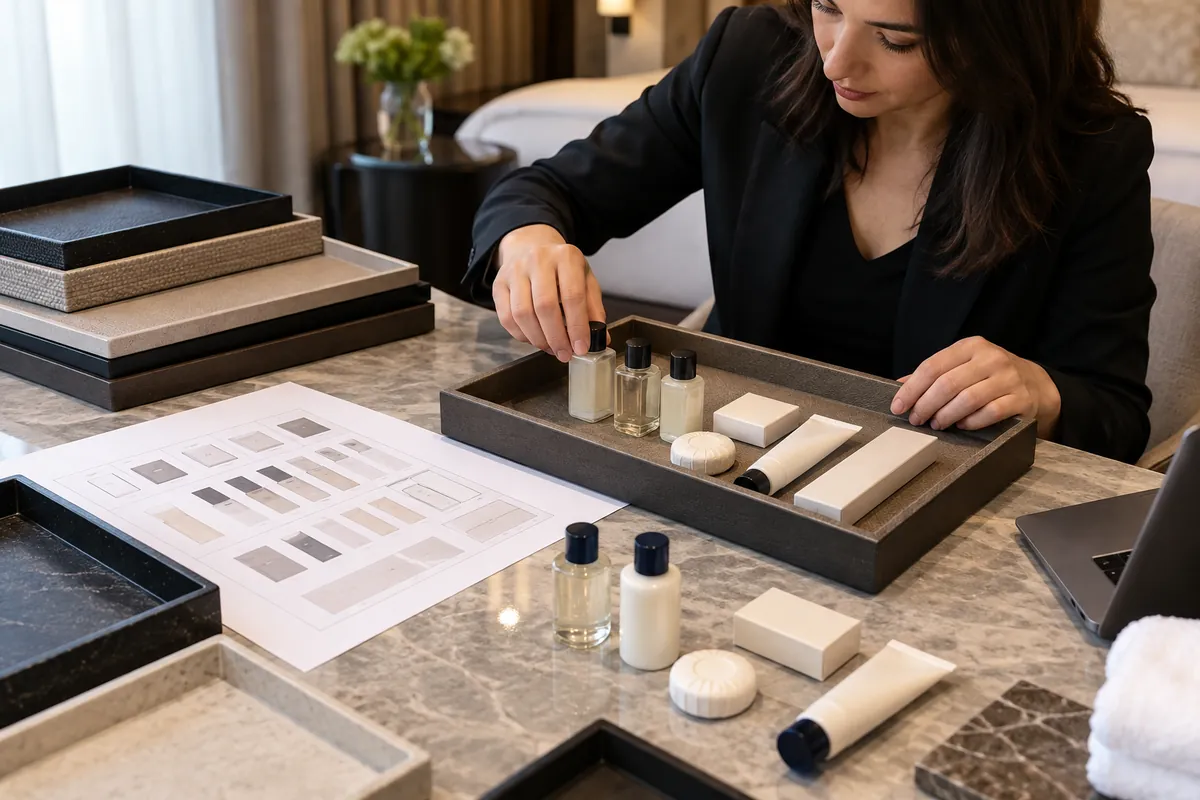
A hotel bathroom amenity tray matrix should identify the source of each assumption: product sheet, measured sample, room plan or owner decision. Mark preliminary room counts and item dimensions as provisional. This makes a change visible when a dispenser, welcome item or vanity layout changes.
What Should Be Checked for Cleaning and Housekeeping?
Ask the housekeeping or facilities owner how the tray will be reset between guests. Can it be lifted as one piece, or are parts meant to remain on the vanity? Does it have a removable insert or divider? Is it easy to wipe around and underneath in the planned setup? The buyer should confirm the routine with the property team rather than inventing a universal hotel cleaning practice.
If a removable component is proposed, check that it can be lifted and returned without mixing the room’s items or damaging the vanity surface. Record how staff identify the correct orientation and how the tray is restocked. A photo in an amenity catalog may show a styled arrangement but does not demonstrate cleaning access, workflow, or chemical compatibility.
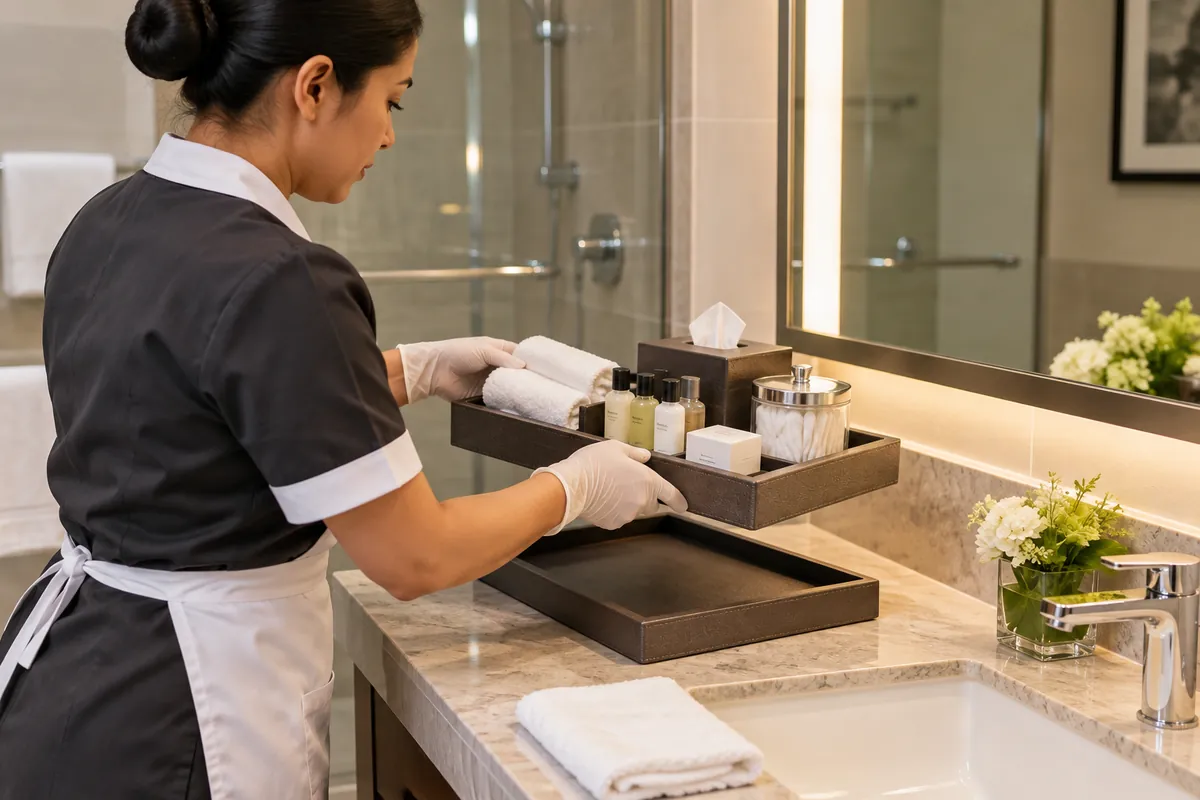
The tray material and finish should be discussed with the supplier in relation to the property’s approved cleaning instructions. Do not assume a metal, coated, resin or other surface is compatible with every cleaner. Ask for product-specific care guidance and validate any chemical-resistance requirement with appropriate evidence. Visual inspection of one sample does not establish long-term chemical performance.
Service flow also affects replenishment. Identify who owns each consumable, how it is ordered, where reserve stock is stored and whether the tray itself is replaced or reused. If different room tiers use different items, label the replenishment kit or checklist by room type. The housekeeping-cart product range is a separate operational topic; see the hotel housekeeping cart assortment guide for cart-level SKU planning.
How Should the Sample and Finish Be Approved?
Document the approved hotel bathroom amenity tray with its specific configuration and sample items. A sample should include the intended tray configuration and representative items. Record the tray code, dimensions, material and finish description supplied by its maker, insert or divider parts, and the room-tier sample arrangement. Review interior area, external footprint, rim access and stability on the actual vanity surface. Do not turn a static display into a product safety or durability claim.
Approve a finish reference using the method defined by the supplier and buyer. Note the visible top, interior and underside where relevant. If the tray contacts wet containers or cleaning products, describe the expected environment and request product-specific guidance. Avoid broad terms such as “waterproof,” “chemical proof” or “scratch proof” unless a defined test and evidence support the claim.
Take photos of the approved arrangement and attach them to a controlled drawing or sample record. State which amenity pieces were included and which were not. A tray approved with small containers may not suit larger packaging after a brand or product change. Define that as a change trigger and confirm whether a new layout review is needed.
How Do Buyers Compare Tray Options and Quotes?
Normalize the configuration: material, finish, size, usable interior, divider or insert, packaging, label, quantity and room-tier mix. If one supplier quotes a tray only and another includes an insert or branded pack, the offers are not comparable. Ask each bidder to state assumptions and exclusions.
A buyer can compare open trays, divided trays and removable inserts as concepts, but should not declare one universally easier to clean or better for guests. Test the actual sample against the property’s operating needs. If the supplier proposes a custom size or logo, ask whether it changes tooling, sample scope, finish review or pack dimensions; do not infer cost or timing without a quotation.
Before release, ask the supplier how samples and production units will be packed. A tray may ship with inserts nested separately, with the room-tier set already arranged, or as a standalone piece; these are different packing and receiving tasks. Record which party kits the consumables, who applies property or room labels and whether cartons identify the tray revision. Do not assume a photographed arrangement is the shipment configuration. A small sample pack can confirm the contents and identification method before the buyer freezes artwork or carton quantities. If trays are ordered by room phase, keep the pack count and destination grouped with the same room schedule used for procurement.
For repeat supply, define the product code by tray and insert version, and align carton labels with the property or distributor’s item system. Record room type and approved contents as separate fields from the tray specification. This lets procurement change the amenity set without accidentally changing the tray, or vice versa.
What Common Sourcing Errors Should Be Avoided?
Selecting only by appearance. A styled catalog photograph does not prove the item set fits or can be reset efficiently.
Using outside dimensions as usable area. Rims and dividers reduce space; measure inside the tray.
Ignoring packaging. The retail carton or wrapper may alter the fit even if the product itself fits.
Applying one room tier everywhere. Standard rooms and suites may use different owner-approved sets.
Assuming any tray material tolerates any cleaner. Request care instructions and evidence for a specific requirement.
Leaving replenishment ownership vague. Identify who supplies items, kits and replacement trays.
Changing amenities without rechecking layout. A new bottle, carton or dispenser can alter the tray arrangement.
Treating one sample as hotel-wide approval. Tie approval to the exact item set, room plan, tray revision and finish.
What Can Koitor Confirm?
Koitor is a family-owned custom metal hardware factory with confirmed bathroom and home-storage hardware experience, metal finishing, assembly, packaging, drawing and sample review. These facts may support a buyer discussion about metal tray or support concepts if a project fits current production scope. They do not establish a current Koitor hotel amenity tray SKU, hotel supply contract, resin or ceramic manufacturing, chemical-resistance testing or housekeeping experience.
For an adjacent-product inquiry, share the tray drawing or physical sample, room-tier contents, vanity dimensions, finish expectations, cleaning requirements and order quantities. Koitor should first confirm whether the proposed materials and product construction fall within its current capability. Do not imply that a similar bathroom accessory proves the tray is already manufactured.
For confirmed bathroom hardware sourcing context, see the custom bathroom hardware overview. It describes a general OEM path and does not claim an amenity tray is currently available. A project inquiry can be shared through the contact page.
Buyer Checklist Before RFQ Release
- Identify room types and owner-approved amenity set for each.
- List each item and its measured packaging dimensions.
- Measure tray inner usable area and outer vanity footprint.
- Check counter clearance on the current room plan.
- Record inserts, dividers, removable parts and orientation.
- Confirm who supplies and replenishes each consumable.
- Ask housekeeping or facilities staff to review the reset process.
- Obtain finish reference and supplier care instructions.
- Request evidence for any specific cleaning-chemical or durability claim.
- Approve a physical sample with the actual item set.
- Link photos, tray model, finish and room drawing revision.
- Define changes that require a new sample/layout review.
- Specify pack, label, quantity mix and replacement code.
- Keep preliminary assumptions distinct from approved project decisions.
Frequently Asked Questions
Does every hotel room need an amenity tray?
No. The property or project owner defines the room program. A tray is useful only if it supports the selected items and service plan.
Should standard and suite rooms use the same tray?
They can if the approved items, space and operating needs align. Compare the actual room-tier layouts and confirm with the property buyer.
How should a buyer decide the tray size?
Measure the item set and the usable interior, then check the outside footprint against the vanity plan. Do not rely on a catalog photo or external dimensions alone.
Does a metal finish tolerate hotel cleaning chemicals?
That depends on the exact finish, product construction and cleaner. Request care guidance and relevant evidence from the responsible supplier.
Can a sample prove the tray works in every property?
No. Approve the sample against the specified room plan and item set. Different vanities or amenity packages may require separate review.
What should a private-label buyer send for a tray quotation?
Provide a drawing or reference, room-tier item list, footprint, finish, insert needs, packaging, target quantities, market and any specific evidence requirements.
Discuss a Custom Bathroom Hardware Project
Share the tray drawing or sample, room-tier item set, vanity dimensions, finish and packaging requirements, cleaning guidance and target quantity. Koitor can first confirm whether the requested scope fits current capabilities.
OEM / PRIVATE LABEL
Turn this sourcing guide into a product brief
Share your target product, size, finish, order quantity and packaging requirements. Your team receives a practical manufacturability review before quotation.


 English
 Español
 Português
 Français
 Deutsch
 العربية