

A hotel minibar cabinet ventilation shelf is not approved by measuring the empty cabinet cavity alone. A metal shelf can fit the opening and still intrude on a maker-specified air inlet, outlet, drawer path or service route. The buyer must identify the exact minibar model and manual revision, obtain its installation envelope from the appliance maker, and pass those constraints to the cabinet and metal-accessory suppliers. The shelf supplier can assess the metal part against the approved interface drawing; it cannot independently certify refrigeration performance, ventilation, electrical safety or the appliance installation.
The practical workflow is to establish who owns the appliance, cabinet and accessory, mark the no-go areas from the current appliance documentation, and then inspect the assembled sample in the relevant operating and service positions. A hotel project may not need an extra shelf at all. If it does, the buyer should specify its purpose, load and attachment separately from the minibar’s requirements.
Why the exact model controls a hotel minibar cabinet ventilation shelf
Hotel minibars are appliances, not generic empty boxes. Their installation documents may specify cabinet openings, rear or side clearances, ventilation areas, fixing points, door or drawer operation, electrical connections and access to components that require maintenance. Those details vary by model and can change between revisions. A buyer should never take a dimension or vent arrangement from one manufacturer’s manual and treat it as a universal rule for every minibar.
A useful source example is the Dometic DM20D/F operating manual. It applies to the named model family and describes installation and ventilation conditions for those appliances. The manual illustrates why a project needs the current maker document before a metal shelf is designed. Its drawings, clearances and instructions are not transferable to a different minibar, to another Dometic model, or to a different cabinet arrangement without confirmation from the relevant appliance owner.
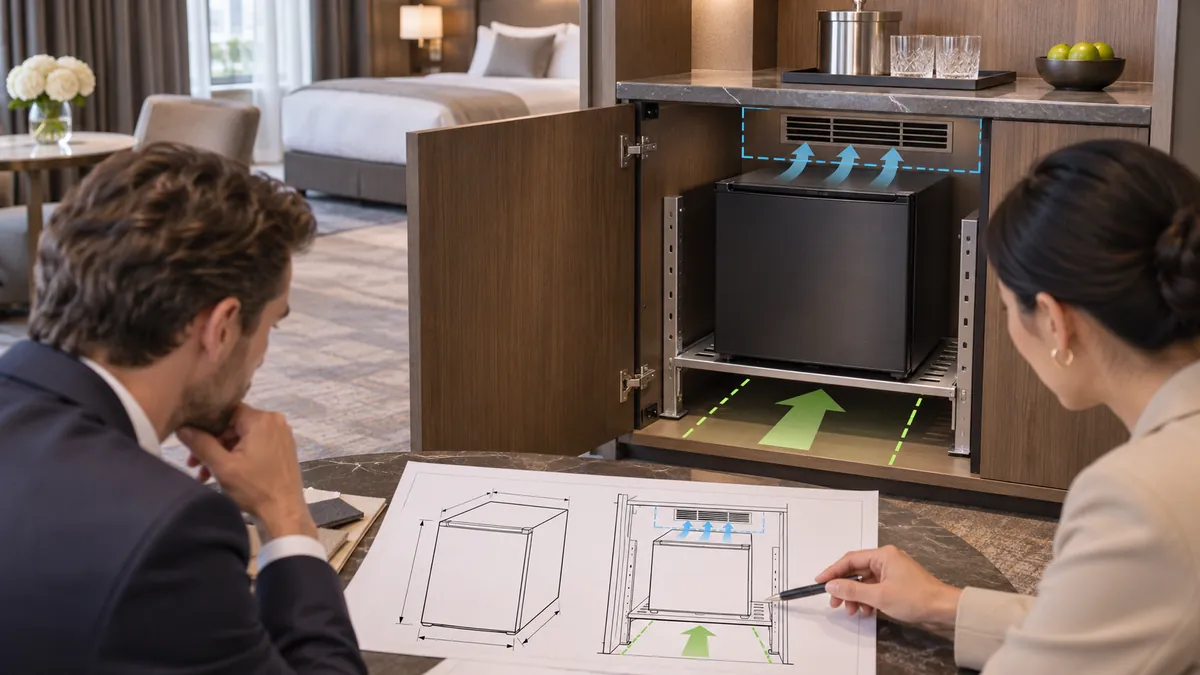
That is the central meaning of a hotel minibar cabinet ventilation shelf: a buyer-side coordination object, not an appliance specification. A metal accessory should be shown against the appliance model’s own exclusion zones. The accessory drawing should identify where metal is permitted and where the appliance maker requires air movement, fixing, removal or service access. Only the maker or qualified project professional can confirm that those zones are correctly interpreted.
The phrase “vent path” can conceal several distinct requirements. Some appliances draw air through a front or lower opening; others may have specified cabinet openings, rear gaps, a filter path or another arrangement. The location and purpose must come from the selected model’s instructions. Do not infer an inlet or outlet from a grille’s appearance, from the appliance’s outside dimensions or from a photo of another hotel installation.
Likewise, a shelf that is adjacent to the appliance may affect its surroundings even if it does not touch the case. The shelf edge can create an obstruction, reduce the usable area for a specified opening, interfere with a drawer or make the appliance harder to pull forward. The buyer’s drawing must show the full cabinet and accessory assembly, not only a close-up of the metal part.
Do not generalize dimensions from an example manual
A model-specific manual can provide an excellent reference for how to locate requirements, but its values and diagrams belong to that model. A specification should cite the exact model, language, publication or revision date, page number and document source. If the manual is unclear or conflicts with a project drawing, the buyer should ask the appliance manufacturer or its authorized technical representative. The metal supplier should not resolve an appliance airflow question by guessing.
This avoids a common handoff error: writing a fixed clearance into an accessory drawing because a number appeared in a different installation guide. It might be too small, unnecessarily large, or measured from the wrong surface for the current appliance. The project owner should translate the maker’s current requirement into a clear marked zone and have that translation reviewed by the person responsible for the appliance installation.
Build an interface register before asking a metal supplier to quote
The interface register is a compact document joining the appliance, cabinet, project and accessory. It can be a table in the RFQ, a coordinated drawing or a controlled submittal. The important thing is that every input has an owner and a revision. A list of rough dimensions is not enough if the source or model is unknown.
| Register field | Required buyer input | Approval owner |
|---|---|---|
| Project and room type | Hotel, room tier, cabinet location and intended minibar role | Hotel/project buyer |
| Appliance identification | Manufacturer, exact model, revision and current manual | Appliance supplier or maker |
| Appliance installation zones | Vent openings, clearances, fixing, drawer and service requirements copied from current instructions | Appliance technical owner |
| Cabinet interface | Interior drawing, opening, panel, shelf, grille and door details | Casegoods/cabinet designer |
| Proposed metal component | Purpose, drawing revision, material/finish scope, attachment and intended load | Metal accessory buyer and supplier |
| Exclusion zones | No-metal areas and keep-clear envelopes drawn on the coordinated assembly | Appliance/project technical owner |
| Service route | Direction and method for removing appliance or accessing serviceable parts | Appliance maker / installer |
| Operating check | The positions in which vent paths and drawers must remain unobstructed | Project technical owner |
| Sample record | Appliance or dimensionally accurate mock-up used, cabinet revision, photos and observations | Buyer with relevant suppliers |
The metal supplier needs enough information to assess its own work: a dimensioned drawing, the attachment concept, appearance and finish expectations, stated design load if relevant, package requirements and the no-go zones furnished by the appliance/project owner. The supplier should be told whether the part is a side shelf, bridging rack, divider, bracket or another accessory. Its function affects geometry and inspection criteria.
The appliance maker’s manual and cabinet drawing should be included in the same revision package. If either is not yet available, state the assumption and keep the quote or sample conditional. Do not let an early schematic become a silent production release. A later change to the minibar model, cabinet ventilation panel, service access, finish or shelf position can require new coordination.
A small project may use a one-page interface drawing with colored zones, provided the colors have a legend and the drawing calls out the source page. The color alone should not replace the appliance instruction. The buyer should preserve an extract or linked document version so the accessory supplier can see where the constraint came from. If the instruction changes, the register can show which metal drawing and sample need review.
The register also prevents scope creep. Koitor’s confirmed capabilities are in metal hardware fabrication and drawing/sample development. This article does not state that Koitor manufactures minibars, refrigeration equipment, complete hotel cabinetry or electrical components. It does not claim that Koitor can approve a vent path. If a metal shelf is needed, the project can supply a validated interface zone for the metal supplier to work within.
Define how the shelf will be used
The buyer should state the shelf’s practical purpose. Is it meant to support glassware, a kettle, a tray, a minibar accessory, or another approved item? What footprint must it hold? Is the product accessed by guests, housekeeping, or maintenance staff? Does it remain fixed, slide, lift out or attach to the cabinet? Each decision affects the risk review and should be answered before dimensions are frozen.
If the shelf carries items, specify the intended load or use condition through the project engineer rather than adding a generic value. Clarify the load distribution and whether items may be moved while the appliance door or drawer is open. The metal supplier can then assess the bracket, support and joining details for its own product. That assessment does not replace the appliance’s installation or cabinet approval.
A hotel project may have more than one room layout. A premium room, accessible room, corner room or refurbished room can use a different cabinet or appliance version. List the variants and state whether the metal accessory is common across them. If the approved zone differs, a single universal shelf drawing may not be suitable. Record the distinct room configuration and sample coverage.
Review the installed sample in four states
Sample approval should reproduce the intended assembly closely enough to expose relevant interference. When a complete hotel room is not available, use a controlled mock-up that matches the appliance model, cabinet opening, vent grilles, shelf mounting points and service direction. A mock-up only proves what it represents; differences from the real casegoods should be documented.
State 1: installed, static. Place the appliance in the specified cabinet and install the metal shelf using the intended fixings. Compare the assembly with the coordinated drawing. Confirm that the appliance’s designated vent zones remain clear according to the maker’s requirements. Do not judge airflow by appearance or hand feel. The person responsible for the appliance must confirm that the marked zones and clearances meet the current instructions.
State 2: intended operating positions. Open any appliance door or drawer through its designed travel. Check the shelf edge, stored items and cabinet door against the opening path. If the minibar has a drawer, record its travel and the shelf’s relationship to it. This is a physical movement check, not a test of refrigeration performance. The metal accessory should not foul the moving component or alter the instructed installation position.
State 3: access for service or removal. Follow the appliance maker’s method for reaching the filter, fixing or other stated service point. If the appliance must be pulled out, record the path and what must be removed first. A metal shelf may need to be lifted, unfastened or left untouched; the correct sequence depends on the project. The appliance owner confirms that the service arrangement is acceptable. Record the person and document revision used.
State 4: normal room configuration. Add the cabinet door, adjacent furniture and representative items. Check whether a guest or housekeeper can use the shelf as intended without blocking the model-specific vent area or appliance access. If the room uses a housekeeping or restocking routine, let that team review the practical reach. Do not use an empty workshop mock-up as proof that the finished room will work if doors, trim or accessories were absent.
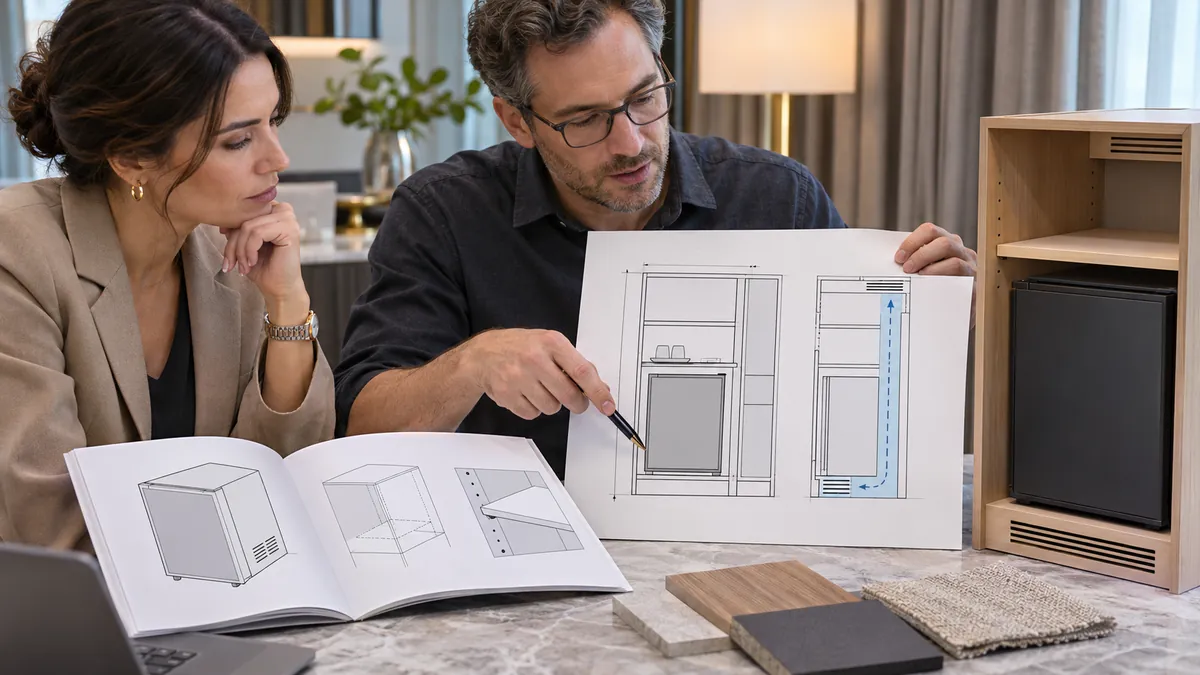
The interface should be reviewed with the named minibar manual and the final cabinet configuration, because the appliance’s own installation envelope controls the metal accessory boundary.
For each state, collect a photo, drawing reference, observation, owner and result. A practical result can be approved, revise, hold for appliance-owner confirmation or not applicable. Avoid writing “ventilation passed” unless a qualified person used an appropriate documented method and owns that statement. The metal supplier can record that a shelf matches a provided exclusion drawing; it should not convert that fit observation into an appliance-performance claim.
Record what the sample can and cannot establish
A fit review can establish that the sampled shelf occupies the intended envelope, attaches as shown and does not physically conflict with the tested cabinet components. It cannot prove that an appliance cools adequately, meets electrical safety requirements, consumes a particular amount of energy or remains reliable over its life. Those require product-specific evidence and the proper technical owner.
Likewise, a visual opening around a grille does not measure airflow. A sample photograph may support a design discussion, but it should not be used as a certification or system test. If the hotel or appliance maker requires testing, define that separately: who performs it, what equipment and operating conditions are used, and which result authorizes release. Do not invent a temperature, clearance or airflow threshold in the accessory article.
Common interface conflicts to prevent before sample approval
Shelf crossing a vent zone. A bracket, rail, shelf lip or stored object may intrude into a keep-clear area marked in the appliance instructions. The exact boundary must be taken from the selected model and translated by the responsible project owner. The metal supplier can follow an approved drawing; it should not infer a safe boundary by examining a photo.
Fixing point competes with appliance clearance. A screw, bracket or mounting plate may be positioned where the appliance must be inserted, fixed or removed. The cabinet designer and appliance owner should coordinate those operations. The metal supplier should receive the approved fixing substrate and position, not a guessed wall construction.
Service access is treated as permanent access. A manual may require a filter or other point to remain accessible for a specific maintenance action. “Accessible” should be described by the actual operation: reach a filter, release a fixing, remove the appliance, open a panel or inspect an inlet. If a service task requires a tool or a particular sequence, preserve the current maker instruction and record the sequence.
Shelf load changes the geometry. A shelf intended for glassware or other items may deflect under load depending on its span, support and construction. Define the intended product and load condition with the responsible engineer. Do not assume an apparently sturdy shelf is acceptable or add unverified load capacity to the product copy. The approval should apply to the tested construction, materials, joints and mounting method.
Furniture revision changes the inlet or service route. A cabinet maker may add a rear panel, trim, grille, divider or cable access after the accessory sample. Even if the minibar model stays the same, the installation context may change. Update the interface register and repeat the affected checks. A previously approved metal part is not automatically approved in a new assembly.
Mixed room tiers create hidden variants. Procurement may issue one metal accessory across multiple rooms to simplify purchasing. If a room has a different minibar, cabinet depth or door swing, list it as a separate variant and obtain the relevant appliance instructions. Do not use a sample from one room type as evidence for unreviewed layouts.
A marketplace image substitutes for a manual. Product photos rarely show all clearances, fixing requirements or service instructions. Obtain the manufacturer’s technical documentation for the exact model. If it is unavailable, hold the interface for confirmation instead of extrapolating from a visually similar appliance.
Keep approvals with the right project owners
The hotel’s project buyer coordinates schedules and commercial packages, but each technical decision still needs a named owner. The appliance maker or its qualified representative owns appliance installation constraints. The casegoods designer owns the cabinet structure and openings. The project electrical professional owns electrical requirements. The metal supplier owns the accuracy and workmanship of its part within the approved specification. The hotel maintenance team can comment on practical servicing, but it does not replace technical sign-off where a maker or code requires one.
An RFQ should say which documents are reference only and which drawings control. A sensible order may include: appliance maker instruction, coordinated cabinet drawing, metal accessory drawing, sample observation record and final approved submittal. The project’s contract or document-control procedure decides precedence; this article does not establish legal order. Put revision numbers, dates and approver names on the files.
If the appliance owner moves a vent, changes its model or updates its manual, the buyer should notify the cabinet and metal suppliers. If the metal supplier proposes to move a bracket to avoid an interference, the revised drawing must return to the project owner for review. No supplier should assume that one party’s local design adjustment preserves the entire system. A controlled comment process can reduce back-and-forth: identify the changed feature, reason, affected zone and sign-off owner.
For a metal fabrication quote, provide the current accessory drawing and the approved appliance/cabinet interface. If the intended design remains uncertain, ask for a feasibility review rather than a production commitment. Buyers who are preparing drawings or samples can use Koitor’s drawing and sample preparation guide to organize metal-part inputs. A separate coffee-appliance article about water-tank access is available in the coffee station rack access guide; its appliance and service conditions should not be transferred to a minibar.
Project release checklist for a metal minibar accessory
Before a sample is released, confirm each item with the relevant owner:
- Exact minibar manufacturer, model, variant and current manual revision are recorded.
- Cabinet interior drawing and room configuration match the intended installation.
- Vent, fixing, moving-part and service zones are drawn from the appliance-specific instructions.
- The metal shelf’s purpose, envelope, mounting, finish and buyer-defined load are stated.
- The accessory drawing identifies its revision and uses the project-approved exclusion zones.
- Any electrical, installation or appliance-performance question is assigned to the proper professional.
- The sample represents the final cabinet and minibar, or differences are listed.
- Static, operating, access and removal positions were reviewed.
- The supplier’s scope separates metal-part fit from appliance ventilation and safety approvals.
- Open questions have an owner and due date; unresolved items are not treated as a production release.
- Revisions to the appliance, cabinet or shelf trigger a targeted recheck.
- Product descriptions avoid performance language that the available evidence does not support.
This checklist can be attached to an RFQ, sample approval or hotel project submittal. Adapt it to the project’s own engineering and compliance process. It is a handoff aid, not a substitute for appliance instructions, installation design or local requirements.
A metal shelf’s procurement value should be evaluated against the actual use case. If the minibar already includes all required storage and service clearances, adding a shelf may create extra parts and coordination without a buyer benefit. If the project has a clear need, ask whether it can be placed outside the appliance envelope, whether it should be removable, and who will maintain it. These questions help the buyer avoid designing an accessory simply because space appears available in a rendering.
Hospitality teams may be balancing standardization, room tiers, replacement parts and service routines. Documenting the minibar model and accessory separately helps future purchasing staff understand why a shelf has a particular shape or position. It also supports a controlled substitute review if the original appliance is discontinued. A different model may use a different vent arrangement or service method, so substituting by outside size alone is not enough.
A useful supplier conversation starts with an approved boundary. Koitor can discuss a metal shelf or bracket against a buyer-provided drawing and sample, within confirmed metal fabrication and small-batch OEM capabilities. The appliance owner must still approve ventilation and service constraints. Buyers can review the custom metal storage basket manufacturing scope as general metal-product context, not as a claim about minibar performance.
FAQs for hospitality buyers
Can a metal shelf sit above or beside any hotel minibar?
Not automatically. The selected appliance’s installation manual controls vent locations, clearances, fixing and access. The casegoods drawing and metal shelf must be compared with that model-specific envelope. A visually similar minibar may have different requirements.
Can I use the Dometic DM20D/F manual dimensions for another model?
No. The manual applies to the named DM20D/F models and its stated configurations. Use it as an example of the kind of details a buyer should seek, not as a universal minibar standard. Obtain the current instructions for the exact appliance.
Does a visual check prove that ventilation is adequate?
No. A visual review can identify obvious physical interference with a marked zone, but it does not measure airflow or prove cooling performance. The appliance maker or qualified project owner should determine what evidence is needed.
What should the metal supplier receive?
Provide the current accessory drawing, cabinet drawing, appliance model/revision, relevant manual pages, marked no-go zones, mounting conditions, purpose, appearance/finish requirements, buyer-defined load where relevant and sample approval steps. Identify which items are informational and which are approved constraints.
Who approves appliance service access?
The appliance maker or its qualified representative provides model-specific service instructions. The project owner or responsible installer coordinates those instructions with casegoods. The metal supplier should not redefine a filter or removal route by guesswork.
Should the shelf be removable?
That depends on the room’s use and the appliance/cabinet arrangement. Removability may help with service or replacement, but it can introduce fasteners, handling and storage decisions. Specify the operation and get the project owner to approve the sequence.
Can Koitor certify that the minibar will operate correctly with a shelf?
No such capability is asserted here. Koitor’s relevant scope is metal hardware manufacturing and buyer-led drawing/sample review. Appliance performance, ventilation, electrical safety and installation approval belong to the appropriate appliance and project professionals.
For a metal accessory feasibility review, share the approved cabinet drawing, minibar model and current exclusion zones. Contact Koitor through the project inquiry page. Keep appliance requirements and metal-part scope explicit in the request.
Coordinate a Hotel Metal Shelf
Send the approved cabinet drawing, minibar model, current appliance manual and marked exclusion zones. Koitor can discuss metal accessory feasibility within its confirmed scope.
OEM / PRIVATE LABEL
Turn this sourcing guide into a product brief
Share your target product, size, finish, order quantity and packaging requirements. Your team receives a practical manufacturability review before quotation.
 English
 Español
 Português
 Français
 Deutsch
 العربية