
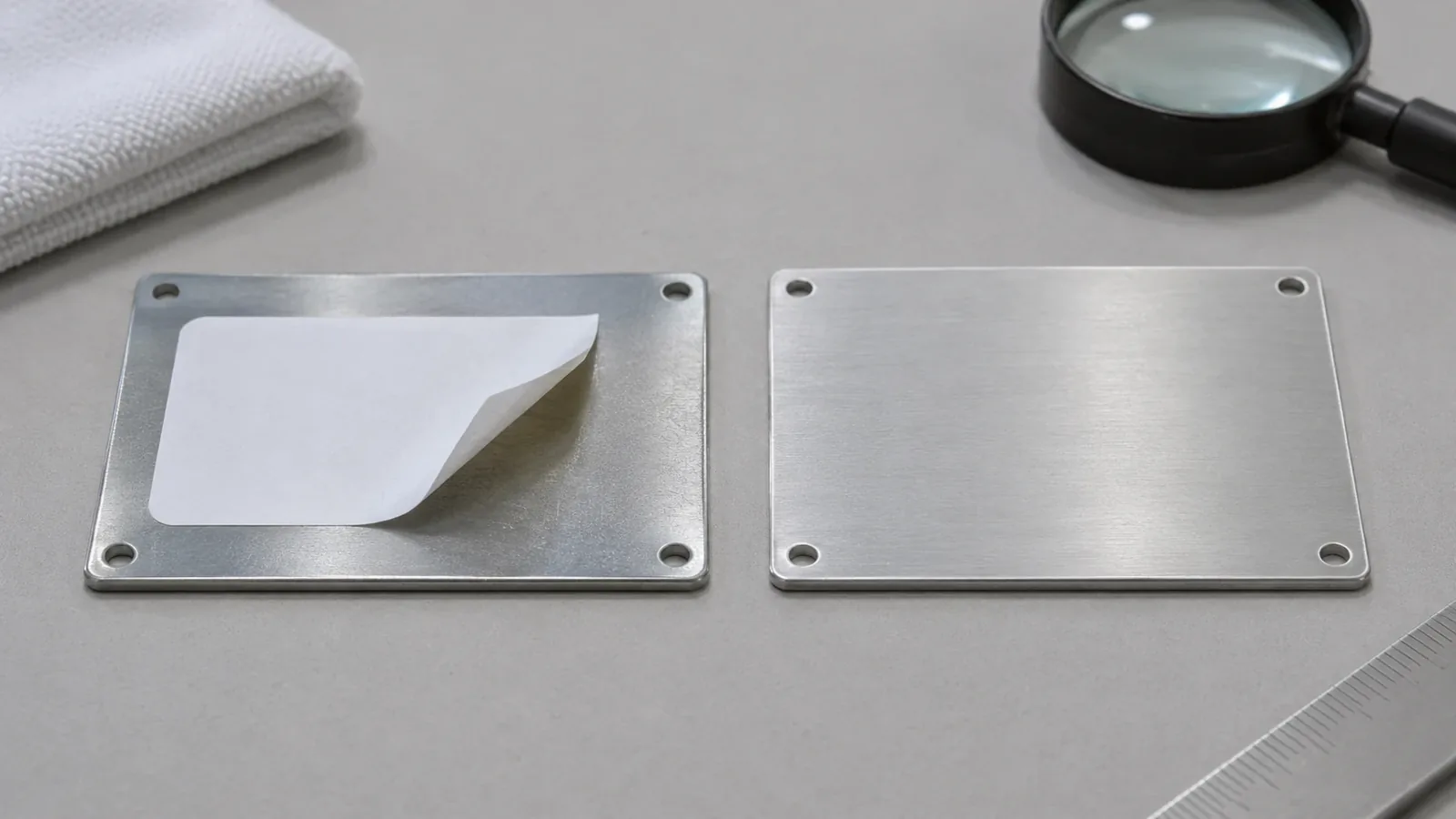
How to remove adhesive labels from metal depends on the label adhesive, the metal finish, and nearby materials, so identify the surface before choosing a remover. For an importer or distributor, the safest sequence is to check the product maker’s instructions, remove the label only by an approved method, test any permitted cleaner on an inconspicuous compatible area, and stop if the finish changes. Keep structural mounting adhesives outside this advice: removing a shipping or identification label is not the same task as releasing a bonded hardware component.
What Should a Buyer Identify Before Removing a Label?
First decide what the label is doing. A removable shipping label, warehouse barcode, retailer sticker, compliance mark, carton label, and permanent product identification label may have different purposes. Removing the wrong mark can erase traceability, obscure a required warning, separate a product from its lot, or violate an internal packaging specification. Confirm the label owner and the reason it must be removed before touching it.
Next identify the surface under the adhesive. “Metal” is not a finish specification. A bathroom accessory can have polished stainless steel, brushed stainless, plated steel, powder-coated steel, anodized aluminum, a clear topcoat, or several materials in one assembly. A cleaner that is acceptable on one may affect another surface, nearby plastic, a seal, a printed instruction, or a decorative layer.
Use the drawing, product record, approved sample, packaging specification, and supplier documentation to establish the finish. If a component is purchased from another supplier, preserve that supplier’s material and care guidance. Do not infer the substrate from a magnet, color, shine, or product photograph. Those observations may guide a question but do not prove the complete surface stack.
Then classify the adhesive task:
| Task type | Buyer question | Why it changes the response |
|---|---|---|
| Removable shipping label | Can the label be peeled without affecting the product or its packaging? | The label may not be designed for direct application to the finished hardware. |
| Retail or barcode label | Which identification data must remain traceable? | The label may connect the item to inventory, lot, return, or retailer systems. |
| Residue from a removed label | What finish and adjacent materials contact the proposed remover? | Residue treatment can expose the surface to chemicals or abrasion. |
| Structural adhesive or mounting pad | Which product-specific release method applies? | It carries or positions hardware and may be a safety-critical part of installation. |
This article covers the first three cases only when the product owner allows label removal. It does not recommend dissolving, heating, cutting, or prying a structural adhesive joint. If the label is part of product identification, compliance, installation instructions, or warranty control, obtain approval from the brand or quality owner first.
How Can a Buyer Test a Label-Removal Method Without Damaging the Product?
Treat a test as a controlled compatibility check, not proof that a method works on every surface. Follow the exact cleaner manufacturer’s directions and safety documentation, and test only when the product maker and finish owner allow it. The product’s own care instructions take priority over a general-purpose adhesive remover’s broad marketing language.
Before any test, document the product code, finish revision, label type, adhesive age if known, and selected part. Choose a discreet area of the same finished surface when the supplier allows it. A separate coupon can be helpful, but it should match the same substrate, pretreatment, finish route, cure, and relevant geometry closely enough to answer the question. A coupon from an unrelated process is not representative evidence.
Record the before condition with neutral-light photographs and note the appearance or approved sample used for comparison. Follow only the cleaner’s product-specific application method; do not increase concentration, dwell, rubbing force, or temperature to make the result appear faster. If the supplied instructions call for a compatibility test, follow that exact instruction and have the responsible owner approve the result before scaling it.
The 3M technical data sheet for General Purpose Adhesive Cleaner, for example, describes particular uses and instructs the reader to test an inconspicuous area for compatibility. The same document identifies its product as a professional-use cleaner and lists its own formulation and handling context. That is evidence for the product’s stated scope, not blanket approval for every anodized, plated, coated, or assembled bathroom part. Follow the exact product’s current label and safety documentation, and ask the finish owner when the instructions do not match your product.
Stop the test if there is color transfer, gloss change, dulling, swelling, tackiness, softening, a visible scratch, residue spreading, odor or heat concern, or any other unexpected change. A result that looks acceptable immediately may not address delayed effects on a topcoat, adhesive, plastic, or printed mark. If the item is a production product, ask the responsible supplier whether a longer observation period or another inspection is needed before approving the method.

Which Methods Should Not Be Assumed Safe for Every Metal Finish?
Do not assume that a solvent, oil, citrus-based product, alcohol, heat source, plastic scraper, metal blade, scouring pad, or polishing compound is universally safe. Even a method described as “gentle” can scratch a soft finish, soften a polymer, affect a seal, leave a film, or alter the appearance of a brushed or plated surface. The exact result depends on the surface and product, and a label adhesive can differ by supplier, age, temperature, and storage history.
Avoid using a household internet recipe as a substitute for product-specific instructions. A method written for glass, automotive paint, a bare metal sheet, or a kitchen utensil does not establish compatibility with a multi-material bathroom accessory. Likewise, a cleaner’s general claim that it works on metal does not mean every metal finish is covered.
Use these buyer safeguards:
- Do not scrape a visible face with an unapproved blade or hard-edged tool.
- Do not apply an unknown chemical to a finished part because it removed residue from another sample.
- Do not heat an assembled product to soften adhesive unless the exact product owner has approved the method and controls.
- Do not soak a component if seams, fasteners, labels, seals, or cavities can trap the liquid.
- Do not mix cleaners or transfer them into unmarked containers.
- Do not increase pressure or repeat rubbing after the surface begins to look different.
- Do not treat a cleaner’s stated use on “metal” as confirmation for powder coating, anodizing, plating, or topcoats.
Chemical products can present worker exposure, flammability, or handling concerns depending on their formulation and use conditions. OSHA’s guidance for solvent and chemical hazards is workplace- and task-specific; it is not a label-removal procedure. Employers and processors should use the applicable safety data sheet, hazard communication, and controls for the material and operation. A buyer should not prescribe a method that requires a professional control environment as if it were a consumer care step.
How Should a Buyer Separate Label Adhesive From a Structural Mounting Adhesive?
The distinction is essential. A packaging label is generally applied for identification, logistics, or retail handling. A structural or mounting adhesive helps retain, position, or support the product. Removing it can change how a towel rack, hook, soap holder, or other accessory stays attached. The label-removal method in this guide must never be applied to a load-bearing or installation adhesive by analogy.
If a product includes an adhesive mounting plate or pad, identify the exact model and obtain the maker’s removal instructions. Some branded mounting systems provide a defined release method for that product; another system may use a different adhesive, substrate limitation, or tool. Do not assume that a visible tab, pull strip, or release direction exists on every model. If the mount is unidentified, stop and ask the product supplier.
Keep the product attached and installed according to its manual while identifying the system. If it is loose, damaged, or supporting an object, follow the maker’s safety guidance and remove the load as directed before proceeding. Do not pull, twist, pry, heat, or insert a tool behind an unknown mount. Those actions can damage tile, paint, a countertop, the product, or the user.
For a returned item, record whether the issue concerns the packaging label, a residue on the metal, or the mounting adhesive between the accessory and the wall. Ask the customer or service team to send a wide photo and close-up before any attempt to remove the hardware. This simple classification prevents an aftersales reply from accidentally recommending a mounting release based on a label-cleaning article.
What Should Importers Check After Label Removal?
Inspect the product against its approved finish sample and product requirements, not only for visible glue. Check the area under the label and the surrounding surface for color difference, gloss change, scratches, softened material, cleaner residue, lifted coating, printing damage, or an edge that has been disturbed. A surface can appear clean while still differing from the approved cosmetic sample.
For multi-component products, review adjacent materials and interfaces too. A soap dish or shower basket may combine metal, rubber, plastic, adhesive, a purchased fastener, and a printed insert. If any cleaner touched more than the label zone, document which parts were exposed. The product may require a new assembly check if a component was removed or disturbed during access.
Use a controlled inspection record:

| Inspection item | Comparison basis | Record |
|---|---|---|
| Surface appearance | Approved sample or finish specification under agreed light | Photos and inspector/date |
| Coating or plating edge | Drawing and visible-face criteria | Location and condition |
| Residue | Product-specific cleanliness requirement | Approved check method and result |
| Identification | Label plan, barcode, lot, and product traceability | Original and replacement identifiers |
| Adjacent materials | Assembly drawing and approved sample | Any exposure or observed change |
| Disposition | Buyer acceptance, rework, hold, or replacement decision | Owner and authorization |
If the product is part of an incoming lot, do not generalize a one-piece test to all units without defining the sampling and traceability plan. Labels can differ by application, storage time, supplier, and carton condition. The buyer and supplier should agree how many items are checked, what counts as a change, and what happens if the result varies.
For recurring shipments, the label specification should control where and when labels are applied. A label placed on a protective bag or carton may meet tracking needs without touching a cosmetic part. If direct application is unavoidable, agree the approved zone and orientation on a drawing or annotated sample. Also record whether the item is labeled before or after finishing, packaging, or final inspection. A label added at a later handling stage may be applied to a different surface condition or for a different data purpose than the original supplier expected.
The buyer should separate adhesive performance from product finish acceptance. A label that stays attached through transit may still leave residue when removed; a label that peels cleanly from one coupon may fail on a different finish or after longer storage. For qualification, keep a record of the product and finish revision, label construction or supplier identification, application step, storage and shipment conditions considered, removal instruction, and the comparison surface used. Define who can authorize a label substitution and whether the substitute needs a new sample review.
The sequence matters to lot control. If cartons are relabeled after inspection, the new barcode or lot code must remain tied to the original product identity. If an individual hardware piece is relabeled, document how the previous mark is voided and how the new identifier is verified. A service team that asks how to remove adhesive labels from metal may be trying to correct a traceability mismatch rather than clean a cosmetic surface. Resolve that data issue first; otherwise a visually clean part could be detached from its quality record.
When a finished part arrives with an unauthorized label, pause the affected units and photograph the label and surface before removal. Notify the supplier or brand owner, determine if the label blocks a required mark, and agree the disposition. If the same unexpected placement occurs repeatedly, treat it as a packaging-process change to correct at the source instead of creating a recurring manual-cleaning instruction. This reduces finish exposure and keeps repacking, relabeling, and quality records under the same controlled decision.
For a coating-preparation context, see Koitor’s live article on surface dust and coating preparation. That page addresses a separate manufacturing inspection question and should not be read as validation of any adhesive remover. For cleaner selection on coated bathroom products, use the distinct guidance on powder-coated hardware cleaner compatibility together with the exact maker’s instructions.
What Should a Packaging or Product Specification Say About Labels?
Preventing the removal question is often easier than cleaning residue after a label is applied to a finished face. The buyer can define where labels may appear, which surfaces must remain label-free, whether adhesive contact is allowed on a cosmetic face, how barcodes are oriented, and how label data maps to the product or carton. Make the label plan part of the packaging drawing or controlled specification.
For each product or pack configuration, record:
- Label purpose: shipping, stock, retail, lot traceability, or customer information.
- Permitted location and orientation, including a no-label zone for visible faces.
- Label stock and adhesive supplier or approved equivalent, if known.
- Application surface and whether the label contacts a protective film, carton, or finished part.
- Required legibility and scanning checks after transit or storage.
- Authorized removal or replacement process, if any.
- Who approves a substitution of label material, adhesive, or position.
- How the product’s lot and revision remain traceable if a label is replaced.
Do not specify an adhesive or label product solely by its marketing description. A label vendor’s compatibility statement may cover certain surfaces and conditions but not every powder-coated, anodized, plated, painted, or polished substrate. If the label will contact a finished product, request the vendor’s technical guidance and validate it against the actual finish and exposure conditions.
The same control matters when protective film is used. A film adhesive can leave residue or affect appearance after extended storage or exposure. A packaging sample should represent the intended surface, application, storage interval, and removal conditions. If the product finish or label stock changes, review the specification and retain the newly approved sample rather than assuming the former result remains applicable.
How Can a Small-Batch OEM Factory Support Label and Finish Controls?
A factory can help map the product drawing, visible faces, packaging layout, label location, finish requirement, and sample-approval path. Koitor Hardware is a family-owned custom metal hardware factory focused on bathroom and home-storage products. Its approved scope supports product customization from drawings or samples, manufacturing coordination, assembly and packaging-preparation discussions. It does not establish that Koitor manufactures every label, adhesive, coating, or bought-in component in a customer’s product.
For a sourcing discussion, share the product drawing or sample, finish identity, packaging artwork or label location, lot-traceability requirement, target quantity, and any known residue issue. The team can help clarify whether the question belongs to the metal part, the surface-finishing supplier, the packaging vendor, or the brand owner. If a chemical product is being considered, the responsible supplier must confirm the application and handling scope; do not rely on an unverified factory assumption.
A controlled sample can help a buyer approve label placement and product appearance before a small trial order. It should include the actual product revision and intended packaging materials. If sample timing or MOQ is discussed, confirm the current project details: MOQ can start from 100 pieces depending on the product; samples usually take 5–7 working days after details are confirmed; and bulk production usually takes 4–6 weeks depending on quantity, finish, and packaging. These are planning ranges, not a promise for a special removal or compatibility test.
The OEM home-storage hardware manufacturer overview explains the relevant product-development scope. Send the item, drawing revision, actual finish and label question through the Koitor contact page so the response can be tied to the correct configuration.
Frequently Asked Questions
How to remove adhesive labels from metal without scratching it?
First identify the finish and the label’s purpose. Follow the product maker’s approved method, and test a cleaner only when both the cleaner’s instructions and the finish owner allow it. Do not use an unapproved blade, abrasive, heat source, or solvent on a visible surface.
Does a cleaner labeled “safe for metal” work on powder-coated hardware?
Not necessarily. “Metal” can refer to a bare substrate and may not cover a powder coating, topcoat, plating, or assembled product. Check the cleaner’s technical and safety documents and obtain compatibility approval for the exact finish.
Can I use the same product on anodized aluminum and plated steel?
Do not assume so. These are different surface systems, and the product may also include plastics, seals, or printed components. Use SKU-specific care guidance or get the finish owner’s written confirmation.
Should a barcode or lot label be removed before resale?
Only when the responsible brand, inventory, and quality teams approve it. Preserve the lot and model traceability, and replace the label only under the controlled data and packaging process.
Is warm air a safe way to loosen an old label?
This guide does not recommend applying heat to an unknown finished or assembled product. Heat may affect coatings, adhesives, plastics, nearby labels, or the product itself. Use only a method explicitly approved for the actual item.
Can I use adhesive remover on a mounting pad?
No general label-removal advice should be applied to a mounting pad. Identify the exact hardware model and follow the manufacturer’s mounting-release instructions. If the mount is unknown, stop and ask the supplier.
What if label residue remains after an approved test?
Stop rather than escalating the chemical strength or rubbing force. Record the label, finish, cleaner, exposure, and surface condition, then ask the product owner or finish supplier for the next approved step.
Work With Koitor Hardware
Share the product revision, surface finish, label purpose and location, and any observed residue or finish change. Koitor can help clarify the metal hardware and packaging scope; use the product maker’s instructions for consumer care and mounting systems.
Approve Label Placement Before the Finished Product Ships
Send the drawing or sample, finish identity, label location, and traceability requirement for a scoped review.
OEM / PRIVATE LABEL
Turn this sourcing guide into a product brief
Share your target product, size, finish, order quantity and packaging requirements. Your team receives a practical manufacturability review before quotation.


 English
 Español
 Português
 Français
 Deutsch
 العربية