

An edge trim grip range is the supplier-defined panel-edge thickness interval that a particular trim profile is intended to accommodate. Buyers should identify the actual metal edge in its production condition, compare that condition with the exact trim family’s documented range, and ask the trim supplier to confirm the proposed pairing. A profile’s outside shape or a generic “U-channel” description does not establish its mating range. A sample review should record the panel revision, finish state, trim identity, and what was actually confirmed.
This guide covers buyer-side identification and RFQ coordination for a sheet-metal assembly that may use a separately sourced perimeter trim. It does not specify an installation method, create a universal gauge-to-profile chart, or establish retention, sealing, impact, fire, chemical, safety, or regulatory performance. The linked trim example is a named supplier product; it is not a Koitor product or a claim that Koitor manufactures plastic extrusion. The responsible trim supplier and the buyer’s product team must confirm the actual application.
What does an edge trim grip range describe?
An edge trim grip range describes which substrate-edge thickness interval the trim supplier associates with a named product profile. The buyer’s first task is to identify the material and edge that the trim must mate with, then find the supplier’s range for the exact proposed profile and option. The range is not established by the trim’s external width, a photograph, or a broad family name.
Trim-Lok’s current product page describes one size-ranged flexible PVC edge-trim family with internal steel clips and gripping tongues, and presents product choices associated with different edge-thickness ranges. That is useful evidence about how this specific supplier organizes its range: the substrate thickness is a selection input, while the outer appearance alone is not enough. It does not mean every edge trim uses that construction, every listed range works on every metal edge, or a different supplier’s product may be selected by the same naming convention. See the Trim-Lok size-ranged edge-trim product page for that family’s current product information.
In a purchasing record, keep four terms separate:
| Term | What the buyer should record | What it does not establish by itself |
|---|---|---|
| Substrate edge | The panel or sheet edge that meets the trim | A fit with an unselected trim profile |
| Edge-thickness range | The named supplier range for the exact trim option | A universal tolerance or acceptance range |
| Exterior profile | The visible outer cross-section and finish | The hidden mating dimension or retention method |
| Pairing approval | The supplier’s confirmation for the identified panel state and trim | Long-term performance or compliance beyond the evidence supplied |
Treat “grip range” as a product-selection term that must be tied to the supplier’s documentation. It should not be converted into a buyer-created engineering tolerance unless the responsible supplier or product engineer has defined that use. If a catalogue uses “edge thickness,” “panel range,” or another term, preserve its wording and add a plain-language explanation in the buyer record.
Which panel thickness should a buyer compare with the trim range?
Compare the trim supplier’s stated range with the actual edge condition the trim is expected to meet, not an unexplained nominal gauge copied from a preliminary concept. The product drawing may state a sheet thickness, but the edge presented to a separate accessory may also reflect the project’s defined bends, hem, coating, plating, deburring, edge finishing, or other operations. Which of those details matters depends on the part geometry and the trim supplier’s requirements.
The purpose of this review is to surface a question, not to invent a correction factor. A buyer should not add a guessed coating allowance, subtract a guessed bend effect, or assume that nominal material thickness is identical to a measured finished edge. Instead, identify the state represented by the drawing and sample. If the edge is coated or formed before trim selection, state that. If the buyer only has an early drawing, label the condition as preliminary and ask what information the supplier needs to assess it.
A useful record separates known facts from unresolved details:
| Field | Example of a traceable entry | Status to preserve |
|---|---|---|
| Metal part identity | Panel number and drawing revision | Confirmed by controlled drawing or sample label |
| Edge under review | Straight perimeter edge, formed return, hem, or other named feature | Identify the exact edge; do not infer from a product photo |
| Thickness basis | Drawing callout, measured sample, or supplier-provided product range | State whether it is nominal, measured, or supplier-confirmed |
| Process state | Before finish, after finish, or production-intent sample | Keep the state explicit; do not mix unlike samples |
| Trim identity | Supplier, product family, option, item number, and revision if available | Unresolved if the quotation names only a generic family |
| Open question | Any missing dimension or fit detail requested by the supplier | Keep open until the responsible party answers |
This record is a buyer coordination aid, not a manufacturing drawing standard. Units, measurement locations, tolerances, and acceptance methods should follow the controlled project documentation and the responsible supplier’s direction. If a trim supplier needs a different edge dimension than the buyer’s first estimate, ask what is being measured and at which process stage rather than silently changing the metal drawing.
Why is the exterior U-shape not enough to identify the mating range?
A visible U-shaped profile can help describe the trim’s general form, but it does not identify the exact supplier family, internal retention construction, or substrate range. Several products can look broadly similar while having different material descriptions, internal clips, size options, or application conditions. Product naming should therefore include the exact item and evidence source, not only a generic shape description.
The Trim-Lok product page describes flexible PVC and internal steel clips with gripping tongues for its listed size-ranged product. Those statements apply to the named product information reviewed here. They do not establish that all flexible profiles contain metal clips, that every size range is suitable for a buyer’s panel, or that the trim will stay attached under a particular use condition. A product family may also list possible applications beyond a metal storage panel; those examples should not be transferred to another product without supplier review.
When comparing quotations, ask each supplier to identify the exact range and option behind its proposed profile. If one quotation includes a product code and technical drawing while another says only “black edge trim,” they do not yet provide equivalent evidence. The buyer can request the same comparison fields from each supplier: product identity, mating-edge range, material description, configuration, any stated limitations, order unit, and documentation revision. Do not assume that different suppliers’ range labels use identical measurement conventions.
The original product diagram linked from the Trim-Lok page labels “Edge Thickness” at the substrate side. That visual label can help a team understand which part of the assembly is being referenced. The diagram is not a dimensioned drawing and does not establish a gripping force, interference, clip spacing, compression, bend radius, or installation procedure. A label in an illustration is not a substitute for the exact specification or confirmation for the chosen product.
How should the metal edge and trim be reviewed together?
Review the proposed trim against an identified metal-panel state and keep the supplier’s answer tied to that combination. A generic sample can clarify appearance, but it does not confirm the production part if the panel revision, finish state, trim option, or edge construction is different. The buyer should record the evidence used and any conditions that remain unverified.
For a first review, prepare the controlled drawing or production-intent sample for the relevant edge, the proposed trim product code or supplier page, and a short list of unanswered questions. Ask the responsible trim supplier whether the stated range covers the described edge condition and what additional information is required. If the supplier requests a measured sample, document how it was identified and whether it represents the planned production stage. Do not alter the metal part or trim based only on a visual approximation.
For a sample review, the buyer can make a comparison plan with the responsible supplier. It may include the documented edge condition, the identified trim option, the method the supplier recommends for evaluating the pairing, and the result that will be recorded. If the production design has multiple edge conditions or revisions, list them separately rather than assuming one observation applies to all. The method and pass criteria should come from the responsible product and component teams; this article does not supply a universal push, pull, retention, cycle, or environmental test.

After the review, record one of three outcomes in ordinary buyer language: confirmed for the identified sample and documented state; provisionally selected pending a missing answer or production-intent sample; or unresolved because the product identity or mating condition remains unclear. Do not use “approved” when the evidence covers only an appearance check, and do not treat a supplier’s general catalogue range as proof of approval for every project edge.
If the panel drawing, trim option, process state, or supplier changes, assess whether the prior confirmation still applies. A replacement trim with a similar exterior appearance may be a different profile. A reworked panel may present a different edge. The purpose of change control is to reopen the specific affected question rather than repeat the entire project review automatically or carry old approval forward without checking.
What should a buyer include in an edge-trim RFQ?
An RFQ should identify the metal edge, the process state being quoted, the proposed trim family or the desired application, and the evidence the supplier should return. If the buyer does not yet know the exact trim option, the RFQ should say so and request a supplier recommendation against the attached panel information. It should not present a guessed profile range as a confirmed requirement.
Useful RFQ fields include:
- Metal part name, controlled drawing number, and revision.
- Exact edge location or drawing view where the trim would be used.
- Substrate material and the drawing’s stated thickness, with units.
- Whether the supplied information is nominal, measured, preliminary, or production-intent.
- Relevant edge geometry, such as a formed return or hem, as shown in the controlled drawing.
- Finish and process state at the point where the trim is expected to mate.
- Trim supplier and exact product family, item number, option, color, and revision if known.
- Supplier-stated edge-thickness range and the source document or product page.
- Questions about measurement basis, material, profile, installation, or application limits that the supplier must answer.
- Which samples or drawing revisions the supplier has reviewed.
- Quote unit, order scope, packaging unit, and how the trim identity will be tracked in the BOM.
- Any requested project-specific confirmation and the person or supplier responsible for providing it.
The last field matters when different companies own the panel, finish, and trim. A metal manufacturer can describe its part and controlled drawing; the separate trim supplier is responsible for its own product limits and mating recommendations. The buyer should make responsibility explicit rather than expecting one supplier to certify another supplier’s product. For a custom metal project, Koitor can discuss the metal drawing, forming, finish, and assembly context within its confirmed scope. The trim manufacturer remains the source for product-specific range and compatibility information.
When there is more than one trim proposal, ask for each option to be recorded against the same panel revision and edge state. Keep alternatives separate in the quote and sample record. Do not combine the most favorable dimension from one product sheet with the retention language of another supplier’s product to create a synthetic specification.
How does edge trim relate to metal-edge acceptance?
The buyer’s trim selection and the metal part’s edge acceptance are separate decisions. A trim accessory does not automatically correct a burr, substitute for the drawing’s deburring requirement, establish safe handling, or prove that a finished metal edge meets an applicable specification. The project owner should maintain the relevant metal-edge criteria even when a cover or trim is included.
This distinction prevents the team from treating a cosmetic accessory as evidence for an unrelated quality question. If the metal drawing defines edge finishing, deburring, or visual acceptance, keep that requirement in the manufacturing and inspection documents. If a trim is proposed to cover a particular edge, identify that as a separate assembly decision and ask the responsible parties what evidence applies. Do not claim that the trim makes a product safe, sealed, impact-resistant, fire-rated, or compliant unless appropriate project-specific evidence supports the exact statement.
The distinction also helps diagnose issues. If a sample appears inconsistent, identify whether the unresolved question concerns the metal edge, the trim profile, the pairing, or the inspection method. Avoid assigning cause to one supplier before the relevant item and state have been checked. Record the observation and the configuration; then request input from the responsible component supplier or product engineer.
For metal storage products, the broader drawing and sample may include other product-specific decisions such as forming, finish, weld placement, assembly sequence, and packaging. Koitor’s custom bathroom hardware manufacturing page and OEM home-storage manufacturing page describe the company’s metal-product context. Those pages do not establish that Koitor supplies the separately sourced trim. For an in-scope project, keep the metal component and bought-in accessory identities distinct when discussing manufacturability.
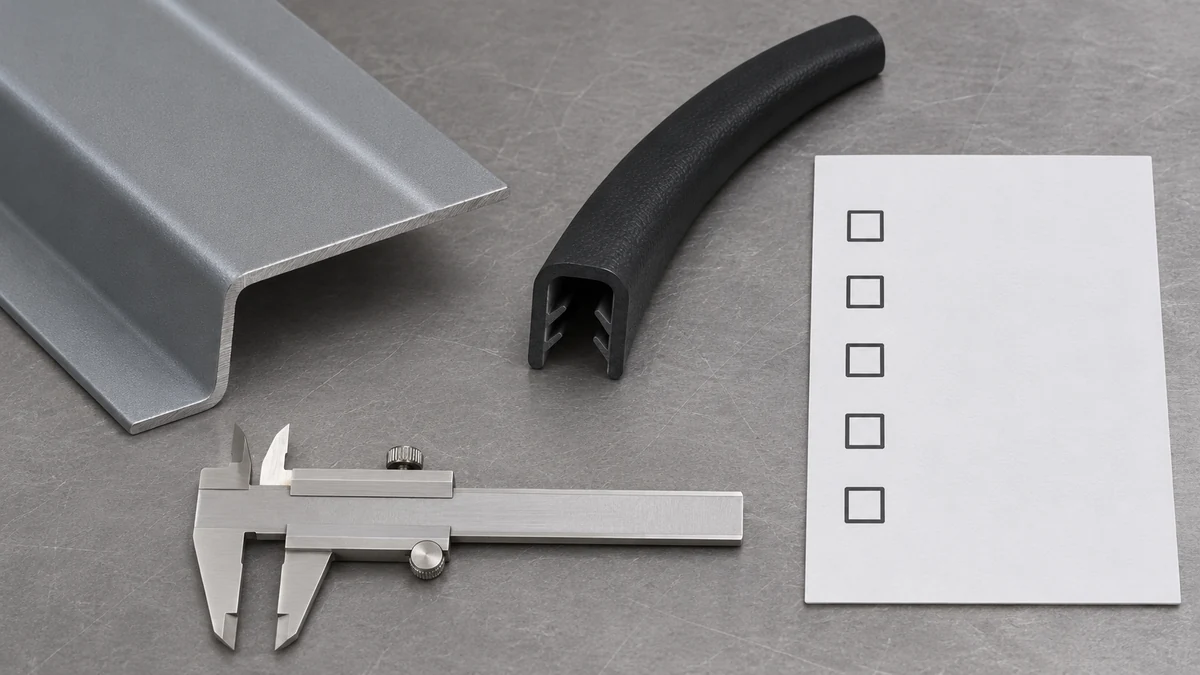
What should buyers check before approving a sample or repeat order?
Before sample approval, verify that the supplier reviewed the same metal part, drawing revision, process state, and trim option the buyer intends to purchase. Before a repeat order, check whether any of those identifiers changed and whether the prior confirmation still covers the revised condition. A sample approval should name what was reviewed rather than simply recording “edge trim fits.”
Use this checklist as a record prompt:
- Is the metal panel, drawing revision, and exact edge identified?
- Is the thickness basis clear: drawing callout, supplier range, or measured sample?
- Is the finish and process state of the reviewed edge stated?
- Is the exact trim manufacturer, family, item, option, and revision recorded?
- Does the supplier’s documented range apply to the identified edge condition?
- Has the responsible trim supplier confirmed the specific pairing or stated what remains open?
- Does the sample represent the planned production configuration?
- Are any project-specific evaluation method and acceptance criteria defined by the responsible team?
- Are the metal-edge acceptance requirements still maintained separately?
- Are the accessory identity, order quantity, packaging unit, and BOM line consistent?
- Have changes to panel, finish, trim, supplier, or drawing revision been screened for impact?
- Are unresolved assumptions visible to purchasing, product, quality, and manufacturing teams?
These prompts do not replace a project specification, supplier drawing, inspection plan, or professional safety review. They help buyers distinguish a documented decision from an assumption. The record should include the source and date of any supplier confirmation so another team member can trace which product information supported the selection.
For a proposed repeat order, compare the current order to the prior approved identity, not just to the previous product photograph. Confirm the panel and trim codes, revision, finish, quantity unit, and packaging scope. If a supplier proposes a substitute, treat it as a new option until the relevant product and component owners confirm its interface. A buyer may accept an alternative, but the acceptance should be explicit and tied to the new evidence.
A repeat-order file is most useful when it makes the evidence retrievable without relying on the memory of the person who approved the first sample. Keep the supplier quotation, the exact product page or technical drawing, the panel drawing revision, sample identification, and the written answer together. If a photograph is used, label which edge is shown and whether it is a pre-finish or finished part. A photograph should support identification; it should not replace a dimensioned drawing, product code, or supplier statement when those are needed for the decision.
When the metal panel comes from one supplier and the trim comes from another, assign a named owner for collecting each answer. The panel supplier can confirm the panel drawing, material callout, and process state it is quoting. The trim supplier can explain its own product range and what edge information it needs. The buyer or product owner then records the pairing decision and any remaining conditions. This division does not require either supplier to certify the other’s product. It makes the handoff clear and reduces the risk that an unanswered compatibility question disappears between a metal-part quote and an accessory purchase order.
If several product sizes share one trim family, do not assume that one sample covers all of them. Compare the documented edge condition for each part or identify which configurations are represented by the reviewed sample. The right scope can be narrow: a buyer may approve one panel revision with one trim option and leave another size unresolved. Recording a limited approval accurately is more useful than using a broad phrase such as “all panels approved” when the actual review covered only one configuration.
For incoming inspection or assembly records, preserve the same identifiers used during supplier review. If the delivered trim label, item code, or packaging reference differs from the reviewed record, pause the substitution decision long enough to confirm whether the product identity changed. A visually similar replacement may still be correct, but similarity alone does not answer whether its profile, range, or order scope matches the project. Record the supplier’s explanation and update the BOM or product record only after the responsible buyer accepts the change.
Frequently asked questions
Does an edge trim grip range prove the trim will stay in place?
No. The range is one supplier-defined selection input. It does not by itself establish retention under a buyer’s handling, use, environmental, or life-cycle conditions. Ask the trim supplier what the stated range covers and what project-specific evidence is available or required.
Can a buyer choose an edge trim by matching its outside width?
Not reliably. Outside appearance or overall width does not identify the exact internal profile, product option, or mating-edge range. Record the supplier and item identity, then compare the panel edge with the supplier’s information for that exact item.
Should the buyer use nominal sheet thickness or measure the finished sample?
Use the documentation basis required by the responsible trim supplier and project team. State whether the value comes from a drawing, a measured sample, or a supplier range, and identify the relevant process state. Do not silently treat those sources as interchangeable.
Does trim eliminate the need to specify deburring?
No. Trim selection and metal-edge acceptance are separate questions. Maintain the metal part’s drawing and inspection requirements, and do not claim that the accessory corrects an unaccepted edge unless the responsible parties have supplied evidence for that specific outcome.
Is a generic U-channel the same as a named edge-trim product?
No. “U-channel” can describe a broad shape, while a named trim product may have a particular material, internal construction, size option, and documented range. Use the supplier’s exact product identity and request confirmation for the intended panel.
Work With Koitor Hardware
If a project includes a custom metal bathroom or home-storage component, send Koitor the relevant drawing or physical sample, finish requirement, assembly context, packaging scope, and expected quantity. The team can review the confirmed metal-product scope and discuss manufacturability. Identify any bought-in edge trim separately; the trim supplier must confirm its own range and pairing information.
Discuss a Metal Panel and Its Edge Interface
Share the controlled metal drawing, edge location, finish state, and proposed trim reference. Koitor can first confirm the metal part’s production scope; the separate trim supplier remains responsible for its product-specific range and fit information.
OEM / PRIVATE LABEL
Turn this sourcing guide into a product brief
Share your target product, size, finish, order quantity and packaging requirements. Your team receives a practical manufacturability review before quotation.


 English
 Español
 Português
 Français
 Deutsch
 العربية