

A service sheet can only tell a buyer how to remove mirror clips once it says which clips hold the glass up and which clips hold it against the wall. Those two roles are released in a specific order, and the glass has to stay supported while that happens. A sheet that treats every clip the same leaves the mirror held by nothing at the wrong moment.
Most mirror clip sets contain lower clips that carry the weight of the glass and upper or side clips that stop it tipping forward. Some sets use spring-loaded top clips; others use fixed clips with a slot or an offset. The removal path follows the set, so the set has to be named first.
This guide is for importers, distributors and private-label teams selling frameless bathroom mirrors or mirror clip kits. Koitor Hardware is a family-owned China OEM manufacturer of custom metal bathroom and home storage hardware. The guide covers the take-down section of a service sheet; it is not a mirror demolition tutorial and not a glass-handling standard.
First hang is already covered on the published how to install mirror clips guide. Purchase units and the roles in a clip set are covered by the mirror clip set support and retention specification. This page adds the reverse path: the mirror is coming down, and the sheet needs to say in what order.
What does how to remove mirror clips depend on?
It depends on three facts: the roles of the clips in the packed set, the release order the supplier documents for that set, and the condition under which the glass is supported while clips are released. If any of the three is missing, the sheet cannot give a safe sequence.
Consumer searches for this task tend to start with a mirror that has been on the wall for years. People ask which clips to move first, whether the mirror is also glued, and how to stop it falling. Each of those questions maps to one of the three facts, which is why the sheet should answer them before the steps.
For a brand, the question is whether a listing can say the mirror is “easy to remove” or “easy to relocate” without qualification. That sentence implies a documented release order and a set designed to be released. If the packed set uses fixed clips that must be unscrewed under load, the sentence needs to change.
Start with a clip map. A simple drawing of the mirror outline with each clip marked by role is more useful than any paragraph. Label support clips, retaining clips and any side guides, and show the screw access for each one. Make the drawing match the packed set, not a catalog image.
Then write the release order exactly as the supplier documents it. Do not reorder for convenience, and do not borrow an order from a different clip design. If the supplier does not document an order, the sheet should say so and recommend contacting the supplier or a glazier rather than guessing.
Before any screw is turned
The sheet should open the removal section with a short preparation block. Clear the area under the mirror, lay a padded surface where the glass will be set down, and confirm who is holding the glass. These are general handling points, not glass ratings, and they make every later step safer.
It should also tell the user to look for fixings that are not clips. Some installers add a small screw through a clip slot, a hidden bracket, or a strip of tape behind the glass. If anything other than the packed clips appears to be holding the mirror, the documented removal path no longer fully applies.
Finally, note any electrical items near the mirror. Lighted mirrors, demister pads and nearby switches add wiring that a clip sheet does not cover. If the mirror has power, the sheet should send the user to the electrical product’s own instructions and to a qualified person before any clip is touched.
Which clips retain the glass and which ones support it?
Clip roles are the backbone of any removal sequence. They also explain why a removal order that works on one set can drop the glass on another. A short role section on the sheet prevents most of the problems reported in forum threads.
Support clips at the bottom edge
Support clips sit under the bottom edge and carry the weight. On most sets they are fixed and screwed into the wall or anchors. Removing or loosening them before the glass is held by hand or by a helper takes away the only thing the mirror rests on.
Because they carry load, support clips are usually the last parts released. The sheet should still not assume that; it should repeat the supplier’s order. What it can say is that support clips are load-bearing and should not be touched until the glass is supported by another means.
Retaining clips at the top and sides
Retaining clips stop the mirror tipping away from the wall. Spring-loaded top clips let the glass be lifted into a recess; fixed top clips may need loosening so the glass can tilt forward. Side guides keep the glass centered and may be fixed or adjustable.
The removal path for a retaining clip depends on its design. A spring clip may release by pushing the glass up into the spring, then tilting the bottom edge out; a fixed clip is loosened at its screw. The sheet must say which design is in the set and describe only that one.
Mixed and decorative sets
Some sets combine fixed support clips with a single spring top clip, or add decorative covers over the screws. Covers have to come off before the screw can be reached, and the sheet should show how they detach if the supplier documents it. A cover pried in the wrong direction often cracks.
When the set includes J-channel or a continuous bottom rail instead of clips, it is a different support system. A removal sheet for clips should name that as a different system and not try to extend clip steps to a channel.

What should the mirror clip removal section list?
A removal section works best as a short set of fields followed by a numbered sequence copied from the supplier. The fields come first because they decide whether the sequence applies at all. The table below is a template; it holds no glass weights, sizes or loads.
| Field | What to write | Source |
|---|---|---|
| Clip set name | The set or part name used on the packing list | Packing list and supplier drawing |
| Clip map | Drawing marking each support, retaining and side clip | Supplier drawing or factory photo |
| Retaining clip design | Spring top clip, fixed clip, or side guide, with screw access | Supplier sheet |
| Documented release order | The order stated by the supplier, copied without changes | Supplier install or service sheet |
| Support condition | How the glass is held while clips are released, such as by a second person | Supplier sheet; blank if not stated |
| Adhesive check | A line telling the user to stop if the glass is also bonded to the wall | Brand policy |
| Exclusions | Bonded mirrors, oversized or overhead glass, and any glass-safety rating | Brand policy |
Make the support condition explicit
“Support the glass” is too vague. The sheet should say who or what supports it and when, using the supplier’s words. If the supplier says two people are needed, print that. If the supplier says nothing, the sheet should not invent a weight threshold for when a helper is needed.
Tie the clip map to the bill of materials
If a later production run changes from fixed top clips to spring clips, the release order changes too. Treat any change in clip parts as a trigger to review both the install and removal sections. The hardware kit packing inspection checklist is the right place to confirm which clips actually shipped.
Keep the screw access visible
Many removal problems start when the user cannot see the screw. Clip covers, caps and grout lines can hide fixings. The clip map should show the screw position for each clip and whether a cover has to be removed first, so the user does not pry at the glass edge looking for a fixing.
Clips on tile, stone and hollow walls
The wall behind the clips changes what the user will find, even though it does not change the clip roles. Clips on tile are often fixed through grout lines or drilled tile with plugs. Clips on drywall may sit on hollow-wall anchors. Clips on masonry may use plastic plugs or masonry anchors.
The sheet should list the fixing that the packed kit used, because that is what the user will meet when each clip comes off. It should not try to give a removal method for every possible substrate. If the installer used a different fixing from the packed one, the user needs to know the sheet’s fixing notes may not match.
Documenting the as-installed state
For hotel and multi-unit programs, ask the installer to photograph each mirror with the clip map marked before handover. That record makes later removal much easier, because maintenance teams can see which clips are load-bearing and where the screws are without guessing. It also shows whether adhesive was added on site.
What happens if the mirror is also glued to the wall?
Then this sheet is no longer the right document. Many bathroom mirrors are held by clips alone, but some installers add mastic or adhesive behind the glass. Once adhesive is present, removing the clips does not release the mirror, and prying the glass off is a different job with different risks.
The removal section should include a check before any clip is loosened: is the glass free to move slightly away from the wall at the top edge? If the supplier documents such a check, copy it. If the glass is bonded, the sheet should tell the user to stop and get professional help rather than give adhesive-removal steps.
Adhesive removal is outside the scope of a hardware service sheet. It involves cutting tools, solvents or wire, and the result depends on the adhesive and the wall. A clip brand should not publish those steps or imply its clips are designed for bonded glass unless the supplier documents that combination.
Glass handling and protection
Glass handling has its own practices and its own industry bodies. The National Glass Association publishes resources for the glazing trade. A hardware sheet can recommend gloves and eye protection in general terms and point to OSHA’s guidance on personal protective equipment, without claiming its clips meet any glass-safety rating.
Oversized, overhead and tilted glass
Large mirrors, mirrors installed above head height, and tilted or ceiling mirrors are outside a standard clip removal sheet. The handling risk is different and often needs specialist equipment. The sheet should list these as exclusions and give no steps.
Where should removal questions go instead?
A removal sheet is easier to keep correct when it stays narrow. Several questions that come up during removal belong in other documents, and the sheet should send readers there in a single line rather than answer them partially.
Reinstalling the same mirror, or hanging a new one in the same place, is a first-hang question. The mirror clip installation guide is where that sequence lives. The removal sheet only needs to note whether the old clips and fixings may be reused, and only if the supplier documents it.
Buying replacement clips or a different set is a purchase question. The mirror clip set specification explains roles, purchase units and whether a part can be replaced without taking the mirror down. A removal sheet should not repeat that RFQ checklist.
Anchors left in the wall after the clips come off are a separate fixing question. If the clips were fixed into hollow-wall anchors, the anchor family decides what happens next. The removal sheet can name the anchor type from the packing list and point to that anchor’s removal guidance rather than inventing a method.
Reusing clips and screws
Reuse depends on the part. Spring clips may lose tension after removal, and plated screws may be damaged by a slipping driver. The sheet should say reuse is permitted, not permitted, or not documented, according to the supplier. It should not encourage reuse to save a few parts on an item that holds glass.
Hospitality and rental programs
Hotels and rental operators sometimes ask whether mirrors can be removed for refurbishment and refitted. The honest answer depends on the clip set, the wall and whether the glass was bonded. A distributor can share the documented release order and leave the refurbishment decision to the property team and its contractors.
Writing for maintenance teams, not only end users
In hospitality and commercial washrooms, mirrors are removed by maintenance staff who may service dozens of rooms with the same set. For them, a laminated one-page card with the clip map, the documented order and the stop conditions is more useful than a long leaflet. The content is the same; only the format changes.
That card should carry the same version number as the consumer sheet and the bill of materials. If the set changes, both are updated together. A card that describes last year’s clip set is one of the most common sources of broken glass in refurbishment work.
What must a mirror clip removal sheet not print?
The lines that cause the most trouble tend to be short and confident. They usually come from a video showing one set on one wall. Before release, check the sheet against this list and remove or replace anything that matches.
- A universal release order presented as correct for every clip set.
- A glass weight, size or thickness limit that is not in the supplier’s data.
- Any glass-safety, impact or breakage rating for the clips or the mirror.
- Adhesive, mastic or wire-cutting removal steps.
- A statement that removal is a one-person job, unless the supplier documents that.
- A promise that the wall or the clips will be undamaged.
- General bathroom-mirror demolition instructions that go beyond the packed clip set.
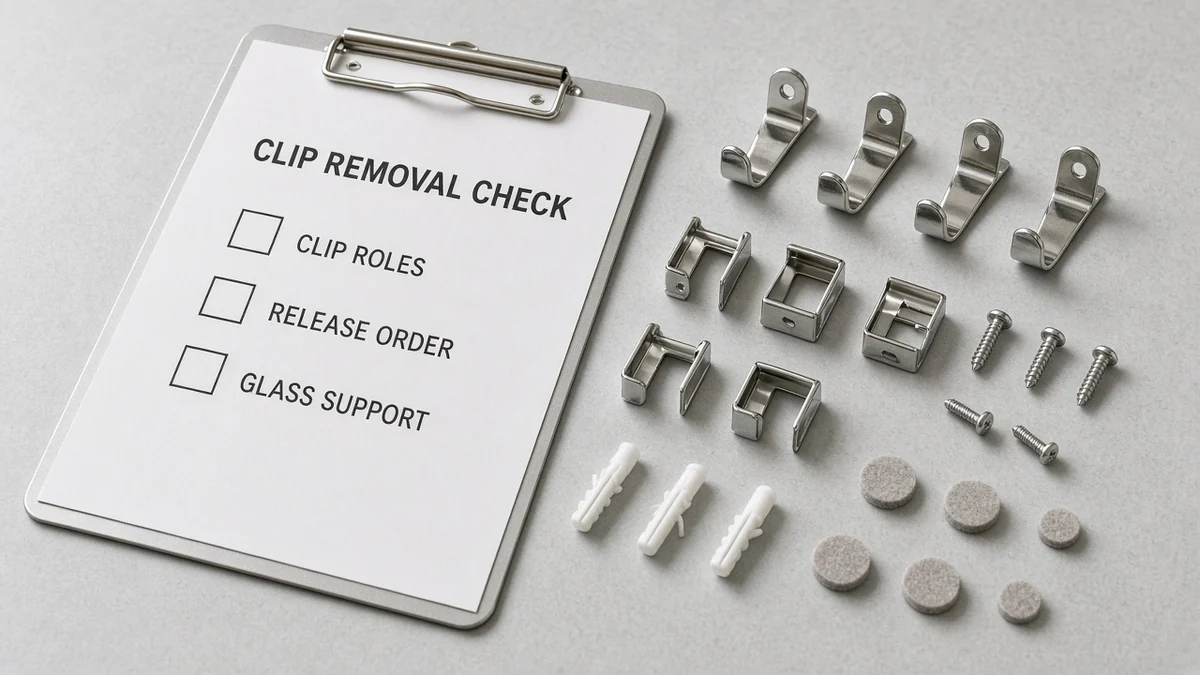
After the list check, read the section with the packed clips and a sample panel in front of you. Each step should name a clip by its role and match what the part does. If a step would leave the glass unsupported, the order is wrong or the support condition is missing.
Translation and photos
Mirror clip vocabulary varies by market. “Top clip,” “spring clip,” “J-clip,” and “retainer” may all mean different parts in different leaflets. Use the clip map as the reference for every language version, so translators match labels to drawings instead of words to words.
Listing copy and removal claims
Product listings often add phrases such as “removable,” “renter friendly,” or “easy to relocate.” Each phrase implies that the clips release in a known order and that the wall can be repaired. If the listing uses those words, the service sheet must contain the documented order, or the listing should drop the claim.
Sign-off
The brand approves the wording and the supplier confirms the clip data. Koitor can review whether the removal language matches the packed set and flag missing fields. Any glass-handling advice beyond general protective equipment should come from the brand’s own safety review.
When to rewrite the whole section
If the existing removal section was copied from a different clip set, rewriting is quicker than editing. Start from the clip map, copy the supplier’s release order, add the support condition, the adhesive check and the exclusions. Five short blocks are usually enough for a complete section.
Frequently asked questions about mirror clip removal
Which mirror clips come off first?
That depends on the set, so the supplier’s documented order decides. In many sets the retaining clips are released while the glass is supported and the support clips come off last, but the sheet should copy the order for the packed set rather than rely on that pattern.
How do I remove mirror clips from the wall after the mirror is down?
Unscrew each clip from its fixing. What happens to any anchor behind it depends on the anchor family in the kit. The sheet should name that anchor and follow its documented removal path, rather than giving a general prying method.
Can I remove mirror clips without taking the mirror down?
Sometimes a single retaining clip can be replaced while the glass is supported, but that depends on the set design. The mirror clip set specification covers whether a part is replaceable in place. The removal sheet should only state it if the supplier documents it.
What if the mirror will not move after the clips are off?
It is probably bonded to the wall. Stop. Adhesive removal is outside a clip service sheet and carries a real breakage risk. Contact a glazier or the original installer.
Why do my top clips not move when I loosen the screw?
Some fixed clips are tight against the glass edge even when the screw is loose, especially after years of paint or cleaning residue. The sheet should not suggest prying against the glass. If the supplier documents a release, follow it; if not, stop and seek help from a glazier.
Are spring clips reusable?
Some may be, some may lose tension. Reuse is a property of the named clip, so the sheet should state the supplier’s position or say reuse is not documented.
Does Koitor make mirror clips?
Koitor makes custom metal bathroom hardware and reviews install and service wording for the parts packed in its programs. Whether a specific clip set is part of a program is confirmed by the packing list and quote, not by this guide.
Work With Koitor Hardware
Review a mirror clip removal sheet
Send the clip set drawing, the packing list and the current install sheet. We can review whether the removal wording names each clip role and the documented release order. We will not issue a glass-safety approval, a weight rating or an adhesive removal method.
OEM / PRIVATE LABEL
Turn this sourcing guide into a product brief
Share your target product, size, finish, order quantity and packaging requirements. Your team receives a practical manufacturability review before quotation.


 English
 Español
 Português
 Français
 Deutsch
 العربية