
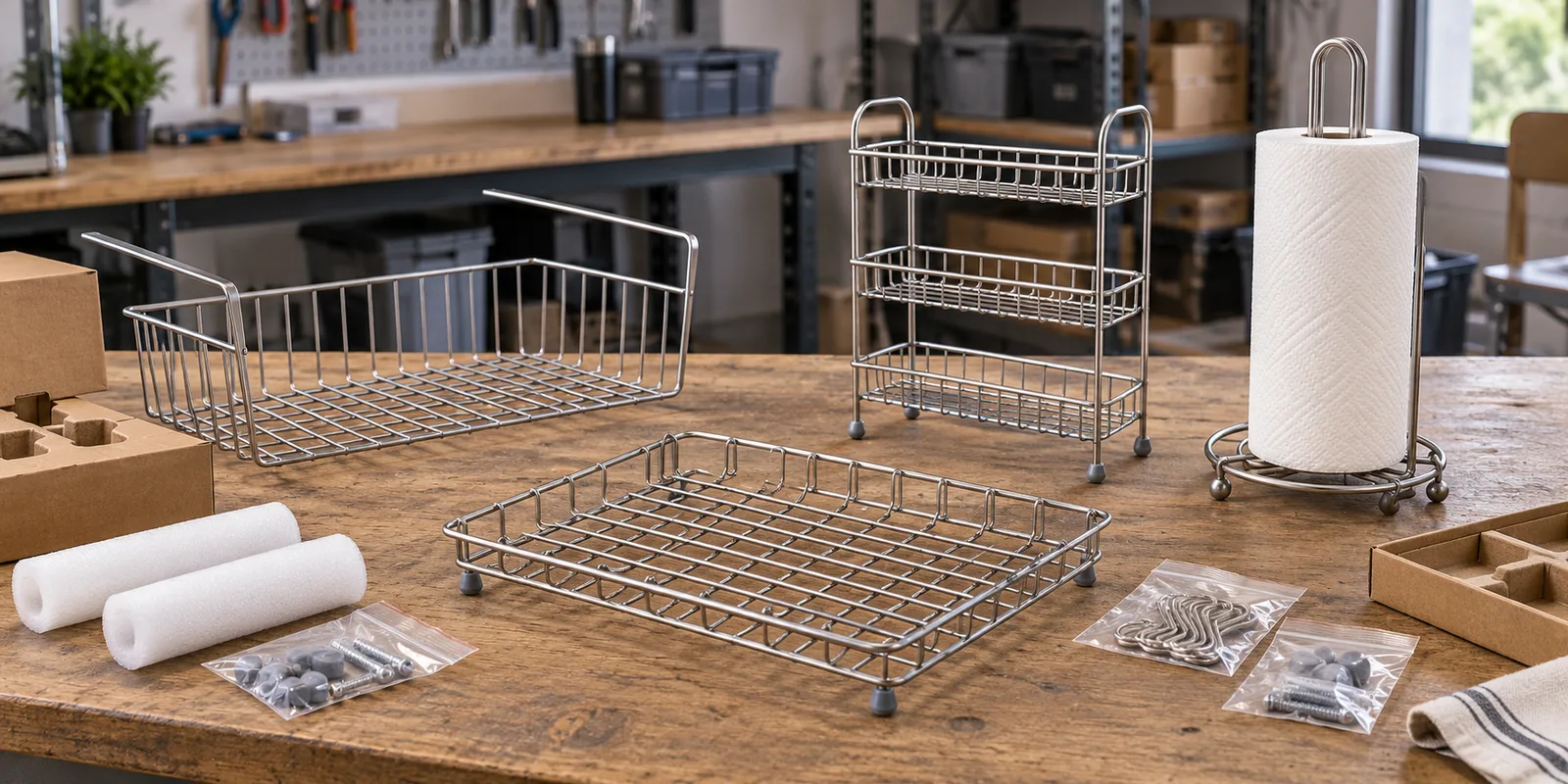
A kitchen storage rack manufacturer China sourcing team can work with should be evaluated by product-category experience, drawing or sample review, manufacturing practicality, finish control, packaging preparation and direct communication. Buyers should define where the rack will be installed, what it will hold, its critical dimensions, material, finish and target quantity before comparing prices. A useful supplier comparison covers the complete product and packaging scope, not only the metal weight. Start with a physical sample and documented approval points before committing to bulk production.
What should buyers expect from a kitchen storage rack manufacturer in China?
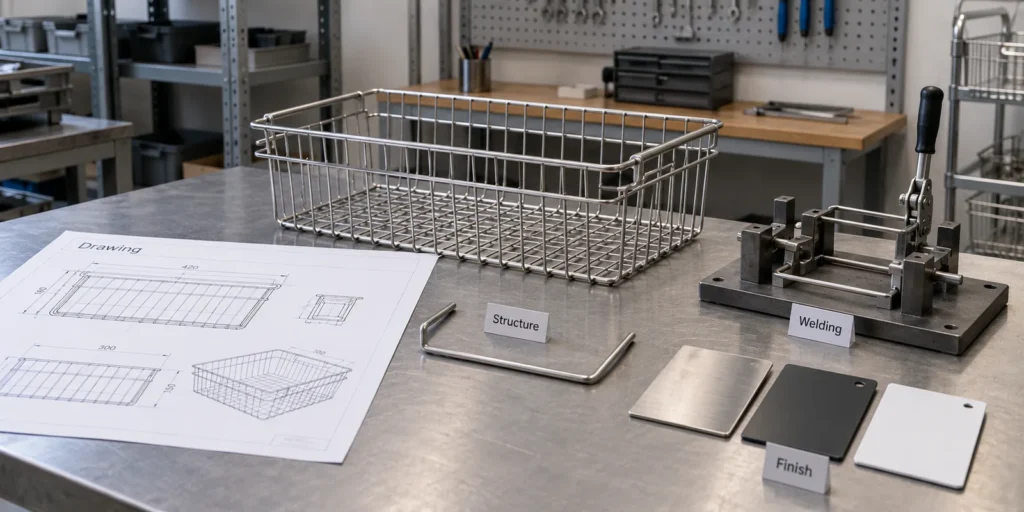
Buyers should expect a specialized OEM manufacturer to turn a product brief, drawing or physical sample into a clear manufacturing proposal. The supplier should identify uncertain dimensions, structures, finishes and packaging details before quotation or sampling.
Kitchen storage hardware includes under-shelf baskets, sink racks, spice racks, paper towel holders, multi-tier organizers and custom wire baskets. These products may share materials and processes, but their installation, load distribution, cleaning access and packaging needs differ.
The search phrase “kitchen storage rack manufacturer China” covers suppliers with very different product and communication capabilities. Buyers should therefore compare evidence in the quotation, sample and production plan instead of relying on a directory description alone.
A supplier should ask where the rack is used: inside a cabinet, under a shelf, beside a sink, on a countertop or on a wall. The same wire basket can behave differently when hung from a shelf than when supported by feet. Installation context influences hook geometry, balance, wall clearance and accessory selection.
Buyers should also clarify the sales channel. Retail display packaging, e-commerce fulfillment and distributor cartons create different protection and labeling requirements. A rack designed for flat packing may reduce package volume but add assembly hardware and instructions.
Koitor Hardware is a family-owned custom metal hardware factory specializing in bathroom and home storage products. The production team can discuss bending, punching, resistance welding, laser welding, TIG welding, grinding, polishing, powder coating, assembly and packaging preparation according to the project.
Direct factory communication is especially useful during early development. Buyers can discuss which dimensions are fixed, which parts may be adjusted for manufacturability and how a trial order will be evaluated. This creates a more useful basis for comparison than a one-line request for the lowest price.
Which kitchen rack type and use requirements should be defined first?
The product type, installation method and intended contents should be defined before material size or price. These requirements determine the rack’s geometry, support points, stability and usable space.
For an under-shelf basket, provide the shelf thickness, available depth, front clearance and the position of cabinet doors or hinges. The basket must hang level and remain accessible without interfering with the surrounding cabinet. A generic hook dimension may not fit the buyer’s actual furniture range.
For a sink rack, describe expected water exposure, drainage direction and contact with the sink edge or counter. Check whether removable trays, utensil holders or rubber contact parts are included. Areas that remain wet or trap residue deserve specific review during sample approval.
For a spice rack or multi-tier organizer, state the approximate container sizes and access needs. Tier spacing should allow buyers to remove items comfortably. A deep front rail may improve retention but make small jars harder to read or lift.
For a kitchen paper towel holder, define roll dimensions, loading direction, mounting method and clearance for tearing paper. If the product attaches under a cabinet or shelf, tool access and screw positions must be considered in the installation sequence.
For a freestanding rack, confirm the footprint, center of gravity, feet and floor-contact materials. Stability should be reviewed with representative items placed in realistic positions, using project-specific acceptance criteria rather than an unsupported universal load claim.
The following table helps buyers compare common kitchen rack formats before requesting a sample.
| Rack type | Key buyer inputs | Main sample question | Packaging concern |
|---|---|---|---|
| Under-shelf basket | Shelf thickness, depth and cabinet clearance | Does it hang level without interfering with doors? | Protect projecting hooks from bending |
| Sink rack | Sink dimensions, drainage and included holders | Does water drain and can surfaces be cleaned? | Separate trays and contact parts |
| Spice rack | Container sizes, tier spacing and retention rails | Are products visible and easy to remove? | Prevent tiers from rubbing |
| Paper towel holder | Roll size, loading direction and mounting method | Is there enough installation and operating clearance? | Contain screws away from the finish |
| Freestanding organizer | Footprint, tier use, feet and assembly | Is it stable with representative loading? | Control long parts and loose hardware |
Buyers developing these products can review Koitor’s custom kitchen storage rack manufacturing capabilities when preparing a drawing, sample or product requirement.
How do material, structure and finish affect an OEM kitchen rack?
Material, component sections, joint design and surface finish must be evaluated together because each decision affects appearance, rigidity, fabrication, corrosion risk, packaging and cost. Specifying only “metal rack” leaves too much room for different supplier interpretations.
Identify the material family and any required grade by component. A rack may contain wire, tube, sheet brackets, fasteners, feet and trays. If different materials are acceptable, ask suppliers to quote each option separately instead of allowing a silent substitution.
Wire diameter or tube size should follow the structure and use requirement. Increasing material size may change the visual proportion, bending radius, weld area and package weight. Reducing it may affect rigidity or make a long span more sensitive to distortion. Sample the complete structure before fixing the specification.
Support placement matters as much as raw material size. Cross wires, rear frames, feet and wall brackets control how forces move through the product. For a custom wire basket, review bottom support, front rail, corners and attachment points where local movement may occur.
Weld position affects strength, alignment and appearance. Resistance welding can suit many wire intersections, while TIG or laser welding may be discussed for other joints depending on access and design. The process should be selected for the product rather than used as a marketing label.
Powder coating can provide color and a consistent visual finish when preparation and application are suitable. Stainless steel can be brushed or polished depending on the design. Neither finish should be described as maintenance-free or guaranteed never to rust; performance depends on material, processing, environment and care.
Inspect weld areas, bends, edges and hidden surfaces because these locations can show grinding marks, coverage variation or trapped residue. Establish an approved sample for color, gloss, texture or brushing direction under consistent lighting.
When selecting a custom metal storage basket production route, include wire spacing, support geometry, finish and packaging contact points in the same development brief.
How does a supplier turn a drawing or sample into production?
A supplier should convert the buyer’s information into a controlled drawing, bill of materials, sample plan and approval record. This process keeps visual references, dimensions and later revisions connected.
When the buyer provides a drawing, mark the critical dimensions and explain the product’s installation and intended contents. A technically complete drawing is useful, but photographs and use notes can clarify which surfaces are visible and which features matter most to the customer.
When the buyer provides a physical sample, identify what should remain unchanged and what should be improved. The supplier may measure the sample, but the buyer should still approve a new drawing. Wear, deformation or assembly variation in the reference piece should not automatically become the new specification.
The first manufacturability review should cover bends, weld access, component availability, finish preparation, assembly and packaging. If a proposed change affects appearance or use, the factory should explain it before producing the sample. Record accepted changes by drawing revision.
Sample quantity and purpose should be clear. One sample may be used for dimensional and appearance approval, while another is needed for packaging or retailer review. If an evaluation may damage the sample, plan enough pieces and identify which revision each one represents.
At Koitor, samples usually take about 5–7 working days after the design and materials are confirmed, depending on the project. Uncommon material sizes, revised tooling, special colors or complex packaging can change the schedule, so confirm timing after the sample scope is agreed.
Return comments in one consolidated list with photographs, drawing references and the requested result. “Make it stronger” is less useful than identifying the area that moves, the use condition and the expected improvement. Separate defects from new design preferences so the next sample has a clear target.
After approval, connect the sample to the production documents. The purchase order should reference the drawing, material, finish standard, accessory list and packaging version. A loose email approval without revision numbers is easy to misinterpret during repeat orders.
What quality and packaging checks matter before shipment?
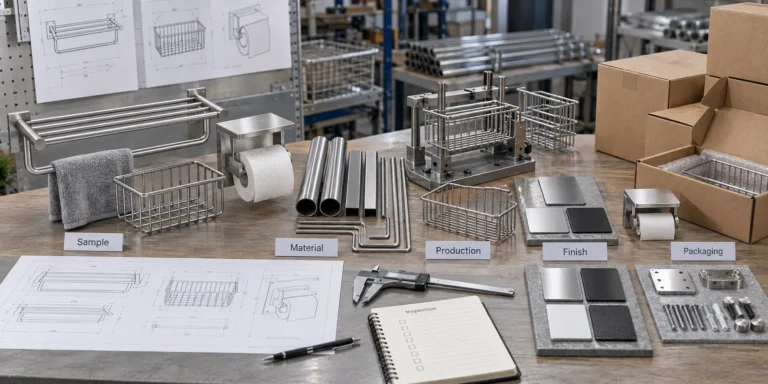
Before shipment, buyers should check dimensions, structure, alignment, weld appearance, surface finish, assembly, included accessories and packaging against approved references. Inspection should sample the finished product rather than relying only on raw-material information.
Start with identity and quantity. Confirm model, color, size and packaging version. Mixed variants can look similar in closed cartons, so outer labels and inner identification should match the purchase order.
Measure the agreed critical dimensions. For under-shelf baskets, check hook spacing and opening height. For tiered racks, check overall height and shelf alignment. For wall-mounted products, check bracket and mounting-hole positions.
Place freestanding samples on a flat reference surface to review rocking or distortion. Assemble knock-down samples using the included hardware and instructions. For hanging products, use a representative shelf or fixture with agreed dimensions.
Inspect welds and finish under consistent light. Look for missed joints, excessive spatter, sharp areas, grinding inconsistency, visible coating gaps, scratches and color variation. Acceptance criteria should come from approved samples and project documents, not from vague descriptions such as “good quality.”
Count screws, feet, hooks, trays and other loose components. Small accessories should be placed in secure bags or compartments and kept away from visible metal surfaces. An attractive rack can arrive damaged if hardware moves freely inside the package.
Review carton fit and movement. Long hooks, narrow frames and welded corners can press against the carton or neighboring products. Add localized protection where the approved package requires it. If retail packaging is used, verify that the sales unit remains presentable after distribution packing.
Any drop, load, corrosion or other performance evaluation should use project-specific conditions and acceptance criteria agreed by the buyer. Do not convert an informal trial into a certification or guaranteed performance claim.
What should buyers include in a kitchen rack RFQ checklist?
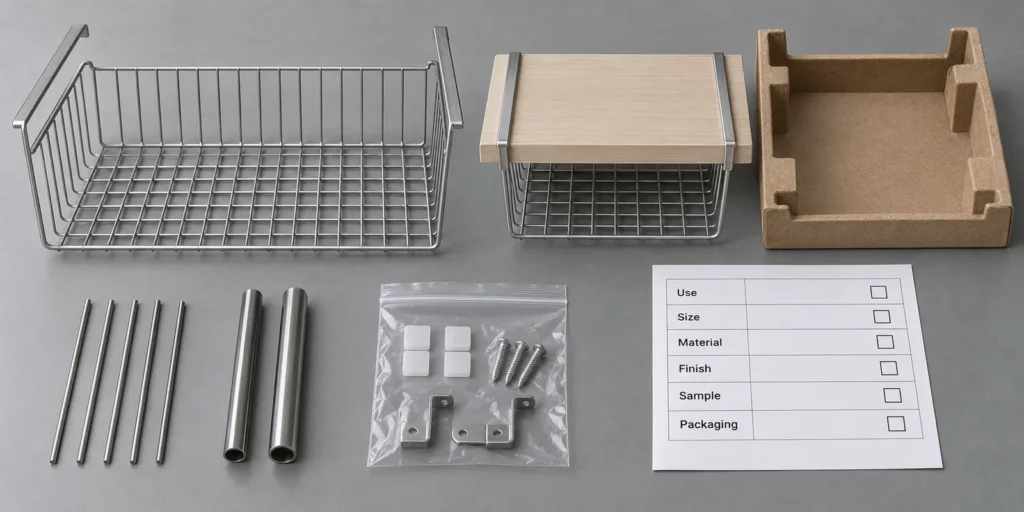
A kitchen rack RFQ should describe the product, installation, material, finish, packaging, quantity and approval requirements in one revision-controlled package. This helps a kitchen storage rack manufacturer China project team quote the same scope as competing suppliers.
Ask suppliers to separate tooling, sample, unit, packaging and optional costs where relevant. Confirm what is included in the unit price and whether a different color, label or carton creates a separate minimum quantity.
Koitor’s MOQ can start from 100 pieces depending on product structure, material, finish and packaging. Bulk production usually takes around 4–6 weeks depending on quantity, complexity, material availability, surface finishing and packing. These are planning ranges, not fixed promises, and should be confirmed for each quotation.
Buyer checklist before requesting a quotation
- Product type: under-shelf basket, sink rack, spice rack, paper towel holder or multi-tier organizer.
- Installation: shelf thickness, cabinet clearance, wall connection, counter contact or freestanding footprint.
- Intended contents: representative container sizes, weight distribution and access requirements.
- Dimensions: overall size, usable space, tier spacing, hook geometry and critical mounting locations.
- Material: wire, tube, sheet, fastener, tray and contact-part requirements.
- Structure: wire diameter, tube section, supports, feet, joints and detachable parts.
- Finish: color, gloss, texture, polish or brushing direction with an approved reference.
- Accessories: screws, anchors, hooks, feet, trays, tools and instructions with quantities.
- Sample plan: required quantity, review purpose, drawing revision and target approval date.
- Packaging: retail or e-commerce needs, surface protection, accessory containment and carton labeling.
- Commercial information: target MOQ, forecast, price basis, destination and desired production schedule.
A clear RFQ also helps buyers evaluate an under shelf basket manufacturer or kitchen wire basket supplier on response quality. Useful replies should identify assumptions, open questions and cost-impact options instead of returning a price with no confirmed specification.
For more procurement topics, the bathroom and home hardware sourcing resources connect material, welding, finish, packaging, MOQ and inspection decisions.
Frequently asked questions about custom kitchen storage racks
These answers address common B2B sourcing questions about samples, quantities, materials and packaging. Final decisions should follow the specific rack and target market.
Can a kitchen rack be customized from a physical sample?
Yes. A physical sample can support dimensions, structure and appearance review. The buyer should explain what to copy or change, and approve a controlled drawing before production so wear or variation in the reference piece is not treated as intentional.
What is a typical MOQ for a custom kitchen rack?
At Koitor, MOQ can start from 100 pieces depending on structure, material, finish and packaging. Custom colors, printed packaging, special components or tooling may affect the practical quantity, so confirm it during quotation.
Should buyers choose stainless steel or powder-coated steel?
The choice depends on appearance, exposure, structure, price position and care expectations. Review actual finished samples and do not treat either material system as completely rust-proof or suitable for every kitchen environment.
How should an under-shelf basket be checked?
Confirm shelf thickness, hook opening, basket depth, front clearance, cabinet-door interference and balance with representative contents. Protect the projecting hooks during packaging and check that they have not bent before installation.
Can a rack be packed flat to reduce shipping volume?
Some structures can use a knock-down design, but flat packing adds joints, fasteners, instructions and assembly work. Compare the package-volume benefit with stability, appearance, missing-part risk and user experience before changing the structure.
What should be approved before bulk production?
Approve the drawing, material, structure, finish, assembly, accessory list, packaging and any project-specific evaluation. Keep revision numbers on the purchase order and retain an approved sample when practical.
Develop a custom kitchen storage rack with Koitor
Koitor Hardware supports custom kitchen and home storage hardware for importers, distributors and private-label brands. Buyers can send a drawing, physical sample or product brief for review of bending, welding, structure, finish, assembly, packaging and flexible small-batch production options.
Need a Practical Kitchen Rack Manufacturing Review?
Send Koitor your drawing or sample, installation dimensions, intended contents, material, finish, packaging idea and target quantity. Our team can review manufacturability and sample-development details before quotation.
OEM / PRIVATE LABEL
Turn this sourcing guide into a product brief
Share your target product, size, finish, order quantity and packaging requirements. Your team receives a practical manufacturability review before quotation.
 English
  Español
  Português
  Français
  Deutsch
  العربية