
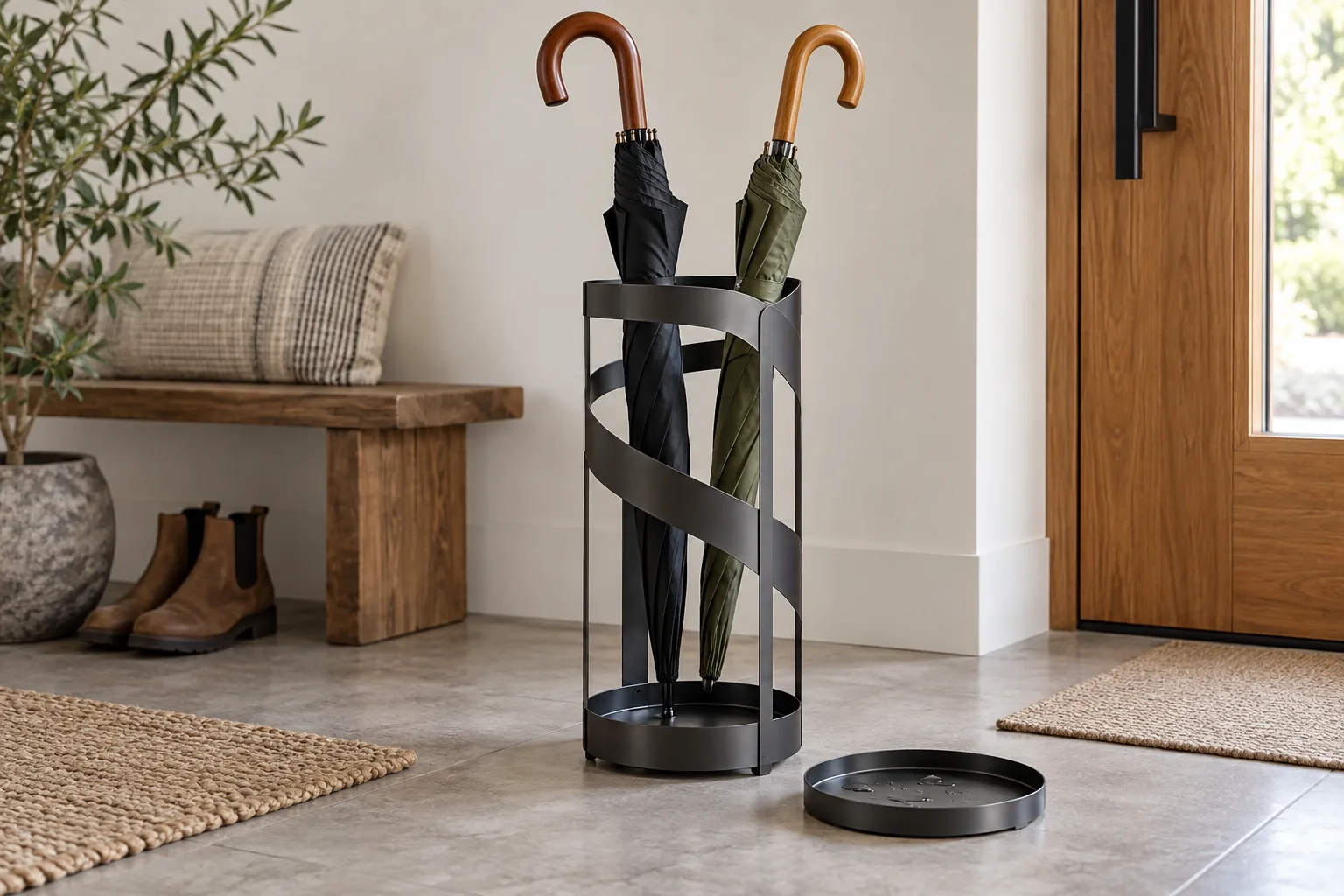
A metal umbrella stand drip tray specification should define how water is collected, how the tray is removed and reinstalled, what umbrella sizes the stand must accommodate, and how the tray and frame are protected from contact, cleaning, and transit damage. A shallow removable tray may be convenient to empty but can be difficult to grip or may shift in use. Buyers should review the full stand-and-tray assembly with representative umbrellas rather than approving the tray as an isolated component.
This is a B2B product-development guide for importers and private-label teams evaluating wet-entryway storage. The article focuses on requirements, supplier questions, and sample approval. It does not claim Koitor currently manufactures umbrella stands or trays; any adjacent product capability must be confirmed for a specific project.
What problem should a drip tray solve?
Wet umbrellas can leave water and debris on an entryway floor. A tray provides a collection surface, but collection alone is not the whole user requirement. Buyers should consider how water reaches the tray, whether drips are contained by the stand, how the tray is accessed, and whether a user can empty and clean it without spilling.
The tray is part of a system that includes the stand opening, umbrella orientation, floor contact, handle and canopy dimensions, and expected storage pattern. A design that collects water from closed compact umbrellas may not behave the same with a large canopy, a long umbrella, or multiple items touching one another. A supplier should not promise a universal containment result without the product geometry and use condition being defined.
A manufacturer product listing can show one configuration and its apparent tray arrangement; it cannot establish that configuration’s suitability for every buyer’s assortment. Treat consumer product examples as evidence that buyers can encounter collection and removal decisions, not as engineering validation. Define the buyer’s intended arrangement first: number and type of umbrellas, whether they are wet when stored, expected tray-emptying frequency, and cleaning access.
Which dimensions and interfaces should the drawing define?
The drawing should show both the outside envelope and usable capacity. Identify the interior opening and any geometry that could interfere with umbrella shafts, handles, straps, or canopy fabric. If a liner or insert is used, specify the fit relationship between the insert and the stand so it does not rattle, bind, or lift unintentionally.
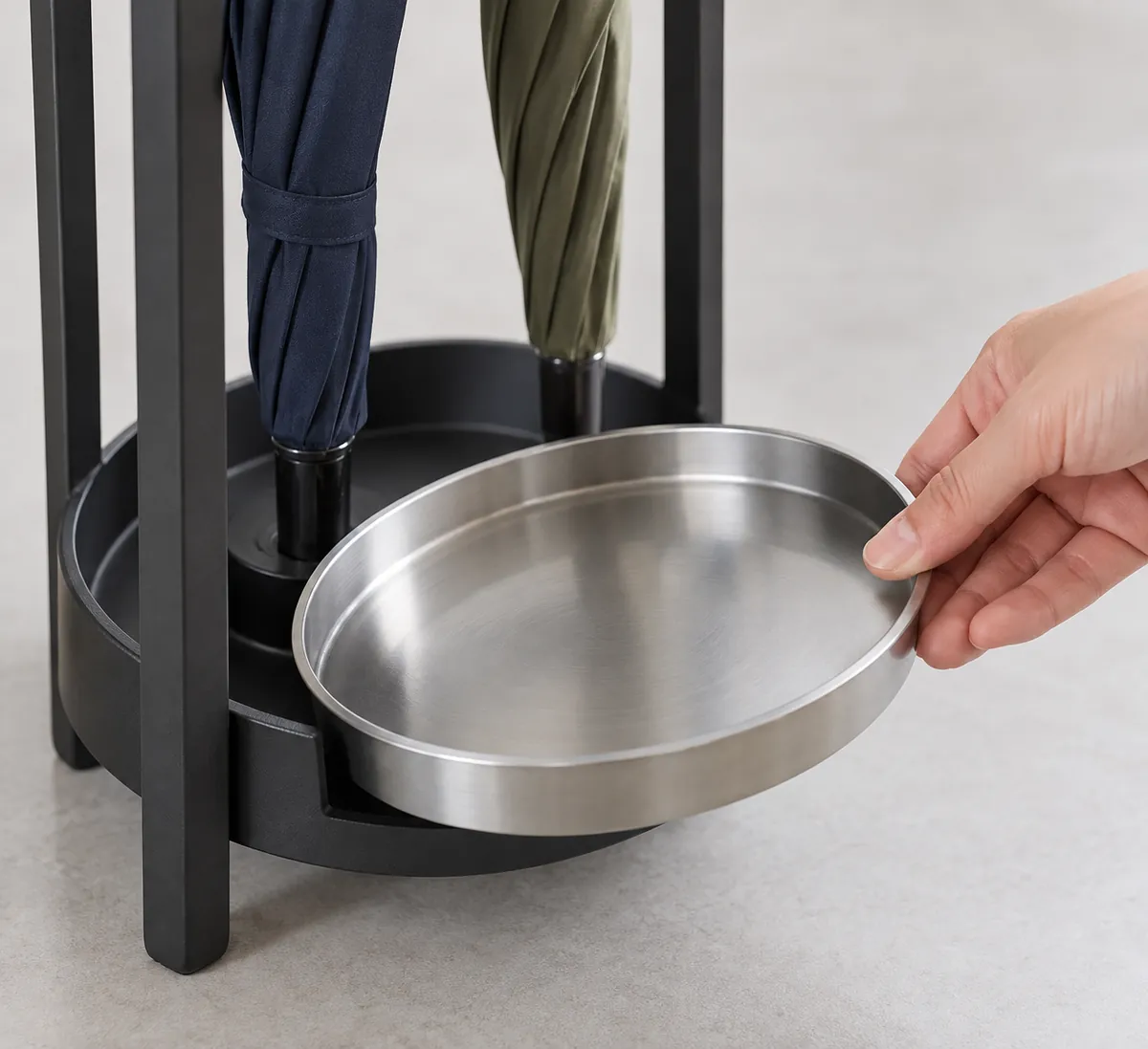
For the tray, define the footprint, depth, edge shape, removal direction, and clearance to the frame. Include the intended contact surfaces and any protective features. A tray that sits under the frame may need enough finger access to lift it; a tray that slides out needs a clear extraction path and a stop or retention detail. A drop-in insert may require access from above, which can conflict with umbrellas already stored in the stand.
| Tray arrangement | Potential benefit | Buyer trade-off | Sample check |
|---|---|---|---|
| Lift-out shallow tray | Simple access for emptying and cleaning | Needs finger access and a stable resting interface | Can it be removed with the stand loaded as intended? |
| Slide-out tray | Can reduce lifting over the frame | Needs extraction clearance and a controlled stop | Does it move freely without falling or binding? |
| Removable liner | May simplify handling and cleaning | Material, fit, and durability become additional inputs | Does the liner stay seated and avoid snagging? |
| Fixed collection base | Fewer loose parts | Cleaning and drying access may be less convenient | Can the interior be wiped and fully inspected? |
The comparison is a design discussion, not a ranking. Material and manufacturing route should be selected only after the interface, appearance, cleaning expectations, and cost constraints are understood.
How should the supplier evaluate capacity and removal?
Do not specify capacity only as a generic number of umbrellas. State the target envelope: approximate shaft length, handle type, canopy bulk, and whether wet, folded umbrellas are stored. If the stand must accept several umbrellas simultaneously, review how handles and canopies overlap. The stand’s usable capacity is determined by the stored arrangement, not by outside dimensions alone.
For tray capacity, define the buyer’s intended collection scenario and maintenance interval if known. Avoid asking for a guaranteed water volume without a use model and validated test. The relevant design question may be whether the tray catches drips during ordinary placement and remains accessible for emptying—not whether it contains every possible amount of water from every umbrella.
Request a sample with the tray fully installed and inspect:
- – whether the tray can be removed without tipping the stand;
- – whether stored umbrellas block the grip point or extraction route;
- – whether the tray can be returned to the intended position without misalignment;
- – whether the stand rocks or slides during removal;
- – whether water can be poured out without catching on a rim or frame;
- – whether the tray can be cleaned and dried in the intended channel.
If the product has a removable liner, use the same sample to review retention and fit. The insert should not be so loose that it shifts during handling, or so tight that a user must pry it out in a way that damages the surface. Any polymer component, if proposed, requires its own material and supplier review; do not assume its properties from a generic description.
What belongs in an RFQ for a metal umbrella stand?
Provide a dimensioned drawing or clear concept model with the target umbrella range, base footprint, tray arrangement, finish, and packaging expectations. If the product is at concept stage, list open questions and request a supplier proposal with assumptions called out. Buyers should avoid treating an early rendering as a controlled production specification.
Ask the supplier to document:
- – outside and inside dimensions, plus usable storage envelope;
- – intended umbrella types and any excluded configurations;
- – tray material and finish, if known, or proposed alternatives;
- – tray removal direction, grip access, retention, and end stop;
- – contact points between tray, frame, floor, and stored umbrellas;
- – cleaning and drying access;
- – assembly sequence and any loose component risks;
- – sample version and production-intent process assumptions;
- – inspection points for fit, finish, and tray movement;
- – packaging method to protect the tray surface and frame alignment.
When a component or process is subcontracted, identify who controls that interface and who performs final inspection. A buyer should understand whether the tray is sourced as a bought-in part or produced with the stand, but should not require disclosure of confidential supplier information unless the commercial arrangement requires it.
How should buyers check finish, water contact, and corrosion risk?
The product’s intended exposure should be described. A stand in a dry lobby that receives occasional drips differs from one that routinely stores wet umbrellas. Buyers should specify finish appearance, cleaning agents or methods that matter, and any corrosion or durability requirement that is part of the program. Do not assume a finish name alone guarantees a particular service outcome.
Inspect the finished tray and frame together. Check edges, seams, corners, and interfaces where water or debris might remain. If surfaces contact one another, look for abrasion points that could become visible after repeated removal. A physical sample should be reviewed after the full proposed finishing and cleaning sequence, because a bare-metal prototype may not represent the production appearance.
If the contract requires a corrosion test or other validation, name the method, sample configuration, exposure, acceptance rule, and responsible party. Do not use vague phrases such as “rust-proof” as a substitute for a measurable product requirement. A supplier should not claim a test result that has not been performed on the agreed construction.
What should packaging and transit review include?
A loose tray can rub against the stand during shipping. A large stand can also be bent or distorted if unsupported in the carton. Ask for a packed sample that uses the intended separators, bags, corner protection, and assembly state. Inspect the unpacked product before and after assembly, then verify tray removal and fit again.
Packaging drawings should show how the tray is restrained and whether it is nested with another metal part. If the finish is decorative, define the separation material and contact points. A bag alone may not prevent metal-on-metal movement if parts can slide inside the package. Buyers should test the actual configuration rather than assume a generic carton photo is sufficient.
For brands that ship flat-packed products, include the tray in the assembly instructions and confirm the end user can identify its orientation. A tray that can be installed backward or omitted should be addressed in instructions, packaging layout, or product geometry. These details influence returns and complaints even if the metal parts meet their individual dimensions.
Buyer checklist: what should be approved before bulk release?
- – Use case: define umbrella types, wet-storage expectation, quantity, and placement environment.
- – Stand envelope: specify outside dimensions, usable opening, and access path.
- – Tray design: record footprint, depth, removal direction, retention, grip access, and end stop.
- – Maintenance: check emptying, cleaning, drying, and reinstallation with the stand loaded as intended.
- – Finish: approve the full assembly after the final finish and cleaning sequence.
- – Water-related claim: define any collection or durability requirement with a test method instead of “waterproof” or “rust-proof.”
- – Sample: record part revision, material, finish, tray version, and sample date.
- – Packaging: review tray separation, surface protection, and post-transit fit.
- – Inspection: establish checks for seating, movement, edges, finish, and assembly.
- – Change control: reapprove material, tray geometry, finish, supplier, or packaging changes.
For broader OEM context, review Koitor’s OEM home-storage hardware and custom metal storage rack pages. They describe adjacent manufacturing scope and do not confirm an umbrella-stand product line.
How should the approval record support later orders?
The buyer should also name an owner for each open item. Product engineering may own the interface, sourcing may own price and supplier changes, and quality may own inspection evidence. Smaller teams can combine these responsibilities, but assignment still needs to be explicit. Without an owner, an open dimension or sample deviation can be mistaken for an accepted production condition.
Use sample review to close the highest-risk unknowns first. A photograph or supplier explanation can support the conversation, but a physical, production-representative sample is stronger evidence when the requirement depends on fit, finish, use, or handling. If a full test is not available before purchase, record that limitation and avoid making a performance promise beyond the evidence.A tray decision should be checked in the way a buyer expects the finished product to be maintained. Review the stand with the intended umbrella arrangement, remove the tray, empty it, clean it, and return it to position. Note whether a user must move other items or tip the stand. The metal umbrella stand drip tray specification should state which operations must be possible and whether the review uses a loaded or empty stand.
Buyers should also decide whether a tray is a replaceable part, a loose accessory, or a permanent part of the base. That choice affects packaging, spare-part planning, assembly instructions, and the supplier’s inspection points. If the tray is produced by a different source from the frame, keep the interface and finish approval under one controlled drawing package. Reconfirm the metal umbrella stand drip tray specification whenever material, tray depth, retention geometry, or frame clearance changes.
For this project, the metal umbrella stand drip tray specification requirement should be recorded with the approved sample and drawing. Reconfirm the metal umbrella stand drip tray specification criteria if material, process, supplier, or intended use changes.
FAQ
No. The decision depends on maintenance, cleaning access, expected water collection, and design. A fixed base may reduce loose parts but make cleaning less convenient; a removable tray adds fit and retention requirements.
How much water should the tray hold?
There is no universal capacity. Define the intended umbrella mix and expected maintenance interval, then validate the proposed construction. Avoid a numeric claim without an agreed use condition and test.
Should the tray slide out or lift out?
Either can work. Compare clearance, grip access, retention, loaded-state removal, and spill risk on a representative sample.
How can buyers reduce tray scratching?
Review contact points and the intended packaging separation. Inspect the actual packed sample after transit simulation or the agreed shipment validation.
Does stainless steel automatically make a tray corrosion-proof?
No material label alone proves performance in every environment. Specify the actual grade and finish when confirmed, the exposure, and any required validation.
Is this a current Koitor product?
This is adjacent sourcing education. Buyers should confirm the exact category and production capability with Koitor for their project.

Work With Koitor Hardware
Discuss a Custom Metal Hardware Project
Share your drawing, target interface, material, finish, sample needs, and buyer acceptance criteria with Koitor. Confirm exact category capability and process responsibilities for each project.
OEM / PRIVATE LABEL
Turn this sourcing guide into a product brief
Share your target product, size, finish, order quantity and packaging requirements. Your team receives a practical manufacturability review before quotation.

 English
  Español
  Português
  Français
  Deutsch
  العربية