
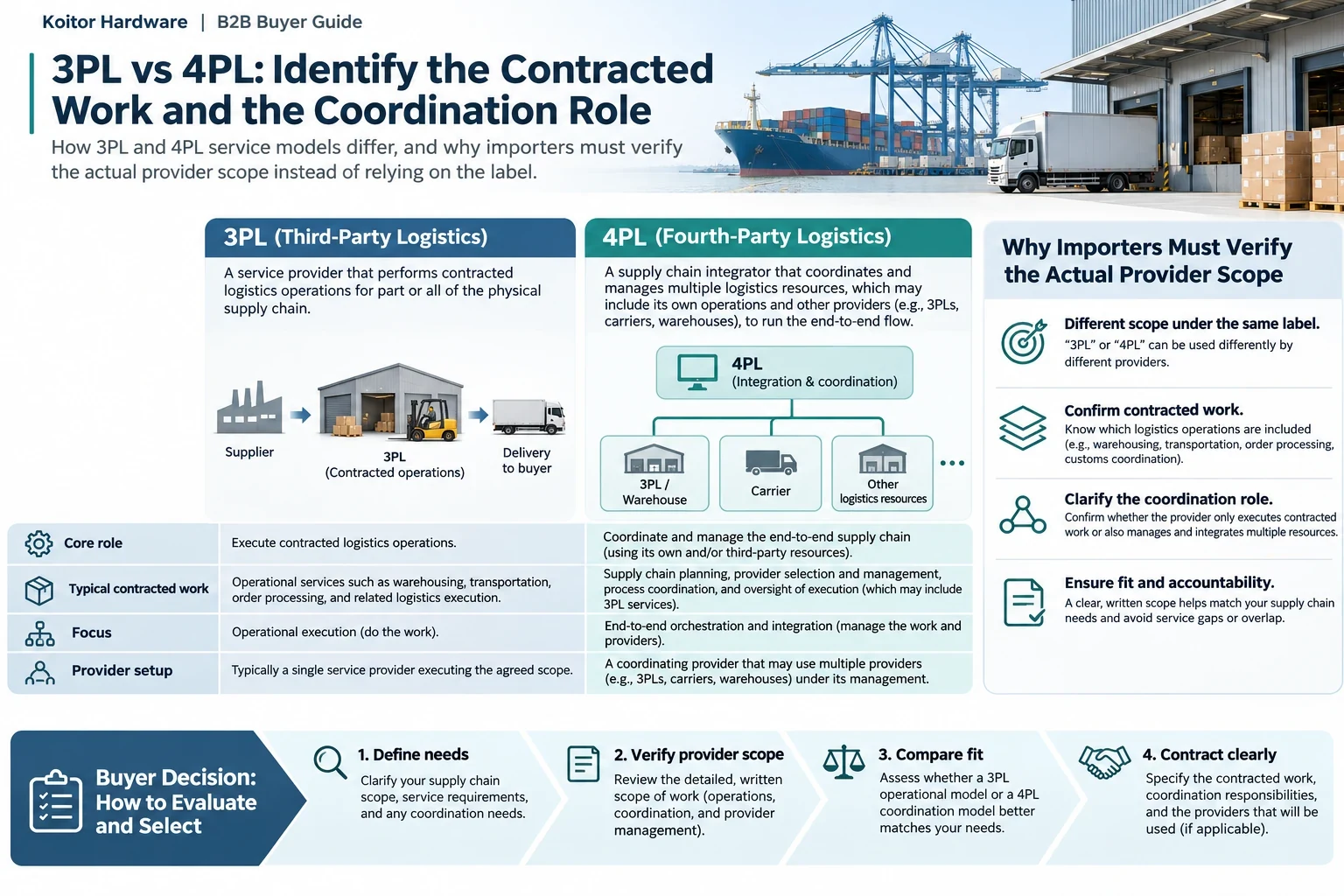
3PL vs 4PL is commonly explained as a comparison between outsourced logistics execution and broader coordination across logistics providers, but industry usage is not fully uniform. A 3PL may perform or arrange services such as transport, warehousing, or fulfillment, while a 4PL is often described as integrating and coordinating several providers or a wider supply-chain function. A label alone does not define who performs each task, owns the data, approves changes, or carries contractual responsibility. Importers should map the actual contracted work and authority before relying on the number in a provider’s name.
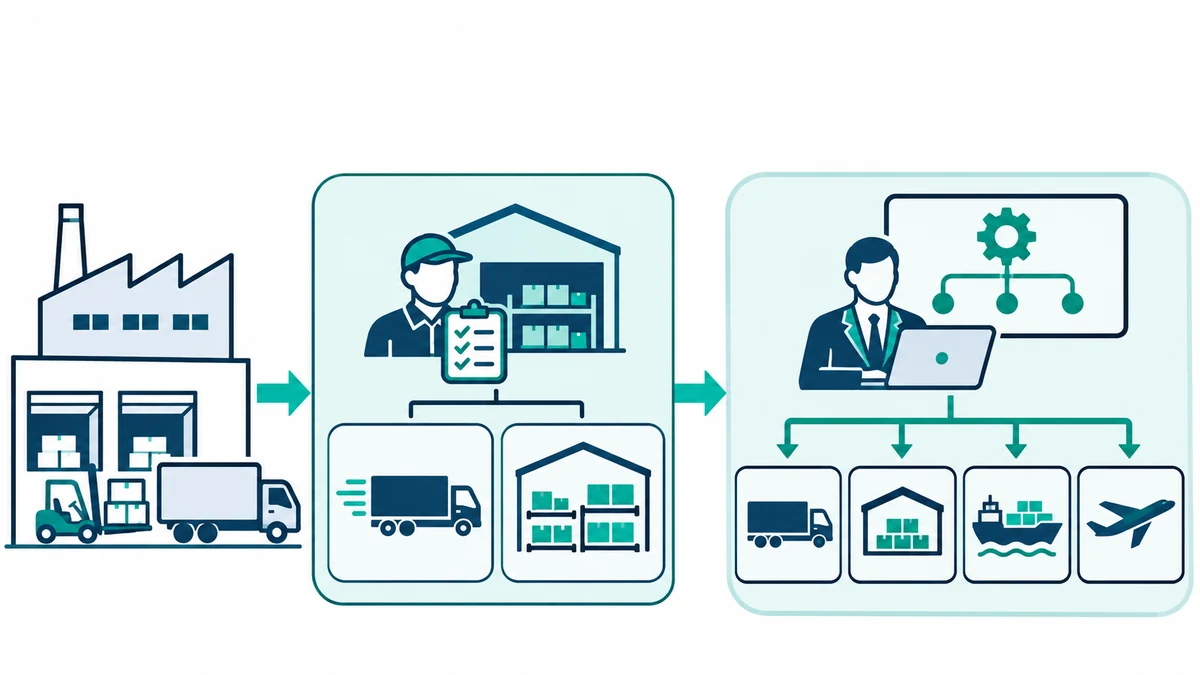
What decision does a 3PL vs 4PL comparison help an importer make?
The comparison helps a buyer understand what kind of logistics relationship is being offered and what questions to ask before contracting. A provider may execute one or more logistics activities, coordinate other suppliers, provide technology, or combine those roles. Different companies use “3PL” and “4PL” in different ways, and a single provider may offer multiple service models. Therefore, an importer should treat the terms as starting points for a scope discussion rather than universal legal or operational definitions.
For an overseas OEM order, the buyer might coordinate origin pickup, consolidation, export handoff, international transport, customs support, and destination delivery through different parties. A hypothetical metal hardware shipment makes the responsibility question concrete: who books each leg, who receives cargo data, who contacts the factory, who can approve a changed pickup time, and who alerts the buyer if the shipment is held? These questions belong to the actual contracts and written instructions.
This article explains the common service distinction and gives a practical role map. It does not provide legal advice on customs, Incoterms, freight liability, or contract interpretation. Koitor Hardware is the metal hardware factory in this scenario, not a freight forwarder, 3PL or 4PL provider, customs broker, or supply-chain consultancy. Its relevant role is direct communication about confirmed product, packaging, cargo, and document handoff with the buyer and the buyer’s designated parties.
What is commonly meant by a 3PL?
Third-party logistics, or 3PL, generally refers to outsourcing logistics activities to an external provider. Depending on the arrangement, those activities can include transport, warehousing, order fulfillment, freight coordination, or related services. The provider may use its own assets, subcontract services, or combine both approaches. The label does not tell the buyer which exact tasks are included.
Some 3PL arrangements focus on execution of a defined service, such as moving goods between locations or handling inventory in a warehouse. Others may provide more planning or coordination. A 3PL can coordinate carriers or subcontractors while still being described as a 3PL. Consequently, “execution” and “coordination” are useful dimensions for comparing proposals, but they are not rigid categories that every provider follows.
An importer should ask the provider to state the work it will perform directly, the work it will arrange through other companies, and the work that remains with the buyer, factory, customs broker, or another party. The quotation should specify locations, service windows, cargo assumptions, reporting cadence, exception handling, and any limits or exclusions that matter to the order. A broad service label should not replace this list.
What is commonly meant by a 4PL?
Fourth-party logistics, or 4PL, is commonly used for a model in which a provider integrates, manages, or coordinates multiple logistics services or providers. It may involve broader oversight than a single transport or warehousing function. However, no one universal definition or fixed service package applies to every provider using the term. A company may use “4PL” as a commercial description, while its contract defines a narrower or different scope.
A 4PL offer may involve coordinating carriers, warehouses, freight forwarders, data systems, or other suppliers. The buyer should ask how the provider’s responsibilities are documented and whether it has authority to select or direct subcontractors. A 4PL label does not automatically prove that the provider controls every supply-chain activity, owns the assets, or accepts every operational risk.
The practical comparison is therefore not just “one type handles transport and the other handles everything.” It is a question of contracted scope, integration responsibilities, reporting, decision authority, and accountability. A provider may execute some services and coordinate others. The actual answer is in the service description, subcontracting terms, escalation path, and written delegation of authority.
How do asset ownership and provider count relate to the labels?
The number in “3PL” or “4PL” should not be treated as a reliable count of physical parties in the shipment. It also does not, by itself, establish whether a company owns trucks, warehouses, or other assets. Providers may operate asset-light models, own some assets, or rely on partners; their service label is not enough to infer these details.
Similarly, using several carriers does not automatically make an arrangement a 4PL. A 3PL may coordinate subcontractors within its contracted service. A company calling itself a 4PL may perform some operational activities directly. The buyer should record the role that matters rather than infer it from an industry shorthand.
| Comparison point | Common 3PL description | Common 4PL description | What the importer should verify |
|---|---|---|---|
| Main emphasis | Outsourced logistics activities or services | Integration or coordination across providers or a broader scope | The exact contracted tasks and locations |
| Execution | May perform or arrange specific logistics services | May execute some services while coordinating others | Which tasks are performed directly versus subcontracted |
| Coordination | Can coordinate carriers and suppliers within scope | Often emphasizes multi-provider coordination | Who directs each provider and how authority is delegated |
| Assets | May own assets, lease them, or use partners | May own assets, use partners, or be asset-light | Asset ownership and operating responsibility if relevant |
| Data and reporting | Reports tied to the contracted service | May integrate information from multiple parties | Data fields, update frequency, system access, and escalation |
| Accountability | Defined by the actual service agreement | Defined by the actual service and management agreement | Responsibility for exceptions, claims, approvals, and records |
The columns describe common market usage, not a binding definition. The provider’s contract and applicable law determine the real obligations. A buyer should avoid using this table as a substitute for legal review where liability, customs responsibility, or regulatory duties are at stake.
How should an importer map shipment roles?
A role map can clarify the handoffs before an order is ready to ship. The goal is to identify the responsible party for each action and decision, not to force every company into a generic category. An importer can prepare a simple matrix covering the order’s logistics path.
| Activity | Questions to assign | Typical parties to identify |
|---|---|---|
| Cargo readiness | Who confirms goods are packed, labeled, and ready for pickup? | Factory, buyer, inspection provider |
| Pickup booking | Who arranges vehicle, date, and collection reference? | Buyer, forwarder, 3PL, nominated carrier |
| Origin handoff | Who receives the cargo and confirms quantity or visible condition? | Factory, warehouse, carrier |
| Consolidation | Who chooses the receiving point and manages compatible bookings? | Consolidator, 3PL, buyer-appointed provider |
| Export documents | Who prepares, reviews, and submits each document? | Exporter, customs broker, forwarder, buyer |
| International movement | Who books and monitors the transport leg? | Carrier, forwarder, 3PL, buyer |
| Exception handling | Who notifies the buyer and what changes require approval? | Contracted provider and buyer-authorized contact |
| Destination delivery | Who coordinates release, appointment, and receiving? | Destination provider, broker, warehouse, buyer |
| Records and claims | Who retains shipment evidence and handles a discrepancy? | Contractually assigned parties |
The matrix should include a named owner, an alternate contact, required input, expected confirmation, and escalation route for each critical activity. If a shipment changes from one nominated party to another, the buyer should know who can authorize that change. A provider’s ability to recommend an option does not necessarily mean it can approve a commercial or delivery change on the buyer’s behalf.
What should be checked in a logistics provider proposal?
A useful provider review moves from the label to the scope and then to operational controls.
Define included and excluded services
List each service, origin and destination, expected volume assumptions, shipment mode where known, and activities outside the provider’s responsibility. Avoid broad descriptions like “end-to-end” unless the proposal states what each end includes. Determine whether customs brokerage, storage, cargo insurance, inspections, consolidation, or last-mile delivery is included, excluded, or separately contracted.
Identify subcontracting and management roles
Ask which parties the provider will use and how they are selected or changed. Confirm whether the provider coordinates them, contracts them, or only provides an introduction. Clarify which party issues instructions and who handles a missed collection or schedule change.
Define decision authority
Write down who may approve a changed pickup date, route, service level, extra cost, storage, or delivery appointment. Require escalation to the buyer for decisions outside delegated authority. Do not assume that a provider’s integration role gives it unlimited purchasing or contract authority.
Specify data and visibility
Identify the shipment references, cargo fields, update intervals, status definitions, and exception notifications the buyer expects. If multiple providers are involved, define how data is combined and who corrects inconsistencies. A portal or dashboard is not a substitute for clear ownership of data and exceptions.
Clarify commercial and liability terms
Review rates, surcharges, service limits, cargo handling conditions, claims process, liability limitations, and termination terms with the appropriate commercial and legal reviewers. This article does not interpret an individual contract or predict liability. The buyer should not infer cost savings, performance guarantees, or legal authority from the service label.
What mistakes do buyers make when comparing 3PL and 4PL?
Assuming every provider uses the same definition
The labels vary. A provider’s marketing page may use a broad description while its contract covers a specific set of activities. Ask for a service schedule and responsibility matrix.
Treating 4PL as “everything”
A wider coordination role does not mean that every supplier, decision, or risk is included. Verify which providers are covered, what the coordinator can direct, and what remains with the buyer.
Assuming 3PL means asset-owning carrier
A 3PL may use owned or non-owned assets and can arrange third-party services. Ask who will execute each activity and which legal entity is responsible under the agreement.
Equating provider count with service model
Several subcontractors do not by themselves establish a 4PL model. Scope and integration responsibilities matter more than counting organizations.
Leaving factory communication ambiguous
The provider may need packing lists, carton counts, pickup readiness, dimensions, or contact information. The buyer should define what the factory supplies, who receives the data, and how discrepancies are resolved. A factory’s confirmation of cargo readiness is distinct from approval of carrier terms or shipment changes.
Using a general comparison as contract advice
A blog can explain common usage but cannot determine the meaning of a signed agreement. The contract, governing law, and actual operating instructions control. Obtain legal or specialist review when needed.
How does the factory handoff fit into the provider relationship?
For an OEM hardware order, the factory and the buyer’s logistics providers have separate responsibilities that must connect at the shipment handoff. The factory can communicate confirmed production and packing information within its agreed scope. The buyer or its designated provider organizes pickup and transport according to the order instructions. The receiving party should confirm who is authorized to request or approve changes.
Before booking, the buyer can align product readiness, package configuration, carton or pallet information, shipping marks, pickup reference, and documentation responsibilities. The details depend on the actual product and commercial arrangement. Do not assume that a 3PL or 4PL will automatically receive complete factory data, or that a factory can approve a change in freight service or commercial terms.
Koitor Hardware is a family-owned custom metal hardware factory focused on bathroom and home storage products. It is not a 3PL, 4PL, carrier, customs broker, or logistics consultancy. In a confirmed OEM project, it can communicate about the metal product, packaging preparation, and agreed handoff information with the buyer and designated parties. That statement does not imply it books freight or takes over the buyer’s provider contracts.
For context on Koitor’s role as a metal-product supplier, see Hardware de armazenamento doméstico OEM. Buyers evaluating a project can share their drawing, sample, packaging requirements, and proposed handoff with the team through the contact page.
Buyer checklist before signing a 3PL or 4PL agreement
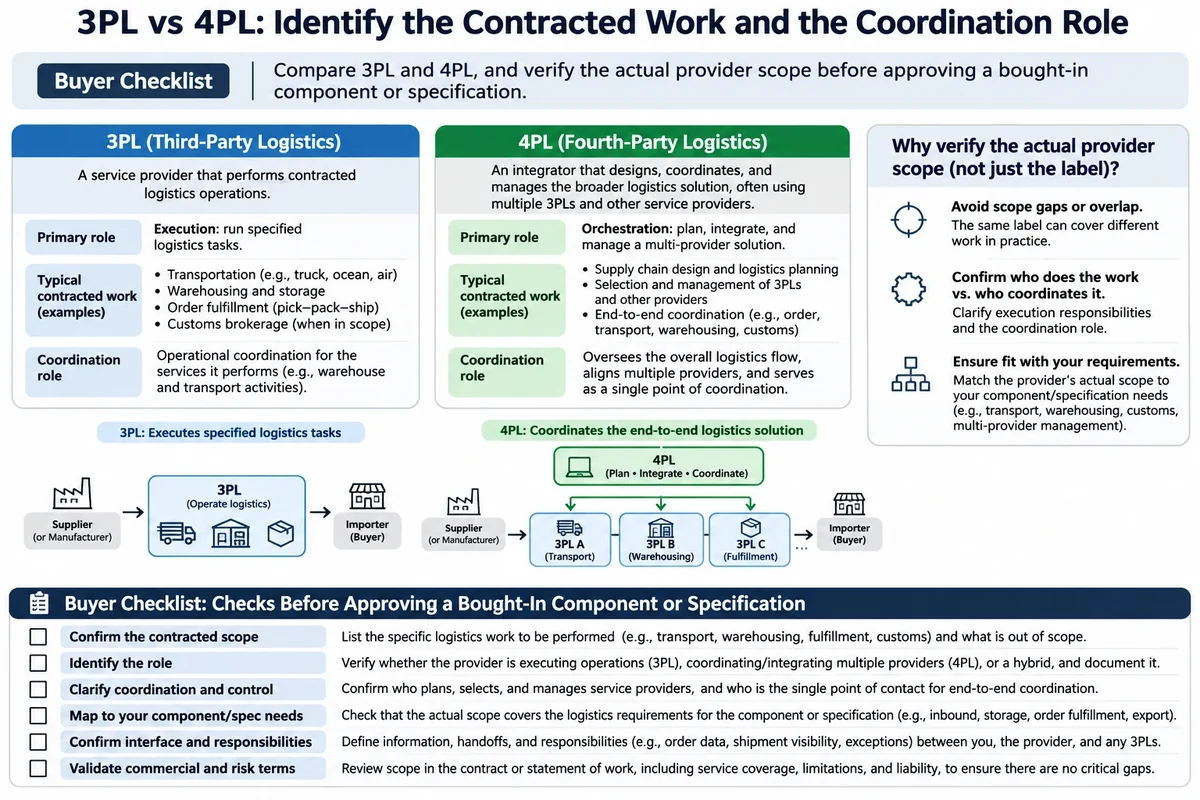
- List each logistics activity included in the offer.
- Record services that are excluded or separately contracted.
- Identify who performs each task and who coordinates subcontractors.
- Confirm the legal entity responsible for each contracted service.
- Ask how the provider uses, selects, and changes subcontractors.
- Identify which decisions the provider can make without buyer approval.
- Define the exception notification and escalation process.
- List required shipment data, status definitions, and update timing.
- Clarify who books pickup, consolidation, transport, and destination delivery.
- Assign responsibility for customs documentation and brokerage separately.
- Review rates, surcharges, claims, liability terms, and service limitations.
- Confirm factory information requirements and the receiving contact.
- Treat the service label as a starting point, not the complete scope.
- Obtain appropriate specialist or legal review for contract interpretation.
How should roles be reviewed when a shipment is delayed?
A delay review should follow the agreed activity and escalation map. The importer can record when the issue was detected, which party had the latest confirmed status, what information was available, who notified the buyer, and which options were presented. This timeline helps separate a carrier event from a booking, data, documentation, or authorization issue without assuming responsibility before the contract is reviewed.
The buyer should also distinguish operational coordination from approval authority. A provider may be responsible for obtaining an update or presenting alternatives while the importer retains authority to approve additional charges or a revised delivery plan. A written delegation can define exceptions that the provider may resolve and matters that must be escalated. The arrangement should be set before shipment when possible, because an unclear approval route can slow the response once cargo is already moving.
After the event, compare the actual handoff with the service schedule and the records kept by each party. If shipment data was incomplete, determine who was expected to provide and validate the missing field. If a factory readiness update was late, distinguish that communication issue from a logistics provider’s separate booking role. Keep the facts, contract terms, and any corrective actions distinct; an incident by itself does not establish a general failure rate or prove that one service model would have prevented it.
A compact responsibility matrix can be attached to a shipment instruction and updated when a provider or route changes. It should identify the contracting party, operational contact, approving role, record owner, and escalation deadline for each important handoff. The matrix is a communication aid; it does not amend the underlying agreement unless the parties formally incorporate it. Buyers should retain the relevant contract and order instructions as the authoritative record.
When comparing proposals, buyers can also request a sample operational report or a redacted example of the status fields, if available. This shows whether the provider’s promised visibility aligns with the importer’s purchase-order, carton, and receiving records. It does not establish the accuracy or timeliness of every future update, so the agreement should still state how exceptions and corrections are handled.
How should the contract handle exceptions and handoffs?
Labels such as 3PL and 4PL are less useful than a written map of who performs each task and who owns each decision. A buyer can list the shipment activities that matter—booking, pickup, export documentation, consolidation, warehousing, carrier coordination, delivery appointment, exception notice, and proof of delivery—and assign a named responsible party for each one. The list should distinguish the party executing a task from the party coordinating it. A provider may perform some services directly and coordinate others through subcontractors, depending on the actual agreement.
An exception process deserves its own line. Specify who is contacted when a pickup is missed, a document is rejected, a shipment is delayed, or a delivery appointment changes. The contract or operating procedure should state what information is sent, who communicates with the factory or importer, how revised instructions are approved, and which party maintains the record. These are scope questions, not a universal distinction that follows automatically from the 3PL or 4PL label.
For the 3PL vs 4PL decision, review the statement of work, service boundaries, subcontractor role, reporting, and escalation path together. A coordination provider may be valuable where several providers must be integrated, but the label alone does not establish decision authority, liability, service coverage, or outcome. The buyer should align those responsibilities with the shipment and internal procurement process before signing. For a Koitor order, the factory-to-forwarder handoff should identify what shipment details the factory supplies and who assumes control after collection; exact obligations depend on the agreed order and shipping terms.
Maersk’s 3PL and 4PL overview is an additional reference; verify scope against the actual provider agreement.
Perguntas frequentes
Does a 4PL label guarantee a fixed service scope?
No. The label is used differently across providers. Review the agreement, service schedule, subcontracting terms, and authority matrix to determine the actual scope.
Can a 3PL also coordinate other parties?
Yes. A 3PL may coordinate carriers, warehouses, or subcontractors as part of its service. Ask which tasks it performs, which it arranges, and who is accountable.
Who can approve a factory shipment change?
The buyer’s authorized contact or another party expressly delegated that authority should approve commercial or service changes. A logistics provider may recommend an option, but authority depends on the contract and written instructions.
Does a 4PL always own no transportation assets?
No universal asset rule follows from the label. Confirm whether the provider owns, leases, or subcontracts the assets relevant to the service if that distinction affects the buyer’s decision.
Does a 4PL replace a freight forwarder or customs broker?
Not automatically. The roles and contracts can overlap or remain separate. The importer should identify which legal entity performs each service and who is responsible for each required document or action.
Coordinate the OEM Shipment Handoff Clearly
Share the product drawing, packaging requirements, and handoff information for a project-specific discussion of Koitor’s metal hardware scope.
OEM / MARCA PRÓPRIA
Transforme este guia de fornecimento num resumo do produto
Indique o produto pretendido, as dimensões, o acabamento, a quantidade a encomendar e os requisitos de embalagem. A sua equipa receberá uma análise prática da viabilidade de fabrico antes da apresentação do orçamento.


 English
 Español
 Português
 Français
 Deutsch
 العربية