
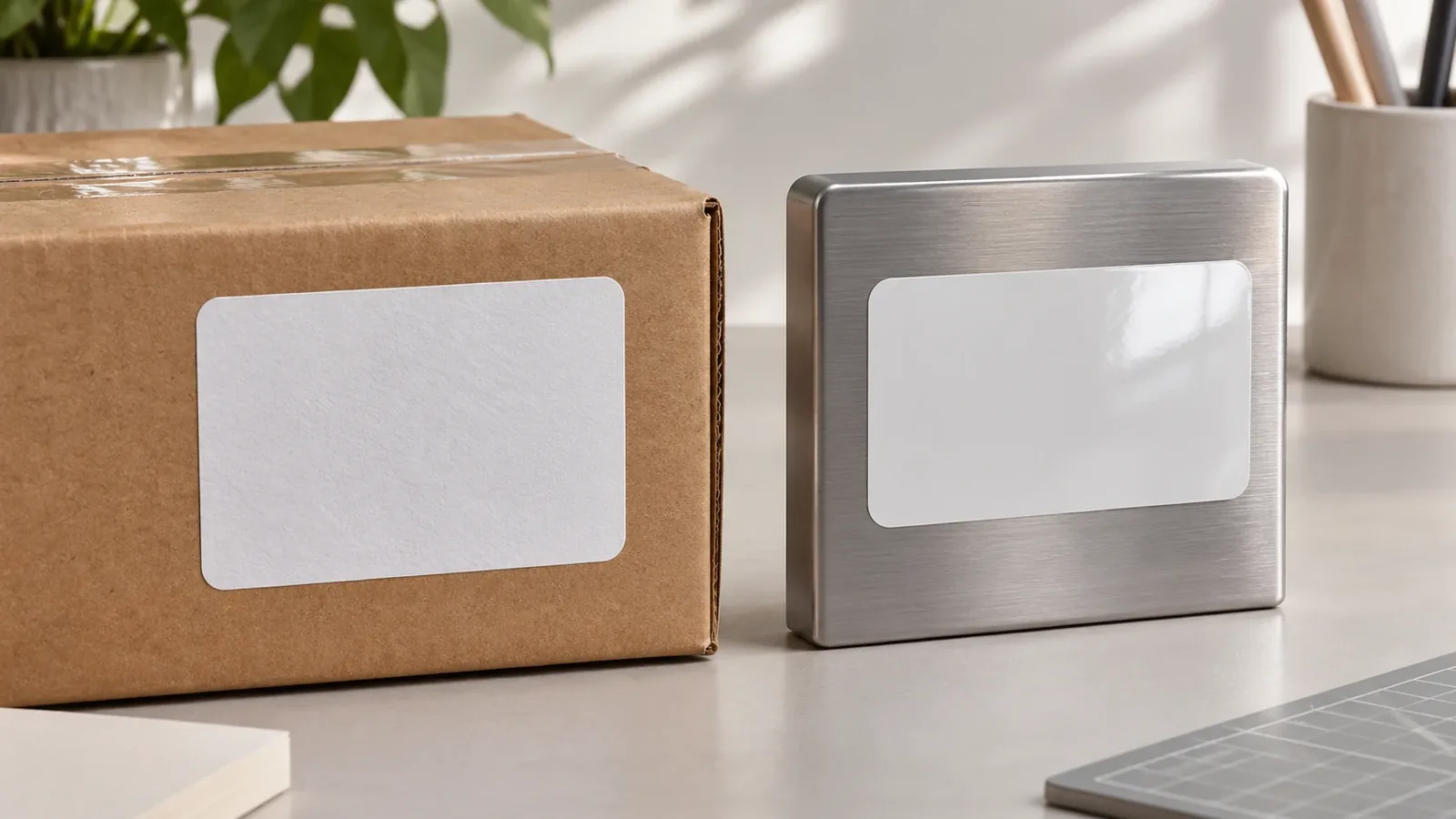
Paper vs vinyl stickers is a face-material comparison: paper and vinyl describe label families, but “film” is a broader plastic-face category that includes vinyl. Paper can suit a desired printed presentation on protected packaging, while vinyl may be considered when the intended exposure or wear calls for a film face. Neither label alone proves a finished sticker is waterproof, removable, outdoor-rated, or suitable for a particular metal finish. Specify the face, adhesive, printing or protective construction, application surface, and cut format separately.
How Should Buyers Compare Paper vs Vinyl Stickers?
Paper and vinyl identify face-material families used in labels or stickers. “Film” is a broader category for a thin plastic face material; vinyl is one type of film. They are not three mutually exclusive tiers. A paper label and a vinyl label can each be supplied in different adhesives, print constructions, shapes, and release-liner formats.
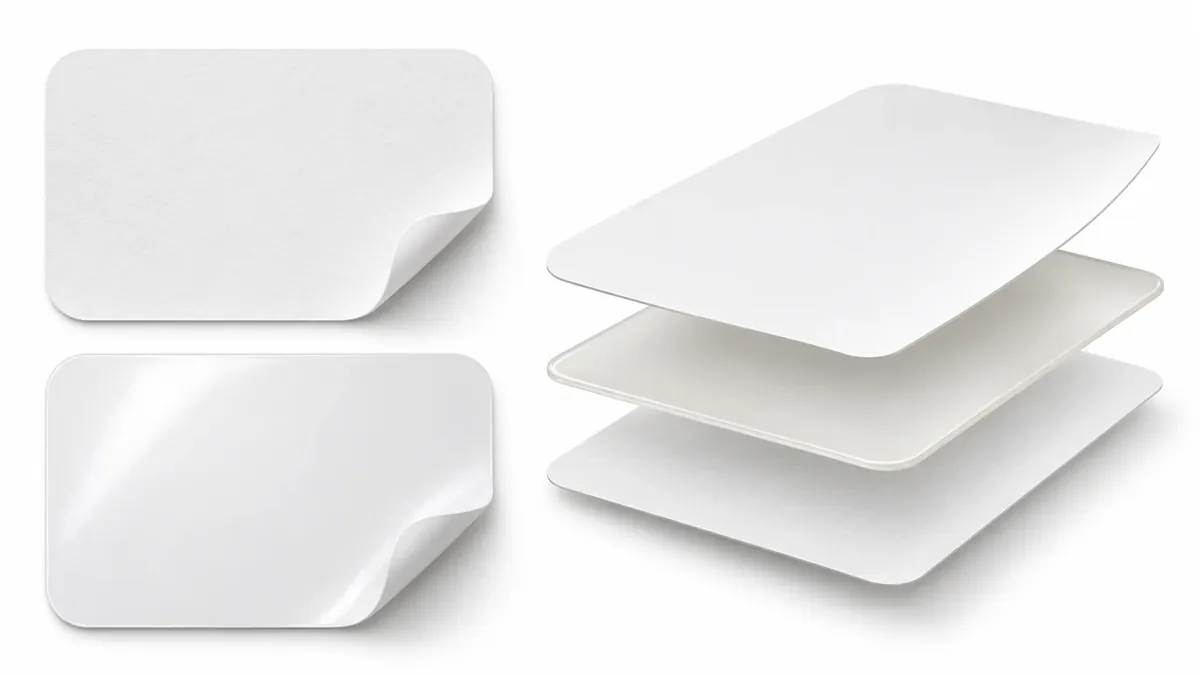
A label has more than one layer or function. The face material receives or carries the printed image. An adhesive bonds the label to an application surface. Printing inks and any protective coating or laminate affect how the printed face is constructed. A release liner supports storage and dispensing before application. The die-cut or kiss-cut format describes how the label is cut and released. The word “vinyl” does not specify all of those characteristics.
Avery’s material overview describes paper faces and plastic-based film labels, with vinyl as one film option. That category distinction is useful for vocabulary. It does not establish that every paper or vinyl product has the same water resistance, fade resistance, removability, adhesive strength, cost, recyclability, or service life. Those properties depend on the exact label construction and use conditions.
For a buyer, the material name is a starting point for a supplier discussion. It is not a complete performance specification. If the label must stay readable on a protected shipping carton, the exposure differs from a label placed on a frequently wiped metal product. The same artwork may need a different construction depending on where it will be applied and for how long it must remain legible.
When Might Paper Be Considered?
Paper can be considered when the intended use calls for a paper-faced printed label and the label’s handling and exposure are appropriate for the specified construction. A protected carton identification label is an illustrative case: the package may be stored, handled, and shipped under conditions defined by the buyer, and the label supplier can recommend a paper face and adhesive combination for that setting.
The example is not a universal prescription. A carton may encounter moisture, abrasion, oil, dust, temperature changes, or rough handling. The buyer should describe the actual packaging path and reading period rather than assuming every carton is dry or protected. A paper face alone does not prove the completed label is unsuitable or suitable for a particular exposure.
Paper may also be selected for presentation, print appearance, touch, or a buyer’s packaging preference. Those are legitimate selection criteria when they match the product and distribution context. The buyer should still confirm the label supplier’s intended construction, application surface, and any handling constraints.
If a label is applied to an export carton, identify which information it carries and whether it must remain readable through storage or transport. This article does not provide legal labeling requirements or specify what a carton must say. Those fields should be defined by the product owner and applicable market documentation. The face-material decision should not be used to infer regulatory compliance.
When Might Vinyl or Another Film Face Be Considered?
Vinyl is a plastic film option that buyers may evaluate when the expected exposure or wear differs from the protected-carton example. The name suggests a material family, not a guaranteed service result. A label maker should confirm the exact film, adhesive, printing, protective layer if any, and application conditions for the intended surface.
For instance, a product identification label on a metal bathroom accessory may be exposed to wiping or handling after installation, while the same product’s shipping carton may remain within a separate distribution environment. A vinyl face might be one candidate for the product label, but the face name alone does not prove compatibility with the actual finish or cleaner. The label supplier needs to assess the particular powder-coated, plated, brushed, or other surface and intended application conditions.
The buyer should not interpret “vinyl” as automatically waterproof, outdoor-rated, removable, permanent, fade-proof, or durable for a stated number of years. Such performance claims require evidence for the complete construction and relevant conditions. A label supplier may have product-specific technical information, but a generic material family does not supply it.
The application surface matters. A label adhesive intended for a smooth packaging film might not behave the same on a textured powder coat, curved tube, oily surface, or low-energy plastic. This guide does not claim a universal adhesion ranking for stainless steel, powder-coated steel, or any other hardware finish. The supplier should evaluate the actual substrate and surface condition.
Why Is the Adhesive a Separate Decision?
The adhesive is the bonding layer; it is not identified fully by the face material. Two vinyl-faced labels can use different adhesives, and a paper-faced label can also be produced with different adhesive options. The buyer must describe whether the label should remain attached, be removed cleanly, be repositionable before final placement, or meet another project-specific requirement—and ask the label maker what it can substantiate.
“Permanent” and “removable” can be product labels with defined conditions rather than universal guarantees. Surface energy, cleanliness, texture, temperature at application, dwell time, pressure, curvature, and later exposure may affect the outcome. Do not turn a supplier’s generic adjective into a guarantee for every metal product or packaging surface.
An application surface should be named in a way the label supplier can evaluate. “Metal” is broad. State the actual finish or coating, whether it is flat or curved, and whether it has a texture. If the surface treatment is still undecided, the label decision may also remain open. A representative sample on the actual finish is more informative than selecting adhesive from a generic material chart.
For product labels, identify whether the label is placed before or after a coating or assembly step. A label applied to a finished surface has a different interface from a label intended to be placed on packaging. The buyer should confirm whether the label can be applied at the proposed point in production and how the part is handled afterward. Do not assume a label maker’s application guidance covers an unreviewed manufacturing sequence.
How Do Printing and Protective Layers Affect the Decision?
Printing is another independent part of the label construction. The face material does not by itself determine the ink system, print method, or whether a clear protective layer is included. A buyer should state whether the label contains variable information, color, a barcode, an instruction graphic, or other content and ask the supplier how the selected construction will be produced and verified.
A laminate or coating may be considered to protect printed content in some constructions, but its presence and performance must be confirmed for the product. Do not assume every vinyl label has a protective laminate or that an added layer makes it compatible with every chemical, cleaner, or outdoor exposure. Likewise, do not assume paper labels cannot receive protective layers. Ask for the exact construction and evidence relevant to the expected use.
If readability is critical, specify the expected viewing distance, lighting context, minimum information size, and duration of use where those requirements are known. The label maker can advise how the chosen material and print process address the brief. This guide does not prescribe barcode grades, regulatory symbols, or a print-performance test.
Keep the print proof, approved artwork, material, adhesive, and sample revision associated. If the buyer changes the artwork or label size, confirm whether the same face and adhesive remain suitable. A changed size or shape may affect placement, curvature, or handling even when the material names remain unchanged.
What Does Cut Format Mean, and Is It Related to Face Material?
Cut format describes how the label is cut from its liner or surrounding material. It is separate from whether the face is paper or vinyl. A paper or vinyl sticker can be manufactured using different cutting and liner configurations, subject to the label maker’s capability and the desired application method.
A buyer may want individual labels, a roll, sheets, or another dispensing format. The specific format should be confirmed with the supplier. Do not assume a given face material requires a particular cut or that the word “sticker” communicates the intended liner. The existing die-cut versus kiss-cut guide explains that distinct cutting question.
Cut geometry can affect how a label is peeled and applied, but it does not determine waterproofness or adhesive performance. Keep these product attributes separate in a specification:
| Attribute | What the buyer should define | What it does not establish |
|---|---|---|
| Face | Paper or named film/vinyl construction | Adhesive, print protection, or life |
| Adhesive | Supplier-identified adhesive and target surface | Face material or cut format |
| Printing | Artwork, color, variable data, and proof | Surface compatibility by itself |
| Protective layer | Whether a coating or laminate is included | Universal chemical or outdoor resistance |
| Cut and liner | Individual, roll, sheet, or named cut style | Face, adhesive, or print durability |
| Application | Surface, curvature, cleanliness, and timing | Performance beyond supplier evidence |
A complete quote request avoids using one of these fields to answer another. The buyer can then compare offers based on the same construction rather than comparing only “paper” and “vinyl” labels.
How Should Buyers Compare a Protected Carton Label With a Wiped Product Label?
Consider two illustrative uses for the same product family. A carton label identifies a packaged item during warehouse handling and shipment. A product label is intended to remain on a metal accessory that may be touched or wiped during use. The same artwork may serve both purposes, but the exposure and application surfaces differ. The buyer should not assume the same construction is appropriate for both.
For the carton, provide the packaging material, storage and handling assumptions, label position, information that must remain readable, and expected time before disposal or archive. For the product, identify the exact metal finish, location, curvature, cleaning exposure if known, and whether removal is expected during servicing or replacement. The label maker can use these details to recommend and support a construction.
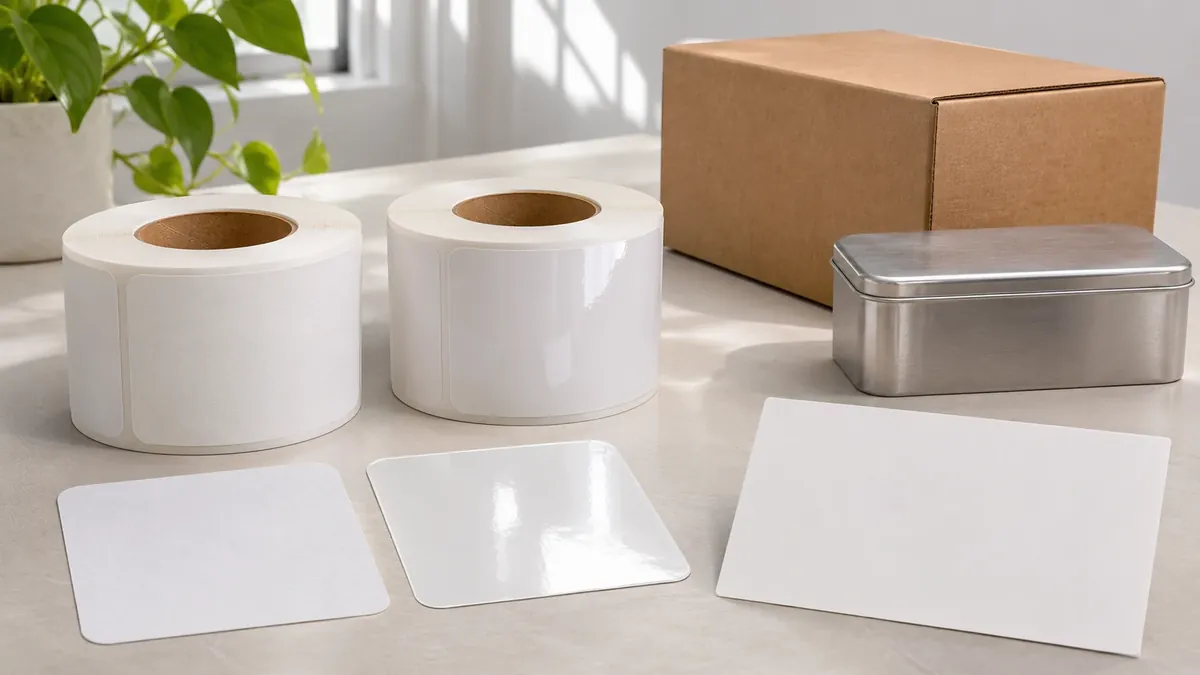
| Illustrative use | Face-material discussion | Additional supplier questions |
|---|---|---|
| Identification label on protected carton | Paper may be considered for the desired presentation and known handling path | Which adhesive, liner, print, and carton surface are included? |
| Label on a metal product expected to be wiped | Vinyl or another film may be considered for the stated exposure | Has the exact finish, cleaner exposure, curvature, and label position been reviewed? |
These examples do not guarantee performance or prescribe one face material. A protected carton can still face environmental stress, and a product label may have no need for a film face if the actual requirement does not call for it. The distinction is that the intended use must be stated before supplier selection.
How Should a Buyer Write a Label RFQ?
A label request for quotation should describe the complete intended construction and leave unresolved technical choices for the label specialist to answer. Include the use, substrate, location, artwork, label dimensions, quantity, format, application method, environment, and the expected period of readability. Attach a sample of the actual surface where practical or provide its finish description and revision.
Ask the supplier to quote or recommend these fields separately:
- Face material and exact product family.
- Adhesive suited to the named surface and expected application.
- Printing method, artwork proof, and any protective coating or laminate.
- Cut shape, liner, sheet or roll format, and dispensing method.
- Application conditions and any required surface preparation.
- Evidence available for the stated exposure and performance requirements.
- Sample approval and revision identification.
If a property has not been evaluated, ask whether the supplier can test or document it. Keep a “not confirmed” value visible; do not replace it with a guess based on the word vinyl or paper. If the label will be applied to a coated hardware part, make sure the supplier knows which coating and surface condition are intended.
The buyer should also identify the responsible supplier. A metal hardware OEM may define where a label belongs or include it in a packaging plan, but the label construction and adhesive evidence may come from a specialist label maker. Do not imply that the hardware factory manufactures the label unless approved company information confirms that capability.
What Common Sticker-Sourcing Mistakes Should Buyers Avoid?
Treating paper, vinyl, and film as three mutually exclusive levels. Vinyl is one film category. Define the face material accurately.
Assuming vinyl automatically means waterproof. The label construction and exposure evidence matter; the face name alone does not prove the claim.
Assuming paper cannot be protected. Protective construction is a separate question to confirm with the label maker.
Ignoring adhesive and surface. The same adhesive may not suit every coating, texture, or curved part. Identify the actual surface.
Using one label for both carton and product without review. The applications can have different handling, cleaning, and readability needs.
Confusing die cut with material. Cut format is independent from the face. See the separate cut-format guide.
Assuming removability or permanence is unconditional. Ask for supplier evidence tied to the substrate and application conditions.
Treating a print proof as an adhesion test. Appearance approval does not establish service performance.
Leaving the application point undefined. Application before or after finishing or assembly can change the relevant surface and handling.
Calling an adjacent supplier’s performance a Koitor claim. Keep the label maker’s evidence and the hardware manufacturer’s scope distinct.
How Should a Label Sample Be Reviewed Before Release?
Review a label sample on the actual carton or finished hardware surface when the application requirement depends on fit or adhesion. Keep the sample’s face material, adhesive, printed construction, protective layer, cut, and liner information with the approval. A loose label shown on a desk cannot demonstrate how that construction behaves on a textured or curved product surface. If the final substrate or coating is still changing, keep the sample approval provisional until the supplier can review the released surface.
For readability, compare the approved artwork with the intended viewing context and confirm that required text, codes, or symbols are present and legible under the project brief. This is an artwork and application review, not proof of a barcode grade, regulatory compliance, fade resistance, or service life. Any such property needs the responsible supplier’s documentation or a defined test.
If a label must be repositioned during packing, describe that application step to the label maker and verify it with the proposed adhesive. Do not infer repositionability from a paper or vinyl face. If permanent placement is intended, confirm the supplier’s application method and any surface preparation. Record who applies the label, at which production stage, and how the finished part is protected afterward. This connects the purchase specification to the actual packing workflow without claiming a universal adhesive result.
How Should Material Changes Be Recorded Across Label Revisions?
Treat a change from paper to a film face, or from one named vinyl construction to another, as a label revision that needs supplier review. Preserve the approved artwork and identify whether the adhesive, print system, laminate, liner, or cut also changed. If several fields change together, a later problem may be harder to trace to a single cause. The record should show which exact construction was approved for the carton or product surface and who authorized the change.
A supplier’s sample can confirm the requested appearance and application setup under the review conditions, but it does not establish all service properties. Keep claims about water resistance, chemical exposure, removability, or expected life tied to the evidence the label maker provides for that full construction. If the buyer’s usage changes, recheck whether the same sample and supplier recommendation still apply.
Buyer Checklist Before Ordering Stickers
- Is the label for a carton, product, component, or another location?
- Is the face material named as paper or a specific film/vinyl construction?
- Has the actual adhesive been considered for the exact application surface?
- Are printing and any protective layer described separately?
- Are cut, liner, roll, or sheet requirements clear?
- Is the expected handling, wiping, storage, or exposure stated?
- Is the surface flat, curved, textured, coated, or still undecided?
- What information must remain readable and for how long?
- Has the supplier provided evidence for any claimed resistance or removability?
- Are artwork, material, adhesive, and sample revision linked in the approval record?
- Is the label supplier clearly identified as the owner of label construction?
If the material label is the only confirmed detail, the specification is not complete enough to conclude waterproofness, removability, or compatibility. Request the missing information from the label maker and keep the uncertain property out of the buyer’s claims until it is substantiated.
Perguntas frequentes
Are vinyl stickers made from film?
Vinyl is one type of plastic film face. “Film” is broader than vinyl; the names should not be treated as separate, mutually exclusive performance levels.
How should buyers compare paper vs vinyl stickers?
Not automatically. The face, printing, protective construction, adhesive, application surface, and exposure all matter. Ask the label supplier for evidence on the complete product.
Are paper stickers suitable for shipping cartons?
They may be considered for a protected carton label if the specific construction suits the handling and exposure. Confirm the carton surface, adhesive, print, and expected readability with the supplier.
Can I use the same sticker on the carton and metal product?
Possibly, but do not assume it. The application surface and exposure differ. Have the label maker review the actual carton and finished metal surface.
Is kiss cut a type of vinyl label?
No. Kiss cut describes a cutting format, not the face material. Paper and film labels can use different cut and liner formats depending on the supplier’s offer.
Fontes
- Avery: Film, Paper and Vinyl Labels
- Koitor: Die Cut vs Kiss Cut
- Koitor: Label Adhesive Minimum Application Temperature
- Koitor: Direct Thermal vs Thermal Transfer Labels
Trabalhe com a Koitor Hardware
Plan Packaging for a Custom Hardware Product
Share the product drawing or sample, intended label location, finish, packaging layout and target order quantity. Koitor Hardware can discuss the defined metal hardware and packaging scope; label construction and adhesive performance should be confirmed with the label supplier.
OEM / MARCA PRÓPRIA
Transforme este guia de fornecimento num resumo do produto
Indique o produto pretendido, as dimensões, o acabamento, a quantidade a encomendar e os requisitos de embalagem. A sua equipa receberá uma análise prática da viabilidade de fabrico antes da apresentação do orçamento.


 English
 Español
 Português
 Français
 Deutsch
 العربية