
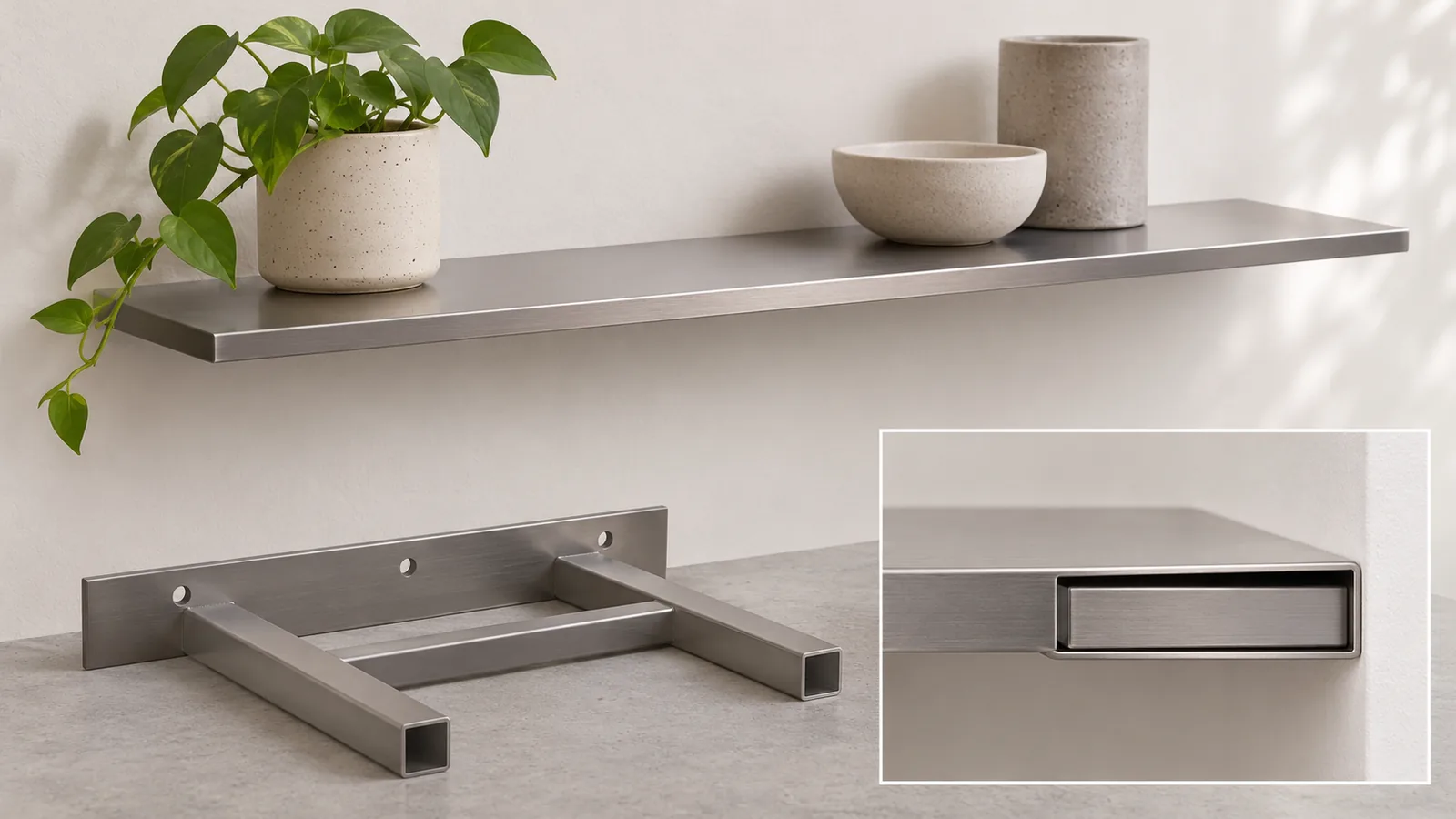
Floating shelf thickness has no universal minimum. The shelf must be designed around the exact concealed support and its required engagement. Buyers also need to distinguish overall shelf thickness from a bracket’s vertical height, its plate gauge and a support rod’s diameter. A shelf thick enough to hide hardware is not automatically strong enough for its intended use, and a support that fits inside a static section may still be impossible to engage. Approve the shelf and support as a matched system using the actual drawings and product instructions.
How Thick Should a Floating Shelf Be?
The correct answer is: thick enough for the specific shelf construction and concealed support to fit, engage and meet the design’s separate performance requirements. There is no universal number that answers all three questions. Bracket architecture, shelf material, internal cavity, assembly motion and the manufacturer’s model-specific limits all affect the decision.
This distinction matters when an importer chooses a slim profile before selecting the hidden hardware. A thin visual edge may look attractive in a product concept, but the support has a physical envelope. The hardware may also require a particular insertion path or space for an internal rail. If the shelf and support are purchased separately, the products may be incompatible even though their outside dimensions look close.
The relevant decision is not simply “Will the bracket fit?” It is “Will this exact bracket fit inside this exact shelf, with the intended material around it, and can the assembly be installed and retained according to its design?” A yes to one part does not answer the others.
Original manufacturer guidance illustrates why generic dimensions should not be turned into a rule. HOVR describes one Classic aluminum support with model-specific height recommendations and distinguishes its stated minimum from a recommendation. Its Slim system uses a different support envelope and different guidance. Rockler’s item 20103 specifies a minimum shelf thickness for concealing its own support. Those published figures describe named products and purposes; they do not create a universal structural minimum for all floating shelves.
The article’s measured anchor is the broad selection question, but the buyer’s practical need is a matched component decision. Before approving a profile or requesting samples, obtain the support drawing, shelf section and the exact maker’s installation requirements. If any source gives a minimum or recommended thickness, retain the product model and scope alongside that number.
Which Dimensions Are Often Confused?
“Thickness” can describe several different dimensions in the assembly. A section drawing should make each axis explicit:
| Dimensão | Direction or location | Por que é importante |
|---|---|---|
| Overall shelf thickness | Top to bottom at the shelf edge or specified section | Establishes the outside shelf envelope |
| Backplate or rail height | Vertical dimension within the shelf section | Determines how much top-to-bottom space the support occupies |
| Support plate gauge | Material thickness from wall-facing side toward the shelf front | Describes a different direction from the support’s vertical height |
| Support rod diameter | Cross-section of a projecting pin or rod | Affects its own envelope and mating cavity |
| Shelf depth | Wall to front edge | Relates to rod projection, support reach and the product’s external size |
| Material above/below hardware | Remaining shelf sections around a support | Must be defined by the design owner; no universal split follows from total thickness |
The word “thickness” in a supplier email may therefore refer to different directions. If a buyer compares a 10 mm plate gauge with a 30 mm shelf section without a section view, the dimensions may have no direct relationship. Show arrows or use explicit terms such as overall height, vertical bracket envelope, plate gauge, pin diameter and front-to-back depth.
The existing article about concealed shelf support panel preparation owns the panel preparation and support interface question. The shelf bracket types guide owns architecture classification. This article focuses on the dimensional envelope and why “shelf thickness” alone is incomplete.
How Can Buyers Think About the Support Envelope?
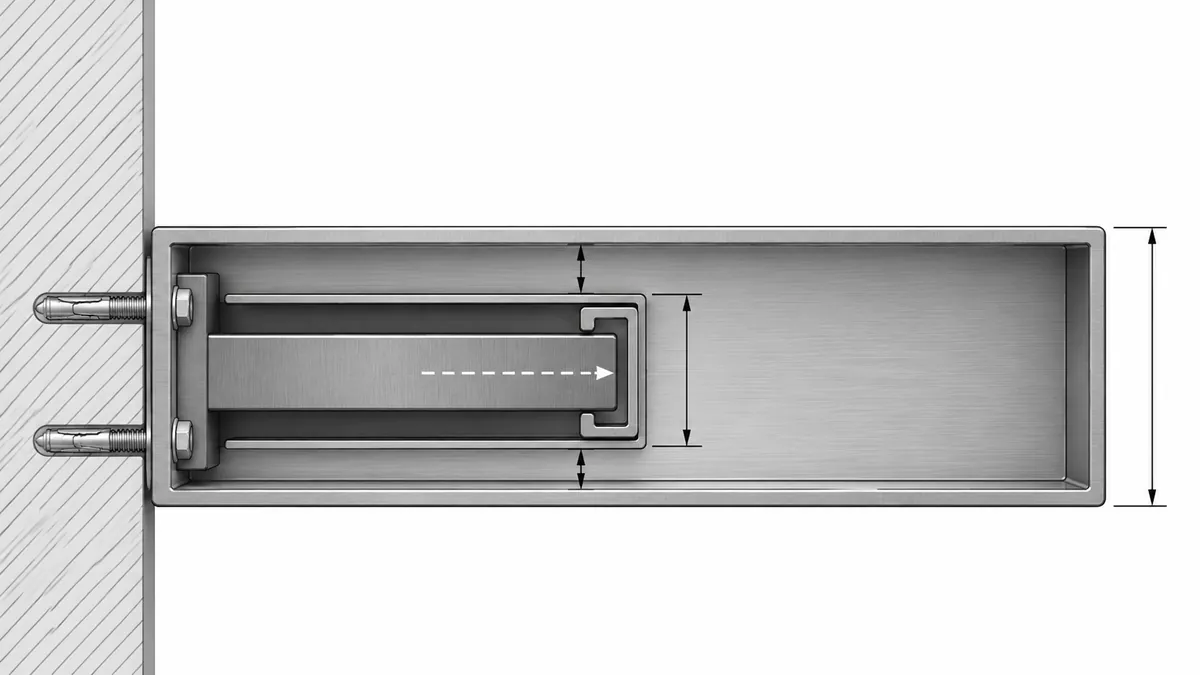
For a simple solid-section diagram, imagine total shelf thickness as T. Let h be the vertical space occupied by a support or cavity, u the material remaining above it and l the material remaining below it. The relationship is:
T = u + h + l
This is only a dimensional identity for the illustration. It is not an engineering minimum, strength equation or permission to cut a channel. A hypothetical 40 mm section might contain a 30 mm support envelope and 5 mm above and below. Another section with the same 40 mm outside thickness might allocate 9 mm above and 1 mm below. The two sections have different support positions and remaining material even though their total thickness is identical.

The hypothetical numbers above are arithmetic only. They are not approved clearances, material dimensions, manufacturing tolerances or product recommendations. The required material distribution depends on the actual shelf and support design. A buyer must not divide leftover thickness evenly or select a thin upper section just because the equation balances.
For a hollow shelf, the simple model needs even more care. The outside front edge may be 40 mm tall while the sheet gauge is much smaller and the inside cavity is partly empty. A support may contact only one skin, a folded return or a designed internal reinforcement. The internal shape and attachment method matter more than the external edge dimension alone. A hollow folded metal box is not equivalent to a solid timber block of the same outside height.
For a solid panel, material surrounding the support still needs to be evaluated for the actual product. This article does not provide wood species strength, adhesive performance, screw pullout capacity, wall-anchor requirements or a load rating. Those questions require the chosen panel, hardware and wall system to be assessed by their responsible makers and design owners.
Is the Thickest Compatible Shelf the Safest Choice?
Not necessarily. More thickness may provide space for one support architecture, but thickness by itself does not establish structural capacity, retention or suitability. The wall, bracket design, number of supports, spacing, fasteners, material, installation and intended load are separate factors. This article does not provide load calculations or approve a particular installation.
Similarly, choosing a thinner shelf does not automatically make the design unacceptable. A system may be engineered around a smaller envelope, a different support shape or a different engagement path. The buyer needs the exact support’s published requirements and the shelf construction that it is intended to work with. A product-specific minimum must stay attached to its named system.
An original manufacturer document may distinguish an absolute minimum from a recommended thickness. Another model from that same brand may use a different support and have different guidance. A retailer may also specify a minimum to conceal hardware rather than to certify a structural capacity. These statements answer different questions and should not be collapsed into one “safe thickness.”
Ask what a stated dimension means. Is it the minimum outside thickness to conceal all parts? The minimum to allow insertion? A model-specific design recommendation? A threshold for a specific shelf material? Is it a structural rating? Unless the source explicitly makes that claim, do not infer it. A concealment dimension is not a load qualification.
Why Does Engagement Motion Matter?
Some concealed supports are engaged by sliding, while others require a tilt or another defined motion. The shelf may fit around the support once stationary but still fail to engage if an edge strikes the wall or if the internal channel is placed incorrectly. HOVR’s model-specific guidance describes how the vertical position of a channel can affect the tilt path in its system. That is a geometry constraint, not a universal offset for all floating shelves.
This is why a section drawing should show more than the final resting position. It should identify the support, its installation direction and any controlled internal channel or opening. If the shelf needs to rotate or tilt, show its movement envelope or follow the exact model drawing. Do not copy a slot location from a different bracket simply because both supports are called floating shelf brackets.
The separate floating shelf installation guide owns the installation, engagement and retention steps. The present article should link to that guide rather than repeat its sequence. Here the buyer’s task is to check that the chosen shelf thickness and support geometry permit the documented operation.
Review the actual part or a representative sample if the motion is difficult to understand from the drawing. Confirm that the sample uses the same bracket, shelf construction and revision planned for production. A prototype assembled by a different method may conceal a conflict that appears later when the official instructions are followed.
What Changes for Metal or Hollow Shelves?
A metal floating shelf may be formed as a hollow box, an open channel, a welded assembly or a combination of sheet and reinforcement. Its outside vertical height is not its sheet gauge. The internal opening, returns and joints determine how a support can be located and attached. A buyer should not treat the outside front edge as a solid material block.
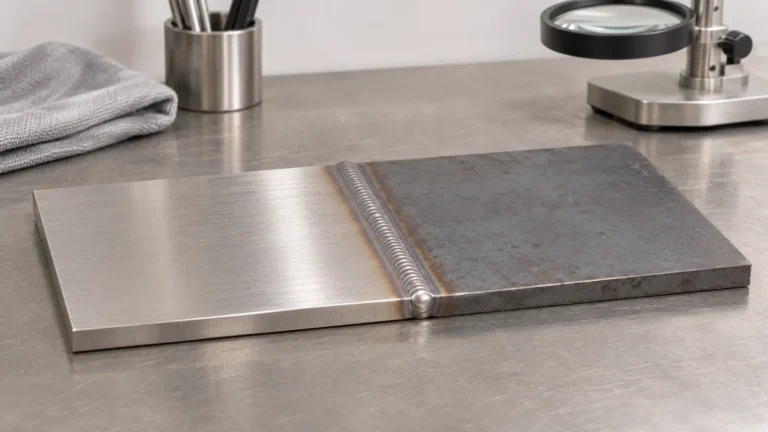
For a custom metal design, communicate the support envelope and attachment interface through the drawing. Show the inside section, visible face, support orientation and any required access. If welding or forming affects the internal geometry, specify which dimensions matter after fabrication. Avoid leaving the supplier to infer that a generic hollow profile can accept a concealed bracket.
The sheet-metal shelf thickness and deflection specification guide covers the separate relationship among metal gauge, span and deflection. The two questions connect in product development but are not interchangeable. A thickness sufficient to package a support does not establish deflection performance, and a gauge selected for a span does not prove that a hidden bracket fits.
Koitor’s confirmed scope includes custom metal storage hardware and communication about formed metal parts and assemblies. That does not mean Koitor supplies the wooden shelf, manufactures a branded concealed support, designs a wall structure or qualifies a named proprietary bracket. For a sourcing review, provide the actual shelf section and support drawing, then confirm which supplier owns each component and interface.
How Should Buyers Compare a Support Maker’s Guidance?
Compare source documents only after confirming the model. A Classic aluminum bracket, a Slim bracket and a third-party steel support can have different geometry. A dimension from one should not be transferred to another. Verify whether the web page refers to shelf height, bracket height, support length or a material clearance. Keep the unit and the dimension direction attached to the statement.
Also distinguish “minimum” from “recommended.” A maker may state that a product can be concealed at a particular dimension but recommend a different construction for other reasons. A recommendation may be based on its system’s intended shelf, not every custom shelf. Ask the maker which support and material the statement applies to, and check that the linked instruction is current for the model being purchased.
If a supplier proposes a custom bracket, require the relevant drawing and interface dimensions rather than treating a similar commercial product’s guide as approval. A visually similar bracket may have different backplate height, rod length, engagement method or fixing arrangement. The product’s actual engineering owner must confirm compatibility.
For a combined assortment, record a compatibility matrix: support model, shelf construction, overall shelf thickness, internal envelope, engagement motion and approved instruction revision. This makes it easier for the importer to ensure the packaged shelf and hardware correspond. The matrix is a purchasing tool, not a substitute for each supplier’s design responsibility or a structural calculation.
What Should the RFQ or Sample Package Include?
An RFQ should include a section view of the shelf and support together. Identify the intended shelf construction and mark which dimensions are controlled. Provide the concealed support model or drawing, the wall-side interface, shelf depth and installation motion. If a supplier owns only the metal bracket, say so; do not imply that it has approved the shelf panel or wall installation.
During sample review, verify that the support is the specified model and that the shelf section matches the drawing. Check the physical fit and documented engagement method. If the support is hidden after assembly, inspect and record the interface before closing it. Keep photographs or measurements tied to the revision and sample identifier. A fit check does not establish a load rating or long-term performance.
If the sample does not fit, identify the actual conflict: support too tall, channel offset, insufficient cavity, incompatible movement, obstruction by a return or mismatch between supplier revisions. Avoid requesting an undocumented field modification such as thinning a panel or cutting a larger pocket. Such a change may affect material remaining, visible appearance or another supplier’s warranty and must be approved by the design owner.
The buyer should also ask whether a proposed revision affects the product’s outer dimensions, finish, price, assembly time or installation instructions. Those consequences are project-specific. Recording them helps prevent a quick dimensional adjustment from silently changing the product that was originally approved.
Common Floating Shelf Thickness Mistakes
One mistake is choosing the shelf profile first and searching for any hidden bracket that seems to fit. Start with the actual use and support concept, then match the shelf construction. Another is comparing support plate gauge with overall shelf height. These dimensions act in different directions. A third is treating a maker’s stated minimum as a universal strength threshold when it may only describe a named model or concealment condition.
A fourth mistake is checking only the static envelope. The shelf must also follow the intended engagement motion. A fifth is treating hollow metal construction as solid stock. The internal section, formed returns and attachment detail govern the real interface. A sixth is using a single thickness number to imply load capacity without the material, span, support, wall and fastener evidence.
Avoid approving changes based on appearance alone. A thicker front edge may still conceal an empty cavity that cannot engage the support. A thin profile may work with a different support architecture, but only its maker or design owner can approve that actual combination. A bracket that slides in during a factory mockup may not match the documented installation direction.
How to Handle Conflicting Supplier Dimensions
Two suppliers may provide dimensions that appear inconsistent because they describe different parts of the interface. One may state an overall shelf minimum; another may list the support’s backplate height. Before treating those statements as a conflict, map each dimension onto the same section drawing. Confirm whether the number refers to the outside shelf, the internal cavity, the metal plate, or clearance for movement. Units and reference surfaces should be recorded along with the value.
If the dimensions still conflict, do not average them or choose the smaller one to preserve the intended look. Ask each supplier to identify the exact model and drawing revision behind the statement. The shelf supplier can explain its internal construction; the support supplier can confirm its own envelope and installation path. The product designer then resolves the interface and states which revision controls the combined assembly.
This exchange is especially important when the buyer sources a shelf and support from different manufacturers. Each product may meet its own catalog dimensions and still fail as a combination. The buyer needs a joint review that identifies the responsible party for compatibility, sample approval and any subsequent design change. A general article can explain the distinction, but it cannot certify an unreviewed pair.
Record the conclusion in a short interface note or drawing update. State the approved shelf construction, support model, relevant internal dimensions, assembly movement and the source documents used. If a different panel, coating thickness or support revision is later proposed, compare it against that record rather than relying on an old verbal assurance.
Compatibility Is Not a Structural Rating
Once a support fits and engages, the structural question remains separate. The complete installed system includes the shelf material, its span and geometry, the support layout, the wall or receiving structure, fasteners and installation quality. A hidden bracket that disappears inside a shelf is not evidence of a particular load capacity. Likewise, a shelf that has a thick profile is not automatically appropriate for an unknown wall or use.
Use the responsible product maker’s documented rating and installation instructions for the exact system. If a custom configuration differs from the maker’s tested arrangement, request a project-specific evaluation. Do not combine a shelf size from one source with a bracket rating from another and assume the result is validated. The cited source dimensions in this article are examples of differing product architectures, not a comparative load test.
For buyer communication, specify both the compatibility requirement and the performance requirement. “The support must fit and engage in this section” answers a geometric question. “The assembly must meet the specified load condition” is a separate requirement that needs its own evidence. Keeping the two statements separate helps prevent a fit sample from being mistaken for performance approval.
Primary technical references: HOVR Classic shelf dimension guidance; Sheppard Brackets support-selection explanation. Their scope and limits are described in the saved research pack; examples and guidance are not universal product specifications.
Related Koitor guidance: shelf bracket types; floating shelf installation.
For this decision, floating shelf thickness should be tied to the exact component, documented requirement and evidence described above.
Perguntas frequentes
Is there a standard thickness for floating shelves?
There is no universal thickness suitable for every design. The exact shelf construction, support envelope, engagement path and named system requirements determine compatibility. A model-specific minimum should not be applied to another support.
Does a thicker shelf hold more weight?
Thickness alone does not establish capacity. Material, span, support architecture, wall, attachment and installation also matter. Use the product’s approved load and installation information rather than inferring performance from outside dimensions.
What is the difference between shelf thickness and bracket height?
Overall shelf thickness is its outside top-to-bottom dimension. Bracket height is the support’s vertical envelope within that section. Plate gauge and rod diameter are different dimensions again. A section drawing should identify each axis.
Can a hollow metal shelf use a concealed support?
Possibly, if the actual internal section and attachment are designed for that support. Outside height alone does not show whether a hollow shelf can engage or retain a bracket. Review the support and shelf drawings together.
Trabalhe com a Koitor Hardware
Review Your Product Requirements with Koitor
Share the relevant drawing or sample, intended use, material or finish requirements, and target quantity. Koitor can review the manufacturing scope for custom bathroom and home-storage hardware based on the information provided.
OEM / MARCA PRÓPRIA
Transforme este guia de fornecimento num resumo do produto
Indique o produto pretendido, as dimensões, o acabamento, a quantidade a encomendar e os requisitos de embalagem. A sua equipa receberá uma análise prática da viabilidade de fabrico antes da apresentação do orçamento.


 English
 Español
 Português
 Français
 Deutsch
 العربية